Canon EOS R1 – 8 Months in the Wild: A Field Photographer’s Perspective

Hmm :unsure: I think i will sell my R6m2 low-light camera and buy Fuji or Hasselblad 100-megapixels camera.

Because 100>45>24 Mpx :whistle:
I assume you're being sarcastic... in the context of wildlife photography MF cameras have a slew of disadvantages, such as inferior AF, slow speed and a lack of telephoto lens options

I have a 80mp MF camera and in the right conditions it is indeed superior to my R5, but those conditions are a narrow envelope. Outside of that the R5 is a better tool
 
Upvote 0
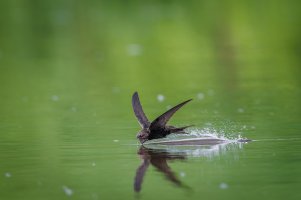
I will add an illustration of a common situation in wildlife photography. This is not wildlife photography from a car in a safari park, these shooting locations are random.
For example, I want to take a picture of "Apus apus" drinking water: they do not choose a place convenient for me, do not fly nearby, they are fast and small. I have no way to be closer and have to shoot from afar, using cropping for composition. The attached photo is not at all ideal, taken with R5M2, while the result on R1 is so bad after strong cropping that I did not even save it. At the same time, I was greatly limited by the speed of R5M2 + RF600 / 4 - very slow, R1 with this lens works quickly. On the one hand, speed, on the other - the ability to get at least some frame and not throw it in the trash due to lack of megapixels. I would be satisfied at the moment - a camera with 45 MP in a large r3/r1 case for fast work with RF600/4 and good weather protection (I sometimes shoot in heavy rain), of course the sensor would not be as fast (so as not to compete with the R1).
R52_1476.jpg
 
  • Like
Reactions: 3 users
Upvote 0
I will add an illustration of a common situation in wildlife photography. This is not wildlife photography from a car in a safari park, these shooting locations are random.
For example, I want to take a picture of "Apus apus" drinking water: they do not choose a place convenient for me, do not fly nearby, they are fast and small. I have no way to be closer and have to shoot from afar, using cropping for composition. The attached photo is not at all ideal, taken with R5M2, while the result on R1 is so bad after strong cropping that I did not even save it. At the same time, I was greatly limited by the speed of R5M2 + RF600 / 4 - very slow, R1 with this lens works quickly. On the one hand, speed, on the other - the ability to get at least some frame and not throw it in the trash due to lack of megapixels. I would be satisfied at the moment - a camera with 45 MP in a large r3/r1 case for fast work with RF600/4 and good weather protection (I sometimes shoot in heavy rain), of course the sensor would not be as fast (so as not to compete with the R1).
View attachment 225663
I have downloaded and downsized your image to what it would be like with 24 Mpx. Would you object to my uploading it to compare or would you do it? I am an R5ii shooter, an opportunistic bird shooter in the field, and much prefer 45 Mpx to 24 Mpx, but I do like the actuality and people should be able to see for themselves the difference it makes, significant or not.
 
Upvote 0
I have downloaded and downsized your image to what it would be like with 24 Mpx. Would you object to my uploading it to compare or would you do it? I am an R5ii shooter, an opportunistic bird shooter in the field, and much prefer 45 Mpx to 24 Mpx, but I do like the actuality and people should be able to see for themselves the difference it makes, significant or not.

My photo is already reduced (and was heavily cropped before). Also, without a paired comparison of the same object at the same distance, the comparison will be inaccurate.

I can offer you more suitable photos:

This hawk was shot from the same distance with one lens, but two cameras (R1/R5M2), and the shooting parameters are almost the same. I could not get closer so as not to scare the bird or choose a different angle because of the many branches around, and for the portrait I had to crop the photo. In the original file you can view the whole thing. I will be glad to see the opinion and conclusions after such a comparison.
As a result, I cropped the photo to this composition, and I would like the details to be visible on a 4k/8k monitor.
 
Upvote 0
Can you do wildlife photography with 24 mp? Of course you can.
Are there no advantages of doing wildlife photography with more than 24mp? Of course there are some. Whether they matter to you or not it depends on your preference, style and circumstances. Noise is not a >24mp disadvantage anymore.
Cropping is a well-established photographic tool. Calling people that crop "lazy" is hardly fair and certainly not constructive.

Cropping for composition is one thing. Thinking cropping is a feature because you didn't get close enough to your subject is lazy.
 
  • Like
Reactions: 1 users
Upvote 0
Can you demonstrate the speed difference? I've seen the claim made for decades, but I've never actually seen anyone show the difference.
I don't have a monitor to record what's going on in the camera. But I use both cameras, and the R5M2 is slower to focus and aim than the R1 and R3. This could be due to either "Dual Power AF" or focusing algorithms (the R1 has a different AF, for example, it doesn't have an "auto" option when selecting tracking objects). I also have speculations (just speculations) that the R5M2's AF performance is intentionally reduced to extend battery life.
 
Upvote 0
I don't have a monitor to record what's going on in the camera. But I use both cameras, and the R5M2 is slower to focus and aim than the R1 and R3. This could be due to either "Dual Power AF" or focusing algorithms (the R1 has a different AF, for example, it doesn't have an "auto" option when selecting tracking objects). I also have speculations (just speculations) that the R5M2's AF performance is intentionally reduced to extend battery life.

The R1 focuses quicker due to the sensor readout speed and at certain times the "cross-type". That is definitely noticeable. It also locks faster and tracks better. It's not a case of Canon doing anything intentional, it's just about the R1 having different tech at the sensor level.

I misunderstood, I thought it was about the added power. Maybe that plays a role too, even though I have never noticed it. o_O


Those CR3 files won't download, it seems like a heavy throttle on the server. It could just be me though.
 
Upvote 0
The R1 focuses quicker due to the sensor readout speed and at certain times the "cross-type". That is definitely noticeable. It also locks faster and tracks better. It's not a case of Canon doing anything intentional, it's just about the R1 having different tech at the sensor level.

I misunderstood, I thought it was about the added power. Maybe that plays a role too, even though I have never noticed it. o_O


Those CR3 files won't download, it seems like a heavy throttle on the server. It could just be me though.
We are talking about how fast it focuses, for example from a distant object to a near one. This is critical when shooting fast objects moving from/to the photographer. The R5M2 does it slower, sometimes not keeping up with the object at all. I tried many parameters in the AF settings. The R3 does focusing from a distant object to a near one as fast as the R1 (but does not detect eyes as accurately).

Can I attach cr3 files on this forum? They are large in size...
 
Upvote 0
My photo is already reduced (and was heavily cropped before). Also, without a paired comparison of the same object at the same distance, the comparison will be inaccurate.

I can offer you more suitable photos:

This hawk was shot from the same distance with one lens, but two cameras (R1/R5M2), and the shooting parameters are almost the same. I could not get closer so as not to scare the bird or choose a different angle because of the many branches around, and for the portrait I had to crop the photo. In the original file you can view the whole thing. I will be glad to see the opinion and conclusions after such a comparison.
As a result, I cropped the photo to this composition, and I would like the details to be visible on a 4k/8k monitor.
Firefox will not allow download of the files because of security risks. I still would like to see a cropped version of your previous image that is not reduced but just cropped to about 4000px width that the site allows as I am very intrigued that the 1.4x lower resolution renders the image unusable.
 
Upvote 0
Next time I am photographing eagles out in the water about 150 or more yards away, I will remember how lazy I must be to not swim closer.

Why are you shooting them from 150 yards away? That's binocular time. If you had a boat, that would be worthwhile to explore.

At one and a half football fields away, there is no shot to be had. It's not even lazy at that point, it's pointless. That couldn't even be shot with a 1200, nevermind the potential environmental issues that would crop up at that focal length.
 
  • Like
Reactions: 1 users
Upvote 0
What firmware version did you use to shoot with the R1? I confirm the situations you described with firmware version 1.0.2 - terrible quality of bird and animal detection, the camera did not even detect hawks in close-up. I returned the firmware to 1.0.1 and the quality of detection and focusing returned. I still continue to shoot only with this firmware.
I don’t know exactly which firmware I used; it was the latest available because I always keep everything updated. The musk ox trip was last March. After that trip, I decided it was time to switch to SONY. Two years earlier, I had bought the RF 600 F4, and I had the R1 since November, which arrived just in time for a trip to Kenya. When I decided to buy the RF 600 F4, it was a bet on the future—I assumed the R1 would deliver a breakthrough in animal autofocus, or at least catch up with the competition, Sony in this case. Clearly, I was wrong.

The trip to Kenya was very disappointing because I realized my bet on the brand had been a mistake. It’s normal for some brands to surpass others—by cycles, by periods—and maybe I trusted that it was Canon’s turn (speaking about wildlife), but that moment still hasn’t come. After the musk oxen trip, I decided to sell all my Canon gear (R1 + R3 + RF 400 2.8 + RF 600 4) and switched to Sony.

No matter what people say here, having 50 MP for wildlife is better than having 24 MP, and anyone who says otherwise, in my opinion, is either mistaken or has never truly needed more detail or to crop while still retaining detail. With 24 MP you can crop, but you won’t have nearly as much detail.

The A1 II isn’t perfect, but for wildlife it is light-years ahead of the R1. Just the fact that the hit rate of in-focus shots is vastly higher than with the R1 (because of how Canon “understands” wildlife scenes—or better said, how it doesn’t) is already a big advantage, since many more images become potentially good shots.
 
Upvote 0
I don’t know exactly which firmware I used; it was the latest available because I always keep everything updated. The musk ox trip was last March. After that trip, I decided it was time to switch to SONY. Two years earlier, I had bought the RF 600 F4, and I had the R1 since November, which arrived just in time for a trip to Kenya. When I decided to buy the RF 600 F4, it was a bet on the future—I assumed the R1 would deliver a breakthrough in animal autofocus, or at least catch up with the competition, Sony in this case. Clearly, I was wrong.

The trip to Kenya was very disappointing because I realized my bet on the brand had been a mistake. It’s normal for some brands to surpass others—by cycles, by periods—and maybe I trusted that it was Canon’s turn (speaking about wildlife), but that moment still hasn’t come. After the musk oxen trip, I decided to sell all my Canon gear (R1 + R3 + RF 400 2.8 + RF 600 4) and switched to Sony.

No matter what people say here, having 50 MP for wildlife is better than having 24 MP, and anyone who says otherwise, in my opinion, is either mistaken or has never truly needed more detail or to crop while still retaining detail. With 24 MP you can crop, but you won’t have nearly as much detail.

The A1 II isn’t perfect, but for wildlife it is light-years ahead of the R1. Just the fact that the hit rate of in-focus shots is vastly higher than with the R1 (because of how Canon “understands” wildlife scenes—or better said, how it doesn’t) is already a big advantage, since many more images become potentially good shots.

Sorry man, I've been to Africa a couple of dozen times between 16mp and 24mp and printed 60" wide.

The autofocus thing? That can come down to user error, the environment, lighting, positioning. My time with the A1 II, no, it wasn't as good in any situation I threw at it. YMMV

If you have to crop on a safari in Kenya (Mara or private reserves), you have a crappy guide that doesn't understand photographer needs.
 
  • Like
Reactions: 1 users
Upvote 0
The speed of the R1 sensor also aids in the autofocus performance, which is the best in the business.

Different use cases, and that's why there are so many different cameras for you to choose from. The R1 is already the "king of the hill" as far as the flagships go. A camera is the sum of its parts, and Canon is well ahead of Sony and Nikon.
I find those statements far too categorical. That the R1’s AF may be the best on the market—maybe it is for sports, photojournalism, or other specialties, I won’t argue with that. But for wildlife, it’s light-years behind Sony.

On the hardware side, I won’t deny that the cross-type AF points, the chips, all that—yes, they’re excellent, innovative, and impressive. But what good is it to focus almost instantly on the spot you choose, if the spot you choose isn’t actually the right one? As you rightly said, that camera is the sum of its parts, and in this case, the software or firmware to interpret the scene (for wildlife) is a disaster.

Of course, if you have a standard subject in a clean scene, it will track well—I’m not talking about that. I’m talking about situations like animals behind grass, birds in unusual positions, or what I mentioned about a musk ox in a snowstorm, where the AF wasn’t capable of focusing on the ox’s eyes—or even on the ox at all—because the snowflakes distracted the camera.

So your claim seems wrong to me—it’s not all black and white. Same with saying Canon is ahead of Sony or Nikon: the vast majority of people I know are either already on Sony or have switched to Sony because of the gear. The 200-600 is a fantastic lens, and the autofocus for wildlife is objectively much better than Canon’s.

In my own circle, I’ve been seeing this for years now. Even though I once decided to stay with Canon, in the end it became impossible, because it really feels like they ignore wildlife photographers. Some Canon users I know have even told me their “solution” is to avoid testing Sony gear so they don’t get tempted to switch (because of the financial hit of selling all their Canon gear, etc.).

That’s the reality I see around me, no matter how much Canon insists that 24 MP is enough or that agencies want smaller files.

Best regards!

 
Upvote 0
I find those statements far too categorical. That the R1’s AF may be the best on the market—maybe it is for sports, photojournalism, or other specialties, I won’t argue with that. But for wildlife, it’s light-years behind Sony.

On the hardware side, I won’t deny that the cross-type AF points, the chips, all that—yes, they’re excellent, innovative, and impressive. But what good is it to focus almost instantly on the spot you choose, if the spot you choose isn’t actually the right one? As you rightly said, that camera is the sum of its parts, and in this case, the software or firmware to interpret the scene (for wildlife) is a disaster.

Of course, if you have a standard subject in a clean scene, it will track well—I’m not talking about that. I’m talking about situations like animals behind grass, birds in unusual positions, or what I mentioned about a musk ox in a snowstorm, where the AF wasn’t capable of focusing on the ox’s eyes—or even on the ox at all—because the snowflakes distracted the camera.

So your claim seems wrong to me—it’s not all black and white. Same with saying Canon is ahead of Sony or Nikon: the vast majority of people I know are either already on Sony or have switched to Sony because of the gear. The 200-600 is a fantastic lens, and the autofocus for wildlife is objectively much better than Canon’s.

In my own circle, I’ve been seeing this for years now. Even though I once decided to stay with Canon, in the end it became impossible, because it really feels like they ignore wildlife photographers. Some Canon users I know have even told me their “solution” is to avoid testing Sony gear so they don’t get tempted to switch (because of the financial hit of selling all their Canon gear, etc.).

That’s the reality I see around me, no matter how much Canon insists that 24 MP is enough or that agencies want smaller files.

Best regards!

Well, YMMV in the end. The R1 proved to have better performance for avian and mammal photography for me.

The article here does mention Canon needs to improve tracking during a snow fall. I'm done with the cold, so I won't come across that.

The R1 has a setting to deal with grass, and it works flawlessly. The bird thing makes no sense unless you're shooting into some crazy backlight or something.

Enjoy the Sony though, keep shooting!
 
  • Like
Reactions: 1 user
Upvote 0
Cropping for composition is one thing. Thinking cropping is a feature because you didn't get close enough to your subject is lazy.
Clickbait?
My use case underwater is different to the birding/wildlife being discussed here but my R5 gives me much more flexibility when cropping as you never know what type of size critter you will meet underwater.
I generally shoot 100mm macro around Sydney but sharks, turtles and seals can be there. I can still use my 100mm from a distance for part of the critter but generally switch to video with my mounted GoPro to the housing.
Hard cropping when shooting wide angle (14-35/4) but come across smaller critters.
Can't change lenses (or bodies) underwater.
Both you and the subjects are moving.
Lighting and particulate challenges beside buoyancy, current/surge, buddy checks and staying alive.
The housing already protects the body/lens so no need for the ruggedness of the R1.

Calling the ability to crop "lazy" as you didn't get close enough is just a lazy comment.

Snorkeling with humpbacks/calves at the end of the month in Aitutaki.
The big question is whether to shoot fisheye or 14-35/4 as they are very large and can get too close for cropping!
 
  • Like
Reactions: 1 users
Upvote 0