Canon Cinema EOS C50 To Replace EOS R5 C

If it’s based off of the R5II sensor it doesn’t go head to head with the FX3 in my mind, maybe only in form factor and perhaps price. While I don’t deny the image off of the R5 sensor is stunning, I would argue 8K is not practical for most video applications, at least when derived from a photo-oriented sensor. I’d rather see a camera of this caliber using the sensor found in the C400 and C80, with 6K resolution and a triple native ISO. The main draw many people have to the FX3 is its dual native ISO of 640 and 12800, an R5 sensor is decent in low light but cannot compete with that. The aforementioned C80/C400 sensor can go head to head with the capabilities of the FX3’s sensor, with the added bonus of 6K resolution. The main complaint I see from FX3 users is that it’s sometimes too low of resolution. 6K is the sweet spot, where you can have both good low light and very powerful video oriented features without burning through your media storage and slowing down your computer when editing. Really hope Canon does some sort of R6C variant with a 6K focus.
The latest news is that its not the 45 mp sensor of the R5 but a 32mp sensor. Which makes more sense for cinematography/video
I wonder if they kill the stills side on this camera. If that‘s gone next to the evf, I‘d consider this is a step back from the r5 c. But that‘s from someone that doesn‘t bother investing in an „upgrade“ for half a stop more DR or a bunch more fps. IMO where all this small „cine“ cams lack is in audio capabilities, monitoring and nd filtering – all of which doesn‘t seem progressed on this camera. (But arguably most of the potential buyers don‘t seem to care too much about that either.)
IBIS improves low light performance. The 45mp sensor demanded a larger cooling fan & heatsink etc. Reducing the sensor throughput from 45mp to 32mp reduces camera size and cooling demand.
 
  • Like
Reactions: 1 user
Upvote 0
Canons misstep is going to be creating a great camera and not a great camera ecosystem. Every Sony has slog 3, unlimited recording, and scinetone. That’s why it works so well. Fx30, zve1, zve10ii.

The hard part won’t be switching from the fx3, it will be all the other cameras. If they add clog 2 to the others like the r3, r5c, r6ii and unlimited recording to the r8’s and apsc . They need 10bit video outside of log shooting for faster turn on the other cameras…. My fx30 & zve1 are invaluable in support to the fx3.
 
Last edited:
  • Like
Reactions: 1 user
Upvote 0
Canons misstep is going to be creating a great camera and not a great camera ecosystem. Every Sony has slog 3, unlimited recording, and scinetone. That’s why I works so good. Fx30, zve1, zve10ii.

The hard part won’t be switching from the fx3, it will be all the other cameras. If they add clog 2 to the others like the r3, r5c, r6ii and unlimited recording to the r8’s and apsc . They need 10bit video outside of log shooting for faster turn on the other cameras…. My fx30 & zve1 are invaluable in support to the fx3.
Switching? People rarely switch systems. Canon doesn't care about switching. Canon owns the majority of camera market share by a very wide margin and that margin is growing. This simply eats into another Sony segment. In total camera sales Canon is the big dog on the block and it aint even close. Canon doesn't care about if don't switch. All the new young users especially those that barf at Sony's outrageous prices are using Canon and even Panasonic cameras.
 
  • Like
Reactions: 1 users
Upvote 0
If it’s based off of the R5II sensor it doesn’t go head to head with the FX3 in my mind, maybe only in form factor and perhaps price. While I don’t deny the image off of the R5 sensor is stunning, I would argue 8K is not practical for most video applications, at least when derived from a photo-oriented sensor. I’d rather see a camera of this caliber using the sensor found in the C400 and C80, with 6K resolution and a triple native ISO. The main draw many people have to the FX3 is its dual native ISO of 640 and 12800, an R5 sensor is decent in low light but cannot compete with that. The aforementioned C80/C400 sensor can go head to head with the capabilities of the FX3’s sensor, with the added bonus of 6K resolution. The main complaint I see from FX3 users is that it’s sometimes too low of resolution. 6K is the sweet spot, where you can have both good low light and very powerful video oriented features without burning through your media storage and slowing down your computer when editing. Really hope Canon does some sort of R6C variant with a 6K focus.
1756883601928.png

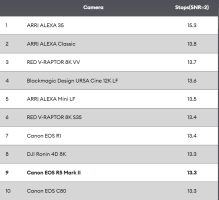
Bro, what are you even talking about? CINED marked it as one of the highest DR camerast to be released right now. SMH.
 
  • Like
Reactions: 1 users
Upvote 0
Different markets. Apple doesn't manufacture cameras
It might not 'manufacture' the camera units in the ~230m iPhones it sold last year, but they all had cameras, and the specs of those cameras are a big selling point in, especially, the higher end models.

I recall that Canon has scheduled announcements like this on other 'Apple Big Days' - they seem to not care at all what most of the headlines will be reporting.
 
  • Like
Reactions: 1 user
Upvote 0
IBIS improves low light performance. The 45mp sensor demanded a larger cooling fan & heatsink etc. Reducing the sensor throughput from 45mp to 32mp reduces camera size and cooling demand.
"IBIS improves low light performance" How is that a sensible statement in regards to video? Do you shoot your 24/25/30fps videos with a 1/10 shutter?
 
  • Like
Reactions: 1 users
Upvote 0
I like the viewfinder on my R5 C. I purchased the R50v to see what direction Canon video was going in. It's a fun camera and being able to control video start/stop (remotely) is super nice.

You can start and stop video on your R5C remotely using a Godox TR-C3 Wireless Remote Control. I find it 100% reliable. It's great to be able to do this. As you can imagine.
 
Upvote 0
You can start and stop video on your R5C remotely using a Godox TR-C3 Wireless Remote Control. I find it 100% reliable. It's great to be able to do this. As you can imagine.
Greetings,
Yes. I am familiar with the N3 controllers that allow you to engage AF and start stop video. Of course like others I always wished Canon would allow us to use the camera's native Wi-Fi in Cinema OS but it never happened. I thought might be added in a subsequent FW update, but alas no. I did know this going in so I wasn't surprised by it, but I remained hopeful. The camera has been wonderful anyway. As for the C50, I am not sure about no EVF and 32 MP. From a Cinema perspective, I see the value in a 6k sensor for light gathering, faster readout, less rolling shutter and smaller files. It would produce less heat too. The fan on the R5 C has never bothered me and it was that feature alone that made me skip the R5. I was so happy I did in the end. While the R5 remains a great camera in its own right, I wanted stronger video features / support which I got.

Im fairly sure the C50 will be a great Cinema camera. I still don't know how I'll feel losing more than 10MP for stills. The versatility of the R5 C remains high for my use cases. However, we all use our cameras differently. I'm sure the C50 will appeal to many. It should be easy to carry, ready for a gimbal and remotely controllable without "add-ons", etc. it will have to be rigged up either way. Most FX3 users still put that body in a cage even with its mounting points. I always thought Canon might eventually move to a box style body. My R50v has a single 1/4 20 mount for portrait mode. I tried it out and it was convient. I am a landscape shooter though. Anyway thanks for mentioning the TR-C3. It's certainly an inexpensive option without being fully tethered.
 
Upvote 0
Really wonder if Canon will make a handle with XLR like Sony does the the FX3. If they want to one-up Sony in this they would add 32-bit float in the handle. Meaning the shotgun mic does not clip making it more run and gun friendly. Of course you want to lav people up, but the on camera is always usable in terms of levels.
 
Upvote 0
  • Like
Reactions: 1 user
Upvote 0
Google the article "And Now Panasonic Explains What’s Not so Good with IBIS" for video.
There were some reasonable points made in this article, but bear in mind - Panasonic rehoused a larger sensor into the existing GH5 body for the GH5S in order to offer low-light and DR advantages. I strongly believe that the whole 'IBIS is no good - no, really, trust us...' thing was a very clever piece of marketing on their part.

I'm not saying there is no valid argument against IBIS for certain situations, rather that those situations are somewhat obscure, especially when you consider the core market for small high-quality video cameras.

My view is that Panny put this out as a marketing sweetener because their (excellent) video IBIS had become a popular addition to the GH series.
 
Upvote 0
How credible is newcamera? That rumoured spec breakdown is insane. It includes all of the unicorn stuff -DGO, Internal ND's, IBIS - sound too good to be true, surely?
The newcamera is not a reliable source. They willingly publish incorrect information and leave it on their site when this is pointed out to them.
Those insane specs are most likely clickbait.
 
  • Like
Reactions: 2 users
Upvote 0