Canon EOS R6 Mark III & RF 45 F1.2 STM November 6

The EF 50mm f1.2 L was a mixed bag in my opinion. I had several copies, my initial copy was always a bit soft compared to all my other L primes (I had them all from the 24mm f1.4 IIL through to the 135mm f2.0). The lens needed to be stopped down to f2.0 before it matched the other lenses in sharpness. However, the contrast, colour rendition and built quality were exceptional. The AF was slower and less accurate than my EF 85mm f1.2 II L. In low light the AF was hopeless. In addition, the lens didn’t have any floating optics. There was a heavy aperture related focus shift on any close target at f2.8.
It was a very frustrating lens to use, but it had a beautiful rendering and could (when it actually focussed properly) it could produce really nice imagery.
My 2nd copy was a tad sharper wide open, but it was never what I would call “sharp”. It was ok, but not amazing. If I stopped down to bump the sharpness, that’s when the focus shift would occur.
The build quality of this lens verses the 50mm f1.4 was like night and day. Built tough and solid. But the 50mm f1.4 was actually a bit sharper wide open, but its contrast and colours sucked and needed a lot of post prod. The files out of the f1.2L were way better.
I don’t know what to expect with this new RF 45mm f1.2 lens. I hope it’s not the same bag of conflicting issues that the EF 50mm f1.2 L lens was.
Exactly what I thought when the OP said "I hope it is anything like the EF 50/1.2L". Mind you - of the many L EF lenses that I had, I sold all but 3 and the EF 50/1.2L is still in my possession. Having compared it to the FD 55's 1.2, FDn 50/1.2L and even the RF 50/1.2L, there is no alternative that renders the background and transitions as magical as the EF 50/1.2L does (that's why I still have it, absolute sharpness is highly overrated). It was claimed at the time it had a floating element but I'm sure it has not (the whole optical group moves as one), which probably accounts for the subpar closeup performance (where the FDn 50/1.2L, for instance, with its floating (or rather stationary :-) rear element shines). But it is a classic double-gauss design, which also means you only need f1.2 if you need the light, not necessarily the blur. Stop it down to f2 or even f1.4 and it's brilliant with only minor reduction in blur.
It could be that, with the RF 45/1.2 and the double-gauss design as a the basis, Canon added a couple of aspherical elements to touch up those weak points of the EF 50/1.2L (like Voiglander does) and release a truly brilliant modern design with an unmistakable classis look...
 
  • Like
Reactions: 1 users
Upvote 0
"Discover the power, unleash your passion"
Could it mean something really interesting will be announced? Or an RF 50mm f/1,8 III?:ROFLMAO:
If I look a the teaser picture (dawn, where the blackness of night meets the bright light of day) and the text, we may be into a pleasant surprise regarding dynamic range? The C50 sensor should make that possible in theory?
 
  • Like
  • Haha
Reactions: 1 users
Upvote 0
If I look a the teaser picture (dawn, where the blackness of night meets the bright light of day) and the text, we may be into a pleasant surprise regarding dynamic range? The C50 sensor should make that possible in theory?

No. The claim of 15 or 16 stops of DR with the C50 is for video. They can achieve that with video because Canon uses a non-linear algorithm to map sensor pixel values to image pixel values - unlike photography where the mapping from sensor pixels to image pixels is linear. This means that the video is "lossy" in ways that picture images are not because of compression in the highlights.
 
  • Like
Reactions: 1 users
Upvote 0
No. The claim of 15 or 16 stops of DR with the C50 is for video. They can achieve that with video because Canon uses a non-linear algorithm to map sensor pixel values to image pixel values - unlike photography where the mapping from sensor pixels to image pixels is linear. This means that the video is "lossy" in ways that picture images are not because of compression in the highlights.
And just to illustrate - per CineD, the R5 Mark II (which is panned as having 'terrible' dynamic range in photography circlces) gets similar dynamic range to the EOS C80 in video, which is claimed to have 16 stops.

 
  • Like
Reactions: 1 user
Upvote 0
And just to illustrate - per CineD, the R5 Mark II (which is panned as having 'terrible' dynamic range in photography circlces) gets similar dynamic range to the EOS C80 in video, which is claimed to have 16 stops.

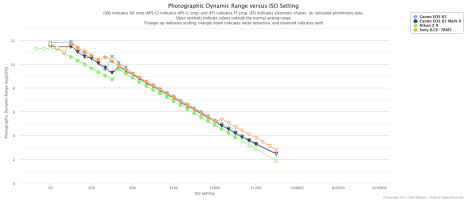
The R5 II having a "terrible" dynamic range ???? Slightly less than the R5.
Strange "photography circles". The internet "experts", I presume...
Quote from TDP's Brian. "The R5 Mark II delivers outstanding image quality, including ultra-high resolution with modest noise levels with excellent dynamic range."
 
  • Like
Reactions: 4 users
Upvote 0
The R5 II having a "terrible" dynamic range ???? Slightly less than the R5.
Strange "photography circles". The internet "experts", I presume...
Quote from TDP's Brian. "The R5 Mark II delivers outstanding image quality, including ultra-high resolution with modest noise levels with excellent dynamic range."
And yet there are non stop complaints, including on this very forum, about how its dynamic range is awful and it's resultantly terrible in low light.

Not to mention that for the most part we're throwing away a large chunk of the dynamic range when converting to jpeg and viewing on our displays regardless.
 
  • Like
Reactions: 1 users
Upvote 0
And yet there are non stop complaints, including on this very forum, about how its dynamic range is awful and it's resultantly terrible in low light.

Not to mention that for the most part we're throwing away a large chunk of the dynamic range when converting to jpeg and viewing on our displays regardless.
I haven't seen much furore about this (some complaints yes).

One would hope people have got used to this, since it has been the case for a while now: the faster the sensor, the worse the dynamic range at low ISO, that's the trade off we incur into with current sensor technology.

The decrease in dynamic range is is small and usually imperceptible apart in very specific scenarios... but more dynamic range gives you more good image data that, if correctly processed, can lead to (marginally) better final conversions.
The increase in speed tends to be much more visible and it has other positive side effects apart from the immediate increase of FPS, such as better AF.

Choose your poison ;)
 
  • Like
Reactions: 2 users
Upvote 0
I've been enjoying Canon Rumors for years, but I finally joined the forum with this topic. I have an original R6, which is an amazing and capable camera. I've owned numerous Canon bodies of varying tiers prior to this. I'm very fortunate that my day job is that of a COO of a successful analytics company, so I don't need to pursue photography for pay. I do shoot a lot, all the same, and the pictures are used by my community. But in that context at the CAD $3k range of pricing I'm probably representative of a number of purchasers. I know many here are as well. I'm pretty optimistic about what the R6 III will bring, but my concerns about ISO (and related matters, such as dynamic range) is really head room. Like many people point out, there's probably not a lot of shooters using high ISO values exceeding 12k on a regular basis, but that 12k or lower is in the context of 102,400. If 12k is good when the ceiling is 102.4k, then how much worse might it be when the ceiling is 64k? Yeah, yeah, the R5 scaled down is equivalent, and so might the R6 III, but who buys one to scale down (not crop) from 45mp? So for us R6 shooters it feels like a potential downgrade -- at 3k+ for cost. It's a double-whammy too, because the new glass sacrifices light for speed and weight, so not only is Canon reducing the ISO but they're increasing the need for sensitivity for prosumers who aren't buying f/2 28-70 glass in bulk. I'm sure Canon does what it feels is appropriate, but whereas the R6 felt like a love letter to a patient community of well heeled but non-professional flag bearers then the R6 III, in terms of photography, feels more like a middle finger. Moreso if the price goes up. What did I actually want to see that would make me upgrade when the R6 II didn't? (And not knocking that edition, it's great for people who didn't buy an R6 but want that tier.) A better EVF. A better back screen. More programmable buttons. Maybe more resolution, if the ISO / DR is maintained. None of these are big ticket enhancements, but they'd get me to trade in and spend dollars on gear instead of on my wife or kids. Anyhow, I hope Canon monitors the comments from people like me for when they plan the R6 IV. By all means make an R6c, but for R6-pure go back to the original spirit please! Make it a love letter to the non-pros who want the essential character of pro gear--but not the expense of pro SLAs or high resolutions. But maybe it doesn't matter—maybe 2025 ISO 64k offers such improved quality that it's equivalent to 2015 ISO 102.4k. Given the R5, R5 II, and R6 II I doubt it. I'll keep saving for something that's interesting to me, and in the meantime hopefully the R6 III makes someone else's day.

 
Upvote 0
And yet there are non stop complaints, including on this very forum, about how its dynamic range is awful and it's resultantly terrible in low light.

Not to mention that for the most part we're throwing away a large chunk of the dynamic range when converting to jpeg and viewing on our displays regardless.
Of course there are complaints, it's no Sony!
Sorry, but as a certainly naive and satisfied owner of 2 R5 II cameras, I didn't notice anything awful or terrible, even in low light conditions.
But if the knowledgeable internet masses say so, I guess I'll have to get rid of my crappy cameras...
 
  • Like
  • Love
  • Haha
Reactions: 2 users
Upvote 0
I have noticed that the RF 24-240 has been out of stock for quite a while. Coupled with the recent revisiting of superzoom patents, it makes me wonder if an evolution for that lens is forthcoming. Especially with more sensitive sensors coming online for their "consumer" level cameras.

And since we're playing with the crystal ball some, I'm also going to go out on a limb and guess that we might get surprised with a 70-180f/2.8 or something along that line to round out the lower cost trinity.

I didn't expect to be interested by the 45 f/1.2, but I admit that I am.
 
  • Like
Reactions: 1 users
Upvote 0
my concerns about ISO (and related matters, such as dynamic range) is really head room. Like many people point out, there's probably not a lot of shooters using high ISO values exceeding 12k on a regular basis, but that 12k or lower is in the context of 102,400. If 12k is good when the ceiling is 102.4k, then how much worse might it be when the ceiling is 64k?
I think this is being blown out of proportion by some on the forums. First it's a difference of 2/3 of a stop and it's at the extreme end. Second, Canon has form for being conservative with max ISO - it brings to my mind the 5Ds(R), which had a maximum native setting of 6400 but was no worse normalised than the 5D3 which went to 25600. Why they chose that limitation I don't quite know, but it didn't really reflect on the relative sensor capabilities.
It's a double-whammy too, because the new glass sacrifices light for speed and weight
And yet the next lens is a cheap f/1.2?
whereas the R6 felt like a love letter to a patient community of well heeled but non-professional flag bearers then the R6 III, in terms of photography, feels more like a middle finger.
A bit of a leap.
Moreso if the price goes up.
Prices go up. Inflation is inexorable. Will it be more in real terms?
 
  • Like
Reactions: 3 users
Upvote 0
I think this is being blown out of proportion by some on the forums. First it's a difference of 2/3 of a stop and it's at the extreme end. Second, Canon has form for being conservative with max ISO - it brings to my mind the 5Ds(R), which had a maximum native setting of 6400 but was no worse normalised than the 5D3 which went to 25600. Why they chose that limitation I don't quite know, but it didn't really reflect on the relative sensor capabilities.

And yet the next lens is a cheap f/1.2?

A bit of a leap.

Prices go up. Inflation is inexorable. Will it be more in real terms?

I hear you on the 2/3rds, but it's still a potential downgrade for on the stills side -- if the lower ISO value quality depends on the total reach and that works the same for both generations of sensor. If the lower quality remains the same then it's just a number so whatever, but until evaluations hit it's a real concern as someone wondering about the new specs if the potential is a loss of capability. On paper it's a loss.

For the lenses I think it's more important to consider non-L offerings, like the RF 600 f/11, 800 f/11, long zooms starting at 5.6, etc. Sure, many of us are fortunate to have a collection of fast glass, but it's all specialized and above-and-beyond purchases for non-paid amusement. If you're a pro photographer and the purchase is justified then these worries don't apply to you, but for the rest of us it's material. Quite a few of the general purpose modern lenses on shelf feature darker glass than prior equivalents so demand more sensor sensitivity if shooting the same times of day in the same degrees of shade as prior sensor or glass offerings for comparable tiers. On paper, it's a loss that's been creeping on the lens side for a while and now manifests potentially on the sensor side. And anyhow fast glass isn't always the answer -- depth of field matters in cases as well.

OK, so I was probably a little harsh with the middle finger. But it's still no longer a "thanks for keeping with us non-pro still shooters" message. Maybe that's just a sign of the times, though.

And all of my view is from stills photography. I have an iPhone Pro for ad hoc non-paid video.

Thanks for remarking! Food for my thought.
 
Upvote 0