Canon EOS R7 Mark II to Have Stacked 40MP Sensor?

I don't doubt that full-frame sensors with larger photosites have a one-stop advantage in signal to noise ratio, as documented by Photons-to-Photos.com, but that doesn't mean that an f/2.8 lens is magically transformed into an f/4 lens by being mounted on an APS-C body, which is what the prophets of "equivalence" insist.
It's not the larger photosites that give the one-stop advantage in S/N. There have been plenty of posts here from photonstophotos where you can see there is no difference in DR between the R5 and R6, R5ii and R6ii etc where there is a difference in photosite size. Again, it is the area of the whole sensor that is important, not the area of the individual photosites, and that is independent of pixel size. This is highly relevant to this thread for those who are worrying that a 40 Mpx sensor will be noisy because of its very small pixels. It shouldn't be worse than the R7, R50 etc when viewing at the same size.

I am trying to be helpful, not to argue. If you are not interested, OK, but others might find it useful.
 
  • Like
Reactions: 5 users
Upvote 0
No!! You are confusing engineering DR, which is the DR of a single pixel, with photographic DR, which is the DR of the collection of pixels that make up the image. When we look at an image, we don't look at the DR of a single pixel but of the collection. To use your bucket analogy, 4 1/4 sized buckets that occupy the same area of space as a single 4xlarger bucket, hold as much water as the large one. Surely, you must have seen the DR curves on photonstophotos that have been used here 100s of times to show that photographic DR is virtually independent of pixel size. I'll show two pairs: the R7 and lower pixel R10, R5 and lower pixel R6. I recommend you read the first link posted by @neuroanatomist.

View attachment 227175View attachment 227176
Thank you Alan, I did mean what is called the Full Well Capacity of single pixels, but I didn't want to stress the technical term. In the German physics magazine that I co-edit we had a 2-part in-depth series about smartphone cameras, and in part 2 this was explained. If you don't bother to translate a German article into English, you can read the details here (as I wrote, one of the authors is a ZEISS engineer. Have nice saison's holidays:

 
Upvote 0
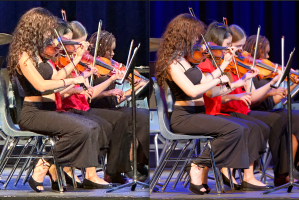
I'm still waiting for you to disclose what gear and settings were used for your two side-by-side pictures of violinists designed to suggest, when you click on it to enlarge it, that APS-C gear is terrible. Your silence on the subject is deafening.

UPDATE: I now see that you admitted last night (by the link in post #101 in this thread) that the terrible shot on the left in that pairing is a crop of a shot from an iPhone. Not relevant at all to this forum, much less this thread. Shame on you!
Try to grasp the context. 1) I did not state that I was comparing APS-C and FF, you assumed that, and 2) I mentioned fairies, wizards and magic in that post. But you were still expecting a 'fair' comparison. Regardless, the point stands. If using a smaller sensor to achieve a 'longer effective focal length' had no undesirable consequences, then the iPhone photo would be just as good as the FF image. But it's not. The example is far more extreme than a comparison to APS-C, but the concept is identical.

Factual information, please. Not snark. I'm not posting shots taken with a phone but with APS-C Canons. You're the one caught in a circle of confusion, insisting that nothing but a full-frame camera is worth considering - a totally out-of-bounds bit of snobbery in a thread about a hoped-for APS-C model.
The fact is that I stated in this thread, "...the higher pixel density of APS-C sensors enables putting more pixels on target for distant or macro subjects. That’s a tradeoff that can be worthwhile, provided you understand what you’re giving up to achieve it," and, "...in bright light with a reasonably close subject and no desire for a shallow DoF, a smaller sensor can produce results that are just as good as those from a larger sensor." All one needs to do is look at some of the images posted with the R7 (by @AlanF, for example), to understand that APS-C sensors definitely have utility.

In case it escaped your notice, I have two FF cameras, two APS-C cameras and a 1.4-type camera (which is essentially m4/3 but in a 3:2 aspect ratio). If you can count, you will see that I have more crop cameras than FF cameras. So why would anyone with a modicum of intelligence or at least the rudimentary ability to read assume I would believe only FF cameras are worth considering, much less insist that is true? Yet...you did make that very assumption.
 
  • Haha
  • Like
Reactions: 1 users
Upvote 0
It's not the larger photosites that give the one-stop advantage in S/N. There have been plenty of posts here from photonstophotos where you can see there is no difference in DR between the R5 and R6, R5ii and R6ii etc where there is a difference in photosite size. Again, it is the area of the whole sensor that is important, not the area of the individual photosites, and that is independent of pixel size. This is highly relevant to this thread for those who are worrying that a 40 Mpx sensor will be noisy because of its very small pixels. It shouldn't be worse than the R7, R50 etc when viewing at the same size.

I am trying to be helpful, not to argue. If you are not interested, OK, but others might find it useful.
And since PhotonsToPhotos also says that an APS-C R5 shot has shot noise comparable to an R7 and is far worse than a full-frame R5 shot, I now understand that I can ignore this entire discussion - and PhotonsToPhotos - on this issue, since you and they are talking about noise produced by appyling a larger degree of enlargement, starting from a smaller image, to get to the same size. That is totally academic and not relevant to my real-world use of my camera.

I care whether the photosites on my sensor are collecting enough light to create a clean image, I don't care about whether my camera's sensor is collecting as much light in total as a larger sensor might collect.

Congratulations! You folks have liberated me.

PS At 32.5 megapixels, I'm applying less enlargement than a user of an 24 megapixel camera might, and even less than the user of an R5, which still has a lower pixel density than the R7 would with the same lens, since an APS-C crop from an R5 would be starting from less than 18 megapixels.
 
Last edited:
  • Haha
Reactions: 1 user
Upvote 0
Consider the number of heated arguments that occur on this web site over trivial issues. In Neuro's previous account, he had over 30,000 postings. I'd bet money that at least 10,000 5000 included some unnecessary snipe at another poster.
I 'snipe' at posters who post misinformation or show a clear lack of understanding of facts...and rarely the first time they make such a post. What you may consider unnecessary, I consider well-deserved. As I (repeatedly) state, ridiculous statements engender ridicule.

What I don't do is insult whole swaths of people in an insensitive and puerile manner, like you chose to do. Perhaps your pronouns are he/asshat.
 
  • Like
  • Haha
Reactions: 1 users
Upvote 0
And since PhotonsToPhotos also says that an APS-C R5 shot has shot noise comparable to an R7 and is far worse than a full-frame R5 shot, I now understand that I can ignore this entire discussion - and PhotonsToPhotos - on this issue, since you and they are talking about noise produced by appyling a larger degree of enlargement, starting from a smaller image, to get to the same size. That is totally academic and not relevant to my real-world use of my camera.

I care whether the photosites on my sensor are collecting enough light to create a clean image, I don't care about whether my camera's sensor is collecting as much light in total as a larger sensor might collect.

Congratulations! You folks have liberated me.
I am happy for you that you are now liberated and can ignore the whole discussion as it fits nicely with "Ignorance is bliss".
 
  • Like
  • Haha
Reactions: 2 users
Upvote 0
... but that doesn't mean that an f/2.8 lens is magically transformed into an f/4 lens by being mounted on an APS-C body, which is what the prophets of "equivalence" insist.
If that's what you believe has been stated by several people clearly possessing more knowledge on the subject than you, then my recent denigration of your reading ability was not inaccurate. Equivalence has been explained, and links provided that offer more detail. For someone who dismisses the concept as irrelevant, you seem to be arguing very hard against it.
 
  • Like
Reactions: 1 user
Upvote 0
Are you the perfect or the good? Or both?
Don't tell me you've never heard that expression. It means don't reject the good because it's not perfect.

In this context, don't dump on APS-C because full frame has some advantages over it.

We are, after all, in a discussion thread about an anticipated APS-C body - and many of us -perhaps most - see the R7 as their main camera, not merely a telextender for their full-frame setup.

There's a related aphorism, "Don't yuck my yum."
 
Last edited:
Upvote 0
I salute your continued technical replies, which will hopefully help bystanders, but I am put in mind of that analogy of playing chess with a pigeon.
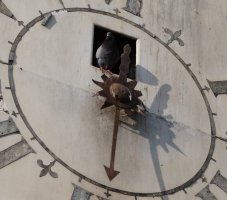
Thank you. I was, in fact, a strong chess player in my youth, which was useful training for playing with pigeons. Though I now prefer to photo them. Here is one looking out of a clock taken on my R7 in a beautiful town in Tuscany this summer.

3R3A4652-DxO_Pigeon_on_clock.jpg
 
Last edited:
  • Like
Reactions: 1 user
Upvote 0
Don't tell me you've never heard that expression. It means don't reject the good because it's not perfect.

In this context, don't dump on APS-C because Full Frame has some advantages over it.

We are, after all, in a discussion thread about an anticipated APS-C body - and many of us -perhaps most - see the R7 as their main camera, not merely a universal telextender for their full-frame setup.

There's a related, if not exactly the same aphorism, "Don't yuck my yum."
You're taking offense where there is none.
 
  • Like
Reactions: 1 users
Upvote 0
Can we please go back to the topic.

When discussing the R7 people often refer to bird and wildlife photographers. I am a macro and close-up photographer, and the camera is also very suited for that. To get enough magnification I almost always crop the image in post-processing. Because I use a diffused flash most of the time, low-light behavior is not the most important. So, I look forward to the R7ii if that has a higher resolution. A stacked sensor is less important although an advantage I hardly ever read is that you can then use a flash with the electronic shutter. Also, I look forward to improvements in pre-capture and focus stacking functionality.

When the new APS-C camera becomes considerably better in all aspects (including form factor), wouldn't it make sense to call it the R4 or R2? In that way there would be a flagship APS-C camera and Canon could raise the price. The R7 mark ii could then be a more modest upgrade for a lower price.
 
  • Like
Reactions: 1 users
Upvote 0
Can we please go back to the topic.

When discussing the R7 people often refer to bird and wildlife photographers. I am a macro and close-up photographer, and the camera is also very suited for that. To get enough magnification I almost always crop the image in post-processing. Because I use a diffused flash most of the time, low-light behavior is not the most important. So, I look forward to the R7ii if that has a higher resolution. A stacked sensor is less important although an advantage I hardly ever read is that you can then use a flash with the electronic shutter. Also, I look forward to improvements in pre-capture and focus stacking functionality.

When the new APS-C camera becomes considerably better in all aspects (including form factor), wouldn't it make sense to call it the R4 or R2? In that way there would be a flagship APS-C camera and Canon could raise the price. The R7 mark ii could then be a more modest upgrade for a lower price.
The R7 with the RF 100-400 is also very good for close up/near-macro photographing of insects in the wild. I use it for dragonflies and butterflies where you can't get too close because you scare them away but that kit gets 0.4x magnification from about a metre away.

3R3A4021-DxO_Darter_Dragonfly_eyes_resolved_crop.jpg
 
  • Like
  • Love
Reactions: 3 users
Upvote 0
Because I use a diffused flash most of the time, low-light behavior is not the most important. So, I look forward to the R7ii if that has a higher resolution. A stacked sensor is less important although an advantage I hardly ever read is that you can then use a flash with the electronic shutter. Also, I look forward to improvements in pre-capture and focus stacking functionality.
If the R7II has the stacked sensor that is mentioned in this rumor, the ability to use flash with electronic shutter and thus combine flash with focus stacking (as currently possible on the R1 and R5II) might be of significant interest to you. That assumes you use the camera's focus stacking feature, if you use a macro rail as I sometimes do then you won't have that limitation.
 
  • Like
Reactions: 1 users
Upvote 0
I don't post intentionally-deceptive comparison shots and lecture the hoi-polloi that their gear is not as good as they think it is, which is what neuro has done.
No, it isn't. But you have that combination of a superiority complex, a (deliberate?) misconstruing of everything you read, and a brittle defensiveness that makes any discussion pointless. The horse has been led to water, but it is on a hunger strike. To bring it back to topic, pixel size is essentially irrelevant. Citations above, ad nauseam.
 
  • Like
Reactions: 1 user
Upvote 0
No, it isn't. But you have that combination of a superiority complex, a (deliberate?) misconstruing of everything you read, and a brittle defensiveness that makes any discussion pointless. The horse has been led to water, but it is on a hunger strike. To bring it back to topic, pixel size is essentially irrelevant. Citations above, ad nauseam.
So what, pray tell, was the point of neuro's post #38 in this thread, which explicitly mocked a discussion of the advantages of an APS-C camera in getting more reach from a lens by calling those who said that those "who still believe in fairies, wizards and the magic of the crop factor.:geek:" and then included the following image:
1766453952542.png
with no disclosure that it was actually a comparison of an iPhone photo to a picture taken with an R3 with a 70-200mm f/2.8L until 63 posts later in post #101, and then only if you followed the link in post #101 to see it was that image.

I consider it perfectly appropriate to call that intentionally deceptive, which is why, in post #85 I was demanding that neuro tell us what gear was used to take those shots. If neuro had labeled that image as what it was in post #38, it could be claimed as disclosed with full caveats, but the opposite was the case.
 
Last edited:
  • Like
Reactions: 1 user
Upvote 0
The R7 with the RF 100-400 is also very good for close up/near-macro photographing of insects in the wild. I use it for dragonflies and butterflies where you can't get too close because you scare them away but that kit gets 0.4x magnification from about a metre away.
I use the RF 100-400 for butterflies and dragonflies and the RF 100 Macro for smaller insects. See my website www.insectenfotograferen.nl for lots of examples.
 
  • Like
Reactions: 1 users
Upvote 0
If the R7II has the stacked sensor that is mentioned in this rumor, the ability to use flash with electronic shutter and thus combine flash with focus stacking (as currently possible on the R1 and R5II) might be of significant interest to you. That assumes you use the camera's focus stacking feature, if you use a macro rail as I sometimes do then you won't have that limitation.
That is indeed one of the things I am looking for. And better pre-capture would also be great, e.g. for insects taking off. I do hope the auto focus will be better because it currently has trouble following flying insects.
 
Upvote 0