

Mirrorless Interchangeable Lens French, i.e. French people wearing non reflecting glassesMILFs?

Upvote
0
Mirrorless Interchangeable Lens French, i.e. French people wearing non reflecting glassesMILFs?

OOOPSY...Thailand and Malaysia were similar as far as cameras.
I am choosing to decline to comment on MILFs as I'm a newly wed and shouldn't even think about it.

I look at you in admiration, you are a saint!Thailand and Malaysia were similar as far as cameras.
I am choosing to decline to comment on MILFs as I'm a newly wed and shouldn't even think about it.

I'm the patron saint of F-stop equivalence debating.I look at you in admiration, you are a saint!
Didn't even know what MILF meant before googling...MILFs?


I could also imagine (wish!) an RF 50-200 f/2,8 or even f/4, as compact as the collapsible 70-200.Lets hope Canon brings also a 50-150 f2.0.... and update their 28-70 f2.0 with less weight.
Really good overview! @CR! <3

If the Nikon Z5iii gets the nod over the Canon R6iii because of ones favors "value for money" over "overall specs with all the whistles and bells" that premise should be applied to lenses as well. In that case, the 45mm F1.2 should be favored over the Sony 50-150mm f/2 GM. Don't get me wrong, the Sony lens is absolutely great, but I just don't get why in one case "value for money instead of overall specs" makes the decision and in the other category it is the opposite.
The 45mm F1.2 brought together two things that I´ve never seen put together: F1.2 and cheap (or at least affordable). That imo is an absolute game-changer and easily the best "value for money" this year concerning lenses.
Yes and so is the community here.Being fair isn’t being a hater. Canon Rumors actually has decent writers, not merely blind fanboys.
I often find that Canon Rumors (CR) writes better than Sony Alpha Rumors (SAR) even for Sony gear, which is commendable for CR and laughable for SAR. Heck, a friend of mine, who is a Sony user, enjoys more reading this website than theirs, because the writing is clearly more responsible and mature here.
For this article, specifically, I think Sigma deserved a few recognitions, but that’s all I have to say.

Yes, but there are guys who recommend this camera exactly for wildlife, here is an exampleTL;DR: the Z5 II is a great camera unless you use it for a use case it was not made for.
WOW. Somehow I think I could say the same for most cameras….
 www.youtube.com

Interesting. I still use my old EF 100mm f/2.8 L IS USM (not yet upgradet) and I never missed that it can't a 1.4x TC, but I use it quite frequently with extension rings to get closer for more magnification...I own it and many other L series RF lenses, and I think it's useless
I would take a 1.4x compatibility any day over it

Can't watch YT videos at workYes, but there are guys who recommend this camera exactly for wildlife, here is an example
I was running into that trap because I hadn't much time to make decision, and I already ask my wife to trade it in for a real camera such as Nikon's highly praised Z9. She can afford it.- YouTube
Enjoy the videos and music you love, upload original content, and share it all with friends, family, and the world on YouTube.

That's the thing, yes. Even if being done optically, it's still stretching. Some defend adding, for instance, an extra lens element to straighten the image.
Will that extra element lead to a softer image? Perhaps.

I've suggested before that you refrain from engaging in technical arguments, and you repeatedly fail to heed that advice. Optical correction is bending light, and that is not without consequence. While you are correct that a single photon cannot hit two pixels instead of one, a picture is not generated from one photon. Light from a point in space can certainly be bent in a way that more than one pixel is hit, in fact that's the basis of chromatic aberration, as illustrated for lateral CA here:Lets get it right: optical correction is not stretching. The goal with optical correction is to try and ensure that as many individual photons are distinguishable as possible when hitting the thing capturing the image. You can't stretch a photo to make it hit two pixels instead of one, but what you can do is try and ensure that two photons on very similar trajectories hit individual pixels on the sensor.
With firmware/software stretching photon strikes that didn't happen have to be invented.
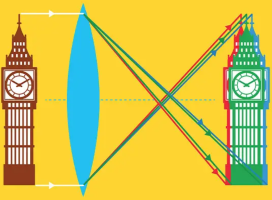
I've suggested before that you refrain from engaging in technical arguments, and you repeatedly fail to heed that advice. Optical correction is bending light, and that is not without consequence. While you are correct that a single photon cannot hit two pixels instead of one, a picture is not generated from one photon. Light from a point in space can certainly be bent in a way that more than one pixel is hit, in fact that's the basis of chromatic aberration, as illustrated for lateral CA here:
Like geometric distortion, CA is something that is easily and routinely digitally corrected.
What about photon strikes that are in the wrong place? I mean, many ultrawide zoom lenses that fill the corners still have 3-5% barrel distortion. Do you turn off all distortion correction in your images (along with CA correction), so that they remain 'optically pure'? I doubt it.
How do you process images? Do you use jpegs straight out of camera or do use RAW? If you use RAW, how do you convert to jpegs or TIFF or whatsoever to view them?Let me make your day: I don't use distortion correction when processing images, I can't even remember when I last used CA correction.
How do you process images? Do you use jpegs straight out of camera or do use RAW? If you use RAW, how do you convert to jpegs or TIFF or whatsoever to view them?
The point of the question is to lead to a discussion of what happens when we process RAW data and the choice of RAW converters. If you are unaware of your software doing correction, then how on earth could that make you a liar? (Lying is deliberately telling an untruth.)I can see where you're going. What's the point of your question? To try and turn me into a liar because CA/LensCorrection is being done implicitly without me being aware of it? That's a disappointing angle to take.


