
You are using an out of date browser. It may not display this or other websites correctly.
You should upgrade or use an alternative browser.
You should upgrade or use an alternative browser.
Landscape Question
- Thread starter bdunbar79
- Start date
- Status
- Not open for further replies.
Richard Lane said:well_dunno said:Recently saw this on DPR, all landscape shots at f/22:
http://www.dpreview.com/articles/4491391950/evolution-of-an-image
As I finished the entire article, the OP of that link, states at the end in the comments section that he was used to medium Format and the f/22 setting just stuck with him, certainly not ideal pertaining to our discussion, unless you're trying to achieve a slower shutter-speed for affect.
I personally don't understand the ISO 400 @f/22 settings. ???
He says "By CarstenKriegerPhotography (3 days ago)
I always shoot landscapes with a tripod, it aids accurate composition and is necessary for longer exposure times. On this occasion I tried to keep exposure time short to avoid any blur that could be caused by the slight breeze, that's why I went for ISO 400. Usually I go for ISO 100 when a long exposure time isn't an issue. F22 obviously is to get maximum DOF."
I personally would not use the same settings but posted to exemplify even f/22 is/can be used when needed. Not a bad image after all, is it?
Cheers!
Upvote
0

Great stuff. This fall there is a week in September where I have no sporting events and am traveling to Pennsylvania and I'd like to do some landscape scenery so this thread will certianly come in handy. Hate to start another thread, but I'm definitely, anyways at least, going to buy a TS lens. I cannot decide between the 17 and 24 at this point. I don't shoot a whole lot below 20mm, but I wanted to ask. Thanks.
Upvote
0
Thanks, I always wanted to buy a TS lens, and I think based upon your suggestion and my focal lengths that I typically use, I'll start with the 24. If I really get into using them, I'd consider the 17 as well, down the road. Thanks.
Upvote
0
scrappydog said:I have both. Both are sharp, but the 24 is by far my sharpest lens. You may want to try that one first, as it is easier to see in LiveView that you are getting tack sharp focus across the entire shot.bdunbar79 said:I cannot decide between the 17 and 24 at this point.
+1 for the 24 but for different reasons. The 17 is much wider, so you either need a strong foreground element to make it interesting or you end up cropping it to get rid of large boring sections (i.e. sky). If you need a wider lens for landscapes, a quick shift panorama would satisfy most situations. The 17 is handy when space is confined (indoors) or the object is really large (i.e. skyscraper) and you can't move back.
Upvote
0
Random Orbits said:scrappydog said:I have both. Both are sharp, but the 24 is by far my sharpest lens. You may want to try that one first, as it is easier to see in LiveView that you are getting tack sharp focus across the entire shot.bdunbar79 said:I cannot decide between the 17 and 24 at this point.
+1 for the 24 but for different reasons. The 17 is much wider, so you either need a strong foreground element to make it interesting or you end up cropping it to get rid of large boring sections (i.e. sky). If you need a wider lens for landscapes, a quick shift panorama would satisfy most situations. The 17 is handy when space is confined (indoors) or the object is really large (i.e. skyscraper) and you can't move back.
Agreed. 17mm and the like can get you a big feeling that is dramatic and very cool (plus easier deep focus) but it's kind of a cheap trick that results in a lot of boring photos unless you go for a really "near/far" look.
I asked a photographer whose work I really like what focal lengths he uses--99% 150mm-300mm (and then crops) on 4x5. So that's like 35mm to 70mm or so on full frame. But it's harder and your subject must be a lot better to shoot at these focal lengths. 24mm has a nice wide feel without the extreme linear perspective distortion (and t/s will take care of converging verticals) you'd get from a wider lens. And you can always stitch if you want to go super wide.
I make almost no money and am about to make a lot less so the TSE lenses are out of my price range by far...but I have heard some rumors about a T/S Samyang lens that will be announced in a month. Might be worth waiting on if the $2000 price is hard to stomach.
Upvote
0
R
Richard Lane
Guest
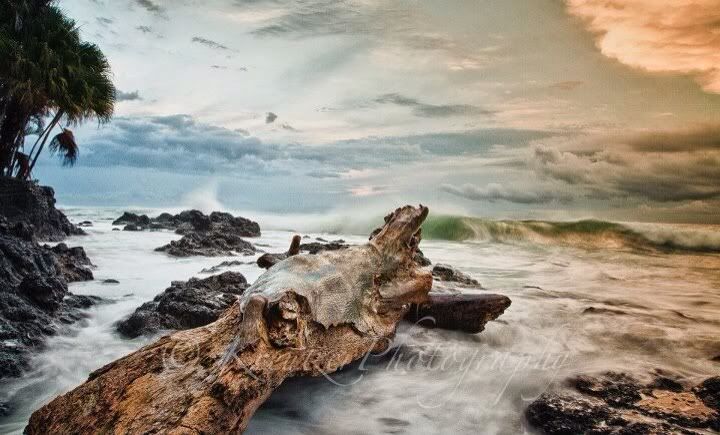
That's certainly a beautiful image, and f/22 does have it's place in photography, but when you blur the water and the clouds like you have by using a slower shutter-speed, f/22, and/or filters, then image sharpness and loss of resolution are less of a concern, since it's the artistic image that takes precedence.KreutzerPhotography said:This was shot on 16-35 II at 22 on 50d. I don't see any real issues with an aperture of 22... maybe its just me.
There aren't any real issues, it's just physics, you can only fit so much light and sharpness through a smaller aperture.

Rich
Upvote
0



As with any photography, there are often compromises to be made. I usually try to avoid f/22 on full frame, unless I really need the DoF (or I want to lower the shutterspeed) and am willing to sacrifice overall sharpness to get it, as overall loss of sharpness is often less noticeable than part sharp and part soft. With a natively sharp lens (like the 24L MkII), the effects of DLA results in less softness, so it may still be sharper than a lesser lens is at f/16 anyway (I have noticed this in comparison with the 24-105). I don't really notice any major problems at f/16 on either my 5D MkII or MkIII, but on the 7D the decreased sharpness is definitely noticeable. If I could get enough DoF at f/11, I'd use it, but for the type of landscapes in my area, it is rarely possible. It really depends on whether anything is blocking infinity or not, but you can get away with more at 24mm.
While DLA (which involves pixel densities and Airey discs, as well as light diffraction) may start around f/10 (or whatever the exact figure is) for the 5D MkII/III, but as the TDP article states, that doesn't preclude using narrower apertures and it is much lower before it becomes usable. What they don't state however, is that lens quality will also come into play, IQ on a higher quality lens will have to degrade much more before it is unusable than a lesser quality lens.
While DLA (which involves pixel densities and Airey discs, as well as light diffraction) may start around f/10 (or whatever the exact figure is) for the 5D MkII/III, but as the TDP article states, that doesn't preclude using narrower apertures and it is much lower before it becomes usable. What they don't state however, is that lens quality will also come into play, IQ on a higher quality lens will have to degrade much more before it is unusable than a lesser quality lens.
Upvote
0
- Status
- Not open for further replies.
Similar threads
- Replies
- 14
- Views
- 678


L
- Replies
- 12
- Views
- 6K
L
