The sharpness curse!

Aug 22, 2013
931
60
10,186
To me... sharpness is a curse!

Let me explain. For me, it is frustrating when I see individuals, be it on a review website, youtube channel, or forum, conduct a sharpness test on a lens and then write-off whichever lens is less sharp as the inferior lens. I have seen this happen time and time again. It is true, that some lenses may be simply bested by others, but generally sharpness is only one factor of this equation.

I do understand the importance of objective tests. With objective tests, we can determine if a lens is optically different than another lens. I struggle to say improved, as I have seen many examples of a lens that falls short on the standard array of optical tests (sharpness, falloff, CA being the ones I see most discussed) yet end up delivering subjectively fantastic results.

For a personal example, I will go back to a lens I like to discuss a lot - the 50L. This lens is by far my #1 favorite lens bar none, no comparison. If I was only allowed to have one lens, it would be the 50L. Now, I have a lot of lenses that are sharper than the 50L (i.e. 24-70 II, 70-200 II, 100L come to mind). But, there is something about their output that subjectively I do not like as much. I also love the subjective output of the 85L II, but I'd still rather have the 50L because the 85L II requires too much working distance for many photos - so with the 85L II I would miss a lot of opportunities. 50L can do pretty much everything, and make it all look beautiful.

I also find it frustrating when lenses without a red ring get ignored simply because they don't have a red ring. For instance, the new 24 IS, 28 IS, and 35 IS are all brilliant lenses. The 24 IS is one of Canon's best landscape lenses in the entire lineup, because at f/11 it is ultra sharp AND virtually free of flare even when shooting into the sun (no L can claim this) - plus it looks great subjectively and is extremely portable! If I was a landscaper, this would be a *must have* lens for me. But I often see it ignored, and I think its because its not an "L". The 35 IS is finally appearing to get some credit thankfully with pro reviews declaring it overall superior to the aging 35L 1.4, which I agree with despite both being excellent. The old 35L's bokeh just isn't as good when its not wide open - the 35L does still have a purpose for those who need f/1.4, but it really needs an update IMO.

Again, I think objective tests are important. Perhaps our tests are not yet advanced enough to fully describe a lens' output, and that is the issue. And, I do appreciate the objective tests to learn more about a lens' characteristics. But, I think that is only part of the process, and wish more "reviews" and discussions of lens quality focused an equal amount of time on subjective factors - as it appears the objective tests simply are not there yet.

But sharpness is easy to understand, easy to test, and easy to see differences in... Making it an easy thing to get hooked into and focus on almost exclusively. But remember, in the end, while some of us are documenting things where sharpness is the #1 priority, others are capturing moments in time where sharpness is not the most important factor. If you are not doing clinical work that really does require edge to edge sharpness, remember that in the end its not about sharpness - its about capturing the moment. Might save you a bit of money over time too ;)
 
I think it is a bad habit that digital photography has imposed photographers. ??? Any image when viewed at full size on a large monitor, looks like it could be "a little more" crisp. :( Sharpness is never enough for pixel peepers. :-X How could anyone not feel like an idiot, to find that 36 megapixel NO produces much more sharp images than 18? :P
 
Upvote 0
I think it is important that everyone is ok with the results his lenses get him/her. Pros love the 24-70II because of its excellent sharpness and fast AF - they need it and journalistic photographers don't need a specific look, they need to capture a moment, not its feeling. If you want to do that, understandably, you choose the 50 due to its specific look and that is totally ok, because then the 50 is the right lens for you. But for some people, sharpness is extremely important, and that is also ok, because then, the 24-70II is the perfect lens for them. Let everyone choose as he/she wants and hope that in the future there will be a lens with the look of the 50 and the sharpness of the 24-70 ::)
 
Upvote 0
sanj said:
Nice post.

+100 for me too, Dear Friend sanj.
I agree with you, Sir. I have learn from my great teachers/ the PRO that, The great pictures/ Photos are created by the great Artistic Photographers, who have a great Artistic ability, Great Technical Know how, Great Point of views, Great Story teller---And The Most important Factors , that they know how to use their equipment 120% of it's ability, such as the sweet spots of their lens/ F. Stop---To create the best sharp of the lens that they have in their hands.
Yes, My great teacher teach me that, We ( 99% of all photographers) not need to enlarge the photos for Street poster/ Bill Board that = 20 feet high X 48 feet long. just need to get 24 X 36 inches for display at local Museum or Exhibition hall only ( Ha, Ha, Ha ).
Great post, Sir, Dear Mr. Ruined----Thanks for start the great post like this.
Have a great weekend.
Surapon

Here are the Masterpiece photos by disposable camera with plastic lens, from the PRO.

http://blog.flickr.net/en/2014/05/27/disposable-camera-shots-from-jordan/
 
Upvote 0
Nice post by Ruined! I also enjoyed the photo by RavePixel - it's a good example of the very shallow DOF portrait style - you can really see how the glasses and the teeth stand out. I presume it was shot wide open.

Personally, I don't like the DOF to be quite that shallow, so if I shoot wide open for bokeh, I usually stand a bit farther back from my subject (With my old Sigma 50 classic) Or, I stop down to about F/2.

One of the reasons it is so much fun to talk about lenses is because our artistic preferences give us endless variations of opinion. Sharpness is just a small part of the equation. And let's not forget other qualities like my favorite: accurate autofocus!
 
Upvote 0
Well said .. there is some utter nonsense talked about sharpness in many places. ;-)

My general feeling is that (for some) it's much easier to explore sharpness and other technical craft issues relating to image 'quality' than address the fact that their photos just aren't that great, and that concentrating on technical issues is just a way of avoiding concentrating more on the image content, or other less quantifiable/tangible aspects.

Of course this isn't new - photography has a long history of people spending a lot of effort on technical differences very few would ever notice. I'd just note that this behaviour becomes much easier with digital ;-)

The technical aspects (refining my 'craft') are important to me, but only as part of the whole image creation process. The technical has a vital part in my commercial work, but I know that very few clients are ever going to ask for it by name - to them it's primarily about the content of the image and representation of ideas.

Colour management is another area I see a lot of this, with a spurious desire for 'perfection' and 'correct' colours for applications where no-one could ever know (there are times for great precision, but not for photographic work I do)

Curiously enough, I only ever find such behaviour (in colour management and photography) in men ;-)
 
Upvote 0
I kind of agree with Ruined.

As long as 'sharpness' and the lack of aberrations sells lenses, lenses will tend to become more 'clinical', which is good for some. Not so for others maybe - but then there's always older lenses with more 'character' that will stay around for a long time. I'm hesitant about the new Sigma 50mm for example, and would really say I prefer the old EX version exactly because I like some of the subjective qualities of that lens.

So optical perfection is one side of things, but if you like the more 'artistic' side (extreme examples like lomography and heavily processed instagrams come to mind), then the camera is brought back down to earth as a mere tool, not an optical instrument designed for scientific purposes. And it's for everyone to see what tool best fits their needs.

Often it's the advanced amateurs in any discipline that have the 'best' and 'newest' gear, simply because they think that's absolutely needed or through marketing and forums like these, they are led to believe they will be less of a photographer without it. It's the real 'pro's/artists' on the other hand who can do with 'less' and still get 'more'. Maybe it will help us to focus on photography once we let the relative 'importance' of our gear go.

For fun, I like to play around with vintage lenses on my NEX. The less than perfect optics can create really interesting effects, or sometimes I like to try my best at shooting 'photography' even with a cheap compact or whatever inspires me at the moment. The limitations sometimes bring out the better in me. Will that save me from the sharpness bug? Well... at least it brings the notion of gear perfection into perspective.

Mind, I'm not preaching that I know it all, cause after all I'm not quite there - GAS afflicted as I am.

So while on the subject, where in the world is that new, stunningly SHARP 100-400L? I absolutely need it to improve my photography! ;D
 
Upvote 0
mrsfotografie said:
I kind of agree with Ruined.

As long as 'sharpness' and the lack of aberrations sells lenses, lenses will tend to become more 'clinical', which is good for some. Not so for others maybe - but then there's always older lenses with more 'character' that will stay around for a long time. I'm hesitant about the new Sigma 50mm for example, and would really say I prefer the old EX version exactly because I like some of the subjective qualities of that lens.

So optical perfection is one side of things, but if you like the more 'artistic' side (extreme examples like lomography and heavily processed instagrams come to mind), then the camera is brought back down to earth as a mere tool, not an optical instrument designed for scientific purposes. And it's for everyone to see what tool best fits their needs.

Often it's the advanced amateurs in any discipline that have the 'best' and 'newest' gear, simply because they think that's absolutely needed or through marketing and forums like these, they are led to believe they will be less of a photographer without it. It's the real 'pro's/artists' on the other hand who can do with 'less' and still get 'more'. Maybe it will help us to focus on photography once we let the relative 'importance' of our gear go.

For fun, I like to play around with vintage lenses on my NEX. The less than perfect optics can create really interesting effects, or sometimes I like to try my best at shooting 'photography' even with a cheap compact or whatever inspires me at the moment. The limitations sometimes bring out the better in me. Will that save me from the sharpness bug? Well... at least it brings the notion of gear perfection into perspective.

Mind, I'm not preaching that I know it all, cause after all I'm not quite there - GAS afflicted as I am.

So while on the subject, where in the world is that new, stunningly SHARP 100-400L? I absolutely need it to improve my photography! ;D


Ha, Ha, Ha my dear friend/ Teacher mrsfotografie
You are wrong " stunningly SHARP 100-400L? I absolutely need it to improve my photography! "---NO, NO, NO, You Just have the " GAS." Illness, You are already great Photographer = In my Eyes/ My Heart----No, You do not need new $ 12,000 US Dollars toy---BUT ME = Yes, I will dump my 8-9 years old 100-400 mm to my son, and get the new one= With out Pump action shotgun and 3 feet long at 400 mm.
Good night Madam
Surapon
 
Upvote 0
I wouldn't even list sharpness as an attribute of what makes a good or successful photo. Composition, lighting, contrast, color (when applicable), capturing the essence of the subject matter or the mood are the attributes that are judged in a photo or other visual works of art, in my opinion. Too much sharpness can be a distraction if it becomes more noticeable than the previously mentioned attributes. But there is that allure. It is the easiest way to compare lenses. Personally, I think virtually any lens can take a successful and sell-able picture in terms of having enough sharpness.
 
Upvote 0
dak723 said:
I wouldn't even list sharpness as an attribute of what makes a good or successful photo. Composition, lighting, contrast, color (when applicable), capturing the essence of the subject matter or the mood are the attributes that are judged in a photo or other visual works of art, in my opinion. Too much sharpness can be a distraction if it becomes more noticeable than the previously mentioned attributes. But there is that allure. It is the easiest way to compare lenses. Personally, I think virtually any lens can take a successful and sell-able picture in terms of having enough sharpness.

It very much depends on the type of image you are taking, but I agree. Just go look at a Steve McCurry print exhibition to realise sharpness is way down the list of attributes. Come to think of it, go to your local Victoria Secrets and look at the big B&W prints there, none of them are sharp either but they are really nice images.

Sharpness is dramatically over rated a lot of the time. However try doing anything with a blurry image of a bird and you will see not everybody has the same viewpoint.
 
Upvote 0
Sharpness really isn't critical beyond a certain point, so long as you have the right length lens for the job and have time to perfectly compose the shot. Where sharpness starts to matter is when you don't have that chance, and you have to crop after the fact. So basically, I care a lot about sharpness in whatever lens I choose to keep on my camera by default, and I don't care nearly as much about sharpness on the other lenses in my arsenal—except for the long zooms when I'm taking photos of birds; then I care again, because I don't own a $14,000 behemoth lens.... :)
 
Upvote 0
I find that the 'sharpness curse' is a manifestation of the digital age,I have just gone through my records of my film days starting in the late 70's,the silver halides[I could only afford B/W]could only resolve so much and that was it. Some images of mine sold very well without the 'sharpness' of todays gear,back then I think we understood circles of confusion better and shot accordingly for an image that was acceptably sharp and left it at that ,once those grains looked at under the loupe on the baseboard were crisp that was it,this of course depended on the film stock rating as to what was defined as crisp
 
Upvote 0
Sharpness is always nice IMO, but it has never been the primary reason for me buying a lens nor for choosing one lens over another when out shooting. I think most experienced photographers realize this at some point. Plus now, even most of the cheaper lenses are pretty darn sharp - although there are some exceptions and some that get pretty soft in the corners for landscape shooting.
 
Upvote 0
dgatwood said:
Sharpness really isn't critical beyond a certain point, so long as you have the right length lens for the job and have time to perfectly compose the shot. Where sharpness starts to matter is when you don't have that chance, and you have to crop after the fact. So basically, I care a lot about sharpness in whatever lens I choose to keep on my camera by default, and I don't care nearly as much about sharpness on the other lenses in my arsenal—except for the long zooms when I'm taking photos of birds; then I care again, because I don't own a $14,000 behemoth lens.... :)

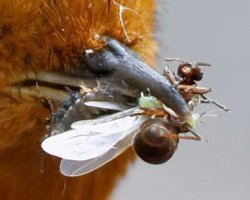
Absolutely right about the superteles. You use them because you can't get close to your subjects, especially birds, and the images have to be razor sharp to allow very heavy cropping. The subject bird typically occupies less than 5% of the frame. Here is a detail of an insect in the beak of a robin I took yesterday. The whole crop is only 356x285 pixels from the 22 Mp full frame. Sharpness might not be necessary for an artistic shot or a portrait, and Cartier Bresson once wrote "Sharpness is a bourgeois concept", but you need the ultimate sharpness for some jobs. With a softer lens that insect would have been too blurred.
 

Attachments

  • RobinsBeak+Insect_6705_Crop.jpg
    RobinsBeak+Insect_6705_Crop.jpg
    15.9 KB · Views: 1,476
Upvote 0
Hmmm, most reviews I read on the net include sharpness as one of many considerations . . . bokeh, autofocus, distortion, CA, flare, price, ergonomics etc etc. It seems odd to me that some people are making huge assumptions . . . a fascination with sharpness is just a way of trying to compensate for a lack of ability? Really?

Thankfully as a number of people have pointed out for some photography sharpness is massively important. I've just ordered the 135L. My considerations there were low light performance, a little bit more reach than I have now, fast AF and yes great sharpness made it what I think will be an excellent choice. I'm sure I can still take "capture the moment" photos with it but what I can't do is take sharp pictures with a lens that doesn't have that as a quality.

I love detail in photos a lot of the time . . . birds, sports, concert photography and often (not always) I am striving for it. And while I'm a beginner compared to many on here that's not necessarily a bad thing to do. You can't tell sportsmen and animals to come close to your lens to capture their expressions. A sharp lens is a very important tool in "capturing the moment".
 
Upvote 0
Sharpness to me is the cherry on top. It is an important consideration when choosing a lens but like others said not the only thing to think about. Obviously things like lighting, exposure and composition have a far greater impact on an image than sharpness but sharpness will make a great image that extra bit better.

I was just looking through an image from a recent wedding with the second shooter. We both loved an image (shot with the 24-70 2.8ii) and were remarking how clear and sharp it was even when zoomed way in. Then we started discussing how the 24-105 would've never produced an image so good. The point is that I'll always pick the image with the extra bit of sharpness if everything else is in order.

It gives me peace of mind that I don't have to worry about the quality of the lenses that I use. I focus on what I am shooting and just try to make the best image I can. But that's me and I can certainly understand when others say that it's not a consideration for them. I will say this though, all these modern lenses aren't going to make a great deal of difference if you are just viewing your images via laptop or dare I say, a smart phone. Get those images to the print lab and enjoy your work on display for everyone to see!

Cheers,
Ben
 
Upvote 0
Sharpness is important. Remember for instance https://en.wikipedia.org/wiki/Group_f/64. Photographers used big format and apertures around 22-64 to reach maximal sharpness. The members of the Group f64 set themselves in opposition to https://en.wikipedia.org/wiki/Pictorialism. With contemporary fast lenses we can choose between the two styles. Wide open you can create Pictures in "pictoralistic fashion" and in using optimal aperture around f4 you have maximal sharpness.

Ansel Adams would shurely have been happy to work with any kind of our modern equipment.
 
Upvote 0
f/64 on a full plate camera has the same Airy disk relative to its size as f/11 on a FF.
A 210mm lens on a full plate is equivalent to a 50mm on an FF.
The hyperfocal distance of a 210mm at f/64 on full plate is 10.1 m, which means setting it at 10.1 m has everything sharp from 5.05 m to infinity.

A 50mm on FF has at f/11 a hyperfocal distance of 7.42 m. So, everything from 3.71 m to infinity will be sharp.

Yes, Ansel Adams would have loved a 5DIII or 1Dx!
 
Upvote 0