
Quick and Dirty AFMA

Sep 21, 2013
1,263
12
13,501
Wautoma, WI USA.
I am sure I am not the first to do this but I don't recall reading it elsewhere. A quick and easy way to check and adjust your afma is: put the camera on a tripod or on a table and focus on a target using live view (make sure to turn off "enable continuous focusing" in the live view options). look at the focus scale setting. now switch off live view and focus again. you don't need to look through the viewfinder of anything just make sure the camera doesn't move and keep watching the focus scale on the lens. If it moves to a closer point it is front focusing, a farther point back focusing. do this a few times to make sure the results are consistent then adjust afma accordingly. When you have it adjusted to where the focus scale setting stays in the same place when switching between live view and normal focusing then your afma is right on. This is a really good way to quickly check make adjustments at different focal lengths and distances.
 
i suppose that's true. i have only done this with the 70d and 6d. i never really used live view on the older cameras much. i have never tried the automated methods that i have seen mentioned here but this seems to work pretty well and its a lot less tedious than shooting targets and transferring the images, analyzing and making notes and adjustments and then doing it all over again which can be very time consuming with lenses like the sigma zooms in particular where you need to make 4 focal length x 4 target distance adjustments with the dock.
 
Upvote 0
i will have to read up on that and maybe give it a try. does that enable you to do something different than what you can do with standard in camera afma? i have been able to get good results with in camera afma and canon lenses which generally seem to focus pretty well to begin with but the sigmas have all sorts of issues. for instance the 18-35 or 120-300 that i have require different input values depending on target distance. the canon lenses that i have had problems with at least exhibit the same front or back focusing behavior regardless of target distance so that can be compensated for with in camera afma fairly easily.
 
Upvote 0
the end result is the same as u would do it all by hand.
The advantage is that dot-tune will give u the AFMA number much much faster and repeatable in an almost
automated way. Credit goes to Horshack for his algorithm and A1ex's of Magic Lantern for the implementation.
 
Upvote 0
neuroanatomist said:
PhotoCat said:
or use Magic Lantern Dot-Tune AFMA 8). I have had excellent & repeatable results

You've had better success than me, I found dot tune to be somewhat unreliable.

I also thought dot-tune had reliability issues for some lenses I have, as it kept hunting left and right (increasing)
for the AFMA value. I finally discovered that one must enter an initial value of AFMA for the lens in question.
Just give it a value like +2. After that, dot-tune behaved itself very well and always converged on a repeatable value +/- 1. Body was 5D2.

I found it critical that the initial live view manual focusing be as precise as possible using 10x digital magnification. Otherwise dot-tune may not converge.
 
Upvote 0
wickidwombat said:
quick and dirty and AFMA are just a recipe for pain an anguish

seriously, do it properly or don't do it

this method really works surprisingly well. give it a try, you can always fine tune the traditional way if you don't like the results.

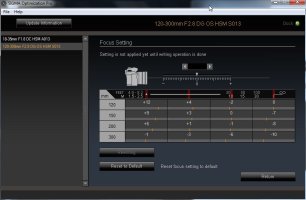
setting focus values with a sigma zoom and the dock is an especially long and drawn out ordeal. they need different adjustment values for different target distances and focal lengths. the screenshot below is from my 120-300 sport.

the way i am describing saves a lot of time, keep in mind that with the sigmas you have to take the lens off and mount it to the dock with every adjustment. it can take hours.

ps. i used this method to adjust a 70d and 50L combo yesterday. i was able to get it adjusted and focusing with a +13 afma value in a matter of 2 minutes or less without any computer.
 

Attachments

  • 120-300.jpg
    120-300.jpg
    57.9 KB · Views: 254
Upvote 0
I have a feeling AFMA is a kludge at best, as I found it is somewhat distance and light-level dependent.
e.g. With dot-tune AFMA, my experience is that focus is spot on most of the time with the same distance and light-level as the calibration condition. When I take it outdoor with much brighter light-level, AFMA still helps but not as much as the darker calibration condition.

For many people who took their canon bodies and lenses into Canon for calibration don't seem to have this
kind of problems.

My guess is that AFMA is a one dimensional adjustment (ie 1 variable to adjust)
while Canon's real in house calibration is probably more than 1 dimension to cover all the distances and perhaps the focal lengths (if a zoom) at the vy least.

Anyone has real experience to share about the quality of in house Canon calibration?

Sigma's lens dock route sounds like a disappointment then... How can one calibrates a lens efficiently without mounting it onto the body? U just don't get instant feedbk from the body and no wonder it is so time consuming.
 
Upvote 0
candc said:
ps. i used this method to adjust a 70d and 50L combo yesterday. i was able to get it adjusted and focusing with a +13 afma value in a matter of 2 minutes or less without any computer.

2 minutes is really impressive for a value of +13 candc! How many iterations did u go thru during the 2 minutes?
 
Upvote 0
With the 5DIII, if I'm wearing reading glasses, I can get a good AFMA result just using a target, camera at 45 degree angle, and the display on the back of the camera.

For fine tuning, same method, but load the images. If I'm doing several lenses, I'll tether with Canon's software.

Not extremely time consuming.

BUT, even with Canon lenses, what is spot on with recommended AFMA distances can be a couple of points off when doing portrait work. Really only critical when shooting below f/2.2, but annoying in such cases.

And I think over time, maybe with temperature and humidity, values change.

Constant battle, ain't it?
 
Upvote 0
YuengLinger said:
BUT, even with Canon lenses, what is spot on with recommended AFMA distances can be a couple of points off when doing portrait work. Really only critical when shooting below f/2.2, but annoying in such cases.

And I think over time, maybe with temperature and humidity, values change.

Constant battle, ain't it?

Same experience here as I often shoot portraits at f2.0-f2.2. I was guessing that was due to higher outdoor light level but not sure. Take the filter off and the AFMA value will shift a few points too.

Now Canon has got the dual pixel sensor focusing technology. In theory, future cameras should be able to auto calibrate the phase dect focusing while u shoot! This can be done by the camera constantly comparing the results of the conventional phase dect focusing module with that of the dual pixel sensor phase dect circuit, and
making automatic adjustments to AFMA or better yet a full blown Canon in-house type calibration.

Hopefully we will eventually get rid of manual AFMA altogether :)
 
Upvote 0
PhotoCat said:
candc said:
ps. i used this method to adjust a 70d and 50L combo yesterday. i was able to get it adjusted and focusing with a +13 afma value in a matter of 2 minutes or less without any computer.

2 minutes is really impressive for a value of +13 candc! How many iterations did u go thru during the 2 minutes?

I could tell it was front focusing quite a bit so I went to +10, not enough,+15 too much, +12 not enough,+13 spot on. so 4 iterations. I think if you go about it that way then you can always get it zeroed in with 4-5 iterations
 
Upvote 0
PhotoCat said:
YuengLinger said:
BUT, even with Canon lenses, what is spot on with recommended AFMA distances can be a couple of points off when doing portrait work. Really only critical when shooting below f/2.2, but annoying in such cases.

And I think over time, maybe with temperature and humidity, values change.

Constant battle, ain't it?

Same experience here as I often shoot portraits at f2.0-f2.2. I was guessing that was due to higher outdoor light level but not sure. Take the filter off and the AFMA value will shift a few points too.

Now Canon has got the dual pixel sensor focusing technology. In theory, future cameras should be able to auto calibrate the phase dect focusing while u shoot! This can be done by the camera constantly comparing the results of the conventional phase dect focusing module with that of the dual pixel sensor phase dect circuit, and
make automatic adjustments to AFMA or better yet a full blown Canon in-house type calibration.

Hopefully we will eventually get rid of manual AFMA altogether :)

That's a great idea,
 
Upvote 0
Here's a photo of the target I use for AFMA:

p942096878-3.jpg

It's about six feet long and each little square is one inch. I like it because I can test at distances I typically use during a photoshoot. Also, I can magnify the image on my 5D3's LCD screen and almost instantly find the exact point of focus.

You can also get a rough idea of the general sharpness of a lens and a feel for the chromatic aberration.

I usually take a few shots, refocusing each time, then I can scroll through the magnified images on the screen and quickly see if the focus is consistent. With Canon lenses in good condition, it usually is. I've taken this chart with me to camera stores and when meeting Craigslist sellers.

I'm really happy with this method. You can see some more examples about half way down in my latest blog post about the 85mm 1.2 L. This one is actually safe for work! No naughty photos. (Don't go to part two if you prefer to avoid that.)

http://www.beyondboudoirphoto.com/blog/2014/8/canon-85mm-lens-comparison-ef-85-1-8-vs-85-1-2-l-part-one
 
Upvote 0