80d vs. 7D MKII

May 11, 2016
153
53
6,201
At present I have the Canon 70D, which I use mainly for landscape and architecture.
The 70D is OK for this although the dynamic range is not that great, which can give limitations in certain landscape photos.

But last year I picked up bird and plane photography again, after many years.
For birds and planes the 70D’s AF system is not bad, but I missed several good pictures due to bad AF – although I must say that if I had known the situation in advance, I could probably have made the shot with different AF settings.

So I want a camera with a sensor with good dynamic range and an AF system that can quickly and accurately lock on and track fast and sometimes erratically moving objects.
I am aware of the fact that erratically flying birds are the biggest challenge for any AF system to track (to acquire focus and then keep in focus), but planes usually have speeds that exceed the speed of birds and therefore also pose a challenge for any AF system (including the lens) to track them.

Because of this, I want to upgrade to another camera and I am in doubt about which is the best for my needs.
I should mention that I make almost no videos, so that part of the specs is of no importance to me.
A FF camera is no option due to the lenses I already have (all EF-S). So I can choose between the 80D and the 7D MKII. The 7D MKII has a stellar AF system, but it’s sensor is not that good when a decent dynamic range is required. The 80D apparently has a better sensor than Canon has ever had (if I summarize correctly what I have read), but it’s AF system for tracking objects is not that good.

My plan was to wait for the test results of the 80D's sensor by DXOmark.com, so I could compare that to the results of the 7D MKII. Alas, on the DXOmark website for the Canon 80D someone asked why it was not tested yet, on which the following reply by some other visitor came.
DXOmark have don't publish camera tests any more. I guess its not profitable. They just use the results for their software now. They didn't even bother to publicly announce that they don't publish camera tests any more.”
So apparently no more camera sensor tests by DXOmark, the only objective sensor test there was to my knowledge.

So now I have a problem to make a good comparison between the 80D and the 7D MKII. I have seen some reviews that speak of a better dynamic range of the 80D, but I never see a test that is done with equipment so there is some element of objectivity.
Some reviews say the 80D‘s dynamic range is far better than that of the 70D. Other reviews say it is better, but not by a huge margin (I read only one stop more). Other reviews say the 80D’s dynamic range is quite good ‘for a Canon’, which does not give much confidence about the 80D’s actual performance.

I hope that someone can help me with answers to the following questions that I have – so I can decide which of the two (80D or 7D MKII) is the best compromise for me.
1. Is there a test/review somewhere on the internet where the dynamic range of the 80D is tested in the same manner (preferably in the same test) as the AF system of the 7D MKII?
2. Is there a test/review somewhere on the internet where the AF system of the 80D is tested in the same manner (preferably in the same test) as the AF system of the 7D MKII – preferably where tracking moving objects is part of the test?

Thanks in advance for any help. :)
 
There are several tests of the dynamic range 80D, compared to other cameras (dpreview for example), and I do not trust the DXO methodology anyway. The tests that I read, the DR in low ISO, seems to have a great improvement in 80D.

Moreover, no known reliable scientific tests on the AF system on different camera models. Only a few users who have used both cameras can opine about their personal experiences.
 
Upvote 0
Thanks for your reply, ajfotofilmagem.

I have read some more criticism about the results of DXOmark tests. But I often some bias of DXOmark against Canon and in favor of Nikon was implied, and therefore i did not take those critics serious. Especially because there seems to be consensus about the sensors in the Nikons and Sony's to have better dynamic range.

My thought was that a uniform measurement method comes closest to being objective, and if it is applied equally to all camera brands and types, then this would result in a sort of 'yard stick' for all to compare.

Can you explain what the issue is/was with DXOmark's measurments?
 
Upvote 0
Just a few personal observations from processing these files: I'd say the 80D has the edge when you nominalise them both to 20.2 mp. As regards the DR I wouldn't get hung up on that; both have more shadow lifting potential ( which is basically the context of DR these days) than most would require, but the 80D is better.

I'd say it comes down to whether you want the larger size, processing power & AF + build of the 7DII. I would no more trust an 80D out in the rain that I would a 6D.
 
Upvote 0
Thanks Sporgon,

you are right that the build quality and especially the weather sealing also is something to look at. Did not have that at the front of my thoughts yet.

My choice is in fact between either a modern sensor or a state-of-the-art AF system.
Wanting both would steer me towards a FF body, and as I wrote that is no option for me.

Shades are often quite hard when photographing airplanes - and the same with birds.
When photographing airplanes, I saw that the dynamic range of the 70D (that is: the ability to get details back in the shadows) is not great. Quite quickly, noise shows its ugly face. There are some ways to reduce that in post processing, but that is quite limited because is quickly makes an unnatural end result.

Now that I give it some more thought, it is probably best to give preference to a good dynamic range instead of to the ultimate AF system. After all, even with the 70D I usually get at least one or 2 sharp photos in a burst. Increasing that number of sharp photos with a 7D MKII gives me more photos to work on, but they all will have hard shades if the weather is sunny. That means that I just have more-of-the-same exposures, because the sensors of the 70D and the 7D MKII are almost identical in dynamic range. Therefore, replacing my 70D with a 7D MKII would not give me any improvement in the image quality of my final results.

But with better dynamic range I can improve the shades better in post processing, resulting in a better end result. And therefore, this would result in an improvement.
This means that the 80D should be my preferred choice.

Now I think of it, that should have been clear to me much sooner.
Because in the end, the quality of the photo gets determined by the quality of the sensor in digital photography. So preference should go to the better sensor.
 
Upvote 0
haggie said:
Now that I give it some more thought, it is probably best to give preference to a good dynamic range instead of to the ultimate AF system.

A good metering system (and learning to use it properly) is probably more important than DR. I'm also a casual bird shooter, and also use a 70D. In poor light or harsh light a tiny bit of DR won't help very often. If your exposure is off by two stops (either direction) a tiny bit of extra DR also won't help.

When I look at my bird photos (either BIF or not), I'm most frustrated when the image is under-exposed or over-exposed by much more than the tiny DR difference of 80D vs 7D2. I suggest you start by looking at your photos in their unprocessed (neutral) state and see if your exposure is consistently correct before starting to look for a new camera.
 
Upvote 0
haggie said:
Thanks for your reply, ajfotofilmagem.

I have read some more criticism about the results of DXOmark tests. But I often some bias of DXOmark against Canon and in favor of Nikon was implied, and therefore i did not take those critics serious. Especially because there seems to be consensus about the sensors in the Nikons and Sony's to have better dynamic range.

My thought was that a uniform measurement method comes closest to being objective, and if it is applied equally to all camera brands and types, then this would result in a sort of 'yard stick' for all to compare.

Can you explain what the issue is/was with DXOmark's measurments?
Because I do not trust DXO Mark?

The results are based on DXO normalized images to an output result with only 8 megapixel, and when compared cameras of different resolutions, this can be misleading. If you want an image output with more than 8 megapixel, can be misleading too.

The DXO measurements only consider the "maximum DR" possible, that only happens in the ISO base. That is, ISO100 on most cameras. If you intend to use your camera at ISO 100, measurements can be useful, but using high ISO these measurements can be misleading.

The DXO measurements assess the noise when it reaches a certain "arbitrary" amount that they consider acceptable. But no camera lets you adjust the ISO in fractional values as ISO1437 for example.

To lift the shadows, 80D is the best Canon option at this time. For his architectural work, for sure. For birds and planes, there is controversy.
 
Upvote 0
thanks for your remark, drmikeinpdx.
I too did a lot of airplane photography when I still had my A-1 and my T-90. With my FD 2.5/125 mm and my FD 4.0/80-200 mm I made great shots. The advantage of that type of 35 mm SLR was something that I never read, but in my opinion was fantastic. Even if you could not afford the most expensive Pro SLR-bodies, you could achieve Pro-results. If you just saved and bought the good lenses, and would use a professional film (who remembers: to be stored in the fridge te retain optimal color balance! 8) ).
In that way you could get the same results as the pro, because the SLR-body (although it determined the ease of use, reliability etc.) had no real influence on the resulting photo.

With digital SLRs that is completely different. It gave manufacturers the possibility to differentiate and build optimised cameras for different situations. That is good.
But it took away the possibility for enthusiasts to get 'pro-results' on a relative budget in the way I just described. That is bad.

That said, todays digital SLR's have an image quality that surpasses the old film, perhaps not always in 'atmosphere', but certainly in capturing details. And post-processing and printing is so much easier than spending hours in the darkroom for only a few prints. So, to be honest, I would not go back to that age.

And yes, I like to think that manual focussing was something that gave good results for fast flying aircraft too. Every pass of a plane I had at least 2 excellent sharp photos. Alas, modern digital cameras do not support manual focus in these circumstances. The lenses rotate very little for a given change in focus, so it is easy to 'overshoot'. And the digital SLR bodies do not have the split focussing screen of those days, which makes accurate but also fast focussing a real challenge. I can honestly say that I tried manual focussing with my 70D and that this is not good for my mood. ;)
So I think you can say that the old technique no longer works: it is simply no longer supported by the camera bodies and the lenses.


Thanks for your repy, Orangutan.
You are right with your remark that a properly exposed image is the base for everything else.
Of course, my exposure is off at times, but that is not what I meant. In sunny circumstances the underside of a plane fuselage and wings gets several stops under-exposed. The same for the wings of a BIF. That is a fact I cannot change.
I have seen photos taken with a Nikon that seem to give more room to 'pull up' details in the shade than my 70D. That is required, because I cannot control the lighting when shooting airplanes in flight or birds in flight. Of course I could say "the light is too harsh, so I won't shoot photos today", but then I would miss many opportunities. So that is why I am looking for a different camera body. I hope this explains why I look for a better (Canon) body, i.e. a body with a better sensor.

And judging from several tests, the 80D could/should give me better lattitude to correct sub-optimal lighting of the subjects in my photos. It is sad it does not have the 7D MKII's elaborate AF-system. But then it would not doubt be more expensive than the 7D MKII is, so there is no sense for Canon to do so.

Thanks for your explanation, ajfotofilmagem.
I did not know that about the DXOmark method. Because for birds and planes I usually work at 400 ISO (800 ISO if I really must), I am more interested in that higher ISO performance.
This means, I guess, that what I read at DPReview is more relevant than a DXOmark test would be.
 
Upvote 0
haggie said:
Because in the end, the quality of the photo gets determined by the quality of the sensor in digital photography. So preference should go to the better sensor.

Greetings Haggie,

So much more goes into determining the quality of the photo than the sensor. Light, color, composition, focus, etc.

A great sensor can't make up for a missed photo so your reasoning/logic does not hold true for a myriad of situations. IMO, you are rationalizing your purchasing decision so you may need to slow down?

The difference between the sensors in the 80D and 7D Mk II (and the D500 for that matter) are minor but the difference in everything else is huge. Are we to dismiss all those? If so, why bother adding those amazing functions?

I can program in a minimum shutter and a maximum shutter (alon gwith ISO and f stop) in my 7D MK II; it has an amazing auto ISO function; in manual mode, I can change lenses that have different f stops and zoom in and out with variable aperture lenses AND still get the exposure I set at the start and so much more.

I really enjoy my wife's T5i because of the flip touch screen but when I need speed, performance, etc. I reach for my 5D Mk III or 7D MK II. The sensor in the T5i has more DR (no banding in the shadows when pushing exposure) than my 5D MK III but I would never say it gives better quality photos.

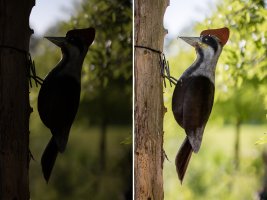
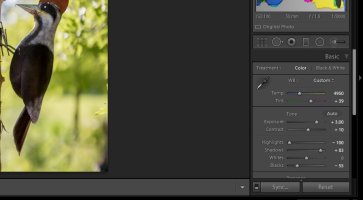
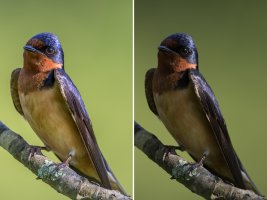
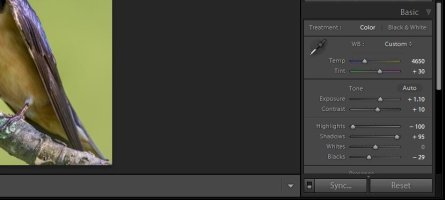
Here are some examples of a pushed exposure. One is extreme, the other (in the second post due to file limitations) is more reasonable and the exposure was set for the highlights.

If you need more latitude than these examples....then you may need a sony sensor. The 7D Mk II sensor is incredible and a huge step up from the 5D MK III. I have seen the 80D results and see no improvement. Of course I also see no significant difference between the D500 and the 7D Mk II either. I was ready to move to Nikon because of the D500 because of all the hype and then the results....well, I am still with Canon :)

NOTE: NR was set to 37 in LR for the fake pecker shot. I missed focus slightly but had no way of checking since the screen was black in bright sunlight. As an aside, the Sigma 50-100 is a joy to shoot with! Works great on a FF from 85mm-100mm
 

Attachments

  • DR7DMKII.jpg
    DR7DMKII.jpg
    3.2 MB · Views: 331
  • 7dmkii.JPG
    7dmkii.JPG
    53.6 KB · Views: 246
Upvote 0
The advantage of Sony EXMOR sensors typically only holds between ISO100 and 400. At ISO 800 and above, ceases to be such an advantage.

I recommend it for its intended use, use the dpreview comparison tool to "push shadows" for 2 or 3 stops with the ISO you usually use. I would ignore the push 5 stops, which would make midtones be poor anyway.
 
Upvote 0
Re: Planes in flight question

Hi,
drmikeinpdx said:
It has been decades since I photographed airplanes in flight at airshows - back in the days of film and manual focus!

If I recall correctly, we would simply focus our lenses at infinity and fire away.

Has photo technology changed to the point that this technique no longer works?
I think the problem is there is no 100% crop view in film, but there is in digital image... as a result, "the DOF on screen become smaller than DOF in most printout" especially when you view at 100% using a lower PPI monitor... a bit of out of focus or motion blur become very obvious.

Have a nice day.
 
Upvote 0
ajfotofilmagem said:
The advantage of Sony EXMOR sensors typically only holds between ISO100 and 400. At ISO 800 and above, ceases to be such an advantage.

I recommend it for its intended use, use the dpreview comparison tool to "push shadows" for 2 or 3 stops with the ISO you usually use. I would ignore the push 5 stops, which would make midtones be poor anyway.

I use iso640 as the norm on my 7DII for bird photography. DR is very similar for most APS-C sensors at that ISO so I don't take much notice of other sensors. Quick and accurate focus is the most critical factor. I didn't like the lack of centre spot focus on the 70. It's very important for locking on to small birds against a crowded background.
 
Upvote 0
What Travelintrevor and AlanF are really saying, is that I should not give prefference to image quality so easily. In effect: my assessment about the importance of image quality being most important is not that absolute. I did not know the functions mentioned in both replies, e.g. 'centre spot focus'.

To be honest, now I am really in doubt. In the thread titled "Canon 80D RAW files available for download. DR improved", in this same sub-forum, I read several observations that seem to confirm my initial preference for optimal image quality over speedy AF. Seeing the examples Travelintrevor posted, I do not. That is definitely a lot better than my 70D allows for!

So I think it is best if I look into the 7D MKII a bit further than the tests and reviews I read on the internet. I wil just get the Instruction Manual from the Canon site and have a thorough look at it.
 
Upvote 0
haggie said:
What Travelintrevor and AlanF are really saying, is that I should not give prefference to image quality so easily. In effect: my assessment about the importance of image quality being most important is not that absolute. I did not know the functions mentioned in both replies, e.g. 'centre spot focus'.

To be honest, now I am really in doubt. In the thread titled "Canon 80D RAW files available for download. DR improved", in this same sub-forum, I read several observations that seem to confirm my initial preference for optimal image quality over speedy AF. Seeing the examples Travelintrevor posted, I do not. That is definitely a lot better than my 70D allows for!

So I think it is best if I look into the 7D MKII a bit further than the tests and reviews I read on the internet. I wil just get the Instruction Manual from the Canon site and have a thorough look at it.

I think that Alan F is getting at the point that good/excellent AF is a/the major priority for the likes of birds etc. Personally I totally agree! My first consideration when buying a camera is it's AF performance and versatility (I currently use a 7D2 and 1DX) only then do I worry about other factors. Naturally image quality is very important but the best sensor in the world won't get to a decent bird shot if the AF isn't up to the job.
I have not personally tried the 80D but it does appear to have a pretty capable AF system so it is well worth a look and may well be the best compromise for you. On the other hand the 7D2 has a very good AF system and drives even the big white lenses nearly as well as a 1 series - but it has an older design sensor.
I would point you at the 7D2, but that is only my opinion, you really need to try them both for yourself before you part with your pennies!
 
Upvote 0
Just adding my 2 cents worth. Not just in this thread (and indeed in many other threads and photo forums), I see time and time again, people exaggerating small differences as if they were ‘poor’ vs ‘excellent’.

While there are differences in AF and sensor between 7D2 and 80D, the absolute differences are not as night and day as many people make them out to be. Compared to digital images possible a mere 15 years ago, we are truly spoiled.

Both cameras have very capable AF, with the 7D2 slightly better for challenging birds in flight. The 80D is probably 90% as capable.
Both cameras have awesome sensors, with the 80D slightly better for low ISO image post processing. The 7D2 is about 90% as capable.

For a balanced opinion, there are many other features that should be considered depending on the potential user’s photographic style and needs (ergonomics, connectivity, cost, build quality, etc).

And even more important than the rather minute differences between AF and sensor capability, is the photographer’s skill level, and willingness to practice and improve.

Regards, everyone

Paul 8)
 
Upvote 0
I was caught between 80D and 7DMk2.

To me it looks like the 80D has no real/great advantage in image quality (DR at low ISO and higher resolution) compared to the 7DMk2.

What made me buy the 7DMk2 was the usability. With the 7DMk2 I can use manual mode with Auto ISO and exposure compensation all controlled with one hand without taking the camera off the eye. The ergonomics are simply better.

The same is true for the build quality -- the 80D feels "plastic", I wouldn't want to be out there shooting a Rugby game in the rain with this one.
 
Upvote 0
I have both.

They are both great cameras, but for wildlife the 7dii is best for me because it has af expansion and spot AF, both very useful options that the 80 doesnt have. Also I have never been caught by the buffer clearing with the 7Dii, and the faster frame rate is nice too. Its pretty much permanently attached to my big lens.

For video, portability and ISO 100 shooting, I prefer the 80D.
 
Upvote 0