
1100D video for astro work

astrophotomag said:
Hi. I have been thinking for a while if it would be possible to use the video mode to use for astrophotography? Has anyone tried this and if so, what were the results please?

Steve
Hi,
Usually, video are usually use for planetary and lunar imaging only... most people use webcam for this. Crop mode in DSLR video is usable, but resolution is very low, so I think most will do a mosaic by imaging many small area of the moon and combine them to a big high resolution version... a lot of work, but result is quite good.

See this: http://www.luisargerich.com/blog/2012/10/high-resolution-lunar-images-with-a-dslr

Have a nice day.
 
Upvote 0
I've taken video of the moon with the 600D before. I found the mov format to be a pain since most astro software handles avis. Also the video is lossy compressed. I note the 7D2 now has the mp4 option which is a bit easier to handle, but don't know when they might have added this to other models. Dedicated astro video cams can output raw video so you get better quality stills out of it. I think someone made a picture style before which was flatter and more neutral which could help with later processing.

On that note, with planets, unless you have seriously big optics, they are still tiny on sensor. A bigger sensor is wasted. For example, the camera I was using is "only" 640x480 with similar pixel size to the 18MP APS-C Canon sensor. You can easily fit Jupiter on that with 6m focal length. I was trying between 4m f/20 and 6m f/30 and there isn't much in it quality wise. Yup, could use a bigger scope :) Other planets are going to be smaller! Also with a dedicated astro camera, you can run at higher frame rates to increase your chances of getting good moments.
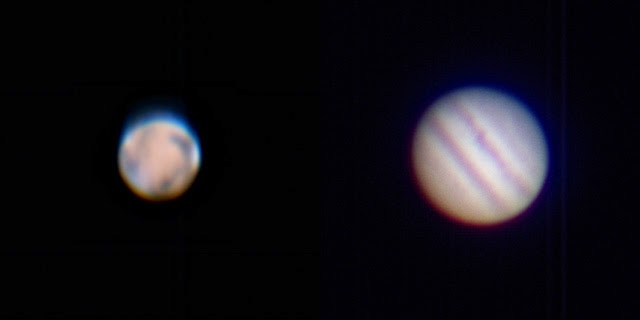
For a rough idea, below are with the astro imaging cam, not DSLR, but gives an example of what you could expect size wise. They are 100% crops. Left is my first and only serious Mars attempt though 6m f/30, and right is Jupiter at 3m f/30 (I was testing out a new scope at the time). That's with 200mm and 100mm aperture optics. If you can go bigger, there is more resolution potential.

Back to DSLR output, I don't think I ever bothered going through processing the moon video I took with the 600D, but I would say the moon would be a better choice to play with in this case.

marsjup-20140414.jpg
 
Upvote 0
1100d is one of the best camera for astro photo, most of astrophotographer using this one, or older like 450D...big pixels and low thermal noise, that s the most important for astro photography.High iso is not that important. the new 7d2 is great too
 
Upvote 0
telemaq76 said:
1100d is one of the best camera for astro photo, most of astrophotographer using this one, or older like 450D...big pixels and low thermal noise, that s the most important for astro photography.High iso is not that important. the new 7d2 is great too

Big pixels are great for deep sky, but useless for planetary photography. Ideally a point grey camera is the way forward for luna and planetary. I use an Atik 383L+ for deep sky, but my 30D outperforms for luna images. Damien Peach uses point grey I think... that's all you need to know.

For planetary on a DSLR there's only one mode you need: RAW video 1x1pixels

You don't want to be using the whole sensor and then saving as low res images, Best will be small pixels and as low a readout noise as possible, then you get the detail required.

Even on my 1500mm fl F5 (12") scope I can get almost the whole moon on the sensor of my 30D, jupiter is less than 1/30th the size of the moon.
 
Upvote 0
PropeNonComposMentis said:
Dont forget safety guys ! For your instruments, I mean.
Dont start with the Moon, you can damage your sensor.
Hi,
Damage your sensor?? What do you mean?? If shooting the video of the Moon using DSLR will damage your sensor, all those mirrorless camera won't exist and nobody will be using a DSLR for video.

Have a nice day.
 
Upvote 0
PropeNonComposMentis said:
Dont forget safety guys ! For your instruments, I mean.
Dont start with the Moon, you can damage your sensor.

Currently using 8" Newt'. 3x8mp CCD's, home-brew Analogue sequencer/sampler. Recording Analogue signal direct to tape.
Comet hunting.

1100D, very good starter.
M31 is best for calibration.

IMO...
Ooops! Clarification - 3 CCD's each 8 megapixels, removed from 3 Canon PowerShot S5's.

I can see a problem with videoing the moon, as you need the lowest ISO and high shutter speed for stills (~1/500, f5, ISO100), but damage? never come across anyone killing their sensor with the moon, the charge per shot is only about 10x full scale at 25fps, so anti-blooming should handle that, but you're not going to see much.
 
Upvote 0
Why video? The 1100D shoots excellent 12mp stills. I love mine and use it everyday even though I own a 60D and a D5300. There's something to that small mp sensor I can't seem to get with the 18mp 60D for some strange reason! So using the photography mode on the 1100D for any purpose is a great start.

So why video? video is fairly limited at 720p (1.2mp). It only produces good looking video when shooting people's faces with shallow DOF where the large s35 sensor gives a lovely background blur coupled with the softening effect of the low resolution image on people's faces. These types of video can look great on the 1100D, similar to any DSLR.

But shooting wide landscapes, detailed shots, cropping, god it's quite a hedious video output in terms of lack of resolution and aliasing/moire. If astrophotograohy requires cropping the 720p video from the 1100D isn't a great option. Shoot in stills mode at 12mp or but a 1200D/600D (which are very near the price point) these will produce a slightly more acceptable resolution at 1080p, not by a great margin, but better.
 
Upvote 0
Ebrahim Saadawi said:
Why video? The 1100D shoots excellent 12mp stills. I love mine and use it everyday even though I own a 60D and a D5300. There's something to that small mp sensor I can't seem to get with the 18mp 60D for some strange reason! So using the photography mode on the 1100D for any purpose is a great start.

So why video? video is fairly limited at 720p (1.2mp). It only produces good looking video when shooting people's faces with shallow DOF where the large s35 sensor gives a lovely background blur coupled with the softening effect of the low resolution image on people's faces. These types of video can look great on the 1100D, similar to any DSLR.

But shooting wide landscapes, detailed shots, cropping, god it's quite a hedious video output in terms of lack of resolution and aliasing/moire. If astrophotograohy requires cropping the 720p video from the 1100D isn't a great option. Shoot in stills mode at 12mp or but a 1200D/600D (which are very near the price point) these will produce a slightly more acceptable resolution at 1080p, not by a great margin, but better.

For planetary work it's best to take a video in RAW format if possible, then stack the best frames, this will have massive SNR, but you need 100% resolution over the area you're working in, no good having the whole frame with low resultion. The huge resulting SNR can then be exhanged for sharpness using wavelets without bringing up visible noise.

For deep sky then a series of stacked stills are the way forward, unless you have an L3 camera with top end QE and near zero readout noise, but their a tad expensive, even for professionals.
 
Upvote 0
So he needs raw video? The 1100D certainly doesn't do that! It's highly h.264 compressed 8bit 4:2:0 720p frames with an actual effective resolution of around SD not HD.

The cheapest raw video solution with an impressive resolving power would be a Blackmagic Pocket Cinema Camera. Would that be good for planetary work?

There's also the option of buying a used Canon 50D and a fast Memory card and shoot Raw with ML. A bit cheaper than the BM but less reliable of course.
 
Upvote 0