1d IV vs. 7D II

I hope that was understandable. I never realize how long these posts are until I've actually posted them. They always end up longer than I expect.

I should caveat my last post with one thing. When I say pixel size doesn't matter, I do mean pretty strictly in context of noise, pixel size doesn't matter much. I don't want anyone to misinterpret that to mean that pixel size doesn't matter at all. On the contrary, pixel size does matter. Depending on what you shoot, it can matter a whole hell of a LOT! Pixel size determines resolving power (spatial resolution). When your photographing landscapes, birds or wildlife at a distance, even sports at a distance, you can always use more pixels. More pixels means more detail.

This should actually give even better context to the reasons why larger total sensor area is important when you are not reach-limited. If you can frame your subjects as you want to frame them, a larger sensor with smaller pixels means the best of both worlds...you can gather more total light, AND you can resolve more detail. There is really nothing wrong with that. Even if we eventually get to the point where sensors are oversampling lenses more often than not (which, unless we eventually see the "average" lens quality equal the quality the Otus delivers at fast apertures (at least f/4, even up to f/2.8), is rather likely), it's actually better to oversample than to undersample.

If we can oversample our images by about two fold at the lens' ideal aperture, then I think we would finally reach a point where AA filters would fundamentally be UNnecessary. The lens would be doing the necessary high frequency blurring for us, there would never be a chance (with the possible exception of the Otus Next :P) that the lens would resolve detail fine enough to create moire patterns and aliasing with the sensor. At that point, it would simply be a matter of practice to always downsample our images by a factor of two (at least, obviously significantly more for publication online) to get the ideal result. In the case of print, sensors with that kind of resolution (and were talking some pretty serious resolution here, 120-150mp FF at least) would be natively producing quality results that don't need to be upscaled (which effectively produces similar results to a sensor that oversamples a lens) unless your printing at some pretty extreme sizes...40x30 or larger (however even then...you wouldn't need to upscale as much, so it's a wash.)
 
Upvote 0
Interesting thread! Loved the unicorn vs dodo and the Holy Grail bits too! LOL

I'm glad this thread was created--kind of read my mind. I would love to pick up a second-hand 1D IV as it fits my "wildlife" photography needs. It would certainly be a massive step up from my 7D. Although I am generally satisfied with the 7D's performance, the better AF of the 1D IV would be a boon. I think it's a relevant comparison between the 1D IV and the rumoured 7D II as both cameras should be similar in price by the time the latter releases. So it's a question of 'bang for the buck.'

I love reading the various opinions in the thread. Personally, I'm still awaiting the 7D II anxiously. Although I don't have any illusions that the 1D IV will outperform it in low light/high ISO, I suspect the 7D II will outperform it from an AF perspective. Although the 1D IV has a great 45 point AF system, the 61 point AF system on the 1DX/5D III appears to have been a quantum leap in accuracy and speed, and I suspect the 7D II will have a variation on that system. That alone makes it worthwhile. And it should match the 10 fps of the 1D IV and may even best it with a 12 FPS burst rate, combined with a deep buffer.

All speculation at this point of course, but speculation based on rumoured prototypes and all very reasonable expectations. On the other hand, if the 7D II fails to materialize or does not have the desirable features we've come to expect.....well, a second hand 1D IV just might find it's way into my pack after all! 8)
 
Upvote 0
expatinasia said:
Kerry B said:
could anybody confirm whether the 1dmk iv will be better than the 7d in terms of overall image quality.

Guys and girls a simple reply would be appreciated without going into the theorem of Pythagoras. I get lost with some of the technical stuff you all come up with.

Simple answer is, yes.

I think Sanj & Expatinasia are Photographers after my own heart.

I agree with both of them, 1DMK IV is a much better all round Camera (at a price) than the 7D (this is the 7D, not the theoretical 7D II that that so many seem to love to waffle about, and that doesn't exist, to my knowledge), so that's a simple Yes.

I base this statement on two very simple principles, I own/owned both, and I use/used both (to be totally honest, I was so disappointed in the IQ of the 7D I gave it to my Brother in Law after 3 months of use, I really don't like my Brother in Law).

The 1DMK IV is still in use.
 
Upvote 0
Another factor no one has mentioned is the lenses used. Small sensors will do comparatively better on great lenses whereas if you compared the 7D with 1DIV using a lens like the tamron 150-600 wide open at 600 or a popular lens like the 24-105 the larger sensor will help more. I know myself how much better my 1DIII performed with the 24-105 compared with my 40D. Both of these are same gen and with the same number of pixels however the 1DIII pictures are noticeable better in most situations, even without pixel peeping.

If you use a fantastic lens like a 300 2.8 II the difference is going to be smaller. The 7DII may indeed be more viable simply because of the quality of the newer canon super teles. Obviously series I super teles weren't bad but still.
 
Upvote 0
Well, in between unicorns and other species I have not been able to nail ... I had the 1DIV ... and the 7D. My wife liked the 7D, so I kept that. But when I got the 1DX, I could not find good cause to keep the 1DIV. But ... after selling the 1DIV, I kept missing the 1.3x-factor. So, today I actually bought a second hand 1DIV. 2k$, 12.000 exposures, mint condition ... Brilliant!

Comparing the 7D and the 1DIV is a Golf GTI vs. Porsche 911 comparison. The 7DII vs. 1DIV ... Well there your guess is as good as mine. But a new Golf GTI will still be a Golf, compared to a 911 ...

I may add that I have also sold the 7D. I was gambling on a 7DII before the summer vacation. Obviously wrong. So this summer my wife will occupy the 5DIII, with accessories. My summer gadget may be the Pentax 645z ... My patience for a high resolution Canon is running thin ...
 
Upvote 0
Eldar said:
Well, in between unicorns and other species I have not been able to nail ... I had the 1DIV ... and the 7D. My wife liked the 7D, so I kept that. But when I got the 1DX, I could not find good cause to keep the 1DIV. But ... after selling the 1DIV, I kept missing the 1.3x-factor. So, today I actually bought a second hand 1DIV. 2k$, 12.000 exposures, mint condition ... Brilliant!

Comparing the 7D and the 1DIV is a Golf GTI vs. Porsche 911 comparison. The 7DII vs. 1DIV ... Well there your guess is as good as mine. But a new Golf GTI will still be a Golf, compared to a 911 ...

I may add that I have also sold the 7D. I was gambling on a 7DII before the summer vacation. Obviously wrong. So this summer my wife will occupy the 5DIII, with accessories. My summer gadget may be the Pentax 645z ... My patience for a high resolution Canon is running thin ...
Just curious:
Why do you miss the crop factor from 1d4 vs 1dx? Will the 1d4 give better Iq in reach limited situations? Even if 1dx is a newer generation sensor.
If so, whats the principle about your claim that 7d cant give better iq than 1d4 in similar situations?
Have you tried to compare a downsampled crop from 1d4 vs 1dx? I woul love to hear about your comparison results!
 
Upvote 0
privatebydesign said:
Pit123 said:
privatebydesign said:
Pit123 said:
You dont get it, do you?

Oh yes, I get it, but you obviously didn't. I am calling you out and asking for actual images of yours that support your theory. And now note you arlimiting the comparison to focal length limited situations, which isn't particularly valid most of the time for most people.

Read my posts again and look forposts where I did not clearly said the example is for reach limited situations.

Read my posts again and show me an example of what you believe you are seeing, that the 7D outperforms the 1D MkIV in focal length limited situations, because the crops of yours I have seen support completely the opposite.

http://www.canonrumors.com/forum/index.php?topic=18368.msg342370#msg342370
Nice, you found this example.
On my monitor, this iso 1600 example shows more details on the 7d. Especial when you look at the hair section in the lower part of the image. To bad the images we can post here is very compressed. On the original it is easier to see the difference. Anyhow, on iso 1600 they have very similar iq. On lower iso 7d is better. Above somewhere between 1600 and 3200 1d4 will be better.
I am not on my computer these days, but next week I can show similar crops with 1d4/1000mmf8 vs 7d/700mmf5.6 if anyone is interested. I claim 7d to give better iq performance here as well ( in reach limited situations).
 
Upvote 0
Pit123 said:
Eldar said:
Well, in between unicorns and other species I have not been able to nail ... I had the 1DIV ... and the 7D. My wife liked the 7D, so I kept that. But when I got the 1DX, I could not find good cause to keep the 1DIV. But ... after selling the 1DIV, I kept missing the 1.3x-factor. So, today I actually bought a second hand 1DIV. 2k$, 12.000 exposures, mint condition ... Brilliant!

Comparing the 7D and the 1DIV is a Golf GTI vs. Porsche 911 comparison. The 7DII vs. 1DIV ... Well there your guess is as good as mine. But a new Golf GTI will still be a Golf, compared to a 911 ...

I may add that I have also sold the 7D. I was gambling on a 7DII before the summer vacation. Obviously wrong. So this summer my wife will occupy the 5DIII, with accessories. My summer gadget may be the Pentax 645z ... My patience for a high resolution Canon is running thin ...
Just curious:
Why do you miss the crop factor from 1d4 vs 1dx? Will the 1d4 give better Iq in reach limited situations? Even if 1dx is a newer generation sensor.
If so, whats the principle about your claim that 7d cant give better iq than 1d4 in similar situations?
Have you tried to compare a downsampled crop from 1d4 vs 1dx? I woul love to hear about your comparison results!
Without getting into a long argument, I have a few that matters to me.

First is that I wanted an extra body, to avoid swapping lenses on my 1DX.

Second is that the quality and functionality of the 1-series bodies, which is far superior to the others, including 5DIII and 7D. And $2k for a mint condition 1DIV is, in my view, a bargain.

Third, when shooting birds with the long whites (600mm + extender), a crop sensor gives you that extra reach, which is something I like, not because it gives me higher IQ in the end, but because it makes it easier to nail focus on small subjects in a forrest area etc, simply because I see them better. I also get that extra reach with my 200-400 f4L IS 1.4x, which is very convenient on trips where I cannot carry everything. But again the reason is to improve my ability to shoot in focus, not for IQ.

Comparing the 1DIV to the 7D, other than the 1D-body vs. 7D-body, I find IQ better on the 1DIV. The AF system is better and low ISO performance is better. It also provides a higher fps, which I really like. The 7D does have even better reach, but I don´t find that it gives me anything, since the AF system on the 1DIV is sufficiently better.

Comparing the 1DIV to the 1DX is not really a fair comparison, because the 1DX outperforms the 1DIV in everything but crop-factor (well actually it does, because it´s FF, but in this case I want reach). When subjects are clearly isolated from their surroundings, so I don´t need the extra reach to focus properly, a cropped 1DX image will, according to what I have read in a lot of places (and I don´t doubt), outperforms a 1DIV shot. If I could have justified it, I would have bought a second 1DX instead.

When the 7DII comes out, I´m hoping they will equip it with a top notch AF system. if they do, the 1.6x crop factor, probably higher resolution (low twenties), with improved IQ and acceptable fps, will definitely motivate me to get one. A 7DII, 300mm f2.8L IS II, with 1.4xIII and 2xIII extenders will be a very handy package for long hikes.

I doubt that I would have bought the 1DIV today, if the 7DII had been out.
 
Upvote 0
Eldar said:
Pit123 said:
Eldar said:
Well, in between unicorns and other species I have not been able to nail ... I had the 1DIV ... and the 7D. My wife liked the 7D, so I kept that. But when I got the 1DX, I could not find good cause to keep the 1DIV. But ... after selling the 1DIV, I kept missing the 1.3x-factor. So, today I actually bought a second hand 1DIV. 2k$, 12.000 exposures, mint condition ... Brilliant!

Comparing the 7D and the 1DIV is a Golf GTI vs. Porsche 911 comparison. The 7DII vs. 1DIV ... Well there your guess is as good as mine. But a new Golf GTI will still be a Golf, compared to a 911 ...

I may add that I have also sold the 7D. I was gambling on a 7DII befojre the summer vacation. Obviously wrong. So this summer my wife will occupy the 5DIII, with accessories. My summer gadget may be the Pentax 645z ... My patience for a high resolution Canon is running thin ...
Just curious:
Why do you miss the crop factor from 1d4 vs 1dx? Will the 1d4 give better Iq in reach limited situations? Even if 1dx is a newer generation sensor.
If so, whats the principle about your claim that 7d cant give better iq than 1d4 in similar situations?
Have you tried to compare a downsampled crop from 1d4 vs 1dx? I woul love to hear about your comparison results!
Without getting into a long argument, I have a few that matters to me.

First is that I wanted an extra body, to avoid swapping lenses on my 1DX.

Second is that the quality and functionality of the 1-series bodies, which is far superior to the others, including 5DIII and 7D. And $2k for a mint condition 1DIV is, in my view, a bargain.

Third, when shooting birds with the long whites (600mm + extender), a crop sensor gives you that extra reach, which is something I like, not because it gives me higher IQ in the end, but because it makes it easier to nail focus on small subjects in a forrest area etc, simply because I see them better. I also get that extra reach with my 200-400 f4L IS 1.4x, which is very convenient on trips where I cannot carry everything. But again the reason is to improve my ability to shoot in focus, not for IQ.

Comparing the 1DIV to the 7D, other than the 1D-body vs. 7D-body, I find IQ better on the 1DIV. The AF system is better and low ISO performance is better. It also provides a higher fps, which I really like. The 7D does have even better reach, but I don´t find that it gives me anything, since the AF system on the 1DIV is sufficiently better.

Comparing the 1DIV to the 1DX is not really a fair comparison, because the 1DX outperforms the 1DIV in everything but crop-factor (well actually it does, because it´s FF, but in this case I want reach). When subjects are clearly isolated from their surroundings, so I don´t need the extra reach to focus properly, a cropped 1DX image will, according to what I have read in a lot of places (and I don´t doubt), outperforms a 1DIV shot. If I could have justified it, I would have bought a second 1DX instead.

When the 7DII comes out, I´m hoping they will equip it with a top notch AF system. if they do, the 1.6x crop factor, probably higher resolution (low twenties), with improved IQ and acceptable fps, will definitely motivate me to get one. A 7DII, 300mm f2.8L IS II, with 1.4xIII and 2xIII extenders will be a very handy package for long hikes.

I doubt that I would have bought the 1DIV today, if the 7DII had been out.
Thanks for your answer!
Love to hear experiences like this. i think a lot depends on subjective shooting style. I, for example find the AF on 7D to be very reliable, especial on static subject, even compared to 1d4. Because 7d has spot focus and 1d4 not. its much easier to nail focus on a bird between branches with the 7d. I think many of the af problems people claim with 7d is because it doesnt work very well Out of the box. You have to customize the settings and then program 3 typical shooting style to the 3 custom settings. That is something I do miss with my 1d4.
Another thing with 7d is that I had to microadjust all of my lens/tc combinations. On the 1d4, every combination works perfect without MA, so far.
Its interesting you find its easier to nail focus with 1d4 than with 1dx due to the crop factor. Despite the spot focus and larger viewfinder on 1dx. Is the subject really that much larger on 1d4 than in the 1dx? I'm asking because I dont see any significant difference on subject size between 7d and 1d4 viewfinder.
I have never seen anyone show crop comparisons between 1d4 and 1dx for reach limited situations. You indicate that the crops from 1dx would be better, but I just cant understand why. They have the same mp? and if so, 1d4 produce a lot more ( 1,3^2 ) pixels on subject. After downsample I would guess the 1d4, would be best. (At least on isos below xxxx).
if you can show otherwise, then maybe 1dx should be my next purchase. I would love a really silent shutter mode, ev comp in auto iso, and the high iso/FF advantages, as on 1dx, if Im not loosing any crop advantages.
I do most of my shooting in reach limited situations, hence prefer the body with best IQ after cropping vs other parameters, as long as other parameters ( af, fps, built , etc) is "good enaough". If that would be 1dx, as you indicate, than im in. So please post some examples!
 
Upvote 0
Don Haines said:
Crop cameras put more pixels on the target. FF cameras have better quality pixels. Which one is better depends on your needs.
Exactly! And more pixels on the subject is normally best (IMO) if you downsize the higher pixel image to show the same subject size as the bigger pixel camera. Up until iso xxxx.
And so far I havent seen anything that can prove otherwise. But I would love to see if I' m wrong, because I do see the advantage of a larger sensor when no cropping is needed.
But as far as I (almost) always need to crop, higher pixel density is better for IQ. (Under iso 2000)
And thats way I really look forward to a high pixel 7d2. I would be happy if the sensor performance is equal to the 24 mp Nikon d7100.
 
Upvote 0
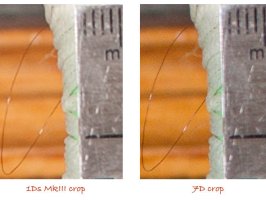
I have shown this example of mine many times before, it is pretty out of date now but the comparison for same generation sensors holds good.

It is an artificially set up situation to maximise the advantage of the smaller camera with higher pixel density, my cameras were a 7D and a 1Ds MkIII.

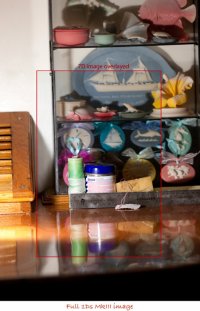
The shots were live view manually focused, mirror lock up, cable release, very heavy tripod, remote flash, 200iso 300 f2.8 IS at f5.6 and 1/200 sec so the only light is a low powered very high speed flash burst.

This is the biggest difference you could ever expect to see in an image, it is unattainable in real world shooting as the vagaries and inconsistencies of AF make a much bigger difference to the IQ of the images.

The 7D is putting over twice the "pixels on duck" as the 1Ds MkIII, but the resolution difference is just not there, the 7D does have a fraction more detail, but if you take the noise out (remember this is 200 iso) it ends up being even closer.

The 1Ds MkIII was upsampled to the same pixel numbers as the 7D and the 7D is a 150% crop.

Now, in my opinion, there are very good reasons for using a crop camera over a ff one in focal length limited situations, things like subject framing, cost, size and weight, AF etc, but additional detail, even at low iso, is not a convincing one.
 

Attachments

  • 1.jpg
    1.jpg
    117.9 KB · Views: 237
  • 2.jpg
    2.jpg
    88.9 KB · Views: 268
Upvote 0
privatebydesign said:
I have shown this example of mine many times before, it is pretty out of date now but the comparison for same generation sensors holds good.

It is an artificially set up situation to maximise the advantage of the smaller camera with higher pixel density, my cameras were a 7D and a 1Ds MkIII.

The shots were live view manually focused, mirror lock up, cable release, very heavy tripod, remote flash, 200iso 300 f2.8 IS at f5.6 and 1/200 sec so the only light is a low powered very high speed flash burst.

This is the biggest difference you could ever expect to see in an image, it is unattainable in real world shooting as the vagaries and inconsistencies of AF make a much bigger difference to the IQ of the images.

The 7D is putting over twice the "pixels on duck" as the 1Ds MkIII, but the resolution difference is just not there, the 7D does have a fraction more detail, but if you take the noise out (remember this is 200 iso) it ends up being even closer.

The 1Ds MkIII was upsampled to the same pixel numbers as the 7D and the 7D is a 150% crop.

Now, in my opinion, there are very good reasons for using a crop camera over a ff one in focal length limited situations, things like subject framing, cost, size and weight, AF etc, but additional detail, even at low iso, is not a convincing one.
Interesting!
 
Upvote 0
privatebydesign said:
I have shown this example of mine many times before, it is pretty out of date now but the comparison for same generation sensors holds good.

It is an artificially set up situation to maximise the advantage of the smaller camera with higher pixel density, my cameras were a 7D and a 1Ds MkIII.

The shots were live view manually focused, mirror lock up, cable release, very heavy tripod, remote flash, 200iso 300 f2.8 IS at f5.6 and 1/200 sec so the only light is a low powered very high speed flash burst.

This is the biggest difference you could ever expect to see in an image, it is unattainable in real world shooting as the vagaries and inconsistencies of AF make a much bigger difference to the IQ of the images.

The 7D is putting over twice the "pixels on duck" as the 1Ds MkIII, but the resolution difference is just not there, the 7D does have a fraction more detail, but if you take the noise out (remember this is 200 iso) it ends up being even closer.

The 1Ds MkIII was upsampled to the same pixel numbers as the 7D and the 7D is a 150% crop.

Now, in my opinion, there are very good reasons for using a crop camera over a ff one in focal length limited situations, things like subject framing, cost, size and weight, AF etc, but additional detail, even at low iso, is not a convincing one.
Thanks for showing! I can only see your example on my ipad, but for me its quite clear, even on these low res images, that the 18 mp 7d shows more details than the 21mp FF camera.
Its even bigger difference in your example than a typical comparison between an upsampled image without using tc vs an image with same lens/body with a 1.4x tc.

I think a comparison 1d4 vs 1dx would give quite similar results in the favour of 1d4. Maybe I'm wrong?
 
Upvote 0
Pit123 said:
privatebydesign said:
I have shown this example of mine many times before, it is pretty out of date now but the comparison for same generation sensors holds good.

It is an artificially set up situation to maximise the advantage of the smaller camera with higher pixel density, my cameras were a 7D and a 1Ds MkIII.

The shots were live view manually focused, mirror lock up, cable release, very heavy tripod, remote flash, 200iso 300 f2.8 IS at f5.6 and 1/200 sec so the only light is a low powered very high speed flash burst.

This is the biggest difference you could ever expect to see in an image, it is unattainable in real world shooting as the vagaries and inconsistencies of AF make a much bigger difference to the IQ of the images.

The 7D is putting over twice the "pixels on duck" as the 1Ds MkIII, but the resolution difference is just not there, the 7D does have a fraction more detail, but if you take the noise out (remember this is 200 iso) it ends up being even closer.

The 1Ds MkIII was upsampled to the same pixel numbers as the 7D and the 7D is a 150% crop.

Now, in my opinion, there are very good reasons for using a crop camera over a ff one in focal length limited situations, things like subject framing, cost, size and weight, AF etc, but additional detail, even at low iso, is not a convincing one.
Thanks for showing! I can only see your example on my ipad, but for me its quite clear, even on these low res images, that the 18 mp 7d shows more details than the 21mp FF camera.
Its even bigger difference in your example than a typical comparison between an upsampled image without using tc vs an image with same lens/body with a 1.4x tc.

I think a comparison 1d4 vs 1dx would give quite similar results in the favour of 1d4. Maybe I'm wrong?

Private has shared this image before. I've also said this before. I agree with Pit here, that the 7D definitely shows a marked improvement in resolution. It isn't marginal and therefor meaningless...it is very obvious. You don't even need to overlay the 7D image on top of the 1Ds III image and flip back and forth to see the difference, the 7D CLEARLY has sharper detail here. It also has more noise, but the noise in smoother backgrounds isn't as much of a problem in the detail areas.

I don't know why this comparison, which clearly gives the edge to the 7D, is always downplayed as showing that the 7D doesn't "really" have an advantage...it does. And that is WITH the 7D's relatively strong AA filter by todays standards. A 7D II with 20-24mp and a weaker AA filter would walk all over the 1Ds III, and would probably walk all over the D800 for detail in a reach-limited scenario. This example is the perfect example of why cameras like the 7D can be quite valuable and useful...when your limited in terms of the longest lenses you can use, and limited in how close you can get, smaller pixels are going to have the edge (even DESPITE the potential for higher noise.)

Now, if Private would reproduce this sample by framing the same with both cameras, then the greater pixel count and greater sensor area of the 1Ds III would trounce the 7D into oblivion, no question.
 
Upvote 0
"I don't know why this comparison, which clearly gives the edge to the 7D, is always downplayed as showing that the 7D doesn't "really" have an advantage...it does."

That is because you like being obtuse and ignoring all the other factors that go into making an image in the real world. You might like to say "the 7D definitely shows a marked improvement in resolution." but it doesn't show anything like the difference all you "more pixels on target" guys always hypothesis about, the difference is small, these are massive crops, the whole setup was artificially created to maximise the crop sensor advantage and, you will never attain that level of detail in real world shooting situations. If you ignore all that it is easy to say the 7D is substantially better, if you accept these conditions are not attainable in the real world and the small difference is easily eaten up by AF inconsistencies, lower contrast, higher iso, less stability etc etc then you would see the example as most practical people, and those who have owned both, do, the difference is marginal in optimal artificial conditions. That doesn't mean there is no reason to shoot with a crop camera, just that the difference in resolution between real world images of cropped ff images and images from a crop camera of the same generation are not compelling in themselves. I only did the tests because I wanted an excuse to buy a 7D, but realised for me there was no point.

But don't take my word for it, there are countless people who had 5D MkII's and 7D's out there that will tell you the same thing, Neuoanatomist is one, so was the complete pixel on target theoretician AlanF, until he got a FF camera.
 
Upvote 0
privatebydesign said:
"I don't know why this comparison, which clearly gives the edge to the 7D, is always downplayed as showing that the 7D doesn't "really" have an advantage...it does."

That is because you like being obtuse and ignoring all the other factors that go into making an image in the real world. You might like to say "the 7D definitely shows a marked improvement in resolution." but it doesn't show anything like the difference all you "more pixels on target" guys always hypothesis about, the difference is small, these are massive crops, the whole setup was artificially created to maximise the crop sensor advantage and, you will never attain that level of detail in real world shooting situations. If you ignore all that it is easy to say the 7D is substantially better, if you accept these conditions are not attainable in the real world and the small difference is easily eaten up by AF inconsistencies, lower contrast, higher iso, less stability etc etc then you would see the example as most practical people, and those who have owned both, do, the difference is marginal in optimal artificial conditions. That doesn't mean there is no reason to shoot with a crop camera, just that the difference in resolution between real world images of cropped ff images and images from a crop camera of the same generation are not compelling in themselves. I only did the tests because I wanted an excuse to buy a 7D, but realised for me there was no point.

But don't take my word for it, there are countless people who had 5D MkII's and 7D's out there that will tell you the same thing, Neuoanatomist is one, so was the complete pixel on target theoretician AlanF, until he got a FF camera.

I think what you may be failing to account for is that photographers often find a way of negating, at least partially, the reach issues when using FF cameras. If we just use bird photography as an example case, as I think that is most often the use case for the Canon 7D and 400mm lenses. A lot of the people who buy a 7D and a 400mm lens (or the 100-400mm zoom) are those who are just starting out, don't really have the option of spending the kind of money necessary on FF and longer lenses (either a 300/2.8 + TCs or a 600/4). They are the most reach handicapped.

One does not remain at a reach disadvantage forever, though. With time comes skill, and eventually most novice bird photographers learn how to get closer (just take a look at Jack in the bird photography forum here to see an example of a guy who took some advice to heart, and is now hardly reach limited at all for most of his work). Once you learn to get closer, you both learn how to maximize the potential of your existing gear, and develop a need for better gear. If you really stick with it and hone the skill of getting close, you can, with care, completely eliminate the reach handicap with FF and a 400mm lens (it isn't easy, it definitely takes skill, and a lot of pro photographers prefer not to get that close as it is generally disruptive to the birds, runs the high risk of scaring off whole flocks, which in turn can be disruptive to other bird photographers....so most stick with much longer lenses...600mm, 800/840mm, 1200mm.)

Neuro is an accomplished photographer. He has the skill to maximize the potential of a full frame camera. He is obviously not one of the reach handicapped, and is also therefor not one of the people who the 7D line is marketed to. That does not, however, mean that there is no market for the 7D line at all. The 6D isn't exactly an alternative for beginner birders or wildlife photographers...it has a slower frame rate (and if the rumors end up true, much slower), and it's larger frame puts them at an even greater disadvantage. The Tamron 150-600 will certainly make the 6D a more viable wildlife and birding camera, however there is still a lot of value in the intrinsic reach of the 7D II and the potential 10fps frame rate.

Plus, at 24mp, it would offer an even better resolution advantage over the 7D. The 7D, as much as you try to downplay it's resolution advantage, is definitely resolving more detail in your comparison images. The 7D II would resolve another 30% more on top of that. The 5D III is a mere 5.7% improvement over the 5D II, and the 1D X is, from a resolution standpoint, a step back (this effectively necessitating the use of great white lenses to maximize it's potential.)

I have no question the 7D II will offer a significant reach benefit. It'll be an excellent camera for biginner bird photographers, it'll be a great option for beginning wildlifers (especially those who want to photograph wildlife in action), although those who shoot after sunset and don't care as much about action could probably do quite well with a 6D.

The advantages of full frame sensors are clear, there is no question about that and I do not deny that. But I think it's unfair to make the ASSUMPTION that you cannot realize the advantages of a high resolution crop sensor in the field. The resolution advantage of the 7D is fully realizable in the field, even with the relatively lowly 100-400mm lens, if you have the skill. Some professional bird photographers have used nothing but the 7D and 100-400mm lens for all of their work, and it's stellar work, too. There are advantages on both sides. FF may have more, but that does not mean that APS-C has none. I am also clearly not the only one who sees the resolution advantage that the 7D has, either. Bird photography is also not the only form of photography where APS-C can be useful, still scene photography is not the only way one can realize the full potential of smaller APS-C pixels.

I'm trying to be objective, give credit where it's due, and having used the 7D for years now, I know full well what it is capable of (and what it is NOT capable of, and where FF is clearly better.) I'm also well beyond reaching the limits of what the 7D can do. I have a hell of a lot more skill now than when I first picked up a 7D. Back then, I had no ability to get close to birds, APS-C was essential. Today I can easily get close, and half the time the birds come right to me when I'm properly hidden. I'll be another one of the people joining the FF camera ranks soon enough here, but that isn't going to give me reason to suddenly ignore the advantages of APS-C, nor forget that there is a prime target market for the 7D line of cameras (one of which is as a backup camera for FF 1D X and 5D III and maybe even 6D users.)

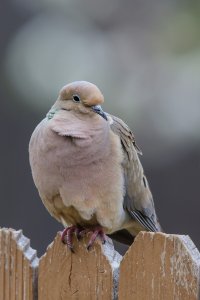
Just as an example, here is a photo I took recently in a reach-limited capacity. My hard is currently home to at least four Mourning Dove couples. They are quite happy to hang out and munch down on my bird seed if I'm out there, so long as they know I'm out there, but they still seem to be camera shy, so I have to hide to photograph them. That usually means setting up behind one of the corners of my house, or hiding inside and poking my lens out my sliding glass door. I don't have the option of getting closer. This photo shows off how sharp a 7D can really get, and if I'd used a 5D III, 6D, or 1D X, I'd have been putting fewer pixels on the subject. This is the exact reason I'd get a 7D II, as a reach-limited backup camera to a 5D III or 1D X:
 

Attachments

  • Another Dove  (1 of 1).jpg
    Another Dove (1 of 1).jpg
    265.2 KB · Views: 402
Upvote 0
jrista said:
privatebydesign said:
"I don't know why this comparison, which clearly gives the edge to the 7D, is always downplayed as showing that the 7D doesn't "really" have an advantage...it does."

That is because you like being obtuse and ignoring all the other factors that go into making an image in the real world. You might like to say "the 7D definitely shows a marked improvement in resolution." but it doesn't show anything like the difference all you "more pixels on target" guys always hypothesis about, the difference is small, these are massive crops, the whole setup was artificially created to maximise the crop sensor advantage and, you will never attain that level of detail in real world shooting situations. If you ignore all that it is easy to say the 7D is substantially better, if you accept these conditions are not attainable in the real world and the small difference is easily eaten up by AF inconsistencies, lower contrast, higher iso, less stability etc etc then you would see the example as most practical people, and those who have owned both, do, the difference is marginal in optimal artificial conditions. That doesn't mean there is no reason to shoot with a crop camera, just that the difference in resolution between real world images of cropped ff images and images from a crop camera of the same generation are not compelling in themselves. I only did the tests because I wanted an excuse to buy a 7D, but realised for me there was no point.

But don't take my word for it, there are countless people who had 5D MkII's and 7D's out there that will tell you the same thing, Neuoanatomist is one, so was the complete pixel on target theoretician AlanF, until he got a FF camera.

I think what you may be failing to account for is that photographers often find a way of negating, at least partially, the reach issues when using FF cameras. If we just use bird photography as an example case, as I think that is most often the use case for the Canon 7D and 400mm lenses. A lot of the people who buy a 7D and a 400mm lens (or the 100-400mm zoom) are those who are just starting out, don't really have the option of spending the kind of money necessary on FF and longer lenses (either a 300/2.8 + TCs or a 600/4). They are the most reach handicapped.

One does not remain at a reach disadvantage forever, though. With time comes skill, and eventually most novice bird photographers learn how to get closer (just take a look at Jack in the bird photography forum here to see an example of a guy who took some advice to heart, and is now hardly reach limited at all for most of his work). Once you learn to get closer, you both learn how to maximize the potential of your existing gear, and develop a need for better gear. If you really stick with it and hone the skill of getting close, you can, with care, completely eliminate the reach handicap with FF and a 400mm lens (it isn't easy, it definitely takes skill, and a lot of pro photographers prefer not to get that close as it is generally disruptive to the birds, runs the high risk of scaring off whole flocks, which in turn can be disruptive to other bird photographers....so most stick with much longer lenses...600mm, 800/840mm, 1200mm.)

Neuro is an accomplished photographer. He has the skill to maximize the potential of a full frame camera. He is obviously not one of the reach handicapped, and is also therefor not one of the people who the 7D line is marketed to. That does not, however, mean that there is no market for the 7D line at all. The 6D isn't exactly an alternative for beginner birders or wildlife photographers...it has a slower frame rate (and if the rumors end up true, much slower), and it's larger frame puts them at an even greater disadvantage. The Tamron 150-600 will certainly make the 6D a more viable wildlife and birding camera, however there is still a lot of value in the intrinsic reach of the 7D II and the potential 10fps frame rate.

Plus, at 24mp, it would offer an even better resolution advantage over the 7D. The 7D, as much as you try to downplay it's resolution advantage, is definitely resolving more detail in your comparison images. The 7D II would resolve another 30% more on top of that. The 5D III is a mere 5.7% improvement over the 5D II, and the 1D X is, from a resolution standpoint, a step back (this effectively necessitating the use of great white lenses to maximize it's potential.)

I have no question the 7D II will offer a significant reach benefit. It'll be an excellent camera for biginner bird photographers, it'll be a great option for beginning wildlifers (especially those who want to photograph wildlife in action), although those who shoot after sunset and don't care as much about action could probably do quite well with a 6D.

The advantages of full frame sensors are clear, there is no question about that and I do not deny that. But I think it's unfair to make the ASSUMPTION that you cannot realize the advantages of a high resolution crop sensor in the field. The resolution advantage of the 7D is fully realizable in the field, even with the relatively lowly 100-400mm lens, if you have the skill. Some professional bird photographers have used nothing but the 7D and 100-400mm lens for all of their work, and it's stellar work, too. There are advantages on both sides. FF may have more, but that does not mean that APS-C has none. I am also clearly not the only one who sees the resolution advantage that the 7D has, either. Bird photography is also not the only form of photography where APS-C can be useful, still scene photography is not the only way one can realize the full potential of smaller APS-C pixels.

I'm trying to be objective, give credit where it's due, and having used the 7D for years now, I know full well what it is capable of (and what it is NOT capable of, and where FF is clearly better.) I'm also well beyond reaching the limits of what the 7D can do. I have a hell of a lot more skill now than when I first picked up a 7D. Back then, I had no ability to get close to birds, APS-C was essential. Today I can easily get close, and half the time the birds come right to me when I'm properly hidden. I'll be another one of the people joining the FF camera ranks soon enough here, but that isn't going to give me reason to suddenly ignore the advantages of APS-C, nor forget that there is a prime target market for the 7D line of cameras (one of which is as a backup camera for FF 1D X and 5D III and maybe even 6D users.)

Just as an example, here is a photo I took recently in a reach-limited capacity. My hard is currently home to at least four Mourning Dove couples. They are quite happy to hang out and munch down on my bird seed if I'm out there, so long as they know I'm out there, but they still seem to be camera shy, so I have to hide to photograph them. That usually means setting up behind one of the corners of my house, or hiding inside and poking my lens out my sliding glass door. I don't have the option of getting closer. This photo shows off how sharp a 7D can really get, and if I'd used a 5D III, 6D, or 1D X, I'd have been putting fewer pixels on the subject. This is the exact reason I'd get a 7D II, as a reach-limited backup camera to a 5D III or 1D X:

Look, I was addressing one very specific point, the difference between a crop camera image with much higher pixel density and a cropped ff image with much fewer pixels, that was all. I wasn't addressing peoples ability to learn, peoples ability to buy bigger, better and, more expensive gear, or their ability to maximise the IQ from the gear they have. I have never suggested for one second the 7D and 100-400 are incapable of making superb images that have very high IQ and tons of resolution, indeed in one thread I specifically linked to 15 or so 7D images of birds shot in the wild at 800iso and above with superb results.

The difference between my point of view, and all the "pixels on target" hypothesists is that my opinion was derived from actual images. As I have said many times the crops I show are artificially set up to maximise the crop camera advantage, that doesn't mean people can't get the best out of the 7D and a 400mm lens, that means this is the best a 7D and a 300 f2.8 IS can do, ever, and it isn't much better even in artificial situations than a ff camera cropped to the same size. I have also said many times times that the real world shooting examples I took at the same time in my testing, whilst not valid for forum comparison, demonstrated that the small differences are not realisable in real world shooting.

Yet again, my claim/point of view is very specific and it "doesn't mean there is no reason to shoot with a crop camera, just that the difference in resolution between real world images of cropped ff images and images from a crop camera of the same generation are not compelling in themselves." And this has been demonstrated at every generation of comparable sensors so far.
 
Upvote 0
privatebydesign said:
Look, I was addressing one very specific point, the difference between a crop camera image with much higher pixel density and a cropped ff image with much fewer pixels, that was all. I wasn't addressing peoples ability to learn, peoples ability to buy bigger, better and, more expensive gear, or their ability to maximise the IQ from the gear they have.

If you were solely addressing the IQ difference, then the data leads to only one simple conclusion: The 7D offers a measurable, visible improvement in sharpness in reach-limited scenarios.

The reason I counter you is because you stated this:

" if you accept these conditions are not attainable in the real world"

and:

"That is because you like being obtuse and ignoring all the other factors that go into making an image in the real world."

You are clearly making the argument that it is impossible to realize the full potential of the 7D in the real world. You stated such quite clearly with the words "are not attainable"...hard to misinterpret that. I posted a real world example of a CRITICALLY SHARP (sharpest possible) image taken with the 7D. It was the best frame out of about 12, slightly over one second of continuous shooting. From a technique standpoint, I wouldn't have done anything differently if I had the 1D X in my hands...I shoot short bursts, as is the recommended best practice, and pick the best frame. Even if there are more frames that are better with the 1D X, the same technique is used, and I would still have picked the best out of 14-16 frames. It's how you achieve critical sharpness in the field, regardless of which camera you are using.

Here is an example of comparable sharpness differences between the 7D, 5D III, and 1D X assuming you achieved critical sharpness (same image resampled to simulate the various pixel sizes of each camera; 7D versions are 1:1 full size crops, no scaling; note: Noise not indicative of real-world noise, as this was saved as s limited-palette GIF for animation purposes):

Yc683nN.gif


Assuming you achieve the BEST focus with all three cameras from the exact same location (which IS an attainable goal, regardless of whether you are using the 61pt or 19pt AF systems), with the exact same lens, on the exact same tripod, that eliminates all the other variables except two: pixel size (primarily) and AA filter strength (a very distant second, although any AA filter at all is going to be additive on top of the differences in pixel size, it cannot make bigger pixels better than their size would dictate).


One other thing I'd like to point out. The differences in sharpness between one generation of sensors and the next is never very large. The difference between the 7D and the 70D, for example, is much less than the difference between the 7D and the 5D III or 1D X. The difference between the 5D III and the 5D II is also much smaller than the difference between the 7D and either the 5D III or 1D X. These "small" and "meaningless" differences in sharpness are what we all scramble about spending thousands of dollars for in the first place! :P The 5D III was about a 5% improvement in spatial resolution over the 5D II, but the 7D is a 111% improvement in spatial resolution.! :o The difference in spatial resolution between the 5D III and D800 is 63%. The difference between the 1D X and 5D III is 24%. The 7D still has a 30% advantage over the D800 (although that's going to be hard to see in a side-by-side comparison)! :P 8) Even when you throw in the 7D's "strong" AA filter (which really isn't too strong, it's just right), it STILL has a greater resolution edge over all of Canon's Full Frame alternatives.

I just thought I would clarify why I think it is important not to underestimate the advantage of smaller pixels in reach-limited scenarios. We all strive for more resolution, for that last minute little improvement that gives our photography the edge. It doesn't even matter if it is the sensor, or some other aspect of the camera that improves our IQ, from generation to generation, the actual measurable differences are not huge by any means. Canon's 61pt AF system is about 35-45% better than the 45pt system they used in the 1D IV (which was a pretty massive improvement over the 1D III, however the 1D III had some pretty major and persistent firmware bugs that crippled the system, which would have otherwise been excellent.) A majority of photographers are pixel peepers at one point or another...even the pros are (just dig into a few pro sports and wildlife/bird photographer blogs, and see how often they post 100% crops to show off their low noise at ISO 51200, or examine sharpness, or something else like that.) As much as I know my images are primarily published to the web, and most frequently at around 1200px on the long edge (over a 4x downsample), even the web is becoming more demanding. I've started uploading my photos to 500px at 1920x1200. In a couple of years time, I suspect I'll start uploading "High DPI/4k Ready" images at 3480x2400. Every little bit counts. It's what we spend thousands of dollars for. If you don't have the budget for high frame rate FF or the lenses to maximize it's potential, higher resolution APS-C parts are going to become increasingly valuable (and the differences in spatial resolution with APS-C pixel sizes, even with strong AA filters, is a lot more than most of the differences between full frame options themselves, even across generations.)
 
Upvote 0