1Dx M2 Sensor Resolution - Back of envelop estimate

filluppa said:
neuroanatomist said:
filluppa said:
neuroanatomist said:
filluppa said:
the noise is lower at higher iso, higher iso means not more noise. as you can se below, but the signal decreases
so it is wrong to suggest that noise increases with higher ISO

It is wrong to suggest that read noise is the only component of image noise.

Do you know why a scene shot at ISO 100 that yields a 24 MB file yields a file that's 75% larger (41 MB) when shot at ISO 204800? The short answer is more noise. The long answer is...also more noise, albeit with more details and explanation because it's the long answer.

no
the short answer is more amplification of a given signal,and a different signal/noise ration the noise does not increase with higher iso

Oh, I see. So, more amplification of something does not mean more ... So, (5 x 25600 widgets) is not more than (5 x 100 widgets). Yeah, that makes so much sense it must be true.

An image shot at higher ISO has more noise that the same image shot at lower ISO. You can continue to disagree, but you'll only make yourself look foolish (as usual...at least until you disappear again).

Just don't fall into the trap of saying the noise increases with less light= higher iso.

The noise is lower with less light, but the noise-to-signal ratio gets higher.

I haven't fallen into any traps, thanks. But then, I'm not the one claiming an image at higher ISO has less noise than at lower ISO...that's you, bub.
giphy.gif
 
Upvote 0
filluppa said:
If you do not understand the concept of signal and noise and that noise does not increases at higher ISO there is no point of discussing the question more

You are correct about one thing - there's no point in further discussion with someone who does not comprehend the simple fact that image noise increases with increasing ISO. Perhaps once you learn some basic facts you can try again.

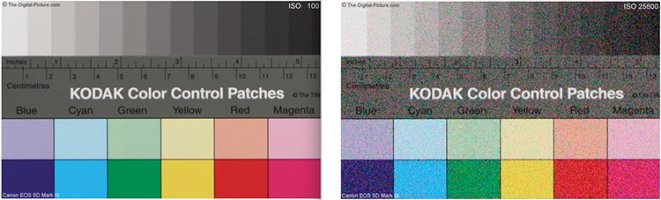
Use your eyes, really it's not all that challenging. If you think the image on the right has less noise, see an ophthalmologist, or better yet visit a psychiatrist (since an ophthamologist could not fix the underlying problem and you could not see one in any case).
 

Attachments

  • Noise.jpg
    Noise.jpg
    196.3 KB · Views: 169
Upvote 0
filluppa said:
If you do not understand the concept of signal and noise and that noise does not increases at higher ISO there is no point of discussing the question more

You wrote earlier,
Higher ISO means more noise which means larger files. From TDP, a studio scene that yields a 24 MB file at ISO 100 is 32 MB at ISO 25600 and 37 MB at ISO 102400.

I believe one of you is talking about noise before amplification, the other after (i.e. what's in the actual image.)
 
Upvote 0
neuroanatomist said:
filluppa said:
If you do not understand the concept of signal and noise and that noise does not increases at higher ISO there is no point of discussing the question more

You are correct about one thing - there's no point in further discussion with someone who does not comprehend the simple fact that image noise increases with increasing ISO. Perhaps once you learn some basic facts you can try again.

Use your eyes, really it's not all that challenging. If you think the image on the right has less noise, see an ophthalmologist, or better yet visit a psychiatrist (since an ophthamologist could not fix the underlying problem and you could not see one in any case).

Neuro, test shots like that are just there to trick people. The ISO 100 shot has received more light, so that clearly skews the result. No self respecting photographer would ever dream of shooting at higher ISO to compensate for reduced light. Filluppa is clearly a follower of the Test Results are Obviously Ludicrous Lies way of thinking.
 
Upvote 0
filluppa said:
neuroanatomist said:
filluppa said:
If you do not understand the concept of signal and noise and that noise does not increases at higher ISO there is no point of discussing the question more

You are correct about one thing - there's no point in further discussion with someone who does not comprehend the simple fact that image noise increases with increasing ISO. Perhaps once you learn some basic facts you can try again.

Use your eyes, really it's not all that challenging. If you think the image on the right has less noise, see an ophthalmologist, or better yet visit a psychiatrist (since an ophthamologist could not fix the underlying problem and you could not see one in any case).

the noise becomes smaller with higher iso, use the right term and understand the signal-noise ratio

Again, you're leaving out the fact that those read noise values get amplified. The read noise component that actually goes into the image does in fact increase with increasing ISO.
 
Upvote 0
filluppa said:
neuroanatomist said:
filluppa said:
If you do not understand the concept of signal and noise and that noise does not increases at higher ISO there is no point of discussing the question more

You are correct about one thing - there's no point in further discussion with someone who does not comprehend the simple fact that image noise increases with increasing ISO. Perhaps once you learn some basic facts you can try again.

Use your eyes, really it's not all that challenging. If you think the image on the right has less noise, see an ophthalmologist, or better yet visit a psychiatrist (since an ophthamologist could not fix the underlying problem and you could not see one in any case).

the noise becomes smaller with higher iso, use the right term and understand the signal-noise ratio
What is actually important for noise reduction in the camera (and also in the image) is noise measured in ADC counts and not in electrons. This is proportional to your noise in electrons divided by the saturation value and clearly rises with higher ISO.
 
Upvote 0
takesome1 said:
In your chart wouldn't the read noise to saturation ratio be what matters?

The real question is which would have more noise – an ISO 100 shot of a QPcard on a barbecue next to a shed pushed 5 stops, or an ISO 100 shot of an awning on a Stockholm street pushed 5 stops. At least, that's the sort of thing that matters to 'filluppa' aka ankorwatt aka Mikael Residal. (Apologies to those newer members who miss the references – you're likely better off, but if you picture the bastard offspring of an unholy tryst between a banned troll and a bad penny you'll understand the gist.)
 
Upvote 0
filluppa said:
takesome1 said:
filluppa said:
neuroanatomist said:
filluppa said:
If you do not understand the concept of signal and noise and that noise does not increases at higher ISO there is no point of discussing the question more

You are correct about one thing - there's no point in further discussion with someone who does not comprehend the simple fact that image noise increases with increasing ISO. Perhaps once you learn some basic facts you can try again.

Use your eyes, really it's not all that challenging. If you think the image on the right has less noise, see an ophthalmologist, or better yet visit a psychiatrist (since an ophthamologist could not fix the underlying problem and you could not see one in any case).

the noise becomes smaller with higher iso, use the right term and understand the signal-noise ratio

In your chart wouldn't the read noise to saturation ratio be what matters?
At ISO 100 38.5 to 90101 is .04%
However at ISO 25600 it is 1.3 to 332 at .39%
A 9 to 10 fold increase and a 9 fold increase in ISO.

what I try to explain to Neuro is that the noise does not increase with higher ISO, the signal decreases which is common sensor Physics,and when it comes to use the correct explanation, it is that noise does not increase with higher iso

and this is an answer to
Neuro
Higher ISO means more noise which means larger files.
It always depends on your definition of noise and on whether you keep the number of photons for your image (i.e. shutter speed and aperture) constant or compensate for the change in ISO to get a properly exposed image.
What everybody is talking about here is noise in ADC counts (which is the relevant quantity here that determines file size and perceived noise in the picture). What you are talking about is "noise" in electrons (which is noise in ADC counts divided by the electrons per ADC count). The only thing I can think of that your noise in electrons is useful for is to decide whether it makes sense to increase ISO compared to just push the exposure in post.

Poisson noise (in ADC counts) on the signal increases with ISO (linear or as square root depending on whether you compensate with shutter speed or not). Noise from the ADC itself (in ADC counts) stays constant. Noise (in ADC counts) from the amplification increases with ISO. So noise in ADC counts clearly increases with ISO.
 
Upvote 0
Haven't really been following this thread, but how much resolution do people need? I have a 1DX and am more than happy with it's resolution. I have also seen what the 5DSr can do and it's pretty special to say the least! The question is how relevant is it?
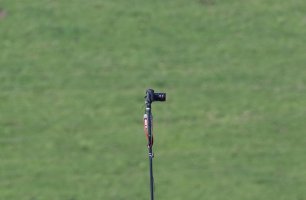
Attached is a severe crop of a picture I took earlier this year simply to see what an other photographer was up to.
It is certainly not a good image but it was taken at between 400-500 yds (and is totally unedited!). It clearly shows that they were using a Canon 24-70 F2.8 L Mk1 and a 5D - BUT which model 5D??? Would a few extra MP have helped? I doubt it.

P.S. I thought the bokeh was quite nice too.
 

Attachments

  • 5D0.JPG
    5D0.JPG
    539.1 KB · Views: 209
Upvote 0
johnf3f said:
Haven't really been following this thread, but how much resolution do people need? I have a 1DX and am more than happy with it's resolution. I have also seen what the 5DSr can do and it's pretty special to say the least! The question is how relevant is it?
Attached is a severe crop of a picture I took earlier this year simply to see what an other photographer was up to.
It is certainly not a good image but it was taken at between 400-500 yds (and is totally unedited!). It clearly shows that they were using a Canon 24-70 F2.8 L Mk1 and a 5D - BUT which model 5D??? Would a few extra MP have helped? I doubt it.

P.S. I thought the bokeh was quite nice too.

My opinion the 5Ds R is very relevant. Even though you loose the resolution benefit with higher ISO or camera shake, the results are never worse than the older 5D bodies once you apply noise reduction or down sample. So it gives you the ability to have the higher resolution when you are able to get it. My opinion isn't a paper opinion, but one I have formulated over the last few months of use. YMMV

I have a prediction along those lines, we may never see a 5D IV. The 5Ds is the new 5D. What we may see is a new 6D II release though.

But this is a 1Dx thread. Sports photography is not my thing, wildlife, birds and nature are. I would really like to see the next 1D have at a minimum 12fps like the current model with 24mp +.
 
Upvote 0
filluppa said:
...
what I try to explain to Neuro is that the noise does not increase with higher ISO, the signal decreases which is common sensor Physics,and when it comes to use the correct explanation, it is that noise does not increase with higher iso
...

Am I missing something? Doesn't increasing the ISO increase amplification? And doesn't this amplify the noise as well as everything else? And am I right in thinking that as the S/N ratio is lower at higher ISO's, and the amplification is set to get the signal back to normal, the noise is higher? Don't we, as photographers, use images which come out of the camera, after amplification? Or am I just looking at this wrong? Should I never look at the images coming out of my camera and just consult you instead? Is the noise lower? Should I be shooting everything with an 8 stop ND filter to help me avoid the noisy low ISO's when shooting hand held?
 
Upvote 0
dilbert said:
Correct. The noise doesn't increase (it's baked into the design and manufacturing of the system so is therefore constant) but because the signal decreases as the ISO increases, the ratio of signal to noise drops.

Ahhhh dilbertland. That place where camera manufacturers know in advance every single picture you will ever take with the camera, and bake those pictures into the design and manufacturing of the system so the noise can be constant. No, perhaps that doesn't make sense...Occam's razor and all. Rather, the laws of physics are simply not applicable in dilbertland, and therefore read noise is the sum total of image noise and even then it's not subject to amplification. I hope you and Mikeal are having a good time in your personal alternate reality!
 
Upvote 0
I am not shure if I am repeating trivia (but I don't like the aggressivity in some posts):

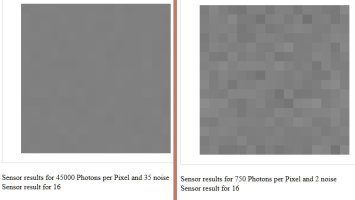
ISO 100 means a maximum of 90 000 detected photons, at 50% it means 45 000 detected photons which leads to an error of sqrt(45 000) which is roughly 200 - the relative error is 200 / 45000 or 0.5%.

ISO 6400 means a maximum of 1500 detected photons, at 50% it is 750 detected photons - sqrt(750) = 27 - relative error is 27 / 750 = 3.6 %

While at ISO 100 the camera makes a 0.5 % error between pixels which get the same amount of light the error is seven times higher at ISO 6400.

The compression of RAW (lossless) and JPEG files trys to define areas with the same values to store image information with less computer data. The higher error at ISO 6400 needs to define more but smaller areas so the compression algorithm needs more computer data volume to store the image information.

EDIT: I have written a simple application which simulates sensor noise on pixel base. Images show a 16 x 16 pixel region of a 50% gray where the detected photons are simulated with random numbers. Read noise is too simulated (simple model with equal distribution) but in the demonstrated case it isn't important. Main effect is the statistics of "detected photons".

now the image:
 

Attachments

  • sensorsimulation_eos_d1X_data.jpg
    sensorsimulation_eos_d1X_data.jpg
    39.3 KB · Views: 184
Upvote 0
filluppa said:
So can we all agree, except Nuro, that the correct description is like i wrote in answer 50 earlier


The noise is lower with less light=higher iso, but the noise-to-signal ratio gets higher.

I will agree that Neuro has lost in this debate. Read below for explanation.

The original statement you made was about a specific portion of an overall equation that happens when a photo is made at higher ISO. The statement was aimed at a broad statement that Neuro made about the file size and the noise in a finished product.

It is an mid level troll tactic to make a correct statement about a small slice of a situation to illicit a response from someone who is talking about a finished product or broader subject. Usually that small slice seems to be in conflict with the end result however the slice is usually true. The troll in this situation crafts his answers and responses in such a way as to acknowledge the final product and maintain the accuracy and correctness of his response.

The overall view;
There were a few times your crafted response outside the original point were shaky. However your original slice point was on target. You were able to solicit some responses from yours that helped your cause.

However

You were able to maintain your focus and unhinge Neuro in a few of the posts. At one point he called you "bub". In others there were choice words. As for the effectiveness of the original points it elicited the desired results and response for those reasons I have to say you did win the debate with Neuro.

Sorry Neuro, but I think he got you on this one.
 
Upvote 0
takesome1 said:
filluppa said:
So can we all agree, except Nuro, that the correct description is like i wrote in answer 50 earlier


The noise is lower with less light=higher iso, but the noise-to-signal ratio gets higher.

I will agree that Neuro has lost in this debate. Read below for explanation.

The original statement you made was about a specific portion of an overall equation that happens when a photo is made at higher ISO. The statement was aimed at a broad statement that Neuro made about the file size and the noise in a finished product.

It is an mid level troll tactic to make a correct statement about a small slice of a situation to illicit a response from someone who is talking about a finished product or broader subject. Usually that small slice seems to be in conflict with the end result however the slice is usually true. The troll in this situation crafts his answers and responses in such a way as to acknowledge the final product and maintain the accuracy and correctness of his response.

The overall view;
There were a few times your crafted response outside the original point were shaky. However your original slice point was on target. You were able to solicit some responses from yours that helped your cause.

However

You were able to maintain your focus and unhinge Neuro in a few of the posts. At one point he called you "bub". In others there were choice words. As for the effectiveness of the original points it elicited the desired results and response for those reasons I have to say you did win the debate with Neuro.

Sorry Neuro, but I think he got you on this one.

I dunno. Most of us use the word 'noise' perhaps a little imprecisely, but it's a valid usage nonetheless. Who would say 'higher ISO images aren't noisier'? Nobody I've ever encountered. If the point was 'SNR is what's changed, no noise per se' that's one thing, but it's quibbling over words, and rather beside the point.

Are higher ISO images noisier? Sure. Is that a major reason for their larger file sizes? I've certainly seen that explanation given in a few places - websites as opposed to forums. Does it matter if what we actually mean is 'the signal is weaker compared to the amplified noise' or whatever? Not in any practical way for most purposes.
 
Upvote 0
scyrene said:
takesome1 said:
filluppa said:
So can we all agree, except Nuro, that the correct description is like i wrote in answer 50 earlier


The noise is lower with less light=higher iso, but the noise-to-signal ratio gets higher.

I will agree that Neuro has lost in this debate. Read below for explanation.

The original statement you made was about a specific portion of an overall equation that happens when a photo is made at higher ISO. The statement was aimed at a broad statement that Neuro made about the file size and the noise in a finished product.

It is an mid level troll tactic to make a correct statement about a small slice of a situation to illicit a response from someone who is talking about a finished product or broader subject. Usually that small slice seems to be in conflict with the end result however the slice is usually true. The troll in this situation crafts his answers and responses in such a way as to acknowledge the final product and maintain the accuracy and correctness of his response.

The overall view;
There were a few times your crafted response outside the original point were shaky. However your original slice point was on target. You were able to solicit some responses from yours that helped your cause.

However

You were able to maintain your focus and unhinge Neuro in a few of the posts. At one point he called you "bub". In others there were choice words. As for the effectiveness of the original points it elicited the desired results and response for those reasons I have to say you did win the debate with Neuro.

Sorry Neuro, but I think he got you on this one.

I dunno. Most of us use the word 'noise' perhaps a little imprecisely, but it's a valid usage nonetheless. Who would say 'higher ISO images aren't noisier'? Nobody I've ever encountered. If the point was 'SNR is what's changed, no noise per se' that's one thing, but it's quibbling over words, and rather beside the point.

Are higher ISO images noisier? Sure. Is that a major reason for their larger file sizes? I've certainly seen that explanation given in a few places - websites as opposed to forums. Does it matter if what we actually mean is 'the signal is weaker compared to the amplified noise' or whatever? Not in any practical way for most purposes.

You do not have to agree that a high ISO picture has more or less apparent noise. By even debating the final product you fall into the trap.
Only the one point is thrown out for validation "The noise is lower with less light=higher iso, but the noise-to-signal ratio gets higher."

That is the small slice used for response.

But this was a validation post, "So can we all agree, except Nuro, that the correct description is like i wrote in answer 50 earlier"

This is the ball spike at the goal line.
 
Upvote 0
Mikael Residal (of whom this is but the latest incarnation, undoubtedly temporary), has consistently demonstrated an inability to see the forest for the trees (or the picture for the pixels, as the case may be). His repetitive posting of the Sensorgen data showing decreased pre-amplification read noise with increasing ISO is a perfect example. While that is true in and of itself, it's irrelevant to the discussion at hand.

Stating that, "The noise is lower with less light=higher iso, but the noise-to-signal ratio gets higher," is patently false, unless one also specifies that one is referring to the pre-amplification read noise. Shot noise goes down with less light, but preamplification shot noise is independent of ISO. Thermal noise is independent of both light intensity and ISO. So, takesome1 it would seem there was a penalty flag on the offense and that goal-line ball spike of yours was meaningless.

Absent the qualifying reference to preamplification read noise, and in the context of the discussion (file sizes) it is apparent to anyone with a modicum of intelligence that what matters is noise in the final image. I won't bore you or anyone else by reposting an image comparison demonstrating that which everyone (probably even Mikael and dilbert) knows to be true – an image taken at high ISO has more noise than an equivalent image taken at lower ISO.

As for the "debate," there isn't one. Mikael is, as usual, arguing a tangential triviality. If he'd like to address the issue of why achieving 12 fps on the 1D X has a restriction of ISO 25600 or lower, he is free to do so. If he suggests that restriction exists because there is less noise at higher ISO, he'll succeed only in making himself look foolish.
 
Upvote 0