5D MK2 and MK3 :: Sub Freezing Temperatures

Hey guys, I'm new here. I found this forum through an attempt to research online about this topic..


Well, at the end of this year (Xmas and New Years) I'll be flying to Alaska to chase the Northern Lights/Aurora Borealis.

Anyway, my main concern is the incredibly cold temperatures I'm going to be out in! Now I know that the 5D2 and 5D3 should be OK to work in those temps, as well as the 24-70mm f/2.8 my friend and I will be using.


But what I wish to find out about, are tips and stuff with dealing with the temperature changes.

I've read on this topic that somebody recommended using an airtight bag (unsure what kind?) while outside before bringing it back inside to avoid condensation.
http://www.canonrumors.com/forum/index.php?topic=17125.0

Another concern of mine is from stepping inside to outside, the sudden drop in temperature I'm scared will shatter the glass or somehow break the camera (as well as later stepping back inside, where it again would be expected to expand?).


So if anybody can please provide any information, insight or tips on this matter, I would be greatly appreciative!


I shoot on a 5D MK3 with a Canon 24-70 f/2.8 (series 1) and my friend has a 5D MK2 with the same lens.

I live in Australia, the cameras have always travelled to hot/warm destinations and the coldest would be maybe 10*C!


Thank you :) :)
 
I've used "zip lock" type of food or freezer bags for this. After the gear comes up to the new ambient temperature, you can remove it.

As far as the gear, itself goes, I've had my camera body and a variety of lenses outside at -30C and no permanent damage occurred. My 50d "stopped working" after being out in the cold for a while but recovered and worked for years afterwards once it was warmed up. The biggest issue is battery life. Bring extras and keep them warm. They don't hold their charge as long as they would in warmer temperatures so you will get less shots per charge.

Be sure to have gloves that allow you to use your gear. You might want to practice adjusting the camera settings, changing batteries, etc. with the gloves on before you go. Be very careful about bare skin and things like tripod legs in the extreme cold!

Finally, IMHO, you will be much happier with something even wider than 24mm. Look into something as wide as 14 or as near as you can get / afford for pictures of the Aurora. There are some good websites full of tips for this type of photography. Basically, though, don't be afraid to try different exposure times while using a relatively fast aperture.

Happy hunting!
 
Upvote 0
I've had my 1Dx in temperatures as low as -40, no ill affects.

The 5DMK III (and prior to that, the 5DMK II), I've had in temperatures as low as -20, again, no ill effects.

Batteries, keep at least 3 fully charged, one in the Camera, another two in pockets close to your body so they remain warm until you change them out, on a recent trip to Svalbard as high as 83 degrees North, I was going through a Battery every 45 minutes in the 1Dx, but this was in -30 to -40 temperatures.

Gloves, two pair, inners (very thin so you can manage the Camera Controls, an outer set that can be removed when you need to shoot, the outers need to have a Zip Cord attachment so you can keep them hanging from your wrists and not trying to stuff into pockets, then they get lost, or you miss the shot.

Think about Lens Coat Covers for your Camera, more important your lenses, allows you to handle the Lens without freezing your fingers and hands.

I've never bothered with the Zip Lock Bag trick, but i know People that do and it works fine. What I try to do is set my gear at a mid point before I head outside, in cold climates you often have a Boots area just inside the door, Cameras left here will cool down, or, warm up slowly, objective is not to bring the Cameras from a freezing environment into a warm Fireside environment without a period acclimating.

Biggest issue will be condensation if you do it too quickly, once the Camera body warms condensation generally goes away, but if you have condensation on a Lens and straight into -40, your likely to have issues.

Canon Cameras and Lenses are extremely rugged pieces of gear, treated with a little for thought, you shouldn't need to be too concerned. I've used the 24-70f/2.8 L I & II Lenses in these environments completely without issue.

I've had a 5DMK II actually stop working in -40 degrees (North Pole 2009 onboard the 50 Years of Victory), once it warmed up worked just fine, but now I tend to leave the 5D3 in the Bag in anything more than -20.

Welcome to CR and enjoy your spell in the Fridge, Alaska is absolutely Beautiful, I'm also originally from Aus, love the Arctic & Antarctic environments, good luck with the Imaging.
 
Upvote 0
Thank you both for the fantastic information :D it's my first time venturing in to such temperatures so I'm trying to find out what I can :)

The "boots room" is a new one for me, a good halfway point it seems! Thanks for pointing that out!

About getting myself a 14mm lens though! I will need to try and find a hire place over there maybe, I can't afford to spend on a lens after everything else for this trip!! Unfortunately :(
 
Upvote 0
Since it's damned cold in Norway, I have some experience with this.

From hot to cold is usually okay, from cold to hot, I use to pack cameras into my jacket and let it slowly acclimatize themselves.

I ran into a problem with the AF 70-200 and 24-70 L lenses were very slow in slightly wet and cold conditions. But once they got warmed up again everything was normal.

Wear good clothes, good boots and woll socks when to be long out ;D
 
Upvote 0
Same here across the border in Finland... :P

I have used 50D, 5DmkIII, 24-70mm f2,8 L mkI, 16-35mm f2,8 L mkII and variety Zeiss Contax&EF lenses in cold weather several times, lowest has been close to -30 C. No problems! AF I have switched off since I have not needed it for stars or Northern Lights.

Only thing that I noticed is that one 5D mkIII non-original battery doesn't work at all below 0 C. Original Canon batteries and 50D non-original batteries have worked quite well in cold. I have been able to take 4-6 30 min exposures with one battery. Spare batteries I have kept in my down jacket's inner pocket or in pocket of fleece jacket that is under down jacket. So spare battery is warm when I change battery to camera.

Cameras and lenses have been out in wilderness over the weekend so they have been fully cooled down. ;D

When I have gone back to my home I have just left cameras and lenses in their packs(Lowepro Topload/similar) to warm up with out opening zippers. Next day cameras have warmed to room temperature. I have not used silica or additional plastic packs. If I have wanted to see pictures just after I get home I have removed memory card before going in.
 
Upvote 0
Hi,

I have been to northern finnland in March this year. During the first night we had -32Grad Celsius. My 5DMII worked fine except for a slightly slower shutter which was good to hear. The camera was exposed to these temperatures over 4-5 hours. I also let the camera warm up in my normal camera back pack with the zippers closed over the night (better: rest of the night) without any silica gel packs. There was no condensation at all.
If you plan to use a remote trigger: LCD´s won´t work in such cold ambient. The mostly very small buttons on these remote triggers with intervallometer and other functions are too small for use with gloves. the 5sek. LCD illumination is ways too short for being usable in combination with gloves. Maybe it is a good idea to think about camranger or DSLR controller for triggering longexposure shots or timelamps shots. A cellular phone is more convenient to use and you can keep it warm near your body when not in use.

regards,
Frank
 
Upvote 0
Moisture kills a camera, not temperature. Its extremely dry in cold weather, but since the dry air is so uncomfortable, many add humidity to indoor living spaces, and then a camera with humid air inside goes out into the cold, and the water vapor immediately condenses. Aircraft can condense huge amounts of water this way, going from a humid airport to a high cold altitude. They are designed to drain away the water, but sometimes maintenance workers don't put the drains back right and it literally rains in that area of the cabin.
If you place your camera in a large zip lock bag before bringing it into a warm humid area, it will stay dry and will not need any protection outdoors. As noted, some moisture absorbent packs won't hurt.
 
Upvote 0
I haven't had the occasion to be with my MkIII in freezing or sub zero temperatures yet, I did however have the opportunity to join my 7D in weather that was approximately -5 below zero.

My 7D worked well, I did have issues after about 3 hours at that temperature with the on-0ff switch freezing up. That was it really. Everything else worked well...

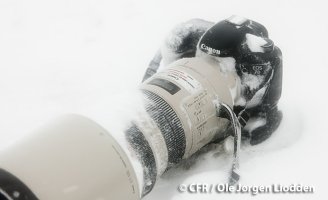
Reminded my about a photo I stumbled across a few years ago. I didn't take it but here it is! All the best! :)
 

Attachments

  • blizzard.jpg
    blizzard.jpg
    60.6 KB · Views: 1,208
Upvote 0