5D3: ISO 160, 320, 640 etc cleanest ISOs?

  • Thread starter Thread starter xthebillx
  • Start date Start date
Status
Not open for further replies.
X

xthebillx

Guest
Hello!

I know that with the 5D2, ISOs 1/3 stop below the native ISOs are cleaner due to a digital "pull", primarily with video (but I've read that it pertains to RAW as well). Conversely, ISOs 1/3 stop above the native ISOs (125, 250, 500 etc) are noisier because they are achieved by a digital "push" over ISO 100, 200, 400, 800 etc.

Does anyone know if the the same is true with the 5D3?
 
I've never seen a real-world difference. Sure, you can shoot the inside of your lens cap and run some sort of meaningless statistical calculation and come up with a number that says there's a difference, but I've yet to see a print where you could tell the difference in a third of a stop of ISO.

If you're really shooting something where a third of a stop of ISO noise will actually make a difference, I'd strongly suggest doing some real-world tests in the actual shooting conditions where you'd be deciding which to use, and basing your decision on your own evaluation of the results you get.

Me? I pick whole number ISO settings because it makes the math easier for me.

Cheers,

b&
 
Upvote 0
xthebillx said:
Hello!

I know that with the 5D2, ISOs 1/3 stop below the native ISOs are cleaner due to a digital "pull", primarily with video (but I've read that it pertains to RAW as well). Conversely, ISOs 1/3 stop above the native ISOs (125, 250, 500 etc) are noisier because they are achieved by a digital "push" over ISO 100, 200, 400, 800 etc.

Does anyone know if the the same is true with the 5D3?

For stills RAWs the 160,320,640 are the same as 200,400,800, they are the exact same thing only the camera meter over-exposes the 1/3 below the main ISO 1/3 stop.

For video or jpg with baked in processing perhaps they could be better since jpg and video are said to chop off some high-end DR anyway so maybe you lose nothing?
 
Upvote 0
Tests like OP is searching for (which are only useful if done in real world conditions) vary greatly if you are testing the low light performance of a higher ISO, or if you are testing that same ISO in adequate light and using it specifically to buy yourself a faster shutter speed/smaller aperture, etc..

My suggestion for testing is just shoot as you normally would with what ever you are testing, try to get good pictures, and if time allows, take the same picture multiple times with a wide variety of settings. EXIF data will tell you which is which when you get them back to your computer, and other than that, just try to keep extra variables like camera shake and focus, etc., consistent so that your tests are more useful. After you do this quite a bit, you will know how to best use the camera + lens you are testing and get the best out of it and that is really a big key to getting great pictures before the editing stage begins.

Everyone, myself admittedly included, worries so much about non-real world details and it's a mind killer. Just use what you got/buy what you can afford/you know you can profit from, and learn to test/use that to it's best, then go rent/try any new equipment and test the hell out of it before you buy it. If the upgrade is worth it to your art or is clearly a worthy investment, then you don't have to worry so much. I say this as a persevarate endlessly about which lens I'm going to sell and which one I'm going to buy next or if I'm selling a lens at all or buying a lens at all, if I need another camera body...... Decisions, decisions.
 
Upvote 0
I used to shoot at ISO160/320/640 etc because tests have shown those are cleaner than ISO100/200/400
However, that was on a Crop camera.
I believe the 5D3 is so castly superior at low ISO that up to maybe ISO800, you won't notice any difference whichever ISO you use. I do believe that even an ISO 400 is the same as ISO100 on a 5D3.
maybe at higher ISOs it will matter but if you're giong to shoot at that high ISO, most likely you're more concerned about shutter speed instead of ISO values. But yes, whole numbers are so much easier to remember so i'm using that now instead
http://a2bart.com/tech/allcamdknz.htm
Check out that "test" if you really want to see "noise" in detail…as i mentioned..ISO100-800 looks identical on the 5d3
 
Upvote 0
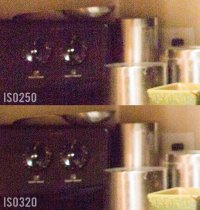
Here is a very unscientific test I just did in my Kitchen as I was very interested in this as well. It runs out when shooting RAW, staying in multiples of 160 definitely pays off. I purposely underexposed the shot, shot it in RAW, and then pushed it 5 stops in LR to bring out the noise. These are 100% crops with ISO 320 showing considerably less noise than ISO 250.
 

Attachments

  • NDP_5737.jpg
    NDP_5737.jpg
    353.9 KB · Views: 1,974
Upvote 0
Theroetically the basinc stop multipliers should be the cleanest.

100, 200, 400, 80, 1600 and so on.

Anything else, 320, 640 aren't supposed to be as they boosted by software. (i.e. 200 is pushed to 320)

This is different from hardware amplification which goes from 100-200. I never have expanded ISO available.
 
Upvote 0
wockawocka said:
Theroetically the basinc stop multipliers should be the cleanest.

100, 200, 400, 80, 1600 and so on.

Anything else, 320, 640 aren't supposed to be as they boosted by software. (i.e. 200 is pushed to 320)

This is different from hardware amplification which goes from 100-200. I never have expanded ISO available.


can't 320 be an underexposed 400?
 
Upvote 0
Someone once started this discussion about the 7D. It grew to like 15 pages, and the smites were handed out like candy.

Ahhh, the past golden days o' smiting! Well, I am sure that the conclusions reached here will be similar, and I will in no case really care, because I can't see a difference, and neither can anyone else who is acting rationally!
 
Upvote 0
This is kind of a spammy post, but . . .

have you guys even seen ISO 2000!? It is amazing! I don't really care about multiples with this camera ;)

I have also noticed that if you guys want the BST images with the mkIII indoors, use a flash and you will be amzed at the sharpness and detail. That is the best way to use this camera indoors. Without flash and high ISO your images will appear not as clear and sharp. but with that little flash it is simply amazing like nothing I have ever seen almost. In a dark hall, use 3-4 strobes mounted on small light duty stands placed around the room and fire away anywhere you want using almost any ISO you want without fear. For small living rooms etc, use 2 stobes at eirthter end of the room and enjoy! The ISO will be SOO much better . . .! And while this subject of multiples is a valid one for greater understanding of your camera's inner workings, I think that it goes by way of the dodo once you switch to mkIII and flash fill. . . . .. mmmmmmmmm
 
Upvote 0
Important thing to remember about the 160, 320 etc

"Because ISO 320 is actually ISO 400 pulled 1/3 of a stop, that means that the highlights are going to clip at exactly the same point as they would at ISO 400. The 1/3 stop pull is just making that point 1/3 stop darker than pure white. The entire image at ISO 320 is 1/3 stop darker (and may be less noisy) than the image at ISO 400, so the blacks lose detail 1/3 stop sooner, but you don't get that 1/3 stop back at the highlight end of the range -- it's still gone. Therefore, at ISO 320 you're losing a net 1/3 stop from the total usable dynamic range that you would have if you were shooting at ISO 400."

http://shootintheshot.joshsilfen.com/2010/05/13/canon-hd-dslr-native-iso/

but they do have less noise..
 
Upvote 0
wockawocka said:
Theroetically the basinc stop multipliers should be the cleanest.

100, 200, 400, 80, 1600 and so on.

Anything else, 320, 640 aren't supposed to be as they boosted by software. (i.e. 200 is pushed to 320)

This is different from hardware amplification which goes from 100-200. I never have expanded ISO available.

Actually 160 and 320 are NOT pushed from the stop below but the stop 1/3 above over-exposed by 1/3 stop and then with the RAW levels reset in cam so you gain 1/3 stop in the shadows and lose 1/3 stop highlights, you'd get the exact same thing though by using ISO200 and ISO400 and using EC +1/3 ;D.

The ones like 125 are bad though since they are just ISO100 pulled up 1/3 stop after being under-exposed 1/3 stop, they actually end up with a little bit less dynamic range than ISO100 or 160 or 200.
 
Upvote 0
Viggo said:
wockawocka said:
Theroetically the basinc stop multipliers should be the cleanest.

100, 200, 400, 80, 1600 and so on.

Anything else, 320, 640 aren't supposed to be as they boosted by software. (i.e. 200 is pushed to 320)

This is different from hardware amplification which goes from 100-200. I never have expanded ISO available.


can't 320 be an underexposed 400?

you mean 320 is an OVERexposed 400 and yes, that is exactly what it is
 
Upvote 0
Status
Not open for further replies.