
You are using an out of date browser. It may not display this or other websites correctly.
You should upgrade or use an alternative browser.
You should upgrade or use an alternative browser.
5d3 not soft anymore?
- Thread starter Viggo
- Start date
- Status
- Not open for further replies.
@ viggo your DPP has to be 3.11.26 version and this does not come with the camera. it has to be downloaded. if you are using the DPP that came with the camera then images will come out soft. I do hope you give it a try and see the difference between using LR and DPP with MKIII
Upvote
0
You can try:
http://www.usa.canon.com/cusa/support/consumer/eos_slr_camera_systems/eos_digital_slr_cameras/eos_5d_mark_iii#DriversAndSoftware
Then you select:
1. Operating System
2. OS Version
3. Software
Then you can download the dpp updater...
http://www.usa.canon.com/cusa/support/consumer/eos_slr_camera_systems/eos_digital_slr_cameras/eos_5d_mark_iii#DriversAndSoftware
Then you select:
1. Operating System
2. OS Version
3. Software
Then you can download the dpp updater...
Upvote
0

tron said:Thank you VERY MUCH for your comparison photos. Now, these seem pretty much equal to me. As you said, now it's Adobe's turn...
No, problem, it was thanks to the tip of trying DPP from RJSY in the firstplace that made me even try it. And it seemed that it might not be the camera an AA filter and all the other suggestions after all. Now, this test isn't 100% conclusive, but it looks to be in the right direction.
I've stated this very early on when thedigitalpicture dude said there was a softness issue with the DPP software, that could it be that Adobe uses, at least some part, of the DPP to make their raw-supprto for the 5d3? So if DPP was soft, then Lr will be as well? Or is this very far fetched? Why do Adobe have the same issue?
Upvote
0
Viggo said:tron said:Thank you VERY MUCH for your comparison photos. Now, these seem pretty much equal to me. As you said, now it's Adobe's turn...
No, problem, it was thanks to the tip of trying DPP from RJSY in the firstplace that made me even try it. And it seemed that it might not be the camera an AA filter and all the other suggestions after all. Now, this test isn't 100% conclusive, but it looks to be in the right direction.
I've stated this very early on when thedigitalpicture dude said there was a softness issue with the DPP software, that could it be that Adobe uses, at least some part, of the DPP to make their raw-supprto for the 5d3? So if DPP was soft, then Lr will be as well? Or is this very far fetched? Why do Adobe have the same issue?
Interesting thought! Until we see an updated camera raw engine so as to compare the same 5D2 and 5d3 photos with the same settings I guess we cannot be sure 100%.
Upvote
0

Woah… Viggo thanks for the test.. This really seems to indicate that Adobe’s LR processing is the one at fault. Lets hope that 4.1 final will fix this! I’ll definitely keep an eye on this thread
Upvote
0
My opinion
I just got my 5D Mark III last week on Thursday. Took me a while to shoot some preliminary tests.
I've always been that rare professional that preferred DPP to Lightroom, mostly because I've had an image database program running in my studio since 1996, so that a big chunk of Lightroom is superfluous for me and, as to the actual heart of the program, the raw converter, I've found DPP to be at least as good, if not better at producing good 16 bit Tiffs, my file of choice, at least the one I start out with. Although Lightroom has more refined tools than DPP, the basic conversion is not always as good and the program itself is 10 times biiger with what seems to be unnecessary bloatware included. So, when testing my new cam, I wanted to use DPP, not Lightroom. I wrote Bryan Carnathan at the Digital Picture to ask him his opinion of the new version, 3.11.26.0, and whether it "solved" his softness issues with the 5D3 output. He very kindly mailed me back, saying that, yes it did. So, I used my updated copy of DPP to convert my tests. I also, just because I wanted to see what it could do, used the Digital Lens Optimizer on each file, found under the Lens tab in the tools pallette. I'm not sure how much more this Optimizer does than what is now automatically done in-camera in the 5D3, but I used it anyway, and didn't yet bother to compare results with it and without it.
My conclusion is a subjective comparison of these raw conversions with what I am used to getting with my now gone- but-not-forgotten 1Ds Mark III, not the 5D2. From what I know, the low ISO results from the 1Ds3 were, if anything, better than those from the 5D2.
Here are my observations. The 5D3 focusing system is better than that of my 1Ds3. It nailed static subjects (didn't yet try action) more precisely and with the 2 L lenses I tested, (24-70 f/2.8 and 16-35 f/2.8 v2), with no lens calibration. My tests were shot at f/4.0 and f/7.1, depending on the depth of field I needed. The files showed a small but significant gain in low ISO (shot at 200 ISO) DR. The exposure meter in Eval mode semed to give me uniformly better exposures without needing to "outsmart" it quite so often. The shutter release actually felt a little better and the seemed very slightly better dampened - a very unexpected result. The images were mostly quite sharp looking, but since my exposures today seemed to yield very narrow but nicely shaped "waves" that filled the center of the graph space but did not extend all the way to the shadow or highlight sides on the horizontal axis, they seemed to lack some contrast; this was, rather than some fault of the camera, rather the result of my exposure choices, (mostly) the existing light values, the default tone curve in DPP and the slightly better DR of the camera. In Photoshop, when I applied some very minor curves and then very minor low amount-higher radius-zero threshold unsharp mask to the image, the histograms spread out as far to the left and right as was appropriate and the image popped like a bubble gum ballon, without any visible artifacts. Most, if not all, of this could also have been accomplished in DPP or Lightroom, if you didn't happen to have Photoshop. Overall, the resulting files looked at least as sharp as any result I could have had with my old 1Ds3, and they have just a little bit more detail in them as well. Finally, the defringing and other functions in the Digital Lens Optimizer seemed to work so well that I can honestly say that it brought "new life" and a whiole new look to my sometimes chromatically challenged 16-35 f/2.8. It couldn't turn it into a Nikon 14-24, but it made it look a heck of a lot better.
I'll not be posting these, but I think I may have given you all a pretty good description of my own personal subjective findings. They're not scientificly rigorous, but they are backed up by my experience of over 16 years spent photographing, scanning and retouching digital files for very very high end commercial clients.
Regards,
David
I just got my 5D Mark III last week on Thursday. Took me a while to shoot some preliminary tests.
I've always been that rare professional that preferred DPP to Lightroom, mostly because I've had an image database program running in my studio since 1996, so that a big chunk of Lightroom is superfluous for me and, as to the actual heart of the program, the raw converter, I've found DPP to be at least as good, if not better at producing good 16 bit Tiffs, my file of choice, at least the one I start out with. Although Lightroom has more refined tools than DPP, the basic conversion is not always as good and the program itself is 10 times biiger with what seems to be unnecessary bloatware included. So, when testing my new cam, I wanted to use DPP, not Lightroom. I wrote Bryan Carnathan at the Digital Picture to ask him his opinion of the new version, 3.11.26.0, and whether it "solved" his softness issues with the 5D3 output. He very kindly mailed me back, saying that, yes it did. So, I used my updated copy of DPP to convert my tests. I also, just because I wanted to see what it could do, used the Digital Lens Optimizer on each file, found under the Lens tab in the tools pallette. I'm not sure how much more this Optimizer does than what is now automatically done in-camera in the 5D3, but I used it anyway, and didn't yet bother to compare results with it and without it.
My conclusion is a subjective comparison of these raw conversions with what I am used to getting with my now gone- but-not-forgotten 1Ds Mark III, not the 5D2. From what I know, the low ISO results from the 1Ds3 were, if anything, better than those from the 5D2.
Here are my observations. The 5D3 focusing system is better than that of my 1Ds3. It nailed static subjects (didn't yet try action) more precisely and with the 2 L lenses I tested, (24-70 f/2.8 and 16-35 f/2.8 v2), with no lens calibration. My tests were shot at f/4.0 and f/7.1, depending on the depth of field I needed. The files showed a small but significant gain in low ISO (shot at 200 ISO) DR. The exposure meter in Eval mode semed to give me uniformly better exposures without needing to "outsmart" it quite so often. The shutter release actually felt a little better and the seemed very slightly better dampened - a very unexpected result. The images were mostly quite sharp looking, but since my exposures today seemed to yield very narrow but nicely shaped "waves" that filled the center of the graph space but did not extend all the way to the shadow or highlight sides on the horizontal axis, they seemed to lack some contrast; this was, rather than some fault of the camera, rather the result of my exposure choices, (mostly) the existing light values, the default tone curve in DPP and the slightly better DR of the camera. In Photoshop, when I applied some very minor curves and then very minor low amount-higher radius-zero threshold unsharp mask to the image, the histograms spread out as far to the left and right as was appropriate and the image popped like a bubble gum ballon, without any visible artifacts. Most, if not all, of this could also have been accomplished in DPP or Lightroom, if you didn't happen to have Photoshop. Overall, the resulting files looked at least as sharp as any result I could have had with my old 1Ds3, and they have just a little bit more detail in them as well. Finally, the defringing and other functions in the Digital Lens Optimizer seemed to work so well that I can honestly say that it brought "new life" and a whiole new look to my sometimes chromatically challenged 16-35 f/2.8. It couldn't turn it into a Nikon 14-24, but it made it look a heck of a lot better.
I'll not be posting these, but I think I may have given you all a pretty good description of my own personal subjective findings. They're not scientificly rigorous, but they are backed up by my experience of over 16 years spent photographing, scanning and retouching digital files for very very high end commercial clients.
Regards,
David
Upvote
0
@ viggo... glad that you did give DPP a try. And by the looks of it you now seem somewhat happy with the results.
Actually I too was not very happy with the mkIII because of it's "softness" I learned that there was a problem with DPP so I turned to LR 4.1RC. I found LR to be a great raw converter with all the parameters you are able to adjust to get that perfect picture. But I was somewhat underwhelmed by the outcome of the pictures i took with the mkiii when processed with LR. I was thinking " is this it????" ...... But then I waited patiently for DPP to be "corrected" and sure enough when it came out, tried it and I instantly saw a world of difference in the conversion process... I guess you saw it too.....
maybe darknightnine could also give DPP a try and hopefully it will also somewhat "solve" his soft mkiii problem
Actually I too was not very happy with the mkIII because of it's "softness" I learned that there was a problem with DPP so I turned to LR 4.1RC. I found LR to be a great raw converter with all the parameters you are able to adjust to get that perfect picture. But I was somewhat underwhelmed by the outcome of the pictures i took with the mkiii when processed with LR. I was thinking " is this it????" ...... But then I waited patiently for DPP to be "corrected" and sure enough when it came out, tried it and I instantly saw a world of difference in the conversion process... I guess you saw it too.....
maybe darknightnine could also give DPP a try and hopefully it will also somewhat "solve" his soft mkiii problem
Upvote
0
Tested today:
Mk II vs Mk III sharpness: Carl Zeiss ZE 100 and 50 MP @ f 4, Av, 1/45-50, LV focusing + shot, 2sec delay release, ISO 100, RAW, Neutral PS, no sharpening during RAW import into Aperture, same export setting for JPEG.
Can't find any difference. Initially I shot only once and imported both files onto my MBP. Looked at them and noticed a slight advantage to the 5D2. Then, I decided to do five additional shots for each with refocusing and average the findings - imported them into my MacPro and looked on the big screen - no difference. The initial impression was mis focusing.
Mk II vs Mk III sharpness: Carl Zeiss ZE 100 and 50 MP @ f 4, Av, 1/45-50, LV focusing + shot, 2sec delay release, ISO 100, RAW, Neutral PS, no sharpening during RAW import into Aperture, same export setting for JPEG.
Can't find any difference. Initially I shot only once and imported both files onto my MBP. Looked at them and noticed a slight advantage to the 5D2. Then, I decided to do five additional shots for each with refocusing and average the findings - imported them into my MacPro and looked on the big screen - no difference. The initial impression was mis focusing.
Attachments


Upvote
0
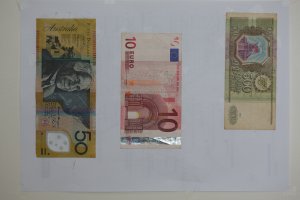
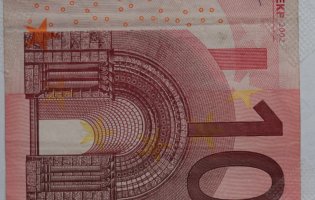

The MarkIII went 1/45 at f/4 and the MarkII went 1/50 but came brighter, don't know why.
Both exposures changed 2/3 stops between LV metering and standard metering. Don't know why. This was a surprise to me, I went to Manual at 1/60 for both and f/4 and between VF and LV metering there was 2/3 stop EV difference.
The 500 ruble note is low value paper - disintegrated while untaping. The Aussie behaved best.
My Manual shots are unfortunately at home now. Results are unequivocal for me: the debate "softer or not softer" should end here. Both Marks are nearly if not the same to me.
Both exposures changed 2/3 stops between LV metering and standard metering. Don't know why. This was a surprise to me, I went to Manual at 1/60 for both and f/4 and between VF and LV metering there was 2/3 stop EV difference.
The 500 ruble note is low value paper - disintegrated while untaping. The Aussie behaved best.
My Manual shots are unfortunately at home now. Results are unequivocal for me: the debate "softer or not softer" should end here. Both Marks are nearly if not the same to me.
Upvote
0
Viggo said:Yeah, I just hadn't taken it out of the box before as I never intended to use it.
But here's the updated shots:

Wow, Adobe needs to get their act together.....
Thanks viggo for your post and findings. You give me hope! Actually you made my day! I had the same feeling of softness in the mkiii i tried to the point where i returned it. Back then i thought LR would solve the problem but my image too were still soft with it! While i returned my unit to patiently wait for the 1dx, i had not tried the new version of dpp because i thought adobe lr 4.1 was the 'correct' representation for this camera.
Tonight i will download the new version of dpp and reprocessed all the raw from the mkiii i save to see if i get the same result as you guys. This makes me hopeful! Boy it is weird how adobe could have been so off with the converter for this camera...how could that be?
Jacques
Upvote
0
JR said:Viggo said:Yeah, I just hadn't taken it out of the box before as I never intended to use it.
But here's the updated shots:
Wow, Adobe needs to get their act together.....
Thanks viggo for your post and findings. You give me hope! Actually you made my day! I had the same feeling of softness in the mkiii i tried to the point where i returned it. Back then i thought LR would solve the problem but my image too were still soft with it! While i returned my unit to patiently wait for the 1dx, i had not tried the new version of dpp because i thought adobe lr 4.1 was the 'correct' representation for this camera.
Tonight i will download the new version of dpp and reprocessed all the raw from the mkiii i save to see if i get the same result as you guys. This makes me hopeful! Boy it is weird how adobe could have been so off with the converter for this camera...how could that be?
Jacques
Adobe has always had to play catch up with almost every new canon/nikon camera ever released... Canon doesn't like to play nice and give developers like adobe insights on how to prep, so adobe has to wait until they can get their grubby hands on something to go off of. Canon 5d mark 2, we had to nearly wait a full month before adobe had any support what-so-ever for the camera after first launch... no beta, no release candidate, nothing. To my knowledge, this is the first big release where they at least had something out there to play around with.
Upvote
0
I did not know that! I was assuming they knew what they were doing but obviously i was wrong in this case. Just because they support it does not mean it works! Just did not make sense that canon would release a camera like the mkiii with soft image compared to the mkii. Cant wait to reprocess all my raw with the new version of dpp. There is hope after all! ;D
Upvote
0
Well i was able to reprocess all my raw file from the mkiii using the latest dpp instead of LR 4.1 and this was indeed the source of the softness issue i was experiencing. The image all became razor sharp using dpp, some of them even more so then my mkii! The only down side for me for now is i still prefer the workflow from lightroom compared to dpp so i really hope adobe will update their raw converter.
Even the shots i thought were sharp from the mkiii before were improved using the latest dpp... Thanks viggo...
Even the shots i thought were sharp from the mkiii before were improved using the latest dpp... Thanks viggo...
Upvote
0
- Status
- Not open for further replies.

