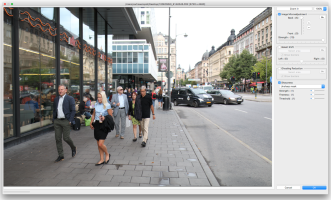
5D4 Dual-Pixel RAW Image Microadjust comparison to AFMA posted at DPR

ahsanford

Particular Member
Aug 16, 2012
8,656
1,664
57,701
https://www.dpreview.com/news/1177471835/testing-image-microadjust-on-the-canon-5d-mark-iv

Interesting -- I'm sure we could pick apart the methods (it is DPR after all), but they've pushed the limits of the Dual-Pixel RAW Image Microadjustment up against good ol' fashioned AFMA to scale the amount of focus correction possible in post with DP RAW. I'll give them credit, it's a simple and clever way to frame this up without just handing us a gallery of pre-/post-correction shots.

"However, the degree of correction we're seeing is so small (on the order of -2 to +2 in terms of traditional AF microadjustment) that we wonder whether it's worth the effort of incorporating DPP into your workflow, especially given its slow performance even on a fast computer. Or the doubling in file size."


They completely drive past the stories this week that Adobe will just directly bolt this functionality into their much-more-widely-used traditional LR / ACR tools, but here's their rough swag for the scale of what you can do with focus in post.

- A
 
It's consistent with the way Canon described the potential in their article from last week. Rudy Winston (Canon tech rep / mouthpiece) made the limitations clear, using words like 'tiny', 'subtle' and 'just a tad'.
 
Upvote 0
Personally i don't see that the benefit is worth the effort. AF accuracy varies so much under different conditions, that the shift in focus is negligable.

Now give me an AFMA that changes over distance to produce perfectly calibrated focus and i'll listen. :)
 
Upvote 0
Early reports with testing on Beta models and software is saying that this feature is very dependent on focal length. Apparently longer focal lengths benefit more from this feature and I think it will end up being a great feature for wildlife photographers and macro users. At least that's my perspective.
 
Upvote 0
LSXPhotog said:
Early reports with testing on Beta models and software is saying that this feature is very dependent on focal length. Apparently longer focal lengths benefit more from this feature and I think it will end up being a great feature for wildlife photographers and macro users. At least that's my perspective.

I'm not sure that 'longer focal length' is correct. Is the thinking that perspective determines how much you can focus microadjust an image? How would that work?

Rather, I think the magnitude of adjustment is inversely proportional to the DoF...so, aperture and magnification are the determinants, with wider and higher, respectively, meaning more effect of adjustment. It shouldn't matter whether that higher magnificaiton is achieved with a longer focal length or a closer subject (the issue of wide lenses giving deeper DoF have been done to death, if the subject is the same size in an image with different focal lengths, the DoF is the same).
 
Upvote 0
neuroanatomist said:
LSXPhotog said:
Early reports with testing on Beta models and software is saying that this feature is very dependent on focal length. Apparently longer focal lengths benefit more from this feature and I think it will end up being a great feature for wildlife photographers and macro users. At least that's my perspective.

I'm not sure that 'longer focal length' is correct. Is the thinking that perspective determines how much you can focus microadjust an image? How would that work?

Rather, I think the magnitude of adjustment is inversely proportional to the DoF...so, aperture and magnification are the determinants, with wider and higher, respectively, meaning more effect of adjustment. It shouldn't matter whether that higher magnificaiton is achieved with a longer focal length or a closer subject (the issue of wide lenses giving deeper DoF have been done to death, if the subject is the same size in an image with different focal lengths, the DoF is the same).

A review online claimed that the 50mm and 65mm didn't seem to have much in the way of latitude and the 85mm and 70-200mm seemed to show more. His comments were purely presumptive, so we'll just have to wait and see more.
 
Upvote 0
neuroanatomist said:
It's consistent with the way Canon described the potential in their article from last week. Rudy Winston (Canon tech rep / mouthpiece) made the limitations clear, using words like 'tiny', 'subtle' and 'just a tad'.

Exactly this ^^^, "tiny" being the key word, and he did emphasise TINY! I think some are thinking way too far on this. :)
 
Upvote 0
I'd suggest the results are entirely consistent with what anyone with a passing knowledge of optics could expect, based on what is known about the sensor structures for DP designs.

To Canon's credit they are careful in how it is described, no mean feat given the demands of marketing ;-)

I expect more uses of it to emerge once others start tweaking their processing software...

That said I suspect we'll see more than a bit of whinging when some find out the realities :-)
 
Upvote 0
arthurbikemad said:
neuroanatomist said:
It's consistent with the way Canon described the potential in their article from last week. Rudy Winston (Canon tech rep / mouthpiece) made the limitations clear, using words like 'tiny', 'subtle' and 'just a tad'.

Exactly this ^^^, "tiny" being the key word, and he did emphasise TINY! I think some are thinking way too far on this. :)

The article (from Sweden) posted on another thread showed some 2m/6ft shift on a picture taken with 35mm lens.

If that's not fake, I'm no calling it tiny.
 
Upvote 0
tpatana said:
arthurbikemad said:
neuroanatomist said:
It's consistent with the way Canon described the potential in their article from last week. Rudy Winston (Canon tech rep / mouthpiece) made the limitations clear, using words like 'tiny', 'subtle' and 'just a tad'.

Exactly this ^^^, "tiny" being the key word, and he did emphasise TINY! I think some are thinking way too far on this. :)

The article (from Sweden) posted on another thread showed some 2m/6ft shift on a picture taken with 35mm lens.

If that's not fake, I'm no calling it tiny.

I don't think that's the case, 2m of shift would be ground braking IMO. I'll bet it's more like 2mm. If you can correct focus by 2m I'll eat my shorts...lol

Also I think Canon would have made quite a deal about DPRAW if it was capable of 2m worth of focus shift, and not time code 2.05 where a few MM is shown.

https://youtu.be/VTt1bDcLFB0
 
Upvote 0
arthurbikemad said:
tpatana said:
arthurbikemad said:
neuroanatomist said:
It's consistent with the way Canon described the potential in their article from last week. Rudy Winston (Canon tech rep / mouthpiece) made the limitations clear, using words like 'tiny', 'subtle' and 'just a tad'.

Exactly this ^^^, "tiny" being the key word, and he did emphasise TINY! I think some are thinking way too far on this. :)

The article (from Sweden) posted on another thread showed some 2m/6ft shift on a picture taken with 35mm lens.

If that's not fake, I'm no calling it tiny.

I don't think that's the case, 2m of shift would be ground braking IMO. I'll bet it's more like 2mm. If you can correct focus by 2m I'll eat my shorts...lol

Also I think Canon would have made quite a deal about DPRAW if it was capable of 2m worth of focus shift, and not time code 2.05 where a few MM is shown.

https://youtu.be/VTt1bDcLFB0

This is what tpatana is referring to:

DR01_0.png

DP02.png
 
Upvote 0
I did read the article and see those images. I agree if that is the case then WOW factor is BIG.

My understanding is that each pixel is placed side by side, thus a slightly different perspective is recorded from each in the raw file, the shift switches data from each, surly focus is more a case of one pixel would need to be forward and one back in order to record two focus points in a single shutter actuation? So are we not seeing a shift rather than two focus points, bit like closing one eye then swap from one to the other, is this not how they also shift the bokeh?
 
Upvote 0
3kramd5 said:
arthurbikemad said:
tpatana said:
arthurbikemad said:
neuroanatomist said:
It's consistent with the way Canon described the potential in their article from last week. Rudy Winston (Canon tech rep / mouthpiece) made the limitations clear, using words like 'tiny', 'subtle' and 'just a tad'.

Exactly this ^^^, "tiny" being the key word, and he did emphasise TINY! I think some are thinking way too far on this. :)

The article (from Sweden) posted on another thread showed some 2m/6ft shift on a picture taken with 35mm lens.

If that's not fake, I'm no calling it tiny.

I don't think that's the case, 2m of shift would be ground braking IMO. I'll bet it's more like 2mm. If you can correct focus by 2m I'll eat my shorts...lol

Also I think Canon would have made quite a deal about DPRAW if it was capable of 2m worth of focus shift, and not time code 2.05 where a few MM is shown.

https://youtu.be/VTt1bDcLFB0

This is what tpatana is referring to:

DR01_0.png

DP02.png

A link and the uncropped image would give more context.

http://www.kamerabild.se/tester/vi-har-provat-canon-eos-5d-mark-iv?nodePage=3
 

Attachments

  • Screen Shot 2016-09-04 at 5.13.49 PM.png
    Screen Shot 2016-09-04 at 5.13.49 PM.png
    1.9 MB · Views: 181
Upvote 0
Thanks for the links guys.

I think this adds to my suspicion that the more DOF is in the original shot, the more leeway you can have for adjustment. I think that people wanting to rescue misfocused shots with 1cm of DOF are going to be disappointed...

I found another video buy by some South African guys:
https://www.youtube.com/watch?v=AhVKMmKFGy8
 
Upvote 0
I agree, I can't find the video now of the Canon guy who was talking about DPRAW, he went on to say the correction is tiny, one or two millimetres at most, perhaps shallow DOF macro stuff it maybe of some use, keep in mind I only talk about what I saw and I'd hope that there is more to come but my suspicions are its minor, I shoot a reasonable amount of macro full frame and crop, using 100mm f2.8 IS, two tubes 12mm and 25mm plus the x2.0 mkiii teleconverter, most of the time I step it right down f11 and more with flash, hand held all of the time it's hard to get focus bang on even at wide DOF, I am interested to try out the mk4 to see if it's worth using DPRAW, I think for the amount of extra space it takes up and slower FPS??? I can't see me using it for much else, chimping focus at zoom works for me and I get to correct any errors at the time of the shoot, I can see the appeal for run and gun shooters at weddings and press etc but I'd bet they want the full 2m or correction shown in those test shots.
 
Upvote 0
I don't know what the guys at DPReview think they're doing, but that was the most depressing article that could possibly be written about the most amazing feature implemented in a camera this century.

They used two examples with full headshots, not "head and shoulder" headshots, the kind of picture of your face that virtually no-one has ever requested be in a photo album.

Take that to a wedding and use the 70-200 at f2.8, for a proper portrait, and people would be doing cartwheels over the amazing new capabilities.

Is it good to know that extremely thin DOF applications won't get very much flexibility? Yes.

Should DPR be ashamed of the gross limitations of the testing they've chosen to publish? Yes.
 
Upvote 0
Seeing it's dpr, none of us are honestly expecting them to like a canon-exclusive (for the moment) technology. (of course DPAF is so big they can't deny its usefulness without losing face) No one has been pretending that this is to replace afma. This designed so that after one calibrates lens/camera combo, after mastering af system on the camera, and after mastering the skills necessary to focus shallow dof lenses, then one will be able to make tiny adjustments for whatever is left over to adjust. Such as the adjustment between focus on the middle of the eyelash vs focus on the centre of the eye.
 
Upvote 0