A Canon RF 7-14mm f/2.8-3.5 Fisheye Zoom is Coming Soon

Yes, focal lengths might be covered but if you don't have 10K to spend, you only have the flimsy and dark 200-800 and the 100-500. Mid range 3-4K options are missing. Nikon looks very attractive at the moment for me, after seeing lenses like the 800 6.3 prime selling for £4K online.
You forgot the 600 and 800 f/11 and 100-400 (dark, not particularly flimsy though). There were no mid range supertele lenses in the EF days, maybe there never will be?
 
Upvote 0
Haha, I figured!

Now we just need the RF Tilt-Shift and i’ finally have zero EF lenses!
last I heard, and this was a while back, Canon was working on an auto-focus TSE lens, which is making the research slow because that is a complex thing. In the meantime, my EF 17 mm TSE works just as well with the adapter on the R5 as it did on the 5D IV. And it's still a very good lens.

Would be nice to have an AF version though, but it will be a much more complex design with regard to its operation.
 
Upvote 0
still disappointed that the RF300-600 L will apparently not be f4 throughout the range… suspect it’s largely to preclude cannibalizing future sales of RF600 f4 L II product
Well, a 600 f/4 lens is very large, and requires a 150 mm entrance pupil (front lens element). 600/4 = 150.
A 600 f/5.6 can be considerably smaller and less expensive with an entrance pupil diameter of only 107 mm. Form follows function and if you're going to be carrying it around and shooting handheld, that's a lot less weight. It would still be considerably larger than the 100-500, more like the 300/2.8 in diameter and probably longer when at the longest focal length setting.
 
Upvote 0
last I heard, and this was a while back, Canon was working on an auto-focus TSE lens, which is making the research slow because that is a complex thing. In the meantime, my EF 17 mm TSE works just as well with the adapter on the R5 as it did on the 5D IV. And it's still a very good lens.

Would be nice to have an AF version though, but it will be a much more complex design with regard to its operation.
I also believe that the "coming?" 14mm TSE could offer even better corner and side sharpness when fully shifted.
Yet, for a 2009 lens, the 17mm performs surprisingly well on current high MP bodies! According to some reviews, it is even noticeably better than Nikon's twice as expensive 19mm T/S lens.
 
Upvote 0
on the other hand, the 400mm 2.8 and the 600 4.0 are just minor modifications from the prior EF Versions. They are not fully designed for the RF mount. This is why they are missing some key features that the 100-300mm is now offering. Compared to especially Nikon, Canon is currently not first choice for wildlife and sports photographers, even if the R5 II is an amazing camera to do exactly that.
For a super telephoto, there really isn't any necessary redesign. The 400 and 600 were brand new - all they needed was the additional spacing for the mount, much like building in the EF-RF adapter. The rearward-most element in super telephoto lenses is sufficiently distanced from the sensor that a redesign isn't warranted. Wide angle, yes - since the design requires lens elements much closer to the sensor (and the closer they can get, the better), they can take advantage of the much shorter distance between the mount flange and the sensor.
 
  • Like
Reactions: 1 user
Upvote 0
For a super telephoto, there really isn't any necessary redesign. The 400 and 600 were brand new - all they needed was the additional spacing for the mount, much like building in the EF-RF adapter. The rearward-most element in super telephoto lenses is sufficiently distanced from the sensor that a redesign isn't warranted. Wide angle, yes - since the design requires lens elements much closer to the sensor (and the closer they can get, the better), they can take advantage of the much shorter distance between the mount flange and the sensor.
from an optical point of view, I'm with you. Nevertheless, the electronics did not change too much either. The 400mm 2.8 is not able to combine IBIS and IS to perform even better. The 100-300 is capable to do so.

A build-in TC for the super tele is really missing, but this is more a product feature decision than a generational topic. After Canon invented it, Nikon is really pushing for it - somehow Canon lost interest. So maybe even in a new 400 2.8 this feature might be missing. Normally, I'm not a fan of switching systems. I shoot Canon for over 20 years now but at least for my wildlife equipment I'm honestly considering buying the Nikon Lens and therefore also a Nikon body... I would really like to stay with Canon but on a certain point, I feel to have no choice.
 
Upvote 0
The 400mm 2.8 is not able to combine IBIS and IS to perform even better. The 100-300 is capable to do so.
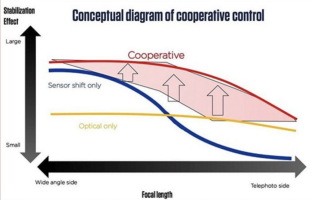
A red herring, perhaps? The additional benefit from IBIS at 100-200mm is meaningful and at 300mm it’s marginal, but the benefit at 400mm is negligible. See the illustration from Canon below, IBIS effect is the blue line – note how it drops to near-zero as the focal length increases. Conversely, at the wide end lens IS offers no real benefit over IBIS alone, which is why both the RF 24-70/2.8L IS and the RF 28-70/2L can deliver 8 stops of IS even though the latter lens lacks IS.

1770039196826.png
 
  • Like
Reactions: 1 user
Upvote 0