AFMA Callibration - How much is too much?

Status
Not open for further replies.
CanonCollector said:
There is some great information here. What I am not reading is that these adjustments have made a noticeable difference in IQ. Is that just implied?

Too early to tell for me, preliminary test say yes but I will have more to report after shooting an event this weekend.
 
Upvote 0
CanonCollector said:
There is some great information here. What I am not reading is that these adjustments have made a noticeable difference in IQ. Is that just implied?

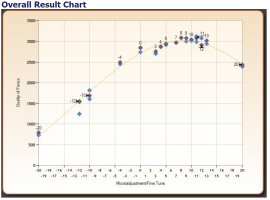
Absolutely. The increase in IQ by calibrating AFMA is staggering. It is both quantifiable and easily noticed when shooting is the field. If your AFMA is off by even a little bit your image IQ will drop dramatically. I have attached a chart that plots IQ for one of my lenses through the AFMA range that was generated by foCal. Before I calibrated this lens I was always complaining that my images looked soft at 100%. As you can see the optimal AFMA point for this lens is +8. I was shooting at the default of 0 and my IQ was suffering. Now I consistently bring home tack sharp images at all shooting distances whether short or long. I am more careful now on how many images I take in a shoot because it is daunting to have to go through hundreds of images that are all sharply in focus. I used to be happy with the 10-15 "lucky" hots I brought home... now my keeper rate is much much higher.

This chart represents the IQ of the following test setup:
Canon 1DIV
600mm F4 NON IS
Distance to target 43 feet
12EV lighting
Fully Automatic Test
 

Attachments

  • FOCAL-CHART-600.jpg
    FOCAL-CHART-600.jpg
    177.8 KB · Views: 583
Upvote 0
If you consistently shoot at F8 or so the AFMA adjustment may not be noticeable as most lenses will AF within the DOF range at smaller apertures. AFMA adjustments shine when shooting wide open or close to wide open or when the lens or camera are terribly out of spec with each other.

Some lenses are soft anyway wide open so results may vary on consumer grade glass. Focal allows high quality lenses to work as designed. Even so, the affects of uncalibrated focus and diffraction will compound so getting the focus right in the first place may help even a consumer lens appear sharper.

Where I'm not 100% totally sold on it is that the software bases it's results on repeatability at different AFMA settings. Honestly if your lens focus varies at one AFMA setting, it should vary just as much statistically at any other AFMA setting. So say if AFMA 4 gave you 100% repeatability but AFMA 2 maybe 25% but 2 resulted in some shots with a higher IQ, AFMA 4 would be favored.

I am struggling with an instance with my 300mm where it recommends AFMA 4 but visually the image resolves the test target at AFMA 2 much better. The nice thing is that the software charts the results as shown by another user here. You can decide which AFMA value to use based on the results.

I'm leaning toward using the AFMA that produced the highest IQ on the test chart. If my combo seems to have a higher repeatability with a soft image it's not really giving me anything.

CanonCollector said:
There is some great information here. What I am not reading is that these adjustments have made a noticeable difference in IQ. Is that just implied?
 
Upvote 0
Jamesy said:
What is the name of the FoCal test you ran to generate that chart? I did a sharpness (aperture test) test on my lenses but it did not look like that.

"Fully Automatic AF Microadjust"

When the test is complete make sure you save it. This will create a PDF which you can view all of the data from the test as well as this visual chart of the data.

I use FoCal Pro.... not sure if that matters but not all versions show the detailed analysis.
 
Upvote 0
canon816 said:
Jamesy said:
What is the name of the FoCal test you ran to generate that chart? I did a sharpness (aperture test) test on my lenses but it did not look like that.

"Fully Automatic AF Microadjust"

When the test is complete make sure you save it. This will create a PDF which you can view all of the data from the test as well as this visual chart of the data.

I use FoCal Pro.... not sure if that matters but not all versions show the detailed analysis.

Thanks for that. I use FoCal Pro. It is on the second page of the detailed report
 
Upvote 0
bkorcel said:
If you consistently shoot at F8 or so the AFMA adjustment may not be noticeable as most lenses will AF within the DOF range at smaller apertures. AFMA adjustments shine when shooting wide open or close to wide open or when the lens or camera are terribly out of spec with each other.

Some lenses are soft anyway wide open so results may vary on consumer grade glass. Focal allows high quality lenses to work as designed. Even so, the affects of uncalibrated focus and diffraction will compound so getting the focus right in the first place may help even a consumer lens appear sharper.

Where I'm not 100% totally sold on it is that the software bases it's results on repeatability at different AFMA settings. Honestly if your lens focus varies at one AFMA setting, it should vary just as much statistically at any other AFMA setting. So say if AFMA 4 gave you 100% repeatability but AFMA 2 maybe 25% but 2 resulted in some shots with a higher IQ, AFMA 4 would be favored.

I am struggling with an instance with my 300mm where it recommends AFMA 4 but visually the image resolves the test target at AFMA 2 much better. The nice thing is that the software charts the results as shown by another user here. You can decide which AFMA value to use based on the results.

I'm leaning toward using the AFMA that produced the highest IQ on the test chart. If my combo seems to have a higher repeatability with a soft image it's not really giving me anything.

CanonCollector said:
There is some great information here. What I am not reading is that these adjustments have made a noticeable difference in IQ. Is that just implied?

You are absolutely right. Shooting at F8 "hides" the fact that a lens might not have optimal AFMA settings. Also you are correct that the repeatability of this test is more reliable with higher end lenses. While wide open may not be the "sweet spot" for real life shooting you need to test wide open so that the images produce the narrowest DOF for the software to analyze appropriately.

It is worth mentioning that FoCal is not only a tool for calibration, but can expose other issues as well. If you have a lens that will not produce a repeatable AFMA point or wide variability along the plotted chart line it can indicate that there is a problem with the lens (or body). No amount of calibration will correct defaults that produce results like this. A problem like this may need service from canon... but you might never know without running tests...
 
Upvote 0
Yep it does uncover repeatability issues but what I was saying is that it might not be a good idea to base your result on an AFMA that appears to be repeatable. It may not be the AFMA that has the best IQ. That is what I'm finding.

canon816 said:
bkorcel said:
If you consistently shoot at F8 or so the AFMA adjustment may not be noticeable as most lenses will AF within the DOF range at smaller apertures. AFMA adjustments shine when shooting wide open or close to wide open or when the lens or camera are terribly out of spec with each other.

Some lenses are soft anyway wide open so results may vary on consumer grade glass. Focal allows high quality lenses to work as designed. Even so, the affects of uncalibrated focus and diffraction will compound so getting the focus right in the first place may help even a consumer lens appear sharper.

Where I'm not 100% totally sold on it is that the software bases it's results on repeatability at different AFMA settings. Honestly if your lens focus varies at one AFMA setting, it should vary just as much statistically at any other AFMA setting. So say if AFMA 4 gave you 100% repeatability but AFMA 2 maybe 25% but 2 resulted in some shots with a higher IQ, AFMA 4 would be favored.

I am struggling with an instance with my 300mm where it recommends AFMA 4 but visually the image resolves the test target at AFMA 2 much better. The nice thing is that the software charts the results as shown by another user here. You can decide which AFMA value to use based on the results.

I'm leaning toward using the AFMA that produced the highest IQ on the test chart. If my combo seems to have a higher repeatability with a soft image it's not really giving me anything.

CanonCollector said:
There is some great information here. What I am not reading is that these adjustments have made a noticeable difference in IQ. Is that just implied?

You are absolutely right. Shooting at F8 "hides" the fact that a lens might not have optimal AFMA settings. Also you are correct that the repeatability of this test is more reliable with higher end lenses. While wide open may not be the "sweet spot" for real life shooting you need to test wide open so that the images produce the narrowest DOF for the software to analyze appropriately.

It is worth mentioning that FoCal is not only a tool for calibration, but can expose other issues as well. If you have a lens that will not produce a repeatable AFMA point or wide variability along the plotted chart line it can indicate that there is a problem with the lens (or body). No amount of calibration will correct defaults that produce results like this. A problem like this may need service from canon... but you might never know without running tests...
 
Upvote 0
CanonCollector said:
There is some great information here. What I am not reading is that these adjustments have made a noticeable difference in IQ. Is that just implied?

One unit of AMFA is 1/8 of the depth of focus for the lens at max aperture, so an adjustment of units means your combination is off by a full depth of focus. Whether or not that makes a difference depends on how you shoot. If you only shoot stopped down to f/5.6 or narrower and your subjects are always relatively distant, AFMA likely will not matter. If you shoot at wide apertures, with close subjects, basically any time the DoF is shallow, it makes a big difference. Obviously, the amount matters, too - a 2 unit adjustment on an f/4 lens isn't going to make much difference, but a 4 unit adjustment on an f/2 or faster lens will be noticed.

canon816 said:
Absolutely. The increase in IQ by calibrating AFMA is staggering. It is both quantifiable and easily noticed when shooting is the field. If your AFMA is off by even a little bit your image IQ will drop dramatically. I have attached a chart that plots IQ for one of my lenses through the AFMA range that was generated by foCal. Before I calibrated this lens I was always complaining that my images looked soft at 100%. As you can see the optimal AFMA point for this lens is +8. I was shooting at the default of 0 and my IQ was suffering.

Right - a big difference because you were off by a full depth of focus. But it really is lens/camera dependent. If you look at your plot, you can see that if you set a value between 7 (or perhaps 5) and 13, there would not be a meaningful, real-world difference. If the lens with your camera had been in the -3 to +3 range, you'd likely not have needed the adjustment at all.

But...when it's needed, it makes a huge difference.
 
Upvote 0
neuroanatomist said:
Moody Blues said:
I would be interested to see what others have had to AFMA input into their 1DX's.

Here are mine.

16-35L II: W=4, T=7
24-105L IS: W=4, T=2
28-300L IS: W=4, T=4
70-200L IS II: W=2, T=2 (haven't done it with 1.4x/2x TCs yet)
100-400L IS: W=-1, T=1
35L: 4
40 pancake: -1
85L: 0
100L Macro IS: 3
135L: 0

Did you do them manually or did you use Focal?

thanks
 
Upvote 0
neuroanatomist said:
balaji said:
Hi, Did you use any software for Camera/Lens calibration? Is there any online tutorial or best method to calibrate. I have a 5DM3, 24-105L F4, 70-200L F4 IS USM. Any advice is appreciated

I use Reikan FoCal Pro, highly recommend it. For my 1D X, manual mode is currently the only option, 5DIII works in semi-auto (for my 7D, and the 5DII I used to have, calibration is fully automatic).

For manual AFMA, I wrote a tutorial for TDP, based on LensAlign Pro, but with a DIY option as well.

Thanks
 
Upvote 0
thank you guys for the ( workaround )
600 f/4 +7
600 f/4 & 1.4III +8
200 f2.0 +7
200 f/2.0 & 1.4III +14
100-400 F/4.5 W-5 T- 0
70-200 F/ 4.0 W-5 T- 5
100 2.8 -0
17-40 F/4.0 W-0 T-0
 
Upvote 0
neuroanatomist said:
JEAraman said:
Did you do them manually or did you use Focal?

Both at once. :P Since the 1D X isn't supported by FoCal yet, I took all the shots manually, then loaded the images into FoCal for analysis in Manual Mode.

Bought the software a while back and never got the chance to try it out. Gotta learn auto before jumping on to manual on focal. :P
 
Upvote 0
Status
Not open for further replies.