Anyone else interested in 1Dx M2 with APS-c sensor?

bdunbar79 said:
What do you want? How many stops do you think can be improved at high ISO? We're at the limit.
How about a 7D III with high iso capabilities of D500. Am I the only Canon user into this? Well, I think 1-2 stops could be improved. D500 has just showed us there is a LOT room for improvements. So we aren't at the limit really, only Canon is IMO. But back to the point, I am only interested if the 7D successor brings major upgrades to the table. The only reason why I have not switched to 7D II is the IQ at high ISO, as plenty of my wildlife photography takes place at dusk and dawn. After editing numerous high iso pics taken with D500, I would say it equals to my 6D FF camera when it comes to high ISO. Anything here you don't agree with?
 
Upvote 0
AdamBotond said:
bdunbar79 said:
What do you want? How many stops do you think can be improved at high ISO? We're at the limit.
How about a 7D III with high iso capabilities of D500. Am I the only Canon user into this? Well, I think 1-2 stops could be improved. D500 has just showed us there is a LOT room for improvements. So we aren't at the limit really, only Canon is IMO. But back to the point, I am only interested if the 7D successor brings major upgrades to the table. The only reason why I have not switched to 7D II is the IQ at high ISO, as plenty of my wildlife photography takes place at dusk and dawn. After editing numerous high iso pics taken with D500, I would say it equals to my 6D FF camera when it comes to high ISO. Anything here you don't agree with?

You don't even know what you're arguing. First you complained that the 1Dx 2 has no improvement or little, in high ISO development. That's because it's a FF sensor and no, there is not room for improvement there. Then in this thread you change to APS-C sensors. Of course there's room for improvement there, but overall nobody is going to get more than 10 stops on any sensor. That's pretty much the limit. So again, the tech improvements will be in read noise.
 
Upvote 0
Interesting Act444.
Posts by Art Morris show there is little to choose between the 7D2 and 5D3 image wise even when cropped but if I recall correctly, others say that the AF of the 5D3 is marginally more secure.

The question I have is regards ISO performance. A lot of these experienced bird photographers seem to have the luxury of southern US and the better light quality. Me? I'm stuck in NW England which is further north than Vancouver and it is the payoff of ISO v quality that I am toying with. What sort of conditions were you shooting in?
 
Upvote 0
Mikehit said:
Interesting Act444.
Posts by Art Morris show there is little to choose between the 7D2 and 5D3 image wise even when cropped but if I recall correctly, others say that the AF of the 5D3 is marginally more secure.

The question I have is regards ISO performance. A lot of these experienced bird photographers seem to have the luxury of southern US and the better light quality. Me? I'm stuck in NW England which is further north than Vancouver and it is the payoff of ISO v quality that I am toying with. What sort of conditions were you shooting in?

As the iso goes up and light and contrast come down the cropped ff camera is favoured, the bigger pixels have better performance.

Good light and contrast is when the crop camera is favoured, but by a surprsingly small amount.

I used to post these comparisons a lot when crop vs cropped FF was THE topic, fallen out of favour since the DR wars took over :-)

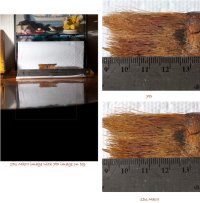
Test is from years ago of a 7D vs cropped 1Ds MkIII, but the same generation thing is the key, my findings have held up well over time when comparing same generation sensors. Conditions were set up to favour the 7D, this is the biggest difference you will ever see, and you will never see that big a difference in 'real world' shooting conditions. Same lens, light, aperture, iso, massive tripod, cable release, live view 10X manual focus (despite this there is a difference in plane of focus, the 1Ds MkIII is focused behind the 7D which makes the ruler look sharper in the 7D image, but the paper towel is much sharper in the 1Ds MkIII image) etc etc.

First image is full frame with the 7D image overlayed on it with the crops at 100% for the 7D and the 1Ds MkIII upsampled to match the pixel numbers (you can argue the methodology but I wanted to see the differences as I would process them).

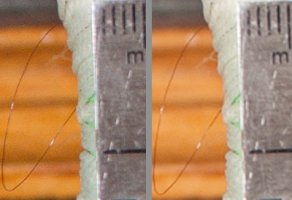
Second image is a fraction of the same frame, 7D well over 200% and 1Ds MkIII at well over 300%. That is a single human hair from about 25 feet away. Where is double the number of the 7D pixels going?
 

Attachments

  • index.jpg
    index.jpg
    161 KB · Views: 1,132
  • index-1.jpg
    index-1.jpg
    38.3 KB · Views: 1,148
Upvote 0
privatebydesign said:
First image is full frame with the 7D image overlayed on it with the crops at 100% for the 7D and the 1Ds MkIII upsampled to match the pixel numbers (you can argue the methodology but I wanted to see the differences as I would process them).

Second image is a fraction of the same frame, 7D well over 200% and 1Ds MkIII at well over 300%. That is a single human hair from about 25 feet away. Where is double the number of the 7D pixels going?

Thanks Privatebydesign.
On the whole I agree with your ideas, and the tests by Art Morris backs up what you say. In those images I can discern a difference in favour of the 7D (small, but noticable) but I am not sure if it is about detail or contrast and in my experience it is the sort of detail that can give disporportionate impression in the final image.
Or maybe the difference is because of the different focus points you mention?

But I also wonder if the differences start to diverge at higher ISOs: so what ISO was that?
Also, there are times where I sometime underexpose a tad to get a better shutter speed and better pixel quality will give a benefit there as well
 
Upvote 0
Mikehit said:
privatebydesign said:
First image is full frame with the 7D image overlayed on it with the crops at 100% for the 7D and the 1Ds MkIII upsampled to match the pixel numbers (you can argue the methodology but I wanted to see the differences as I would process them).

Second image is a fraction of the same frame, 7D well over 200% and 1Ds MkIII at well over 300%. That is a single human hair from about 25 feet away. Where is double the number of the 7D pixels going?

Thanks Privatebydesign.
On the whole I agree with your ideas, and the tests by Art Morris backs up what you say. In those images I can discern a difference in favour of the 7D (small, but noticable) but I am not sure if it is about detail or contrast and in my experience it is the sort of detail that can give disporportionate impression in the final image.
Or maybe the difference is because of the different focus points you mention?

But I also wonder if the differences start to diverge at higher ISOs: so what ISO was that?
Also, there are times where I sometime underexpose a tad to get a better shutter speed and better pixel quality will give a benefit there as well

Yes the apparent differences are due to the different plane of focus. The ruler is sharper in the 7D image, the paper towel is much sharper in the 1DS MkIII image. And don't forget, whilst the differences (from my bad technique) might appear noticeable, you are looking at them at well over 100% (well three of them) which are insane crops or print sizes.

They are shot at 200iso, which favoured the 7D, it was supposed to be base iso for the 7D and put the 1DS MkIII at a disadvantage as that has a base iso of 100 and definitely has more noise at 200 than 100. Having said that the 7D iso was not clear cut, some say 160 was base others that max DR was at 100 which would put both cameras at the same disadvantage.

Underexposure will kill small pixel performance (at the pixel level) faster than anything else, there is a good reason the 1DX MkII has 20MP and the 5DS is capped at 6400. In this 'reach limited' scenario pixel performance is far more important than pixel numbers.
 
Upvote 0
Thanks PBD for sharing. The 7D does appear to be a bit better at first glance, but then again, with the differences in the plane of focus, it's really hard to tell for sure.

I went out with the 5D3 and 100-400 on a dedicated animal shooting trek and the results I came back with pretty much affirms my initial findings and my earlier post. In bright daylight I found little (if any) difference to the 7D- MAYBE the 5D still renders the fine details a bit better, but it was close enough where you could not tell which camera took which shot unless you REALLY scrutinized it at 100%. In the shade, however, it was a different story. And THAT'S where the vast majority of the shots were taken! The ISO climbs as high as 3200...and while the 7D all but turns details to mush at that setting, the 5D3 still retains some of that crispness in most cases (although it's not as good as at the lower ISOs).

The 7D really begins to fall apart above 800 or so in terms of retaining fine detail. Meanwhile, the 5D3 is crisp all the way to 1600, and at 3200 still does an admirable job. IMO (and experience), the ISO 1600-3200 range is where the separation between FF and crop appears to be the greatest - I'm not just talking noise-wise here. It also happens to be a range I shoot rather frequently in - whether it's animal shooting or an indoor event/show.
 
Upvote 0
ahsanford said:
privatebydesign said:
Got any empirical evidence from same generation crop and ff sensors to back up a meaningful 'reach advantage'? I've looked many times and have yet to see any.
I'm just saying that if you want to fill your frame with some varmint at a set distance away, a 'crop 1DX' will get that shot with a less expensive lens, that's all.

- A

I have to disagree with your point Mr. Sanford. I cannot see the point of that at all.

For me, I just don't think the "reach" argument is strong enough especially when one says the point is to use non L glass. In that case the whole point is moot. Better off with a 7D Mark II with L glass. 7D mark II = $1,499, EF 70-200mm f/2.8L IS II USM = $1,949, EF 400mm f/5.6L USM = $1,149 for a total of $4,597.00)

One could even throw in a Canon EF 24-70 f/2.8L II USM ($1,749.00) drop the 400mm f/5.6L and add a 2x III extender and it still comes out to $5,626.00.

A real bargain compared to a single theoretical 1D crop (Assuming a crop 1D is same price as a 1Dx $4,599.00) and a single non-Canon zoom lens (Tamron SP 150-600mm F/5-6.3 Di VC USD AF lens (which is very dark) @ $1,010.48 = $5609.48

Honestly, which of the two ideas would you like best?

Now, a 1D crop camera with which inexpensive glass? I just do not see the upside at all. Even if a crop sensor 1D body is a $1,000 less than a 1Dx Mark II (And I don't think it would be). By the time one buys it and buys just one less expensive 3rd party lens it works out about the same and one is left with the 1D crop camera and only one lens. Nothing else. ;) With the 7D Mark II you end up with a whole fantastic kit.

Not knocking you Mr. Sanford. I have a lot of respect for you. I just do not see the upside at all. One could even drop the 400mm f/5.6L and just throw a Canon 2X III extender ($429.00) on the 70-200mm which will give you 400mm f/5.6L with IS. That brings the total down to $3,877.00 without the Canon 24-70 II, or $5,626.00 with the Canon 24-70 II. (All prices from Adorama.)

I don't know which inexpensive glass you mean. Maybe a Sigma? I just don't know and I may have misinterpreted the point you were making. The way I see it, the point does not add up $$$ wise.

Let's say a crop 1D body costs $4,599 if it gets made. Add a Sigma 500mm f/4.5 EX DG APO HSM Auto Focus Telephoto Lens for $4,399.00 and we are at $8,998.00. This is one way I might see an advantage. Only past 400mm I think. And only with a prime.

I just think the 7D mark II with a grip will give the same "feel" in the hand and get the same job done as a 1D body at a much less expensive price, and you get a whole collection of stellar L glass... since you mentioned price.

7D mark II ($1,499) + Sigma 500mm f/4.5 EX DG APO HSM Auto Focus Telephoto Lens ($4,399) = $5,898.00... $3,100 less than the theoretical 1D crop with the same lens.

7D Mark II ($1,499) + Canon EF 300mm f/2.8L IS II USM Lens ($6,099) + 2X III ($429) = $8,827, but the Canon lens is in a whole other category than the Sigma and you effectively have two lenses instead of just one with the Sigma. $171.00 less than the Sigma on a theoretical $4,599 1D crop body.

Yes, you could extend the Sigma to 1000mm, but it will be very dark (f/9, I think), almost impossible to get a photo of a moving varmint (varmints are small), and probably not near the IQ of the Canon setup.

What you would prefer: The Canon @ 600mm f/5.6 or the Sigma @ 1000mm f/9? I'll take the Canon. Someone wrote somewhere that FF sensors are 1 stop faster than crop sensors. I don't know whether that is true or not. If true, then the Sigma really sucks if it mounts to an EF-S Canon.

I do not see a $$$$ advantage you mention. I don't see a speed advantage at 1000mm either (shutter or f stop).

I know you are comparing a 1Dx to a theoretical 1D crop, but the 1D crop just doesn't add up to me when there is the 7D mark II or one day the 7D mark III. Also, I don't know if the Sigmas or Tamrons I mentioned are full frame or crop. Can they be used on an EF-S mount?

I know, a rambling post, but you know how I am. ;)

Hope you have a great day my friend. :)
 
Upvote 0
AdamBotond said:
bdunbar79 said:
What do you want? How many stops do you think can be improved at high ISO? We're at the limit.
How about a 7D III with high iso capabilities of D500. Am I the only Canon user into this? Well, I think 1-2 stops could be improved. D500 has just showed us there is a LOT room for improvements. So we aren't at the limit really, only Canon is IMO. But back to the point, I am only interested if the 7D successor brings major upgrades to the table. The only reason why I have not switched to 7D II is the IQ at high ISO, as plenty of my wildlife photography takes place at dusk and dawn. After editing numerous high iso pics taken with D500, I would say it equals to my 6D FF camera when it comes to high ISO. Anything here you don't agree with?

I have been a long time Canon shooter and have been taking a serious look at the D500. I want to go to the next level AF and I'm not happy about the prospect of spending $6,000 on a 1DX II. I don't need 14 FPS and I'm not fan of gripped bodies. Nikon puts their top AF tech into prosumer bodies.
 
Upvote 0
digital paradise said:
I have been a long time Canon shooter and have been taking a serious look at the D500. I want to go to the next level AF and I'm not happy about the prospect of spending $6,000 on a 1DX II. I don't need 14 FPS and I'm not fan of gripped bodies. Nikon puts their top AF tech into prosumer bodies.

And so does Canon. The 7D2 has effectively the same AF as the 1DX you see on every sports sideline (with small and noted exceptions*).

*If you want to get in the weeds, you can review that here:
http://www.the-digital-picture.com/Comparisons/Canon-EOS-7D-II-1D-X-5D-III-AF-Comparison.aspx
(spoiler alert: 7D2 does just fine)

And, in time, the even better 1DX2 AF setup will similarly find its way into a future 7D3. So to imply Canon doesn't take crop/prosumer bodies seriously is outright laughable -- they've had a stranglehold on this market segment for a very long time.

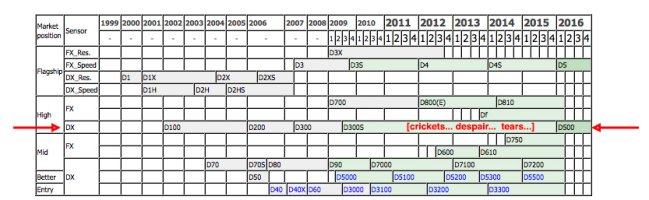
Also keep in mind Nikon altogether abandoned the 'crop flagship' market segment for... how many years was it? Seven?! How do you know Nikon will still have your back once you've invested in all their glass? They may get bored with this segment and abandon it again... Caveat emptor.

- A
 

Attachments

  • D500 timeline.jpg
    D500 timeline.jpg
    100.1 KB · Views: 169
Upvote 0
9VIII said:
privatebydesign said:
I was very interested in this comparison when the 7D came out, I owned the 1DS MkIII and extensively tested the two to see how much difference there was between cropping the FF against using all the frame of the crop camera given the 7D would give me more than double the pixels in the same area. It turned out that even under test conditions set up to favour the 7D the differences were minimal.

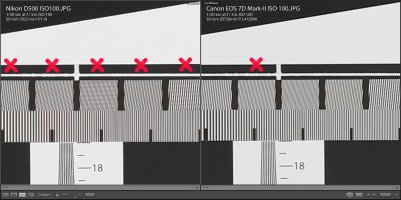
The 7D has a notoriously strong AA filter, everything past the 650D using that sensor was much sharper on the pixel level. At low ISO I think the Rebel 760D has the sharpest image overall right now, Canon still keeps the AA strong on the 7D2, and I think the 80D is still softer than the 760D.
Which seems to indicate that Canon is more concerned about moire on the higher end models.
To AA-filter, or not to AA-filter that is the question...
 

Attachments

  • noAA vs AA.jpg
    noAA vs AA.jpg
    954 KB · Views: 155
Upvote 0
Guys less testing of cameras regardless of APS-C or FF and more on lenses. Recently was testing filters on the 5DS using a light sphere fitted with a CIPA high resolution chart. I used a number of different Canon L lenses we have and was shocked at just how bad some were (we tested with & without filters to see how much of a resolution loss the filters were producing). The difference being talked about regarding resolution between APS-C & FF sensors are not real world in the life-cycle of CMOS today whereas differences between lenses are and on that I would differ with Keith at Northlight it pays to check any new lens you purchase fully and exchange it if your unhappy.
 
Upvote 0