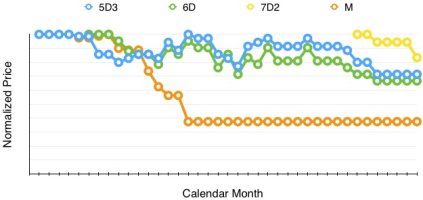
Impossible to know without having access to proprietary market information from Canon, so I presume you only want peoples' opinions. Some thoughts:
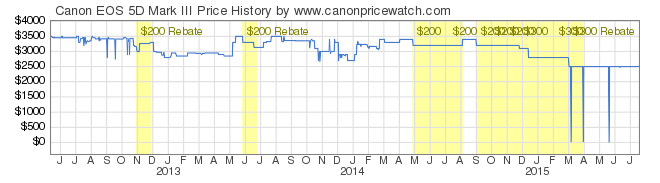
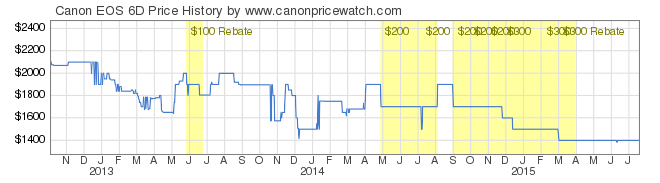
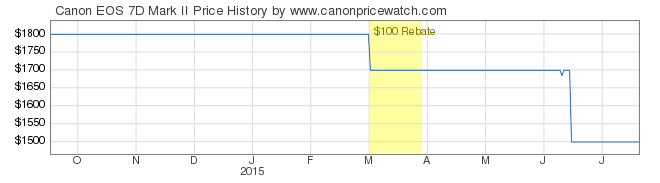
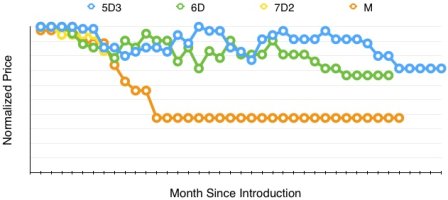
There are way too many variables to draw conclusions about the relative success of a particular model based on the price history.
Don't put too much stock into exchange rate fluctuations. Canon is a multinational company and their costs in yen are only a small portion of the cost of a camera. For example, all the costs of Canon USA must be paid in dollars. The substantial sales and support network, advertising dollars, shipping, warehousing, etc., etc. are paid in local currency and unaffected by the yen.
The exchange rate is having an impact, but not in the way many people think. We are seeing it in the substantial discounts that unauthorized dealers offer for import versions of the cameras. That has definitely driven down the price in the U.S., as authorized dealers skirt the MAP prices in order to compete. (And buyers purchase more import models, as well.)
Keep in mind too that we don't know what the cost to dealers is. Some of the price drops in the currently competitive market are the result of dealers skirting MAP and taking less profit. This doesn't affect Canon's bottom line.
Remember that you are comparing cameras of different release dates. Cameras always fall in value after they are released. Ordinarily, the price settles in sometime around a year after a new body is released and that price falls much more gradually for the next year or so until shortly before the next model is released. As anticipation for a replacement model increases, you may see another significant drop. Since the 5D, 6D and 7D are all at different points in their release cycles, it's misleading to try to compare them.
We are experiencing a much more mature market today than a few years ago. Another thread shows the CIPA data. It's pretty clear from that data that overall, the market is down. That another variable that would have to be factored in.
We don't know what Canon's target were for these cameras, so it's impossible to say whether or not they are selling well. When it was released, the 7D was a general purpose camera for enthusiasts. The only full frame alternative was the much more expensive 5DII. The 7DII is much more of a niche market camera aimed at those who want the extra reach of a crop sensor and 1Dx-like features in a crop body. I suspect that far more 7DIIs are being sold as second bodies than were the original 7D. (In a shrinking market, one way to expand sales is to sell more product to fewer people. I've long suspected Canon's goal was never to convert APS-C owners to full frame, but rather to get their best customers to buy both a full frame and an APS-C body).
The 6D has proven to be one of the best selling full frame cameras ever (based on its long dominance of the full frame slot among Amazon best sellers and other available sales data -- See Frodo's post). Obviously, the 6D cut into the 7D market and possibly to some degree into the 5DIII market – No doubt Canon knew that when it introduced the 6D.
Speaking of the 6D, there were many who felt its price at introduction was high in comparison to Nikon's comparable model. So, it's not surprising it has fallen from that introduced price.
In short, you simply can't pick one data point (retails prices on this day) and draw any conclusion.