Edwin Herdman said:
- Get a telescope that seems to match what you want. Obviously it should allow a t-mount connection (the "t" seems to stand for Tamron, surprisingly enough it was apparently a legacy mount style of theirs).
While some scopes have dedicated adapters to go to T-mount, the fail safe option is to get an eyepiece adapter. This fits between the camera T-mount adapter and the scope eyepiece holder.
- Get a motorized (hopefully computerized) mount for it (if you're handy you can construct one yourself; there are some guides on the net). This is important because the very long exposures required for a good photograph mean that the Earth will rotate during the time of the photograph, and so you will get star trails if you don't follow the part of the sky you're trying to image. On the other hand, this can be used to good effect (point at Polaris and take a long exposure). Some of the computerized mounts should offer an automatic orientation ability, which doesn't really stretch your knowledge of the stars and takes a long while to complete, but it might be accurate if you're having trouble finding something or just don't really know where to look.
One more detail here: if you want to do half serious long exposure work, you need an equatorial mount, or a mount that can be adapted to such. While Alt-Az mounts can track, you will get field rotation over time. Sticking the alt-az mount onto a wedge is one way to convert it to an equatorial mount. This means one of its axis of rotation will match that of the earth.
Now you can take long exposures. You will be using "bulb" mode to do it, partly because the telescope will be a "slow" lens (f/8 or smaller) pointed at an already dim sky. A very sturdy telescope mount will be helpful, and so will a remote release.
A timer remote off ebay has proved invaluable here!
If you don't like the way the photos are turning out, try using the Registaxx software to "stack" multiple images to reduce noise.
Stacking is practically a requirement for deep sky stuff, especially if using a DSLR. I have to admit I haven't tried registax in a long time, but it seemed more suited for processing the video output of webcam imaging.
Deep Sky Stacker is targeted at deep sky objects.
IRIS does everything, if you can ever figure out how to use it! Beyond that is a selection of commercial software also. I've started using
PixInsight as I got frustrated by DSS' limitations.
DSLRs are used by serious amateur photographers who don't have enough scratch to buy one of the professional imagers ($X000-$X0000+ and not likely to be less than the cost of a professional full frame camera, for what is basically a box with control lines for a computer connection). DSLRs can capture video, too; usually on par with the webcams (if not better), and the sensor of a DSLR will be larger as well. There is also that not minor detail of webcams being unsuitable for connection to a telescope. However, I'm not sure that with either video method you will have enough of an exposure to capture enough signal to resolve astronomical objects, especially through a slow (f/8 or smaller) telescope lens.
The webcam suggestion is specifically for planets, and typically moon surface detail too. Planets are small and bright, and DSLRs with their relatively big pixels are harder to work with. You get the crop factor advantage with a webcam, not imaging tons of empty space. A DSLR video doesn't work as well here since you're effectively using far too big a pixel size and might even fall between line skipping, although with the latest ones which can do sensor crop it might not be so bad. Actually "webcams" are so popular a method for doing this, the scope manufacturers do their own dedicated versions too: the
Meade LPI and the
Celestron NexImage.
A DSLR does come in as a value option for deep sky imaging, where you can make use of the size and can be matched with either lenses (which is what I use) or scopes.
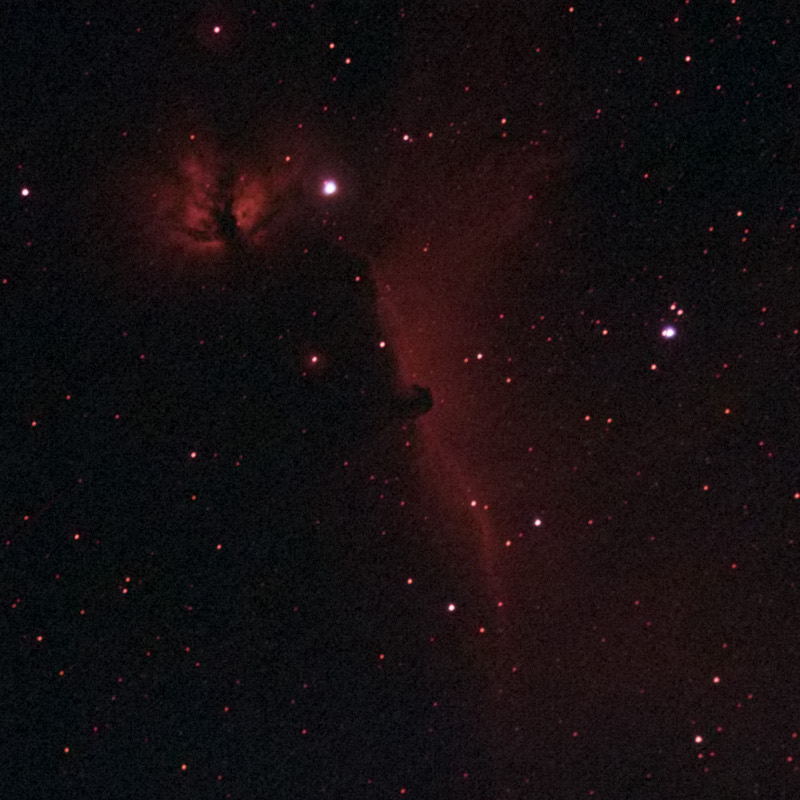
For example, this is a total of less than 30 minutes (14x2m) of exposure time from last night, 100% crop. I know it can be a lot better, but the weather isn't something I can control so I ran out of time to do any more. That was with a modified Canon 450D (increases sensitivity in deep reds), H-alpha filter, 135mm f/2 and astrotrac mount. Light pollution included at no extra cost. I wish I didn't sell the 300/2.8 now...