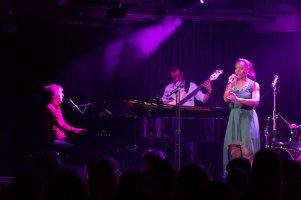
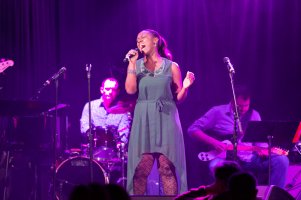
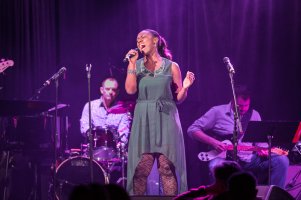
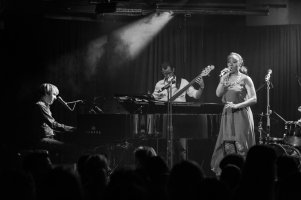
Stage lighting is a real pain to work with. Stages are always lit for audience effect, not for photographers (unless the performance is being filmed or televised).
One thing that does come to mind, is the skin tone on the female singer. I'm wondering if she is actually a bit over exposed. Not to sound racially motivated, but her skin tone in the images is perhaps lighter than it should be, suggesting a little over exposure. I know its very hard to estimate, because skin tone varies a whole lot in individuals. She looks very nice in the images, but I don't know how she actually appeared. Everyone, please think of what I said as a technical comment from a guy who has shot more than his share of mixed race weddings... jeeze... ugh.. the lighting, not someone trying to make some racial statement.
I've shot my share of jazz bands too. Often, stage lighting is moody... extreme, dramatic, sparse, and not what you want. My fallback for those jazz bands was always an M3 Leica with 35mm and 90mm lenses, and either 2475 Recording or later the Illford 3200 high speed stuff... processed very very carefully (for grain reduction).
I think you could have used a stop less exposure and corrected in post... maybe a stop and a half.
This is maybe strange, but I'm thinking about bird photography for a moment. I remember three weeks of shooting birds down at Flamingo in the Everglades. Had a terrible time with some white herons. They simply did not meter. This was film days, but I was shooting K200 in 35mm and 120 sizes. Out for processing.... back in three days. Total crap. Had to find the birds... shoot again... still crap. The only determination I could make was the birds plumage was reflecting in a way that the meter could not see. I was using a Pentax digital spotmeter, and the small area meter on Canon F1 cameras. They literally glowed... not unlike "glowing" of certain laundered white clothes under UV lighting. I'm wondering if some of that is going on in the digital world, as represented by your images.