
You are using an out of date browser. It may not display this or other websites correctly.
You should upgrade or use an alternative browser.
You should upgrade or use an alternative browser.
Can someone please school me on Reikan FoCal??
- Thread starter gqllc007
- Start date
BLFPhoto
Canon EOS user since '91...
Agreed. It is a great tool that will provide you a lot of insight on the workings of your cameras and lenses. I have a ton of gear and automating the process of doing periodic lens cals is a lifesaver to me. And with four or more semi-annual lens calibrations for most of my equipment, I now feel I have an adequate baseline to not only understand the general condition of my equipment, but also spot significant degradation that may need attention at CPS. When combined with my CPS membership's annual CLS program, I now worry little about whether or not my equipment is working properly.
The use is very straight forward, and easy. I will second the advice to ensure good light levels. When I first got it I tried with light levels of 7 or 8 and found that the results would vary under back to back tests using the same settings and gear. That caused me some doubt about the efficacy of the software and method. When I supply sufficient light for the test, more than 9 in my experience, I find that the test result variability goes away and I have confidence in the readings. I suspect many of those who have tried and don't like the software due to "unreliability" were not supplying sufficient light. It is a calibration operation and ought to be performed in optimum, repeatable conditions. I use the same lighting, the same distances, etc, now for every time I run my gear through a check. When aproached thusly, you will find it extremely useful.
The use is very straight forward, and easy. I will second the advice to ensure good light levels. When I first got it I tried with light levels of 7 or 8 and found that the results would vary under back to back tests using the same settings and gear. That caused me some doubt about the efficacy of the software and method. When I supply sufficient light for the test, more than 9 in my experience, I find that the test result variability goes away and I have confidence in the readings. I suspect many of those who have tried and don't like the software due to "unreliability" were not supplying sufficient light. It is a calibration operation and ought to be performed in optimum, repeatable conditions. I use the same lighting, the same distances, etc, now for every time I run my gear through a check. When aproached thusly, you will find it extremely useful.
Upvote
0

I pre-ordered it before it was released, and have found that it gives accurate results when used as directed.
You must pay attention to the requirements, have bright lighting, cover the camera eyepiece, have a stable tripod, and make sure your distance to target is adequate.
They have a blog which has covered some of the things they have learned over the years, -age back thru a couple of years worth of posts, there is some interesting reading. I posted a link to some recent ones.
http://www.reikan.co.uk/focalweb/index.php/blog/
http://www.reikan.co.uk/focalweb/index.php/2014/05/cant-5dmk31d-x-nikon-cameras-completely-automated/
http://www.reikan.co.uk/focalweb/index.php/2014/05/preview-reikan-focal-focus-shift-test/
http://www.reikan.co.uk/focalweb/index.php/2014/02/reikan-focal-rgb-analysis/
You must pay attention to the requirements, have bright lighting, cover the camera eyepiece, have a stable tripod, and make sure your distance to target is adequate.
They have a blog which has covered some of the things they have learned over the years, -age back thru a couple of years worth of posts, there is some interesting reading. I posted a link to some recent ones.
http://www.reikan.co.uk/focalweb/index.php/blog/
http://www.reikan.co.uk/focalweb/index.php/2014/05/cant-5dmk31d-x-nikon-cameras-completely-automated/
http://www.reikan.co.uk/focalweb/index.php/2014/05/preview-reikan-focal-focus-shift-test/
http://www.reikan.co.uk/focalweb/index.php/2014/02/reikan-focal-rgb-analysis/
Upvote
0

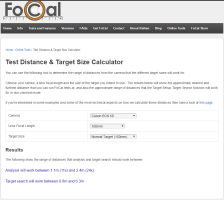
They also have a new target distance and size tool to help you determine the effective distance range to calibrate your lens,
http://www.reikan.co.uk/focalweb/index.php/online-tools/test-distance-target-size-calculator/,
and a good writeup on target distance and size considerations,
http://www.reikan.co.uk/focalweb/index.php/online-tools/test-distance-target-size-calculator/target-distance-size-information/.
http://www.reikan.co.uk/focalweb/index.php/online-tools/test-distance-target-size-calculator/,
and a good writeup on target distance and size considerations,
http://www.reikan.co.uk/focalweb/index.php/online-tools/test-distance-target-size-calculator/target-distance-size-information/.
Attachments
Upvote
0
I have question regarding light source.neuroanatomist said:Works great, IMO. You need a stable tripod, and give it lots of light, ideally >10 EV (it reports light level) from an incandescent source or direct sun (not fluorescent or LED).
Is one halogen lamp 150W is sufficient to properly illuminate the target? I find it difficult to acquire incandescent lamp ( in my country of residence) with powerful bulb. Mostly LED or Fluorescent with max power 60W and those are not recommended for Test
I hope you don't mind asking me this question in your post gqllc007
Upvote
0
DARSON said:I have question regarding light source.neuroanatomist said:Works great, IMO. You need a stable tripod, and give it lots of light, ideally >10 EV (it reports light level) from an incandescent source or direct sun (not fluorescent or LED).
Is one halogen lamp 150W is sufficient to properly illuminate the target? I find it difficult to acquire incandescent lamp ( in my country of residence) with powerful bulb. Mostly LED or Fluorescent with max power 60W and those are not recommended for Test
I hope you don't mind asking me this question in your post gqllc007
In a dark room? Probably not even close. You can't do a accurate job when adjusting manually either, in low light, AF systems operate erratically. FoCal will tell you the light level and warn you if there is not enough. What happens in low light is that results are not repeatable, so you never are sure that the value you get is the right one.
A 60W Fluorescent or led bulb would be fine, but I doubt if you will find them, the ones you are talking about are likely 7 watts. I use twelve 32 watt CRI 98 fluorescent tubes, and even then, I'd like more light. They have reflectors as well.
Go outdoors on in the early morning before the sun hits your target, or on a bright but overcast day, you should have adequate light.
Upvote
0
You're right, those 60W are equivalent to incandescent.Mt Spokane Photography said:DARSON said:I have question regarding light source.neuroanatomist said:Works great, IMO. You need a stable tripod, and give it lots of light, ideally >10 EV (it reports light level) from an incandescent source or direct sun (not fluorescent or LED).
Is one halogen lamp 150W is sufficient to properly illuminate the target? I find it difficult to acquire incandescent lamp ( in my country of residence) with powerful bulb. Mostly LED or Fluorescent with max power 60W and those are not recommended for Test
I hope you don't mind asking me this question in your post gqllc007
In a dark room? Probably not even close. You can't do a accurate job when adjusting manually either, in low light, AF systems operate erratically. FoCal will tell you the light level and warn you if there is not enough. What happens in low light is that results are not repeatable, so you never are sure that the value you get is the right one.
A 60W Fluorescent or led bulb would be fine, but I doubt if you will find them, the ones you are talking about are likely 7 watts. I use twelve 32 watt CRI 98 fluorescent tubes, and even then, I'd like more light. They have reflectors as well.
Go outdoors on in the early morning before the sun hits your target, or on a bright but overcast day, you should have adequate light.
Going outdoors- I'm worried if I will have enough time to do calibration As I live in Middle East and Sunrise and Sunset is much shorter here than in other part of the world
I saw on DP AFMA tips where Neuroanatomist was using 3 lamps each 150W for the LensAlign MkII or the DataColor SpyderLensCal . I cannot find lamps which are able to accept more powerful bulb.
How about 500W
http://www.aliexpress.com/item/Iodine-tungsten-lamp-holder-lawn-lights-spotlights-solar-lamp-outdoor-300-500w/1437767284.html
Upvote
0

Here's an old thread I started on this using FoCal:
http://www.canonrumors.com/forum/index.php?topic=19742.0
http://www.canonrumors.com/forum/index.php?topic=19742.0
Upvote
0
DARSON said:60W are equivalent to incandescent.
Going outdoors- I'm worried if I will have enough time to do calibration As I live in Middle East and Sunrise and Sunset is much shorter here than in other part of the world
I saw on DP AFMA tips where Neuroanatomist was using 3 lamps each 150W for the LensAlign MkII or the DataColor SpyderLensCal . I cannot find lamps which are able to accept more powerful bulb.
How about 500W
http://www.aliexpress.com/item/Iodine-tungsten-lamp-holder-lawn-lights-spotlights-solar-lamp-outdoor-300-500w/1437767284.html
500 might do it, but be sure to get a 5500K bulb.
I have a Tota light that is 750 watts and heats up the room as well as giving out a lot of light. The color corrected bulbs were expensive.
I just bought two inexpensive 32 watt LED work lights to try for photography. They were rated at 2000 lumens. I put them with two 85 watt CFL bulbs that put out 4250 lumens each, but the light output of the two alone is marginal. I just installed them, and have yet to test them for actual photography.
They were on sale for $35 each. They will at least make fill lights to ease shadows.
2000 lumens is about equivalent to a 200 watt incandescent lamp.
http://www.amazon.com/Snap-On-Work-Light-LED/dp/B00H5GRL3Q
You might also check out the large CFL bulbs, They come from china and are cheap. They need a light modifier or reflector, or at least, put them sideways to the subject. Pointing them at the subject without a reflector won't work.
http://www.amazon.com/gp/product/B0019HZQPM/ref=oh_aui_search_detailpage?ie=UTF8&psc=1
Upvote
0

Thanks Mackguyver your post is very informaivemackguyver said:Here's an old thread I started on this using FoCal:
http://www.canonrumors.com/forum/index.php?topic=19742.0
Upvote
0

neuroanatomist said:Works great, IMO. You need a stable tripod, and give it lots of light, ideally >10 EV (it reports light level) from an incandescent source or direct sun (not fluorescent or LED).
Fluorescent (standard lower frequency) - I'm aware of the problem.
What is it about LED light panels or fresnels that causes a problem? This one is new to me. Is it the 60 Hz flicker from alternating current on some lower end products?
Upvote
0
Maybe I did the lighting thing all wrong...I used a 150 watt flood light from Home depot and mounted it in a reflector work light from home depot and placed it 2 feet from the chart at a 30 degree angle. The focal program said EV of 10.9 and that is all I used???
Upvote
0
gqllc007 said:Maybe I did the lighting thing all wrong...I used a 150 watt flood light from Home depot and mounted it in a reflector work light from home depot and placed it 2 feet from the chart at a 30 degree angle. The focal program said EV of 10.9 and that is all I used???
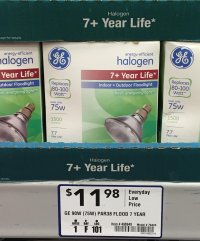
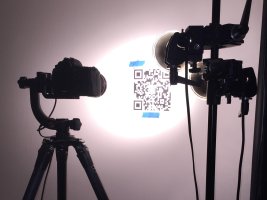
I use something similar with no problems - a pair of 75 watt equivalent floods clamped to a lightstand. Just make sure to set the white balance to the color temperature of the bulbs. This did make a difference in my tests.
I tried similar LED based floods with mixed results - sometimes you would notice the scanning in liveview which suggested they had AC flicker problems similar to fluorescent bulbs. I get more consistent results with the halogens.
Photos taken with a cell phone, talk about lack of DR

Attachments
Upvote
0


