Canon EF 16-35 f/4L IS Sample Images

Got mine today from B&H. What a beautiful lens!

Ran through FoCal 1.9.7 tonight:
AFMA: +1 at 16mm; 0 at 35mm
AF Consistency (on 5DIII): 99.7%
Aperture Sharpness: Relatively flat from f4 to f6.3 at 16mm; sharpest at f4.5 at 35mm
Quality of Focus values are lower at 35mm (max around 1,920) than at 16mm (max around 1,970).
Testing condition: 2x 150W bulbs; EV 10.6; tested at both 25x and 50x distance.

Real world shooting experience: super fast AF; IS operation is extremely fast.

I love this lens. Will take it to a trip in Oregon in August.
 
Upvote 0
Phenix205 said:
Got mine today from B&H. What a beautiful lens!

Ran through FoCal 1.9.7 tonight:
AFMA: +1 at 16mm; 0 at 35mm
AF Consistency (on 5DIII): 99.7%
Aperture Sharpness: Relatively flat from f4 to f6.3 at 16mm; sharpest at f4.5 at 35mm
Quality of Focus values are lower at 35mm (max around 1,920) than at 16mm (max around 1,970).
Testing condition: 2x 150W bulbs; EV 10.6; tested at both 25x and 50x distance.

Real world shooting experience: super fast AF; IS operation is extremely fast.

I love this lens. Will take it to a trip in Oregon in August.

If you are testing with tunsten bulbs and not natural daylight, you are limiting your testing to a shallow portion of the light spectrum. As the colour of light moved to the red end of the scale, there can be a focus shift and more inaccuracys. All you are testing there is the camera / lens focus ability under those lighting conditions.
I'm often correcting photographers who are calibrating their lenses at night (becuase that's when they have the spare time) when they should be calibrating them out doors in good light during the daytime.
 
Upvote 0
GMCPhotographics said:
Phenix205 said:
Got mine today from B&H. What a beautiful lens!

Ran through FoCal 1.9.7 tonight:
AFMA: +1 at 16mm; 0 at 35mm
AF Consistency (on 5DIII): 99.7%
Aperture Sharpness: Relatively flat from f4 to f6.3 at 16mm; sharpest at f4.5 at 35mm
Quality of Focus values are lower at 35mm (max around 1,920) than at 16mm (max around 1,970).
Testing condition: 2x 150W bulbs; EV 10.6; tested at both 25x and 50x distance.

Real world shooting experience: super fast AF; IS operation is extremely fast.

I love this lens. Will take it to a trip in Oregon in August.

If you are testing with tunsten bulbs and not natural daylight, you are limiting your testing to a shallow portion of the light spectrum. As the colour of light moved to the red end of the scale, there can be a focus shift and more inaccuracys. All you are testing there is the camera / lens focus ability under those lighting conditions.
I'm often correcting photographers who are calibrating their lenses at night (becuase that's when they have the spare time) when they should be calibrating them out doors in good light during the daytime.

It might be true. In my personal experience, however, all my lenses were calibrated at night and I have not noticed any focus shifting during daylight shooting conditions. To me consistent lighting is more critical while using software for calibration.
 
Upvote 0
Bryan at The-digital-picture.com has just published the image quality testing results. I've seen the same for my own test. This will be a great travel landscape lens.

This lens is a little soft wide open at 35mm. I've noticed that in my real world shooting. Pretty sharp across the frame at shorter (wider) focal lengths.
 
Upvote 0
Phenix205 said:
Bryan at The-digital-picture.com has just published the image quality testing results. I've seen the same for my own test. This will be a great travel landscape lens.

This lens is a little soft wide open at 35mm. I've noticed that in my real world shooting. Pretty sharp across the frame at shorter (wider) focal lengths.

I'm glad you confirmed that. I don't recall shooting 35mm on my 16-35 f2.8 II. Most of my landscape photos were 16mm - 22mm.

Therefore, I'm dreaming of 20mm f2.8 pancake style(just like the 40mm pancake).
 
Upvote 0
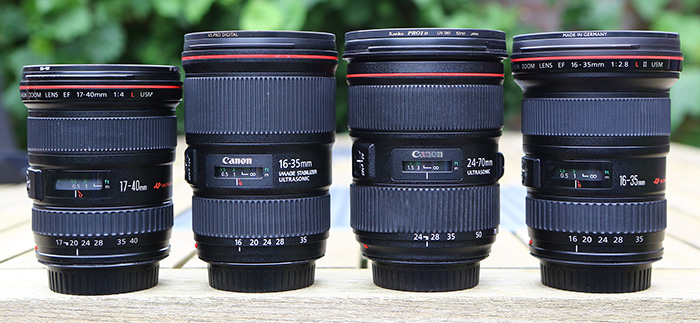
Yesterday I went out with four wide-angles:
[list type=decimal]
[*]Canon EF 16-35mm f/4 IS
[*]Canon EF 16-35mm f/2.8 II
[*]Canon EF 17-40mm f/4
[*]Canon EF 24-70mm f/2.8 II
[/list]

For people that like to see pictures of walls: I took a few shots with each lens at the same piece of wall. The RAW files of these pictures and some additional pictures can be found in this ZIP file (contains 54 RAW files; 1.7GB large):

http://markkoenen.nl/downloads/2014-06-28-4-wide-angles-RAWs.zip

You can judge on the image quality yourself. Handling of the lens is as you would expect for this type of L-lens except for one thing: in case the image stabilization is turned on, the lens makes a weird noise occasionally. Not while you're focussing, but especially during moments that you point the camera at something else.

I thought this was an error in the specific lens that I got, so I went back to the shop and tried another copy of the 16-35mm f/4 and it had the exact same noise. It annoyed me this much that I turned off the stabilization ;)

Cheers,

Mark.

The four lenses:
2014-06-28-the-four-lenses.jpg


The wall:
2014-06-28-the-wall.jpg


One of the other random pictures:
2014-06-28-one-of-the-other-images.jpg
 
Upvote 0
Phenix205 said:
Nice work Mark. Alex Nail has some comparison of center and corner sharpness between this lens and 16-35II, 17-40, and 17TSE. The sharpness of the 16-35 IS is on par with 17TSE. Good to know.
http://www.alexnail.com/blog/reviews/review-canon-16-35-f4l-is-vs-16-35-f2-8l-ii/

The extra sharpness from f/4-f/8 is great on the f/4 IS. At f/11, it looks like a draw between everything except the 17-40 - I see no significant improvement in the 16-35 f/4 IS over the 16-35 f/2.8L II at f/11. The writer only very briefly mentions one of the significant advantages f/2.8 can give you in a number of scenarios, such as increased light, lower ISOs, higher shutter speeds, and thinner DOF. I also disagree that the flare is any better on the 16-35 f/4 IS than the 16-35 II, it looks about a draw.

And, I do think the 16-35 II's sunstar is quite a bit superior, despite this blogger's opinion; the best way I can describe it, the 16-35 f/4 IS sunstar looks like a picture of the sun, while the 16-35 II sunstar looks like the sun as I see it in real life. If I am taking a landscape picture, I want majestic and realistic looking sun rays. I would go as far as to say I would find it difficult to upgrade to the 16-35 f/2.8L III if it has sun rays similar to the 16-35 f/4L IS.

For strict landscape shooters if you have not purchased a UWA yet, the f/4 IS looks like it will probably be your best bet to allow you great sharpness from f/4+, and similarly a much needed upgrade if you have a 17-40L. If you already have a f/2.8L II, it is a muddy proposition. You give up f/2.8 and the 16-35 II's unique sunstars for a sharpness increase that is only readily apparent from f/4-f/8, with differences becoming minor at f/8. And, if you are an event shooter or do both events and landscape, I'd definitely recommend the f/2.8L II over the f/4 IS for the much needed f/2.8 and similar quality at f/11.

Thinking about that for a second, if you are an event shooter, the majority of your shots will be at f/2.8 for increased light. On the other hand, if you are a landscape shooter, f/11 is extremely popular as it is the narrowest aperture/greatest DOF that does not suffer the greater sharpness losses of smaller apertures due to diffraction. So, arguably, the place where the f/4 IS shows the biggest sharpness difference is the middle of the aperture range (i.e. f/4-f/5.6) that will be used but are probably not the bread and butter for either event or landscape shooters. While it is sharper in those middle apertures, is it worth losing f/2.8 and those awesome 16-35 II sunstars for that? Some may think so, but others may not. But, it is worth pondering before you go through the cost and hassle of swapping lenses (and potentially filter sets).

 
Upvote 0
To me, IS is a great feature that a larger aperture cannot provide. Imagine shooting a moving train in a metro station like the one in Washington DC. You want the train to be blurry while keeping the unique architecture sharp. F2.8 is not gonna help. You need that fantastic IS. I had a 16-35 I, and seldom shot at 2.8. For low light shooting 2.8 is just not fast enough.
 
Upvote 0
Phenix205 said:
To me, IS is a great feature that a larger aperture cannot provide. Imagine shooting a moving train in a metro station like the one in Washington DC. You want the train to be blurry while keeping the unique architecture sharp. F2.8 is not gonna help. You need that fantastic IS. I had a 16-35 I, and seldom shot at 2.8. For low light shooting 2.8 is just not fast enough.

If you are going to slow down that much (i.e. 1/4 second or slower), IS does not help much either in real world use on these wider focal lengths. It will be somewhat better, but will still greatly pale in comparison to a tripod. I have done lots of tests with IS at very slow shutter speeds on the 24 IS, 28 IS, and 35 IS and it far less effective than say IS on the 70-200. Instead of the advertised 4 stops which actually is the case with the 70-200, on the 24 IS it is more like 2 at best, and it looks significantly inferior to tripod work.

Keeping with your train example, what if there was a railroad sign in the foreground you wanted to focus on, and blur the train in the background using *both* motion blur *and* DOF/bokeh? Here, you could set up a long exposure with the 16-35 II f/2.8L at f/2.8 with a 10-stop ND filter on a tripod and get an effect that would be impossible to emulate to the same extent on the 16-35 f/4 IS.

The main use of f/2.8 is for low light shots of moving subjects, but there are other creative uses for it as well.
 
Upvote 0
Phenix205 said:
To me, IS is a great feature that a larger aperture cannot provide. Imagine shooting a moving train in a metro station like the one in Washington DC. You want the train to be blurry while keeping the unique architecture sharp. F2.8 is not gonna help. You need that fantastic IS. I had a 16-35 I, and seldom shot at 2.8. For low light shooting 2.8 is just not fast enough.

A tripod can do the same thing. However - a tripod cannot get you an extra stop of light.
 
Upvote 0
kobeson said:
Phenix205 said:
To me, IS is a great feature that a larger aperture cannot provide. Imagine shooting a moving train in a metro station like the one in Washington DC. You want the train to be blurry while keeping the unique architecture sharp. F2.8 is not gonna help. You need that fantastic IS. I had a 16-35 I, and seldom shot at 2.8. For low light shooting 2.8 is just not fast enough.

A tripod can do the same thing. However - a tripod cannot get you an extra stop of light.

Yes, a tripod will do the same thing when you can use it or want to carry it. The big advantage of the f2.8L II is the ability to stop action under dimmed light (weddings, events, etc) that can not be achieved with the f4L IS.
If you have static objects 4-stop IS will help you a lot more than 1-stop of aperture, this is a better travel lens.
I am waiting for my new 16-35mm f4L IS lens to be delivered tomorrow (I already sold the f2.8L II), then I will post some pictures.
 
Upvote 0
We, as photographers, need to stop thinking and talking IS vs tripods, they are different tools with different applications and both are very useful for some people, whilst being totally inappropriate for others users.

Some will argue against IS in wide and ultrawide lenses "because there is no need" well I have a need, if you don't then fine, just like 45 or 61 point AF, some have a need for it, some are happy with one (a lot of Hasselblad owners).

Tripods are banned in ever more places, take the example given above of a mass transit system, well 90% of them have banned tripod use so your tripod isn't going to cut it unless you get written permission and they say yes, you have liability insurance and everything else such permissions insist on. I carried a tripod around India last year, I took about five shots with it, its use was banned and enforced everywhere you might want to use a tripod. Some peoples style doesn't fit in with using or carrying tripods, IS can be a valuable tool at any focal length for these photographers.

On the other hand IS will never replace a landscapers tripod where exposures over 2 seconds are common, as well as multiple exposures and multiple filter use.

Just like video, if IS is a feature you will never use then just don't turn it on, the cost is offset by the increased appeal and sales of the lens and it weighs a just few grams.
 
Upvote 0