
You are using an out of date browser. It may not display this or other websites correctly.
You should upgrade or use an alternative browser.
You should upgrade or use an alternative browser.
Canon EOS 6D Mark II Not Coming Until Spring? [CR2]
- Thread starter Canon Rumors
- Start date


Maiaibing said:tr573 said:You actually can - once you have a flash attached, it will shoot at 1/180 in M without issue. (See attached EXIF) Yes you can't set your external meter to 1/180, but again honestly it's 1/6th of a stop. It's not going to make any difference, just meter for 1/200th and be done with it. This is a big perceived difference for some (and perhaps that makes it a shrewd decision by canon marketing to upsell people) but it's literally never caused me any grief.
The line of argument here is wrong. The issue is not 1/2 or 1/3 stop or whatever. the problem is lack of shutter speed. Try shooting people dancing at a party w/180. Even 1/250 would help a lot.
I never cease to wonder how I could have 1/320 in the film days and now have 1/200-1/250 in the digital age???
Same here, how come a 1984 Nikon FM2 had a 1/250s flash sync or a 1992 Minolta Dynax 9 had a 1/300s (1/12000 max shutter speed), and Canon is still stuck with a 1/200s sync speed on the 5D series, in 2016 ?
Agreed, their shutter is very reliable, but one would assume, since the 5D 11 years ago, they could have worked a bit on improving the speed.
It can only be explained from a marketing point of view, as much as I like Canon gear, this is lame. On a 4000€ camera, one should not get the "el cheapo" flash sync. When you have to sync the camera with manual studio flashes, especially when they are radio triggered, you better stick with 1/125 or 1/160 max if you want full frame exposure.
Upvote
0
More likely the initial price is overinflated to take advantage of the early adopters - if it sells better than expected the shops can keep the price artificially high. But one thing you need to be aware of is that (as far as I am aware) the price Canon sells to the retailers does not change and in that respect the profit margins for Canon do not change after 6 months. What changes is the shops not making as much profit.9VIII said:Dropping the price within six months of release indicates it did not sell well,
If manufacturers don't factor in this 'early adopter premium' then they aren't doing their job properly.
9VIII said:I wouldn't be surprised if competition from crazy high burst rates on mirrorless cameras is eroding the 7D2's intended price point,
Possible but IMO unlikely. Burst rate is not the most important bit to people attracted to the 7D2 - it is the sub-1Dx AF system which mirrorless cannot yet match. And when it can, be assured Canon will be making them as well.
Upvote
0

Mikehit said:More likely the initial price is overinflated to take advantage of the early adopters - if it sells better than expected the shops can keep the price artificially high. But one thing you need to be aware of is that (as far as I am aware) the price Canon sells to the retailers does not change and in that respect the profit margins for Canon do not change after 6 months. What changes is the shops not making as much profit.9VIII said:Dropping the price within six months of release indicates it did not sell well,
If manufacturers don't factor in this 'early adopter premium' then they aren't doing their job properly.
Depends on the product:
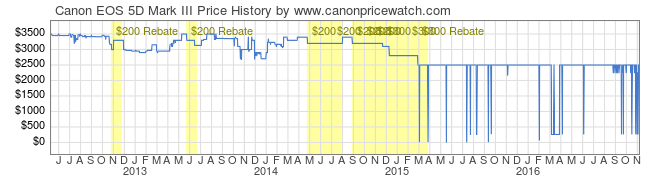
- On some products, Canon insists on holding a very firm price. The 5D3 did this (with some authorized reseller shenanigans that fluttered the price until Canon crushed that practice)and the price was kept high for a very long time.
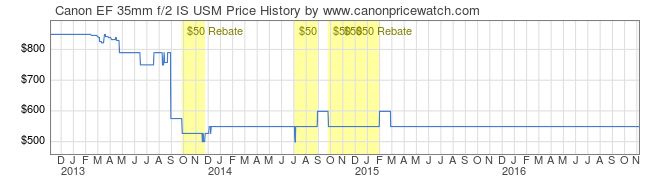
- On other products, Canon got the initial pricing terribly, horribly wrong and initial sales are clearly low: the 24/28/35 IS refreshes for ~ $799, and the 24-70 f/4L IS for $1,499 are prime examples of this. Canon has no choice but to make a one-time major price change.
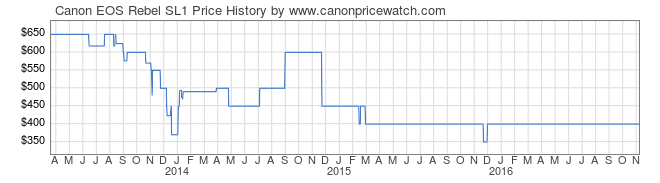
- On yet a third bucket of products, price steadily erodes over the product lifecycle until Canon sets a 'floor' that they will not deviate until inventory is burned off. This has happened somewhat on some enthusiast bodies (6D) and also on some camera bodies that just didn't take off in the market (early EOS M models, SL1, etc.)
But I would argue a classically overpriced item on day one that is discounted intelligently to what the market will bear has not been a normal move for Canon. I stand that for those who were desperately waiting for the 7D2 two years ago, Canon could have sold them a $2500 camera until pre-orders were filled and then walked the price down for the masses. Canon -- never accused of offering bargain-priced gear -- seems to avoided this predatory pricing approach.
- A
Attachments
Upvote
0
ahsanford said:Mikehit said:More likely the initial price is overinflated to take advantage of the early adopters - if it sells better than expected the shops can keep the price artificially high. But one thing you need to be aware of is that (as far as I am aware) the price Canon sells to the retailers does not change and in that respect the profit margins for Canon do not change after 6 months. What changes is the shops not making as much profit.9VIII said:Dropping the price within six months of release indicates it did not sell well,
If manufacturers don't factor in this 'early adopter premium' then they aren't doing their job properly.
Depends on the product:
- On some products, Canon insists on holding a very firm price. The 5D3 did this (with some authorized reseller shenanigans that fluttered the price until Canon crushed that practice)and the price was kept high for a very long time.
- On other products, Canon got the initial pricing terribly, horribly wrong and initial sales are clearly low: the 24/28/35 IS refreshes for ~ $799, and the 24-70 f/4L IS for $1,499 are prime examples of this. Canon has no choice but to make a one-time major price change.
- On yet a third bucket of products, price steadily erodes over the product lifecycle until Canon sets a 'floor' that they will not deviate until inventory is burned off. This has happened somewhat on some enthusiast bodies (6D) and also on some camera bodies that just didn't take off in the market (early EOS M models, SL1, etc.)
But I would argue a classically overpriced item on day one that is discounted intelligently to what the market will bear has not been a normal move for Canon. I stand that for those who were desperately waiting for the 7D2 two years ago, Canon could have sold them a $2500 camera until pre-orders were filled and then walked the price down for the masses. Canon -- never accused of offering bargain-priced gear -- seems to avoided this predatory pricing approach.
- A
why do people look at the US price as if it's gospel on Canon's policy's - not to mention Canon USA street prices?
Canon USA pricing has many different variables not associated with the cost of the camera. Taxation, fuel, exchange rates, insurance, dealer %,etc,etc.
exchange rates even then gets split out for the variations in between the various global companies that make up Canon.. ie: if Canon HK starts to get too low of a price as compared to Canon USA, then Canon USA would tend to adjust their prices, because of grey market. Canon USA also has to adjust values based upon the cost of warranty parts,etc during the lifespan of the product, marketing,etc. Some of the products also were involved in patent litigation, probably also causing their prices to reflect that. Gas / Trucking and shipping prices even as they change will change Canon USA's pricing model. As we saw with the 5D Mark IV nearly half the price of the camera is the local distributor and dealer overhead.
But looking at Canon USA as the be all and end all judge of canon pricing when canon isn't a US company and thinking that it's just because of competition or how a product sells - is odd at best.
Upvote
0
rrcphoto said:why do people look at the US price as if it's gospel on Canon's policy's - not to mention Canon USA street prices?
It's the best data I have, that's all. Your point is well made.
But in fairness, authorized US pricing is at least one step closer to Canon's will than street pricing is.
- A
Upvote
0
ahsanford said:rrcphoto said:why do people look at the US price as if it's gospel on Canon's policy's - not to mention Canon USA street prices?
It's the best data I have, that's all. Your point is well made.
But in fairness, authorized US pricing is at least one step closer to Canon's will than street pricing is.
- A
the cpw graph uses street pricing which isn't the MAP price.
Upvote
0
rrcphoto said:the cpw graph uses street pricing which isn't the MAP price.
Shut the front door. No way. Had no idea.
But surely that only speaks to those Richter/polygraph scale-like deviations from the 'main plateaus', right? The plateaus themselves one would think correspond to MAP, right?
- A
Upvote
0
unfocused
Photos/Photo Book Reviews: www.thecuriouseye.com
ahsanford said:rrcphoto said:the cpw graph uses street pricing which isn't the MAP price.
Shut the front door. No way. Had no idea.
But surely that only speaks to those Richter/polygraph scale-like deviations from the 'main plateaus', right? The plateaus themselves one would think correspond to MAP, right?
- A
I think the CPW graph actually uses lowest advertised price after rebates. It's the price currently being offered on the "street," but isn't the same as CPW's own "street price," which is an unadvertised price offered directly through CPW.
For example, the graph currently shows the 7DII at $1500, which is the lowest advertised price currently available from an authorized dealer. While the CPW "street price" of $1350 is not reflected on the graph. I'm not sure what causes those "Richter/polygraph scale-like deviations" but that might represent dealer specials, rebates, etc.
Upvote
0
unfocused said:ahsanford said:rrcphoto said:the cpw graph uses street pricing which isn't the MAP price.
Shut the front door. No way. Had no idea.
But surely that only speaks to those Richter/polygraph scale-like deviations from the 'main plateaus', right? The plateaus themselves one would think correspond to MAP, right?
- A
I think the CPW graph actually uses lowest advertised price after rebates. It's the price currently being offered on the "street," but isn't the same as CPW's own "street price," which is an unadvertised price offered directly through CPW.
For example, the graph currently shows the 7DII at $1500, which is the lowest advertised price currently available from an authorized dealer. While the CPW "street price" of $1350 is not reflected on the graph. I'm not sure what causes those "Richter/polygraph scale-like deviations" but that might represent dealer specials, rebates, etc.
I stand corrected - I thought it was street and not MAP .. but .. MAP can't go up and down as much as graph tends to show. (sometimes up and down like a freaking yoyo).
Upvote
0
unfocused
Photos/Photo Book Reviews: www.thecuriouseye.com
rrcphoto said:unfocused said:ahsanford said:rrcphoto said:the cpw graph uses street pricing which isn't the MAP price.
Shut the front door. No way. Had no idea.
But surely that only speaks to those Richter/polygraph scale-like deviations from the 'main plateaus', right? The plateaus themselves one would think correspond to MAP, right?
- A
I think the CPW graph actually uses lowest advertised price after rebates. It's the price currently being offered on the "street," but isn't the same as CPW's own "street price," which is an unadvertised price offered directly through CPW.
For example, the graph currently shows the 7DII at $1500, which is the lowest advertised price currently available from an authorized dealer. While the CPW "street price" of $1350 is not reflected on the graph. I'm not sure what causes those "Richter/polygraph scale-like deviations" but that might represent dealer specials, rebates, etc.
I stand corrected - I thought it was street and not MAP .. but .. MAP can't go up and down as much as graph tends to show. (sometimes up and down like a freaking yoyo).
I don't know either, but things like this http://www.canonpricewatch.com/blog/2016/11/hot-rebel-t6-2-lenses-printer-for-349-ar-back-at-adorama/ could explain some of the yoyo-ing.
Upvote
0
Similar threads

- Replies
- 42
- Views
- 8K

- Replies
- 51
- Views
- 7K

- Replies
- 14
- Views
- 2K
- Replies
- 55
- Views
- 5K

- Replies
- 50
- Views
- 9K