
You are using an out of date browser. It may not display this or other websites correctly.
You should upgrade or use an alternative browser.
You should upgrade or use an alternative browser.
Canon EOS R7 Mark II to Have Stacked 40MP Sensor?
- Thread starter Canon Rumors
- Start date
Are u being sarcastic? In my experience, a 45-60mp takes almost identical pics to a 24mp camera in the same price range.The good news is — I guess — is that if we extrapolate the photosite density of the APS-C sensor… Canon might eventually catch up with the 60MP FF sensors that Sony has had for a few years… as Sony is rumored to go beyond that.
Swell.
Upvote
0
A 6000 X 4000 sensor gives a 20in X 30in print at 200 Pixels/inch. That's enough for me. It seems that the most important reason for more is to allow more cropping, including video. Video aficionados sometimes say that 8K video allows them to be looser (sloppier?) in their composition and to make their 4K decisions later, especially if important stuff unexpectedly happens near the edge of the 8K image..Are u being sarcastic? In my experience, a 45-60mp takes almost identical pics to a 24mp camera in the same price range.
Last edited:
Upvote
0

The most disappointing camera I have ever used was the R7, I see it as more a 90D successor than anything else. I'm hoping that the R7ii is a true successor to the 7D ii. Just make it usable above 1600 ISO, make it so that the shutter slap doesn't set off local richter-scale sensors, and have the construction of the body actually feel solid, and that's a win to me.


Upvote
0

Thank you for showing me that you really only want to look for the mistakes, but not the meaning of an argumentation.There's no such thing as "RAWs SOOC". The data is highly processed to give you the image you see on your screen. If you haven't modified any adjustments after opening the images, then whatever default settings are selected when DPP opens raw files can have an effect. You may even be looking at the JPEG preview image attached to the raw file if you have some of your default display settings in DPP set to "fast" rather than "high quality".
Not to mention that Digital Photo Professional has been on version 4 since around 2012. I'm surprised the "original" version of DPP even supports those two cameras, as version 3 certainly does not.

Please tell me your method, how to compare two RAW files with a minimum of PP correction, so that they are almost what one can call "SOOC".
Maybe I can learn from you...
But maybe you are just not willing to think about what I saw with my own eyes and tried to describe here with just a few words instead of a "white paper" 30 pages long, containing all constraints including my blood type


Upvote
0
That is my opinion too. It's sort of numerology. Especially the comparison of xyzD and Ru models. Canon itself made it moot by slicing the APS-C R7 between the FF R6 Mark v and the R8 Mark w specimen.I think they are reading way too much into the meaning of the numbers.
1 is top.
5 is midrange.
9 is the theoretical bottom, before we head into the double-digit APS-C camera range.
There are a bunch of numbers in between.
None of this tells us what specific features a camera will have, but we can go back to history for existing model names.
Regards, Hans
Upvote
0

Yes, with Canon EOS since the EOS 650 (no D) , you could always replace the eyecup by pinching it with 2 Fingers, never needed this function because the rubber was sturdy but often lost the eyecup when handling the camera a bit rough.I hope too that they will do something about that rubber eyecup! The current was just disintegrates in a couple of months.
Now I have the R7 and Eyecup is desintegrating by just looking at it. Of cause now it is fixed in a way that you need a very fine screwdriver to replace it in the field. However the two Chinese "Edelschrott" mailorder companies sell a replacement (With screwdriver and screws) for 10 Euro or less. I chose the extended eyecup which is a lot harder than the one from Canon but which did not fail in 12 month and does not complain when the teeth of the zipper of the camera bag touch it.
Upvote
0

roby17269
R5, X2D II 100c, DJI Mavic 4 Pro & Mini 5 Pro
In my experience they are almost identical only if you look at them on a small-ish screen without zooming inAre u being sarcastic? In my experience, a 45-60mp takes almost identical pics to a 24mp camera in the same price range.
Upvote
0
For anyone who wants to continue this discussion, we were/are talking about a lens with a ~42-135mm zoom range with an f2.8 aperture. This range on an APS-C camera would roughly effectively match the zoom range and field of view of the commonly used 70-200mm lenses used by professionals for indoor sports, weddings, events, and other things. The f2.8 aperture would let you shoot at the same shutter speeds, albeit with less shallow depth of field, which everybody understands and doesn't need to be argued further. It should be lighter and cheaper than a 70-200mm f2.8, which on a Canon APS-C camera would give an effective 112-320mm full frame field of view, but might be too long/narrow, especially if the situation calls for the 70-200mm field of view.
That was something i was looking for trying to achieve a "lightweight" documentary photokit. But the Sigma offerings for EF mount were either optically not top notch or like the 2012 released 50-150F/2.8 EX DC OS HSM with 1340gr / 3 lbs and 200mm / 8 inches long pretty much the same size and weight as a regular 70-200 from Canon. Two years ago after much testing i bought a used G9 and a G70 as a second body, a Lumix 12-35 F/2.8 and a Pana-Leica 35-100 F/2.8 as well as a 15 / F1.7 and a 42.5 F/1.7. The low light performance of the G9 is quite good, at least on par with the 80D, it has IBIS and the lenses are stabilised and it is a small and light kit compared to my Sigma EF 70-200 F/2.8 Sport and my EF 24-70 F/2.8 on my EOS R, R6II or 5DsR together with the Sigma EF 24-35mm F/2.0 ART and the 85 F/1.4 ART.
My usual "walk around kit" for 2 or 3 hour trips in nature is my trusty Sigma EF 60-600 with either an R7 or the R6 II depending on weather, light and mood and an EOS R with the RF 24-105 F/4 L in a slingbag, so my definition of "light and small" may not be universal.......
Upvote
0

You can both crop and modify the levels or distortion of higher mp images without the processing looking as obvious.In my experience they are almost identical only if you look at them on a small-ish screen without zooming in
Upvote
0
Given what Sigma has given us, do we really need RF-S lenses from Canon?A good ~40MP APS-C sensor sounds nice.
But it only makes a happy end if we finally get proper RF-S lenses.
Upvote
0

Nope, Sigma is doing a nice job producing lenses for Canon's APS-C bodiesGiven what Sigma has given us, do we really need RF-S lenses from Canon?
Upvote
0
We still need a 15-85mm replacement (preferably brighter as well), and also a STABILIZED bright fixed aperture zoom for every other RF-S body that lacks IBIS. The Tamron 17-70 f/2.8 would have fit the bill but for whatever reason they have refused to port it thus far. Perhaps Canon is actually refusing to allow it, if that patented RF-S 15-60 f/2.8 is planned for production, but I think there was room for both.Nope, Sigma is doing a nice job producing lenses for Canon's APS-C bodies
Upvote
0
The great news is that it is going to be a BSI sensor. That makes a clear difference. I assume a modern 39MP BSI sensor will give better image quality that the current 32MP FSI sensor. I hope it is stacked or fast enough as I want to be able to do flash with electronic shutter.
Upvote
0
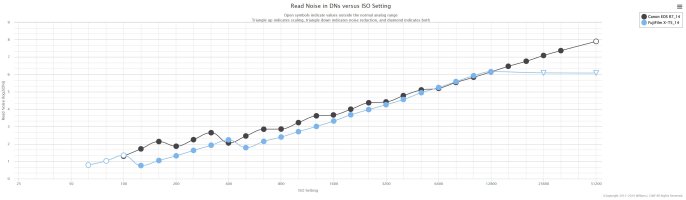
The great news is that it is going to be a BSI sensor. That makes a clear difference. I assume a modern 39MP BSI sensor will give better image quality that the current 32MP FSI sensor. I hope it is stacked or fast enough as I want to be able to do flash with electronic shutter.
Fuji's 40 MP BSI-CMOS sensor has lower read noise than the R7's 32 MP FSI-CMOS. Switching to BSI will be night and day, even if sensor resolution increases. However, higher res means slower readout so we'll see how they address this.
Upvote
0

Read the Notes under the plots. The comparison is inappropriate.Fuji's 40 MP BSI-CMOS sensor has lower read noise than the R7's 32 MP FSI-CMOS. Switching to BSI will be night and day, even if sensor resolution increases. However, higher res means slower readout so we'll see how they address this.
View attachment 227309


Upvote
0

Fuji's 40 MP BSI-CMOS sensor has lower read noise than the R7's 32 MP FSI-CMOS. Switching to BSI will be night and day, even if sensor resolution increases. However, higher res means slower readout so we'll see how they address this.
View attachment 227309
If it's a stacked sensor, the benefits of being BSI might be negated (give or take), the same way the non-stacked, non illuminated R5 sensor produces a cleaner image than the R5 II with its stacked BSI sensor.
Upvote
0
Indeed it's not fully accurate, but it still gives you a good indication if a camera has higher or lower read noise than another one. You can check with other tools such as dpreview's image comparison, the X-T5 is less noisy than the R7 at similar ISO.
Upvote
0
Similar threads

- Replies
- 14
- Views
- 2K
- Replies
- 101
- Views
- 13K

- Replies
- 23
- Views
- 5K
- Replies
- 160
- Views
- 17K