Canon EOS R7 Mark II to Have Stacked 40MP Sensor?

Again, changing one setting as simple as the "fast" or "quality" preview in DPP's settings can significantly change the result you see on your screen when you open the same Canon raw file in DPP.
So you have no solution for my comparison experiment. I got it!
But thank you for beating around the bush for so long. Could have saved you and me some time.
@AlanF showed some RL examples. Thank you for that, Alan.
 
Last edited:
  • Haha
Reactions: 1 user
Upvote 0
No, there are good and better copies of a lens. But the theoretical best copy of the EF 70-200/2.8L II is not going to be quite as good as the theoretical best copy of the RF 70-200/2.8L. And the theoretical best copy of the RF 70-200/2.8L Z is going to be better than both of them.

No one has theoretical copies of any lens. Theoretical lenses are, as someone else here likes to call some things, unicorns.

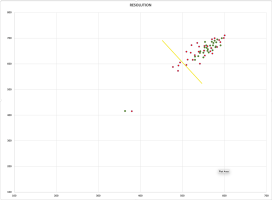
Uncle Roger has also pointed out that the best copies of an expensive lens do not necessarily beat the best copies of a cheaper lens.

The graph below shows plots from multiple copies of two prime lenses. Let's call them 'Red' and 'Green'. The Green lens is a fairly expensive, pro-grade optic. The Red lens is a cheaper, consumer-level prime. You'll see that there's one copy of each in roughly the middle of this graph, away from the main cluster at upper-right. I'd return both of these samples to the manufacturer. So would you – they're awful.


1768417724921.png

(I have no idea how I managed to erase the link to your previous comment above. My apologies for not going back and rewriting this entire post.)
 
Last edited:
Upvote 0
No one has theoretical copies of any lens.
You can say “upper left quadrant” lenses if that helps you understand the point. I understand that you believe you have an excellent copy of a particular lens. To claim that your lens is better than other lenses, based on comparison with pictures posted online taken with those lenses, remains an unsupportable claim.
 
Upvote 0
No one has theoretical copies of any lens. Theoretical lenses are, as someone else here likes to call some things, unicorns.

Uncle Roger has also pointed out that the best copies of an expensive lens do not necessarily beat the best copies of a cheaper lens.


(I have no idea how I managed to erase the link to your previous comment above. My apologies for not going back and rewriting this entire post.)
I beg to differ! I have several theoretical copies HarryFilm lenses!
 
  • Haha
  • Like
Reactions: 2 users
Upvote 0
I am following the News on the R7ii regularly. One of the key features, in my humble opinion, is the weight of the set. OM-1 is an attractive alternative from that perspective. When the R7ii will be pounded with all the features we wantrouwen see it should go at expense of size and weight, as the difference with r6iii becomes too small
 
Upvote 0
I am following the News on the R7ii regularly. One of the key features, in my humble opinion, is the weight of the set. OM-1 is an attractive alternative from that perspective. When the R7ii will be pounded with all the features we wantrouwen see it should go at expense of size and weight, as the difference with r6iii becomes too small

Everything is, has been, and always will be a tradeoff. Even with the likely extra size and weight of the R7 II, there's still a weight benefit in the lenses. There's the small and light RF 100-400mm. With the 100-500mm you've got a 160-800mm effective range without the size/weight of the 200-800mm on a full frame body. Sure an OM-1 with the 100-400mm is lighter, but you're getting a significantly more megapixels with a less noisy sensor. Worth it in my opinion, for my purposes, anyway. Definitely easier than the 6lbs than of an R6 III with the 200-800mm.
 
  • Like
Reactions: 1 user
Upvote 0
Everything is, has been, and always will be a tradeoff. Even with the likely extra size and weight of the R7 II, there's still a weight benefit in the lenses. There's the small and light RF 100-400mm. With the 100-500mm you've got a 160-800mm effective range without the size/weight of the 200-800mm on a full frame body. Sure an OM-1 with the 100-400mm is lighter, but you're getting a significantly more megapixels with a less noisy sensor. Worth it in my opinion, for my purposes, anyway. Definitely easier than the 6lbs than of an R6 III with the 200-800mm.
The relative “range” depends also on the relative pixel densities of the sensors. A 40 Mpx APS-C gives a 1.6x crop factor x 1.3 vs a 24 Mpx FF.
 
Upvote 0
There was a rumor that Fujifilm is going to announce a 180 megapixel medium format this year. And many people complained about the resolution being in the realm of the diffraction limit. Which made me think if Canon was actually not joining this megapixel race for that particular reason. They also didn't bother competing with Sony's 60 MP sensors.

In his latest article, @Richard CR said the diffraction limit wouldn't matter since you're going to have a certain distance from printed photos. But with the same logic, you could say it doesn't matter between just upscaling a photo vs real resolution. Certainly, with some viewing distance and certain print sizes, you wouldn't be able to tell a difference between an upscaled 24 MP photo of the R10 and a 32 MP one from the R7. The main difference lies in the ability to crop the pictures.

Manufacturers have been using that 24MP for so long because it sits almost perfectly in the sweet spot between resolution and diffraction. I'm not an expert on this topic, but from calculations from Gemini, I gather refraction with a 39MP sensor already kicks in at ~f/4, so an image taken at f/8 might actually not look that different from an upscaled 24MP one, in terms of detail. However, this is just theoretical.

Going forward, I think we're slowly reaching physical limits where resolution merely becomes a marketing tool, as we see it with cellphones. We know a 108 megapixel phone picture is nowhere near as detailed as a 24 megapixel camera photo. The only things that make these images look good are advanced algorithms and artificial intelligence.

 
Upvote 0
There was a rumor that Fujifilm is going to announce a 180 megapixel medium format this year. And many people complained about the resolution being in the realm of the diffraction limit. Which made me think if Canon was actually not joining this megapixel race for that particular reason. They also didn't bother competing with Sony's 60 MP sensors.

In his latest article, @Richard CR said the diffraction limit wouldn't matter since you're going to have a certain distance from printed photos. But with the same logic, you could say it doesn't matter between just upscaling a photo vs real resolution. Certainly, with some viewing distance and certain print sizes, you wouldn't be able to tell a difference between an upscaled 24 MP photo of the R10 and a 32 MP one from the R7. The main difference lies in the ability to crop the pictures.

Manufacturers have been using that 24MP for so long because it sits almost perfectly in the sweet spot between resolution and diffraction. I'm not an expert on this topic, but from calculations from Gemini, I gather refraction with a 39MP sensor already kicks in at ~f/4, so an image taken at f/8 might actually not look that different from an upscaled 24MP one, in terms of detail. However, this is just theoretical.

Going forward, I think we're slowly reaching physical limits where resolution merely becomes a marketing tool, as we see it with cellphones. We know a 108 megapixel phone picture is nowhere near as detailed as a 24 megapixel camera photo. The only things that make these images look good are advanced algorithms and artificial intelligence.
Yeah I would have commented on the other article as well if comments were turned on, but despite the limits of diffraction, I would be more than happy to accept those limitations with diffraction for the benefit of having that fine detail at lower apertures. I was focus stacking at lower apertures on the 5DmkIV to really preserve sharpness already. Certainly diffraction will limit how far you can go with that, but for me, a 100MP full frame body which can only really utilize that detail at lower apertures would still be something I was interested in. I agree though, it does limit the practical use of that resource in many situations.
 
Upvote 0