Canon Officially Announces the Canon EOS R6 Mark III

All else is rarely equal though
Please don't try to obscure the basic physics of sensors. The crucial take home message is that whereas the area of an individual pixel may determine its well depth and noise, it is the total area of all the pixels in an image that are important and not the area of a single one.

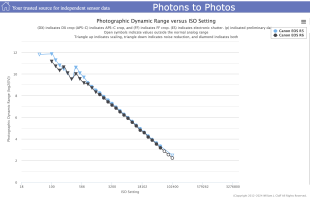
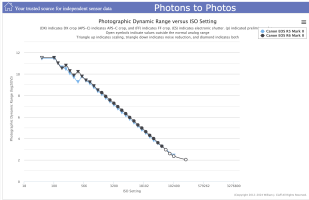
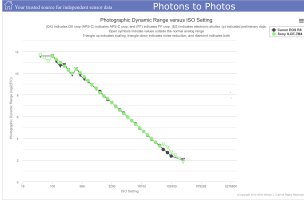
Here is actual evidence about pixel size. At high iso/low light, which was the initial topic of the disscusion, the DRs of all modern Canon sensors are the same within experimental error. Differences appear at low iso because of the different amplification modes and data transfer rates amongst other factors. For pairs of similar sensors, like the R6 and R5, and R6ii and R5ii, the DR curves are very similar despite the factor of close to two in pixel count.R5_R6.pngR5ii_R6ii.png
 
  • Like
  • Love
Reactions: 6 users
Upvote 0
Optyzcne.pl carefully measures the resolution of sensors. They find R6 ii at f/4 resolves 64 lp/mm https://www.optyczne.pl/485.4-Test_aparatu-Canon_EOS_R6_Mark_II_Rozdzielczość.html and the R5 82 lp/mm https://www.optyczne.pl/457.4-Test_aparatuCanon_EOS_R5_Rozdzielczość.html That gives the R5 a measured 28% advantage with a sharp lens at f/4, close to the theoretical.

For narrower apertures the difference decreases, and drops to about 10% at f/16. Low quality lenses will also lower the difference as will poor technique. I could see the significantly better resolution of bird plumage using the R5 vs the original R6.
Thanks for these links Alan, really appreciated.
I've often wondered what the sensor resolution is for the R5 and R6ii, and R7 cameras...and now I know. I kind of maps nicely to the MFT charts from Canon.
Any lens approximately over .65 lpm on the R6ii and over .80 lpm on a R5 should match or exceed the sensor resolution of those cameras.
This confirms my personal observation was that the files using lenses over .7 lpm looked really sharp on my R6ii, and over .85 lpm looked really sharp on my R5.
I noticed that the resolution chart for the R5ii was suprisingly a bit lower than the R5.
 
  • Like
Reactions: 2 users
Upvote 0
Thanks for these links Alan, really appreciated.
I've often wondered what the sensor resolution is for the R5 and R6ii, and R7 cameras...and now I know. I kind of maps nicely to the MFT charts from Canon.
Any lens approximately over .65 lpm on the R6ii and over .80 lpm on a R5 should match or exceed the sensor resolution of those cameras.
This confirms my personal observation was that the files using lenses over .7 lpm looked really sharp on my R6ii, and over .85 lpm looked really sharp on my R5.
I noticed that the resolution chart for the R5ii was suprisingly a bit lower than the R5.
It's an excellent site for such data, systematic and I think very reliable. It's a pity it's hidden away. The R5 does appear to be slightly sharper than the R5ii.
 
Upvote 0
Someone over at Sony rumors is spouting off that the Canon sensors are all FSI (front side illuminated) and basically have poor dynamic range (trash) compared to Sony's BSI (back side illuminated) sensors. Can anyone explain the difference as if they are speaking with a child? My brain starts to hurt after a long day at work and I try to read a photon chart. But its sort of a big decision: Sony or Canon for church event photos and videos. Once we start buying lenses its hard to climb out of that hole.
 
Last edited:
Upvote 0
Someone over at Sony rumors is spouting off that the Canon sensors are all FSI (front side illuminated) and basically have poor dynamic range (trash) compared to Sony's BSI (back side illuminated) sensors. Can anyone explain the difference as if they are speaking with a child? My brain starts to hurt after a long day at work and I try to read a photon chart. But its sort of a big decision: Sony or Canon for church event photos and videos. Once we start buying lenses its hard to climb out of that hole.
I'll take a stab. I have used Canon's Rebel, Rebel XT, T2i, 80D, 6D II, 5D IV, R6, R6 II, R5, and R3. All of my personal glass is EF, mostly L, both primes and zooms, 20mm -> 600mm. This is my opinion based on my experience. No doubt others will contribute other excellent points and experiences!

BSI is physically organized to be more efficient at capturing light than FSI -- in theory. But, in the real world, only the effect matters.

Car engines come in varieties of combustion chambers, oxygen injection, etc. Each one is also, to a degree, special to the manufacturer in terms of their experience making that kind of engine, the skill of their design team, the ability of their factories, and their choices in materials. It's possible for a V8 to outperform a V6 and a V6 to outperform a V8 -- the implementation matters as much as the general technology. The driver helps too.

Yes, many Sony sensors are BSI but their architecture is unique to Sony's capability and Canon's sensors are unique to Canon's manufacturing capability. And all of the technology tricks/secrets that each company possesses.

All of Canon's mirrorless sensors are great. If you know how to use your camera well for your situations then the R8, R6, R5, R3, and R1 can all do very well. The nitpicking you see in these forums is specific to each of our individual experiences, needs, and capabilities -- don't fret over any of it. I have full confidence the R6 II and R6 III will each take magnificent photos when used to their fullest, but there are slight strengths in each case. Nothing you cannot overcome with good attention.

That stated, the R6, R6 II, and R6 III each can capture 14-bits of dynamic range -- that's 16,384 shades or tones from pure black to pure white. A JEPG, which is often used in book printing, offers 256 shades/tones. Getting the full use of that range also depends on the lighting, lens, shutter speed, etc.

The R6 II has 102,400 ISO and a sensor released late 2022. The R6 III has ISO 64,000 and a sensor released late 2025 -- three years of time in which Canon can perfect its tricks. ISO is how the sensor translates light (photon strikes) into dark and bright in a unit of time. Pictures can become noisier if the sensitivity is high and the available light is minimal, but Canon puts significant energy into making that noise look good -- such as by approximating film photo graininess. A lot of the extra work carried out by the more advanced computer chips in each generation is put towards making the best interpretation possible. The more recent the camera, the better the effect. Strobes / flashes add extra light, as you probably know, that significantly overcomes most of the worry here. But even in limited natural light with fast action these sensors will provide a solid start and include enough additional data that you can probably get any photo you make an effort at when taking the picture shine by the time it's ready for print or online.

Canon's colours also tend to be generally acceptable as desirable or satisfactory across its camera and lens range.

Don't forget the shape of the camera bodies and placement of buttons and organization of menus. That matters when speed matters. Anything out of place or that tickles an annoyance will slow you down, take you from the moment, etc. I'd say the body is easily worth 50% of the decision if you're moving at speed, given that most modern options are going to at least be good in capability.

Finally, modern cameras include Canon's formulas that understand lens imperfections and sensor attributes such as anti-alias overlays to create adjusted final images in TIFF (PC/Mac) or HEIF and JPEG (in-camera) form from the RAW file. Even amazing glass often benefits. Not all other camera manufacturers seem to include this capability, and not all third party lenses participate.

There is also the lens investment you might already have in place. Even if a Sony camera were a smidge better in the sensor department than what you choose to afford on the Canon side, if you have a solid lens collection and your muscle memory is trained for the placement of zoom rings, buttons, etc. than you will probably do better out of the gate with familiar equipment than new equipment.

But, in the end, you should do what you are comfortable with. I assume if you're shooting weddings you're mostly doing it for money, and since it's your rent you should go with your gut. You might consider downloading sample raw images from each competing camera model from reputable review sites and play with them in your image editing application(s). Pay attention to grain, colours, contrasts, and the ability to make them brighter or darker by a few stops. See how the files behave.

What makes sense for you will very likely be different for each of us. I'll push my R6 original to 25k ISO with fast outdoor action and be thrilled with the images I have to work with. Others here will think I'm nuts or blind. Our use cases are probably very, very different. And once you throw in strobes the game changes dramatically -- to such as extent all of the Canon series cameras are probably on equal footing.

 
Last edited:
  • Like
Reactions: 3 users
Upvote 0
I'll take a stab. I have used Canon's Rebel, Rebel XT, T2i, 80D, 6D II, 5D IV, R6, R6 II, R5, and R3. All of my personal glass is EF, mostly L, both primes and zooms, 20mm -> 600mm. This is my opinion based on my experience. No doubt others will contribute other excellent points and experiences!

BSI is physically organized to be more efficient at capturing light than FSI -- in theory. But, in the real world, only the effect matters.

Car engines come in varieties of combustion chambers, oxygen injection, etc. Each one is also, to a degree, special to the manufacturer in terms of their experience making that kind of engine, the skill of their design team, the ability of their factories, and their choices in materials. It's possible for a V8 to outperform a V6 and a V6 to outperform a V8 -- the implementation matters as much as the general technology. The driver helps too.

Yes, many Sony sensors are BSI but their architecture is unique to Sony's capability and Canon's sensors are unique to Canon's manufacturing capability. And all of the technology tricks/secrets that each company possesses.

All of Canon's mirrorless sensors are great. If you know how to use your camera well for your situations then the R8, R6, R5, R3, and R1 can all do very well. The nitpicking you see in these forums is specific to each of our individual experiences, needs, and capabilities -- don't fret over any of it. I have full confidence the R6 II and R6 III will each take magnificent photos when used to their fullest, but there are slight strengths in each case. Nothing you cannot overcome with good attention.

That stated, the R6, R6 II, and R6 III each can capture 14-bits of dynamic range -- that's 16,384 shades or tones from pure black to pure white. A JEPG, which is often used in book printing, offers 256 shades/tones. Getting the full use of that range also depends on the lighting, lens, shutter speed, etc.

The R6 II has 102,400 ISO and a sensor released late 2022. The R6 III has ISO 64,000 and a sensor released late 2025 -- three years of time in which Canon can perfect its tricks. ISO is how the sensor translates light (photon strikes) into dark and bright in a unit of time. Pictures can become noisier if the sensitivity is high and the available light is minimal, but Canon puts significant energy into making that noise look good -- such as by approximating film photo graininess. A lot of the extra work carried out by the more advanced computer chips in each generation is put towards making the best interpretation possible. The more recent the camera, the better the effect. Strobes / flashes add extra light, as you probably know, that significantly overcomes most of the worry here. But even in limited natural light with fast action these sensors will provide a solid start and include enough additional data that you can probably get any photo you make an effort at when taking the picture shine by the time it's ready for print or online.

Canon's colours also tend to be generally acceptable as desirable or satisfactory across its camera and lens range.

Don't forget the shape of the camera bodies and placement of buttons and organization of menus. That matters when speed matters. Anything out of place or that tickles an annoyance will slow you down, take you from the moment, etc. I'd say the body is easily worth 50% of the decision if you're moving at speed, given that most modern options are going to at least be good in capability.

Finally, modern cameras include Canon's formulas that understand lens imperfections and sensor attributes such as anti-alias overlays to create adjusted final images in TIFF (PC/Mac) or HEIF and JPEG (in-camera) form from the RAW file. Even amazing glass often benefits. Not all other camera manufacturers seem to include this capability, and not all third party lenses participate.

There is also the lens investment you might already have in place. Even if a Sony camera were a smidge better in the sensor department than what you choose to afford on the Canon side, if you have a solid lens collection and your muscle memory is trained for the placement of zoom rings, buttons, etc. than you will probably do better out of the gate with familiar equipment than new equipment.

But, in the end, you should do what you are comfortable with. I assume if you're shooting weddings you're mostly doing it for money, and since it's your rent you should go with your gut. You might consider downloading sample raw images from each competing camera model from reputable review sites and play with them in your image editing application(s). Pay attention to grain, colours, contrasts, and the ability to make them brighter or darker by a few stops. See how the files behave.

What makes sense for you will very likely be different for each of us. I'll push my R6 original to 25k ISO with fast outdoor action and be thrilled with the images I have to work with. Others here will think I'm nuts or blind. Our use cases are probably very, very different. And once you throw in strobes the game changes dramatically -- to such as extent all of the Canon series cameras are probably on equal footing.

Thank you, this is very helpful. It may be human nature that we get biased towards what works for us or what we use the most. Canon, Sony, Nikon, Fuji, Lumix... there are many choices. Many "features" to parcel through. It is wise to think about each brand like an auto manufacturer. They all have their own strengths and weaknesses. Sometimes they compete directly with one another, sometimes they simply make cars that fit well within their own lineup. Different CEO's, focus and vision can change, etc, etc. All to say, what is your own preference?

My experience, started on Canon 60D as a side hustle hybrid shooter, video first and loved it. But that and my lenses were stolen without insurance. Set me back several years and when I finally saved enough to jump back in I tried a pre-owned Sony A7 II. But the video experience was so poor that I ended up also buying an A7S II, which was way better for video. But I have struggled to get photos that I like out of the A7 II and I need two cameras (so much for a hybrid!) People talk about the ergonomics and menus on Canon and that has proven true for me. My Sony's look good but they have never measured up to the Canon experience. I can possibly afford to sell these and purchase an A7 IV. It should be sufficient as a hybrid again and there is almost universal praise for the image quality of the photos. Video I'm 90% sure will be good and IQ may be sufficient but I'm worried that the experience will still feel sterile or uninspired. Darn Canon 60D may have ruined it for me! Anyway, RF lenses have been so expensive that I haven't reconsidered until seeing the new set of f/2.8 STM's (16-28 and 28-70) and a patent filed for a 70-180 f/2.8. That trinity with an R6 II seems like a dream setup to jump back into Canon (if there weren't that money part to work out LOL). I would have to sell two Sony cameras, 4 lenses, cough up my savings and forego any of the prevalent, fast and cheap Chinese glass showing up on e-mount. And once again Canon shows a glimmer of hope with the RF 45 f/1.2 for less than $500. Then I think about straddling both brands and just using the A7S II for video (they did shoot a movie on it!)... and give photography a chance again on the Canon R8 + 28-70 F/2.8 STM. The R8 could actually be a great hybrid, so you never know, perhaps end up selling the last Sony and jumping all into Canon. But then I would probably wish I had the R6 II. It's all a bit more stressfull than I was hoping for. I guess typing this out has been rather therapeutic after all. I don't think I've admitted before now that photography on the Sony A7 II has been... uninspiring.
 
Last edited:
  • Like
Reactions: 1 user
Upvote 0
Someone over at Sony rumors is spouting off that the Canon sensors are all FSI (front side illuminated) and basically have poor dynamic range (trash) compared to Sony's BSI (back side illuminated) sensors. Can anyone explain the difference as if they are speaking with a child? My brain starts to hurt after a long day at work and I try to read a photon chart. But its sort of a big decision: Sony or Canon for church event photos and videos. Once we start buying lenses its hard to climb out of that hole.
My understanding is that BSI sensors are more efficient at light gathering and that has positive effects such as better DR... but the improvements are dependent on sensor density: the higher the density the bigger the improvement.

So with high density sensors such as modern phone sensors, there is a visible benefit. But with current FF sensors the benefit is tiny and almost invisible. Not something you should base your choice on. As others have mentioned, other factors are more important, such as available lenses, ergonomics, speed, AF, resolution, etc.

I guess in the future BSI may matter for FF sensors if they will see significant increases in resolution.
 
Last edited:
  • Like
Reactions: 2 users
Upvote 0
Someone over at Sony rumors is spouting off that the Canon sensors are all FSI (front side illuminated) and basically have poor dynamic range (trash) compared to Sony's BSI (back side illuminated) sensors. Can anyone explain the difference as if they are speaking with a child? My brain starts to hurt after a long day at work and I try to read a photon chart. But its sort of a big decision: Sony or Canon for church event photos and videos. Once we start buying lenses its hard to climb out of that hole.
I addition to what others have posted: these people on Sony rumors live in the past. The days that Sony BSI sensors had a better dynamic range are more than 5 years behind us. I’ve compared the R8(FSI sensor) with the A7 IV (BSI) sensor:
IMG_0466.jpeg

BSI sensors gather more light than FSI sensors at the individual pixel level since the wiring is underneath the photo diode. Improvements in FSI sensors, a.o. microlenses have largely negated that advantage.

Edit: changed the comparison from R6 Mk II to R8 since it is the R8 that you are considering.
 
Last edited:
  • Like
Reactions: 4 users
Upvote 0
I agree, getting to play with the raw files in Lightroom will give us all an informed perspective on the R6iii's noise and image quality.
However, the max iso has been reduced from the R6ii by 2/3rd of a stop. thisis uaully an indicator from Canon as to it's expected hit on the increased noise threshold those extra mp cause. If the ios noise between the R6ii to R5 was a whole stop then this increase in rez will affect the noise too. So maybe 1/2 to 2/3rd of a stop is about right.
this morning, I've heared numerous youtube influencers talking about the great features of the R6iii....most of these great features are alredy present in the R6ii....which goes to show how good the R6ii is / was.
Here in the Uk, the launch price is around £2700 GDP...whcih is very high considering I can buy a new R5ii (via grey import) for the same price. A mint used R5 for £1600 and a new R6ii (grey) for on;y £1350....for only a few new fetures...that's a lot of £££ for not a lot of benefits. I can literally buy a pair of R6ii's for the launch price of one R6iii.
I think if I was looking to jump from DSLR to mirrorless, this would be a great camera. I think upgraders from the EOS R and R6mk1 have a lot of milage in this upgrade. but for existing R6ii users....it's more of an expensive side grade. Slightly improved, more of an evolution that definatly builds on the shoulders of it's great predecessor. If Canon continues selling their R6ii alongside the R6iii, then the R6ii may become the true bargain of the canon range.
Having had the EOS R6 MKIII for a week and as a former MKII owner the upgrade is way bigger than the move from the MKI to the MKII.
The autofocus has improved over the MKII, I feel the 32.5 MP sensor is the sweet spot and back to the EOS R but with more refined image quality. The precapture is great for birds and so far I’ve not noticed any skewing.
I shoot landscape, wildlife and portraiture before I had the R6 MKII purely for landscape, an R10 for wildlife and the R5 for portraits. The R6 MKIII can do all three I can crop and not notice picture degradation, I can still have 40FPS in electronic shutter and have 1/250th flash sync it’s a win win with very minor down sides.
 
Last edited:
  • Like
Reactions: 1 users
Upvote 0
Having had the EOS R6 MKIII for a week and as a former MKII owner the upgrade is way bigger than the move from the MKI to the MKII.
The autofocus has improved over the MKII, I feel the 32.5 MP sensor is the sweet spot and back to the EOS R but with more refined image quality. The precapture is great for birds and so far I’ve not noticed any skewing.
I shoot landscape, wildlife and portraiture before I had the R6 MKII purely for landscape, an R10 for wildlife and the R5 for portraits. The R6 MKIII can do all three I can crop and not notice picture degradation, I can still have 40FPS in electronic shutter and have 1/250th flash sync it’s a win win with very minor down sides.
I think I'll wait for a few sensor tests (DXO, Photons and optyczne.pl (my new sensor test goto - thanks AlanF) before I make any decisions. I've been rocking a R6ii for a few years and I'm very happy with it. I've recently bought a new R5 for very little because I had a few customers and I needed a 2nd camera urgently. However, I could flip my R5 for pretty much what I paid for it around easter and maybe consider a R6iii. But I'll want to play with a few files in lightroom and see a few test sites before I comit. In the mean time, my R6ii and R5 are taking great images.
 
Upvote 0