Canon Says it’s up to Sigma to Make Full-Frame RF Lenses

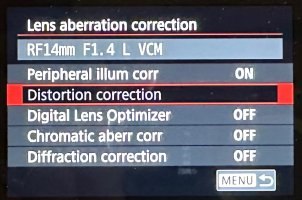
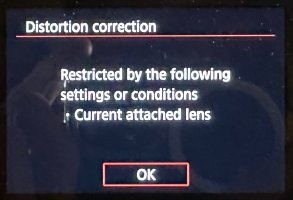
My Sigma RF-S 10-18 f2.8 and 18-50 f2.8, when mounted on my R7, show "Not available with the attached lens" for distortion correction, and "Cannot correct - no data" for Digital Lens Optimizer, in the Lens aberration correction menu. This doesn't bother me much, as I shoot raw and process in Lightroom, which does apply the corrections.
My Sigma 17-40 also shows "not available" for distortion correction, however if you compare the RAW with an OOC JPEG you'll see massive distortion at 17mm being straightened, so this seems to be more of an “always on" situation, as with the RF-S 18-45.Screenshot 2026-04-01 204429.jpg
 
Last edited:
  • Like
Reactions: 1 users
Upvote 0
I like many would buy the Sigma 300-600 f4 and personally, the Sigma 135 f1.4 Art (I have the EF 135, RF 135 and Sigma EF 135 Art) and would pair it with my Sigma EF 105.

I wouldn't pay Canon's price for the RF 100-300 f2.8 before the tariff increase, as I have the Sigma EF 120-300 2.8 and I won't pay for the Canon RF 300-600 f???, as is would be a want and not a need. I have 2 of the EF 200-400 f4 1.4x, the EF 300 f2.8 and the EF 400 f4 DO and I refuse to pay over $11,000 for a lens, but at $6599 for the Sigma, I would buy that, provided it integrates well. Sony limits the AF speed on it, so I won't buy the Sony version. In fact, I was seriously considering the Lumix S1 II, or maybe the S1R II given the alliance and the fact that it is optimized for the Lumix.

I will hold off for now, to see if they release it for the RF mount, if it doesn't happen, then I will buy a Lumix down the line and begrudge Canon for it.

Oh, and I know a retired Canon USA exec, I never asked for any scoops, I didn't think it was appropriate, but was told, "Pay attention to Canon Rumors." So you might have more pull than you know;)

 
  • Like
Reactions: 1 user
Upvote 0
I like many would buy the Sigma 300-600 f4 and personally, the Sigma 135 f1.4 Art (I have the EF 135, RF 135 and Sigma EF 135 Art) and would pair it with my Sigma EF 105.

I wouldn't pay Canon's price for the RF 100-300 f2.8 before the tariff increase, as I have the Sigma EF 120-300 2.8 and I won't pay for the Canon RF 300-600 f???, as is would be a want and not a need. I have 2 of the EF 200-400 f4 1.4x, the EF 300 f2.8 and the EF 400 f4 DO and I refuse to pay over $11,000 for a lens, but at $6599 for the Sigma, I would buy that, provided it integrates well. Sony limits the AF speed on it, so I won't buy the Sony version. In fact, I was seriously considering the Lumix S1 II, or maybe the S1R II given the alliance and the fact that it is optimized for the Lumix.

I will hold off for now, to see if they release it for the RF mount, if it doesn't happen, then I will buy a Lumix down the line and begrudge Canon for it.

Oh, and I know a retired Canon USA exec, I never asked for any scoops, I didn't think it was appropriate, but was told, "Pay attention to Canon Rumors." So you might have more pull than you know;)

When you say "Sony limits the AF speed", is that a diabolical move on Sony's part or is the Sony system simply incapable of providing enough current to run the AF at full speed? I suspect that more often than not, the issues we discuss as if they were marketing decisions are actually engineering limitations. Much the same as the Canon "cripple hammer". A budget was set for a product, and engineering may well have done the best they could with that budget. We may not like the choice of tradeoffs, but the decisions may well have been as much or more engineering decisions as they were marketing decisions.
 
  • Like
Reactions: 1 users
Upvote 0
Sigma should also produce a few tiers of microphones, on-camera flashes, and dual chargers for Canon users alongside their lenses. Canon might even consider selling the R5 Mark III or R7 Mark III without accessories altogether. Maybe Sigma can finally free us from that thing called “Picture Style.”
 
Upvote 0
When you say "Sony limits the AF speed", is that a diabolical move on Sony's part or is the Sony system simply incapable of providing enough current to run the AF at full speed? I suspect that more often than not, the issues we discuss as if they were marketing decisions are actually engineering limitations. Much the same as the Canon "cripple hammer". A budget was set for a product, and engineering may well have done the best they could with that budget. We may not like the choice of tradeoffs, but the decisions may well have been as much or more engineering decisions as they were marketing decisions.
The way it was presented was that Sony cut the AF speed and max frame rate for the Sigma lens (diabolical), keeping peak performance restricted to their GM lenses. Although, it may be in the secret sauce and Sigma has to backwards engineer it like with Canon, and they just couldn’t optimize for the Sony mount,, what the lens is capable of, like they can for Panasonic. With Sigma, Panasonic and Leica making up the L alliance, presumably Panasonic shares the recipe with Sigma, so the Lumix can take maximum benefit of the lens. Or as you suggested, provide the necessary juice with their batteries to drive the AF on the Lumix, like the new batteries required to take full advantage of the R5 II.

I like the idea of a 300-600 f4 in Africa or on the Amazon, especially on a 40-50 MP sensor. Apparently the AF is quicker on the Lumix S1 II, than the S1R II, so that was my reservation with limitation of 24 MP on the S1 II. My thought is by the time Lumix releases the S1R III, the AF and pre capture will be fast enough that I am the rate limiting step, not the camera, that’s where I think I am at with the R1 and R5 II.

The folks I was with, were shooting Sony A1 or A9, or Nikon Z8 or Z9, the Canon guys were shooting the R1 and R5 II. They were all doing better than me with the R3 and R5, particularly on the Amazon, small targets at a distance, locking AF was markedly better on my roommate’s R5 II.

I had just gotten the R5 II, but hadn’t used it, and prior experience heavily suggested that the first time shooting a camera is best not reserved for a trip, no muscle memory and searching the menu, because it is not like your other Canon results in a lots of missed shots for me. I love the R3, but the improved AF in the R1 and R5 II, and pre capture are game changers for wildlife as far as I am concerned. That’s why I want an R7 II, one of the prints from Africa that I printed for my living room went below the 300 dpi once I went above 24” x 36” and it’s on a wall were you can walk right up to it, so people aren’t standing the “proper” distance were everyone says 24MP is enough. I was interested in the rumored R3 II, which I was hoping would have more MP’s than the R3, and obviously the improved AF and pre capture. I got the R1 with Canon’s last trade-in opportunity, but haven’t used it yet, 2026 is all underwater for me with the R7.

 
Last edited:
  • Like
Reactions: 1 user
Upvote 0
We now know that it has nothing to do with Canon. There will still be the naysayers, but it doesn't matter what you tell some people.. the vacuum can be strong.
That is a MASSIVE overstatement.

If we assume the translation from the original Japanese to French was accurate (which given my over 30 years of business experience in Japan, is hilariously FAR from a given) then all he really says is that Canon will not comment on this, and that by extension the current views are based on an outside perspective. That's it. You cannot take his statement and invert it to conclude that he is also saying the opposite (that Canon has already allowed Sigma to make RF lenses but Sigma is not doing so.) This isn't math where you can say that because 2+3=5 that 5-3=2.

From a business perspective, of course Sigma would want to be making FF lenses on RF mount. Right now Sigma are almost entirely reliant on E mount sales to support their business. If something changed at Sony (such as a dispute between Sigma and Sony or a strategic change that resulted in Sigma no longer having an E mount license), it would tank most of Sigma's business. They have all their eggs in one Sony-sized basket, and that is NEVER something a company wants to be dealing with. Even if releasing FF RF lenses meant selling fewer E mount lenses due to production constraints, it would still be the smart business decision. Same goes for Z mount.

In the not so distant past, Sigma sold a truckload of ART, SPORTS, and Contemporary lenses for EF and F along with A and K. At the same time they started selling SLR designs with flange adapters onto E and L. And while doing all this, they were also developing new mirrorless-native designs for E and L. This all happened in an era where more cameras & lenses were sold than today. It's bizarre to think that Sigma is some tiny company that couldn't handle RF sales. They sold a lot more lenses in the past than they do today.

The only things we know for fact are:

1. Viltrox and Samyang released FF AF lenses for RF and Canon made significant enough legal threats to both companies that they not only removed the lenses from sale but they also completely removed all mention of them from their websites. They don't even officially provide support (firmware updates etc) for past RF lenses.

2. Currently there are exactly zero third party companies making FF AF lenses for RF. None. Not in China, not in Korea, not in Japan.

3. Both Tamron and Sigma sell RF-S lenses but neither has made any FF RF lenses. While you might say Sigma is a small family owned company (I disagree with the "small" part), Tamron is not. They are a publicly traded company that is already making FF lenses for Z mount.

That is all we know. The most reasonable conclusion from this is still the same conclusion people have drawn all along: Canon is not allowing third party AF glass onto FF RF mount.

Personally I don't think Canon will ever willingly allow FF AF glass onto RF.
 
  • Like
Reactions: 7 users
Upvote 0
The way it was presented was that Sony cut the AF speed and max frame rate for the Sigma lens (diabolical), keeping peak performance restricted to their GM lenses. Although, it may be in the secret sauce and Sigma has to backwards engineer it like with Canon, and they just couldn’t optimize for the Sony mount,, what the lens is capable of, like they can for Panasonic. With Sigma, Panasonic and Leica making up the L alliance, presumably Panasonic shares the recipe with Sigma, so the Lumix can take maximum benefit of the lens. Or as you suggested, provide the necessary juice with their batteries to drive the AF on the Lumix, like the new batteries required to take full advantage of the R5 II.

I like the idea of a 300-600 f4 in Africa or on the Amazon, especially on a 40-50 MP sensor. Apparently the AF is quicker on the Lumix S1 II, than the S1R II, so that was my reservation with limitation of 24 MP on the S1 II. My thought is by the time Lumix releases the S1R III, the AF and pre capture will be fast enough that I am the rate limiting step, not the camera, that’s where I think I am at with the R1 and R5 II.

The folks I was with, were shooting Sony A1 or A9, or Nikon Z8 or Z9, the Canon guys were shooting the R1 and R5 II. They were all doing better than me with the R3 and R5, particularly on the Amazon, small targets at a distance, locking AF was markedly better on my roommate’s R5 II.

I had just gotten the R5 II, but hadn’t used it, and prior experience heavily suggested that the first time shooting a camera is best not reserved for a trip, no muscle memory and searching the menu, because it is not like your other Canon results in a lots of missed shots for me. I love the R3, but the improved AF in the R1 and R5 II, and pre capture are game changers for wildlife as far as I am concerned. That’s why I want an R7 II, one of the prints from Africa that I printed for my living room went below the 300 dpi once I went above 24” x 36” and it’s on a wall were you can walk right up to it, so people aren’t standing the “proper” distance were everyone says 24MP is enough. I was interested in the rumored R3 II, which I was hoping would have more MP’s than the R3, and obviously the improved AF and pre capture. I got the R1 with Canon’s last trade-in opportunity, but haven’t used it yet, 2026 is all underwater for me with the R7.
Sigma don't reverse engineer for Sony's emount, they have an emount licence in Sony provides them access to mount protocols.

I spoke to a Sigma UK rep a few years ago at a trade show and he told me that Sigma are waiting on licences from Canon and Nikon in order to release FF lenses on both RF and Z mounts. I heard another Sigma UK rep say the same thing at the same trade show last year because people are asking them this question directly. To my knowledge that is Sigma's policy that they will only release lenses for mounts when the OEM provides a licence to do so. Canon and Nikon have both granted Sigma licenses for APSC but not FF, everyone make of that what you will.
 
  • Like
Reactions: 6 users
Upvote 0
Sigma lenses I'd want to see on RF mount

- 35mm f/1.2
- 15mm f/1.4
- 28mm f/1.4
- 135mm f/1.4 (I'd get this)
- 28-45mm f/1.8
Sigma has so much great glass, and they just keep bringing out more. Sadly no 28/1.4 yet but recent patents for a 24/1.2 and 28/1.2 look interesting.

Tamron also have some amazing lenses in their lineup. Their 35-150/2-2.8 is a stunner of a lens. Their 50-400 is also great. Their f2.8 zooms are priced not much more than Canon's budget zooms but perform at 90% of L glass if not 95%.
 
  • Like
Reactions: 1 users
Upvote 0
I think it all has more to do with Sigma not being able to manufacture to the scale required. People grossly overestimate how many lenses SIgma sells.
I'm not a buyer for this. No business would fail to enter a profitable segment because they were worried they might be too successful. Supply and demand will sort it out - if there's too much demand put the prices up until there's not. Over time increase your production capacity with the profits and cut prices.

We now know that it has nothing to do with Canon. There will still be the naysayers, but it doesn't matter what you tell some people.. the vacuum can be strong.
I don't think we know that. We know that Canon say that they're not stopping third parties from making full frame RF lenses. That doesn't mean that they're not making it difficult in other ways - one example being in the way you describe of not giving them information about how to implement the RF mount. There's always more to these things.
My guess would be that the lenses that Sigma and Tamron have that are full frame are not suitable for some technical reason for a direct mount swap to RF - they need some sort of re-engineering. I'd guess they did the ones that were easier first, which is the APS-C lenses for some reason. Or perhaps they're the ones they thought they'd get more volume/profit from for some reason (maybe because Canon's lineup was weak, and because APS-C buyers might be seen as more price sensitive and so more inclined to buy third party).
 
Upvote 0
I would gladly buy the Sigma 300-600mm if they released it in either EF or RF mounts.
Why? Because it's new? Sure it's kind of cheap. It looks a bit like an L lens but it doesn't perform like one. If the price point is your concearn and a 600mm f4 is your goal there are plenty of superior options.
 
  • Haha
Reactions: 1 user
Upvote 0
"The RF Mount is Complex" - i don't think that's the reason at all. Cannot be much different from RF-S (probably identical) and Sigma made lenses for that. I simply think they put some conditions on third party full frame RF licensing that takes longer or not worth it for Sigma.
 
Last edited:
  • Like
Reactions: 2 users
Upvote 0
I like many would buy the Sigma 300-600 f4 and personally, the Sigma 135 f1.4 Art (I have the EF 135, RF 135 and Sigma EF 135 Art) and would pair it with my Sigma EF 105.

I wouldn't pay Canon's price for the RF 100-300 f2.8 before the tariff increase, as I have the Sigma EF 120-300 2.8 and I won't pay for the Canon RF 300-600 f???, as is would be a want and not a need. I have 2 of the EF 200-400 f4 1.4x, the EF 300 f2.8 and the EF 400 f4 DO and I refuse to pay over $11,000 for a lens, but at $6599 for the Sigma, I would buy that, provided it integrates well. Sony limits the AF speed on it, so I won't buy the Sony version. In fact, I was seriously considering the Lumix S1 II, or maybe the S1R II given the alliance and the fact that it is optimized for the Lumix.

I will hold off for now, to see if they release it for the RF mount, if it doesn't happen, then I will buy a Lumix down the line and begrudge Canon for it.

Oh, and I know a retired Canon USA exec, I never asked for any scoops, I didn't think it was appropriate, but was told, "Pay attention to Canon Rumors." So you might have more pull than you know;)

Wow! You have a lot of 135mm primes. Are they not suffient in some way or are you curating a personal collection? That's a lot of investment into a lot of very similar glass.
The RF 100-300/2.8 is vastly superior to the Sigma 120-300/2.8 OS in every regard. With both lenses, you are getting what you pay for. Please don't be deluded in thinking that your bargain Sigma is the equal to the Canon, it simply isn't.
 
  • Like
Reactions: 1 users
Upvote 0
It’s not just the frame rate that Sony limits on Sigma and other makers but also it prevents the use of teleconverters.
That's a key point, most users of a 600mm f4, want the flexibilty of a sharp and convienient (relatively) 800mm f5.6, ie popping on a 1.4x TC. If the native lens isn't particularly sharp wide open at 600mm, what's it going to be like with a 1.4x tc? I'd never buy lens like a 300-600mm and then prat around with it at the wide end becuase that's where it's sharp. Surely it's long end performance that matters.
 
Last edited:
  • Like
Reactions: 1 user
Upvote 0