You have mentioned the EF 400/4.5 a couple of times. I got intrigued a few months ago when one was on sale from WEX. It was priced too high at about £1500 or so. At 25+ years old and focus by wire with no recourse to repair, I passed it by. At £500, I might have bought one for fun. I would guess that at the sacrifice of 1.3 stops, the RF 100-500mm is clearly sharper, and I would further guess that the RF 200-800mm is far sharper at 700mm.
You mean the EF
500mm f/4.5 L USM

. It is an old lens now, and if its AF drive fails, the lens is dead. In fact, my copy still works, after more than 30 years now. Currently I have not enough time but if I could get a broken copy with a still mechanically good mount, I may use it to replace the quite worn-off mount of my copy, also the hood of my copy isn't in a good shape anymore (but one could also use a soft hood).
What I like about this lens is that it fits very good in my hands (medium size, male), it is 3 kg only (like Sigma's later 500mm f/4.5 HSM non-VR lens, my wife has one), very rugged, and delivers very good image quality for its age. At f = 4.5 it gets a little bit soft in the edges, but that's not really disturbing as it is sharp enough in the center for very good results, and stopping down to f = 5.0 improves IQ in the corners already very substantially.
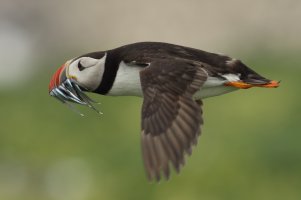
One downside is that the 1st gen. USM drive is a bit slow so if an object is moving fast towards the photographer, it cannot follow it. But even speedy birds like puffins are no problem if they fly in a more parallel direction, and overall this AF drive is fast enough for most typical settings when you are birding.
The other downside is the lack of IS since one has to get used to the more nervous image in the viewfinder. For me that was not problem because I used Canon's EF 400mm f/5.6 for some years before I got the 500mm lens, so I already had my learning curve behind me. For stills images, I never missed IS much, because with a camera attached, you have already close to 4 kg in your hands. So you have a good, passive "inertia" IS that allows you to use quite slow shutter speeds with good results, I managed to get sharp images down to about 1/200 s with no problems. Another plus for me is that you don't have to switch any IS mode between "standard" 3D IS and 2D IS for panning when you shoot BIF, what is required with more modern 500mm and 600mm primes.
If videography is more important for you, that picture changes, and the lack of IS turns out to be a real problem, because even on a solid tripod with a good head, in a bit more windy conditions the lens starts to vibrate, in particular if you have the long hood on it. So I often put my arms on the lens to dampen it. But for video, you already have the great RF 200-800mm available, and video requires slow shutter speeds anyway if you want to have a natural look with no "edgy" movements.
Another nice feature I discovered was that this vintage lens worked very well with Canon's 1.4x TC III attached on it, so this was often my standard combo giving me 700mm @ f/6.3. The result of many years is, that I now ordered a new 1.4x TC III because I noticed that the mount on the lens side of my old copy has also some play after many years use with the 4.5/500mm, and I do not want to destroy the mount of my new EF 600mm f/4 III.
Here is an example for BIF with a speedy bird I shot with that lens and my old 7D2 - it was no in-focus hit by accident, I have a lot of such sharp images (mostly with my 5D3, only 6 fps but an in-focus hit rate of 60-80 % with that lens):