
Canon Tilt Shift Lens Question

Hector1970

Canon Rumors Premium
Mar 22, 2012
1,586
1,181
21,156
I was wondering if anyone here has alot of experience with a Canon T-SE lens.
Specifically maybe the 24mm which I have.

I am wondering what degree of Tilt is required to get the maximum depth of field in a landscape shot.
My understanding it's typically not even one notch (1 degree) down.

I know you should focus on the distance and then tilt until something near is in focus.

I am wondering what do people do when they are taking a landscape shot and they want the maximum depth of field in focus. Do they set it to 1 degree down or would they attempt to put it somewhere between 0 and 1 (which because the notches are so small tiny adjustments).

Kind Regards
Fergal
 
Hi,
I already use the TS-E 24mm L II for a couple of years for landscape shots. Some degree of shift are needed in almost all shots but the tilt stays locked. I used the tilt function a few times with just 1 degree of tilt, which was enough. More degrees were tested but found useless for this application. But IMHO it is not worth the effort because I shoot landscapes normally at f8 till f13 and the shots are sharp enough. The sharp focus you add at the bottom of the frame leads to a slightly unsharp top of the frame. I prefer the sky to be sharp too...

BTW, my biggest problem with sharpness is the small optical view finder of the 5D II and my short eye sight. It's hard to see what's exactly in focus and the focus confirmation doesn't work all the time in my 5D II. So proper manual focus is my biggest concern. In some situations live view is not that practical, although I use it with the TS-E lenses when ever I can. My cam had some water inside interfering with the electronics in the past.... another reason to get a new one.
 
Upvote 0
Hector1970 said:
I was wondering if anyone here has alot of experience with a Canon T-SE lens.
Specifically maybe the 24mm which I have.

I am wondering what degree of Tilt is required to get the maximum depth of field in a landscape shot.
My understanding it's typically not even one notch (1 degree) down.

I know you should focus on the distance and then tilt until something near is in focus.

I am wondering what do people do when they are taking a landscape shot and they want the maximum depth of field in focus. Do they set it to 1 degree down or would they attempt to put it somewhere between 0 and 1 (which because the notches are so small tiny adjustments).

Kind Regards
Fergal

Personally I do this, focus at infinity, then 10x live view into the closest place I want the plane of focus on and then tilt the lens to make that point in focus, then move the live view to the furthest place I want in focus and adjust focus to that if it needs it. Done.

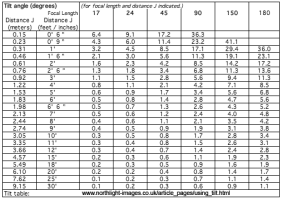
It depends on how far above the plane of focus your camera is. If your camera is 4 ft above the ground and the ground and camera are level then it is 1.1º forward tilt. If you camera is 1 ft off the ground and camera are level then it is 4.5º forward tilt.

Here is a tilt table from a site that has several very good posts on tilt use, done by a member here Keith Cooper. http://www.northlight-images.co.uk/article_pages/using_tilt.html
 

Attachments

  • tilt_table.png
    tilt_table.png
    17 KB · Views: 1,087
Upvote 0
Thanks for the replies.
I actually didn't understand the height of the ground factor.
I guess I am always using it at the same height off the ground.

I probably need to adjust height with this lens to change perspective.
It's certainly made me think.
 
Upvote 0
Here is an article describing how to focus using a TS lens. Browse this website and you will find a number of other pertinent articles regarding Scheimflug principle, depth-of-field, TS lens, etc.http://www.northlight-images.co.uk/article_pages/focus-with-tilt.html. This really all goes back to using a view camera. Keith Cooper, the owner of the site, is a commercial photographer with experience using a view camera as well as TS lenses. You will find a lot of interesting and informative reading here.
 
Upvote 0
Thanks folks for mentioning the links to the T/S articles :-)

Look at the animations for seeing how the 'J' distance (effectively height above the ground in your case) affects where the plane of focus runs.

I have to admit to very rarely using tilt for any landscape shots, it's shift that makes the difference for me, for avoiding trees leaning in when I push the horizon low. The problem with tilt is that the plane of sharpness often doesn't easily fit in with the actual landscape in front of me.

My most common use of tilt is for architecture/interiors where I want an oblique view of a floor, wall or ceiling in sharp focus.
 
Upvote 0