
You are using an out of date browser. It may not display this or other websites correctly.
You should upgrade or use an alternative browser.
You should upgrade or use an alternative browser.
Canon's FF Mirrorless Camera Will Have Same Internals as EOS 6D Mark II
- Thread starter pedro
- Start date
AvTvM said:if Canon were to bring mirrorless in 6D shape and with EF mount I would not buy it. Not even Canon is so stupid to let that happen. So FF mirrorless will be with a new native short flange distance EF-X mount. With nice, powerful, ultracompact cameras and lenses for me. 8)
that's okay .. because I'd preorder that baby so fast that it would make up for the dirty dozen in the AvTvM Universe©
Upvote
0
ahsanford said:Don Haines said:personal preference....AvTvM said:if Canon were to bring mirrorless in 6D shape and with EF mount I would not buy it. Not even Canon is so stupid to let that happen. So FF mirrorless will be with a new native short flange distance EF-X mount. With nice, powerful, ultracompact cameras and lenses for me. 8)
For me, If it involved a new mount and new lenses, I wouldn't buy it
I see a need for a compact mirrorless camera, and also for a full sized mirrorless camera...
Don
Zero chance it mandates new lenses. Zero. It will be a native EF mount or it will be a skinnier mount with an EF adaptor (possibly even in the box with the body, given the price they surely will ask for) -- in either case, your EF lenses will be good to go.
The billion dollar question on this front is / has been / will be until the day it's announced: go skinny with FF mirrorless or go EF?
There is a large list of pros and cons both ways, but broadly:
Going skinny reels in the small crowd and the adapt-other-mounts'-lenses crowd. This is the best move for the smaller-is-better crowd, the street shooters, travel/vacation shooting, people who like vintage glass, etc. Downside: if you want to maximize size savings, you'll need to buy new lenses (possibly smaller mount versions of EF glass your already own). Also, you could leave your house with a bag full of EF glass and a small FF mount lens attached to your body and accidentally leave that adaptor at home -- that could ruin an entire shoot.
Going full EF is a seamless move for existing FF SLR users (use all your existing lenses without added expense) and in this instance, you can never accidentally leave an EF adaptor at home if it doesn't exist. This is the best move for the bigger lens crowd, who want a sturdy / less modular pieces / chunky grip setup. But we would realize zero space savings from pulling the mirror out, which is blasphemy to the mirrorless market.
Canon could redefine the FF mirrorless market with a big professional setup, but Japan loves them tiny little cameras, don't they?
I'm truly torn on this. I want full EF, but I'd completely understand Canon going small (at least at first).
- A
look what happened to sony's SLT sales after going FE mount. they tanked. basically having two competing mount systems, adds alot more instability into their market.
Canon makes a big thing over their EF mount sales - I can't see them doing anything to add a level of consumer uncertainty on it's future.
Upvote
0

rrcphoto said:ahsanford said:Don Haines said:personal preference....AvTvM said:if Canon were to bring mirrorless in 6D shape and with EF mount I would not buy it. Not even Canon is so stupid to let that happen. So FF mirrorless will be with a new native short flange distance EF-X mount. With nice, powerful, ultracompact cameras and lenses for me. 8)
For me, If it involved a new mount and new lenses, I wouldn't buy it
I see a need for a compact mirrorless camera, and also for a full sized mirrorless camera...
Don
Zero chance it mandates new lenses. Zero. It will be a native EF mount or it will be a skinnier mount with an EF adaptor (possibly even in the box with the body, given the price they surely will ask for) -- in either case, your EF lenses will be good to go.
The billion dollar question on this front is / has been / will be until the day it's announced: go skinny with FF mirrorless or go EF?
There is a large list of pros and cons both ways, but broadly:
Going skinny reels in the small crowd and the adapt-other-mounts'-lenses crowd. This is the best move for the smaller-is-better crowd, the street shooters, travel/vacation shooting, people who like vintage glass, etc. Downside: if you want to maximize size savings, you'll need to buy new lenses (possibly smaller mount versions of EF glass your already own). Also, you could leave your house with a bag full of EF glass and a small FF mount lens attached to your body and accidentally leave that adaptor at home -- that could ruin an entire shoot.
Going full EF is a seamless move for existing FF SLR users (use all your existing lenses without added expense) and in this instance, you can never accidentally leave an EF adaptor at home if it doesn't exist. This is the best move for the bigger lens crowd, who want a sturdy / less modular pieces / chunky grip setup. But we would realize zero space savings from pulling the mirror out, which is blasphemy to the mirrorless market.
Canon could redefine the FF mirrorless market with a big professional setup, but Japan loves them tiny little cameras, don't they?
I'm truly torn on this. I want full EF, but I'd completely understand Canon going small (at least at first).
- A
look what happened to sony's SLT sales after going FE mount. they tanked. basically having two competing mount systems, adds alot more instability into their market.
Canon makes a big thing over their EF mount sales - I can't see them doing anything to add a level of consumer uncertainty on it's future.
The thing is, if you want to go small, you have the EOS-M..... Going FF and going small is severely affected by the size of the mount required to have a large enough image circle, and the angle if incidence of the light from that wide image circle hitting the corners of a sensor if you try to shrink down the flange distance. Trade-offs are involved. You can have small, and you can have FF image quality, but you can't have both at the same time.... the sharper you bend light, the more problems you have and the more image quality suffers....
Upvote
0
AvTvM said:if Canon were to bring mirrorless in 6D shape and with EF mount I would not buy it. Not even Canon is so stupid to let that happen. So FF mirrorless will be with a new native short flange distance EF-X mount. With nice, powerful, ultracompact cameras and lenses for me. 8)
They have barely got a decent set of EOS-M lenses. What on earth makes you think they will introduce yet another mount?
The only way I see that working is if they can design a lens with EOS-M mount and FF image circle. But that will be a real challenge.....unless the big thing is with a curved sensor !!
Upvote
0
Don Haines said:... You can have small, and you can have FF image quality, but you can't have both at the same time....
not quite true.


Yes, that Sony RX-1R II has a 35/2.0 *bolted on*, but make it only slightly larger and it would nicely fit an FF mount. It is all about choosing right combo of throat width and flange distance. My guess would be 49mm diameter and about 22mm flange distance. Together with a clever microlens design on sensor, that should allow for a pretty compact camera body as well as some pretty decent, compact, modestly fast primes and some f/4 zooms anywhere between 21 and 85mm focal length. Unfortunately Canon made EF-M mount [48 x 18] about as jammed as Sony E-mount. Therefore FF image circle can be lit, but only with major compromise ... too large, heavy, complex and expensive lenses. See Sony FE lineup.
Had Canon chosen those 2 parameters just a bit larger, they could not have made EOS M and M2 quite as small. But they could use EF-M mount for excellent APS-C and FF mirrorless systems today.
They way they decided, will inevitably lead to a new fully FF-capable MILC lens mount. "EF-X" or whatever it is called. Looking back at transition from FD to EF I have no doubt, that Canon will do this whenever they finally see the right time has come. There will be a bit of whining in the forums, but not so much ... because EF lenses will remain fully functional via a simple adapter. And from then on, Canon will sell boatloads of new EF-X lenses, as people start migrating to new, improved native lenses.
Upvote
0

AvTvM has a point here -- it can be done, though it may not deliver ideal performance.
But that's not the question. Is Canon really going to embark upon an exodus from the EF mount? Because any pushing of the boulder down the hill on new lenses for a thin-mount design may be difficult to contain. Ask Sony. Despite the fact that once you get beyond (say) 50mm f/1.4 the size upsides of dedicated thin-mount lenses isn't really there, Sony folks are still asking for the big pickle jars.
So, of the four possibilities:
1) Canon's FF mirrorless will have a Full EF mount and mails AvTvM a card that says "It's not you, it's me", a lovely breakup bouquet of flowers... and a Sony a7 catalog.
2) Canon's FF mirrorless will have a thin mount + adapter but only offer a handful of small / short FL lenses that will keep the system very small (I'll call this 'the wishful thinking approach')
3) Canon's FF mirrorless will have a thin mount + adapter and offer the 5-7 lenses any Canon system gets over the first few years -- slow standard zoom, slow tele zoom, one small prime, macro, possibly a slow ultrawide zoom (I'll call this 'the EOS M approach')
4) Canon's FF mirrorless will have a thin mount + adapter and steadily replace the EF portfolio over time (quickly becoming 'the Sony approach')
What does everyone think is going to happen?
- A
But that's not the question. Is Canon really going to embark upon an exodus from the EF mount? Because any pushing of the boulder down the hill on new lenses for a thin-mount design may be difficult to contain. Ask Sony. Despite the fact that once you get beyond (say) 50mm f/1.4 the size upsides of dedicated thin-mount lenses isn't really there, Sony folks are still asking for the big pickle jars.
So, of the four possibilities:
1) Canon's FF mirrorless will have a Full EF mount and mails AvTvM a card that says "It's not you, it's me", a lovely breakup bouquet of flowers... and a Sony a7 catalog.
2) Canon's FF mirrorless will have a thin mount + adapter but only offer a handful of small / short FL lenses that will keep the system very small (I'll call this 'the wishful thinking approach')
3) Canon's FF mirrorless will have a thin mount + adapter and offer the 5-7 lenses any Canon system gets over the first few years -- slow standard zoom, slow tele zoom, one small prime, macro, possibly a slow ultrawide zoom (I'll call this 'the EOS M approach')
4) Canon's FF mirrorless will have a thin mount + adapter and steadily replace the EF portfolio over time (quickly becoming 'the Sony approach')
What does everyone think is going to happen?
- A
Upvote
0
AvTvM said:Don Haines said:... You can have small, and you can have FF image quality, but you can't have both at the same time....
not quite true.
Yes, that Sony RX-1R II has a 35/2.0 *bolted on*, but make it only slightly larger and it would nicely fit an FF mount.
except it's ergonomics would suffer greatly with anything larger than that 35mm. so it's not quite true to what you are saying.
once you get into a series of full frame lenses, a small camera is pretty awkward outside of the few outliers that only use twiddly little primes.
Upvote
0
rrcphoto said:except it's ergonomics would suffer greatly with anything larger than that 35mm. so it's not quite true to what you are saying.
once you get into a series of full frame lenses, a small camera is pretty awkward outside of the few outliers that only use twiddly little primes.
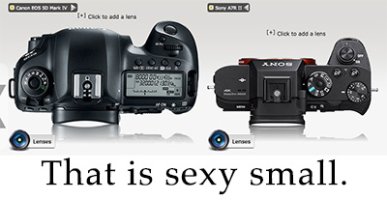
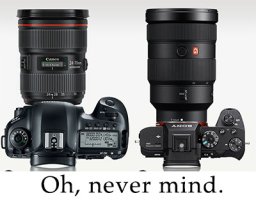
+1. As much as Sony could make the a7 platform small, they did. They did this with f/2 and f/2.8 primes and f/4 zooms of limited FLs.
...and then every enthusiast on the planet got tired of using adapters or third party glass and asked Sony for f/1.4 primes and f/2.8 zooms.
And then the skinny little A7 sucked like a big SLR to carry around. As much as I appreciate the upside of removing the mirror for non-space-saving reasons, physics is still physics -- removing the mirror does not change that.
- A
Attachments
Upvote
0
and when you make the body real small, what happens to the controls?ahsanford said:rrcphoto said:except it's ergonomics would suffer greatly with anything larger than that 35mm. so it's not quite true to what you are saying.
once you get into a series of full frame lenses, a small camera is pretty awkward outside of the few outliers that only use twiddly little primes.
+1. As much as Sony could make the a7 platform small, they did. They did this with f/2 and f/2.8 primes and f/4 zooms of limited FLs.
...and then every enthusiast on the planet got tired of using adapters or third party glass and asked Sony for f/1.4 primes and f/2.8 zooms.
And then the skinny little A7 sucked like a big SLR to carry around. As much as I appreciate the upside of removing the mirror for non-space-saving reasons, physics is still physics -- removing the mirror does not change that.
- A
Upvote
0

Don Haines said:and when you make the body real small, what happens to the controls?ahsanford said:rrcphoto said:except it's ergonomics would suffer greatly with anything larger than that 35mm. so it's not quite true to what you are saying.
once you get into a series of full frame lenses, a small camera is pretty awkward outside of the few outliers that only use twiddly little primes.
+1. As much as Sony could make the a7 platform small, they did. They did this with f/2 and f/2.8 primes and f/4 zooms of limited FLs.
...and then every enthusiast on the planet got tired of using adapters or third party glass and asked Sony for f/1.4 primes and f/2.8 zooms.
And then the skinny little A7 sucked like a big SLR to carry around. As much as I appreciate the upside of removing the mirror for non-space-saving reasons, physics is still physics -- removing the mirror does not change that.
- A
Insert SL1 user with large hands scenario.
This large vs small debate drives me nuts. What I have found by using a 5D series on a regular basis and wanting something smaller (either ML or crop) is really small is too small and just a tad smaller (especially since I will invariably put a damn L plate on it and kill most of the smallness) will probably be just about right so yes, the 6D series body is a nice size for me. Do I represent a large enough portion of the potential Canon buyers? HTFDIK?
Upvote
0
slclick said:Don Haines said:and when you make the body real small, what happens to the controls?
Insert SL1 user with large hands scenario.
This large vs small debate drives me nuts. What I have found by using a 5D series on a regular basis and wanting something smaller (either ML or crop) is really small is too small and just a tad smaller (especially since I will invariably put a damn L plate on it and kill most of the smallness) will probably be just about right so yes, the 6D series body is a nice size for me. Do I represent a large enough portion of the potential Canon buyers? HTFDIK?
Personally, I decouple the three various size/form factor determinants. It's not going to simply be big or small, it's going to one of (roughly) eight outcomes based on 3 questions:
Mount: Thin or EF?
Grip: Small or Chunky?
Height and width of the back of the body (i.e the rear view / looking at the LCD side): Tiny or Full-figured?
In truth, Grip and H/W of the back could a variety of answers, but here's my vote:
Mount: The impossible decision as I said, but EF makes sense for Canon, for folks like us with a lot of EF glass, etc.
Grip: Chunky as f---. Don't fool around if people will put big pickle jars on these rigs. As you can see below, unless you only use pancakes, making a grip smaller 'to make the rig smaller' to pack is somewhat useless as even pedestrian lenses will boss how you pack it away.
H&W: I'd keep it big, I really would. 5D3/4 sized would do it, and you'd have that sexy seamless ergonomic goodness of whatever SLR body you shoot, which is nice if you plan to use it alongside an SLR. Why they'd go in an SL1-ish direction here is simply silly -- that would kill the wheel, possibly the joystick and the thumb grip + controls would be a mess.
- A
Attachments

Upvote
0

By all respect, why don't you guys - who prefer bigger and larger bodys - stick with your DSLRs instead of talking how to improve a mirrorless camera in terms of size/ergonomics? They are meant to be smaller and meant to be used with smaller lenses* (while still having the option to use larger glass via adapter when you really need it). This also means that they cannot and should not have the same amount of dials and controls as a regular DSLR. This is totally fine.
*Smaller lenses also includes EF glass - there are several small sized FF primes for example; 24IS, 35IS, 50STM, 80 1.8, and so on... you name it... just to remind that there are viable options out there for those who want high quality in a (relatively) small package - if you don't want to invest in native (and even smaller) lenses.
Or is it because you miss a EVF on your chunky big 5D mirrorslappers? Maybe it is a solution to use Canons external EVF on the hotshoe of your camera. But I don't know if that's gonna work out or satisfy you.
*Smaller lenses also includes EF glass - there are several small sized FF primes for example; 24IS, 35IS, 50STM, 80 1.8, and so on... you name it... just to remind that there are viable options out there for those who want high quality in a (relatively) small package - if you don't want to invest in native (and even smaller) lenses.
Or is it because you miss a EVF on your chunky big 5D mirrorslappers? Maybe it is a solution to use Canons external EVF on the hotshoe of your camera. But I don't know if that's gonna work out or satisfy you.
Upvote
0
Crosswind said:By all respect, why don't you guys - who prefer bigger and larger bodys - stick with your DSLRs instead of talking how to improve a mirrorless camera in terms of size/ergonomics? They are meant to be smaller and meant to be used with smaller lenses*
Except that's not the case. Olympus has larger PRO lenses now, Panasonic has larger lenses now, and the GM series is anything but small.
if they were meant to be used with smaller lenses, than why are manfacturer's making bigger cameras and even bigger lenses for mirrorless?
a 6D mirrorless *would* be smaller than it's OVF cousin.
and here's another tidbit for you .. not everyone likes primes. and primes on mirrorless is even more crazy. you should not really do field lens swaps in any sort of weather / mist / dust,etc especially with mirrorless since the shutter is always open and the sensor is exposed.. So zooms are best for mirrorless.. but wait .. back to the size and ergonomics then.
Upvote
0
ahsanford said:I'd keep it big, I really would. 5D3/4 sized would do it, and you'd have that sexy seamless ergonomic goodness of whatever SLR body you shoot, which is nice if you plan to use it alongside an SLR. Why they'd go in an SL1-ish direction here is simply silly -- that would kill the wheel, possibly the joystick and the thumb grip + controls would be a mess.
- A
SL1 controls are simpilar really to the A7 series. .. lol.
some people tend to forget that ergonomics goes hand and hand with body size. nicer grip, haptic controls, visual controls .. and guess what? the body will be larger.
Upvote
0
rrcphoto said:Olympus has larger PRO lenses now, Panasonic has larger lenses now, and the GM series is anything but small.
if they were meant to be used with smaller lenses, than why are manfacturer's making bigger cameras and even bigger lenses for mirrorless?
a 6D mirrorless *would* be smaller than it's OVF cousin.
If that is what you want to buy, then go for it.
Yes - I can understand your point about switching primes in these extreme conditions. In this case, I'd stick with my favorite focal lenght prime and be creative. You can do a lot with just one prime lens. A 50mm can also be a 28mm for example when you do a short panorama with proper technique to avoid most parallax errors.
Upvote
0
Crosswind said:By all respect, why don't you guys - who prefer bigger and larger bodys - stick with your DSLRs instead of talking how to improve a mirrorless camera in terms of size/ergonomics? They are meant to be smaller and meant to be used with smaller lenses* (while still having the option to use larger glass via adapter when you really need it). This also means that they cannot and should not have the same amount of dials and controls as a regular DSLR. This is totally fine.
Yes, right now it's about keeping it small, and in APS-C it will likely stay that way.
But I think you should take a longer view with mirrorless. Consider: mirrorless has a boatload of upsides over SLRs regardless of size, such as:
- Less components and less moving components -- easier / cheaper to build products of the same quality
- Amplified EVF in dark rooms
- LiveView-like customizable viewfinders to give you exactly what you need while in the most comfortable/stable handheld shooting posture
- AFMA = RIP. There is no secondary mirror for AF that you need to calibrate your lens to
- All the AF points being clustered in the center = RIP. You can put AF points just about anywhere in the frame.
- Focusing screens = RIP. Focus peak through the viewfinder
- The mirror assembly is no longer rate limiting with FPS --> very high framerates are possible
- (I'm sure I've forgotten a host of things)
And because of those reasons above -- not because of size -- FF mirrorless it will eventually replace everything other than the most exacting performance obsessed shooters (i.e. sports and wildlife). In X number of years, mirrorless will replace everything up to and including the 5D line. It might be 10 years, but it will happen.
Now in that light, should Canon still keep it small? Should it offer up a line of tiny lenses that will only create demand for more that Canon must maintain? My guess is 30-40% of this forum would still say yes because 'mirrorless is about being small' is a black/white it is so definition to that camp.
- A
Upvote
0
ahsanford said:Consider: mirrorless has a boatload of upsides over SLRs regardless of size, such as:
- Less components and less moving components -- easier / cheaper to build products of the same quality
- Amplified EVF in dark rooms
- LiveView-like customizable viewfinders to give you exactly what you need while in the most comfortable/stable handheld shooting posture
- AFMA = RIP. There is no secondary mirror for AF that you need to calibrate your lens to
- All the AF points being clustered in the center = RIP. You can put AF points just about anywhere in the frame.
- Focusing screens = RIP. Focus peak through the viewfinder
- The mirror assembly is no longer rate limiting with FPS --> very high framerates are possible
- (I'm sure I've forgotten a host of things)
And because of those reasons above -- not because of size -- FF mirrorless it will eventually replace everything other than the most exacting performance obsessed shooters (i.e. sports and wildlife).
- A
Exactly these are the things we like the most when using a MILC instead of a DSLR. But I would not make the housing bigger than it needs to be to get all the advantages of a MILC. I think Sony did a great job with their FF A7S for example. I'm excitedly looking forward for Canon to also produce something similar in the future. I do not want to jump ship, because I am very impressed by some of Canons outstanding lenses and I clearly do not want to miss them or adapt on a third-party-camera (wouldn't work out for me).
I'm not sure if DSLRs will ever be completely replaced by MILCs - one main reason being the OVF which is (and will stay) a strong PRO for DSLRs. But again, imo. a MILC shouldn't be bigger than it needs to be. Why Panasonic or Olympus are offering bigger PRO lenses for their MILCs is simply because they want to offer their customers something similar like Canon has had long ago with all their pro-grade L glass. They are playing catch-up and are doing this because they do not have the variety of lenses like Canon has in their portfolio.
You don't need to use big lenses - but you can, if you desire their advantages over the smaller lens options. It's not like they are producing bigger lenses because they think it is better to use bigger lenses on mirrorless cameras, but because to offer some variety. I still think that size/weight saving is one main factor as to why someone would use a MILC in combination with smaller, but still high quality lenses. Canon did everything right with their EF-M portfolio, they're just lacking some good primes there.
I think Canon should go full EF with their first FF MILC, because they have such a great lens variety and they simply do not need an additional "EF-X" lineup.
Upvote
0
Similar threads

- Replies
- 51
- Views
- 8K


- Replies
- 115
- Views
- 19K
- Replies
- 127
- Views
- 17K
