Canon's FF Mirrorless Camera Will Have Same Internals as EOS 6D Mark II

your sample image uses "behemoth" 85 f/1.2 and f/1.4 lenses. i am not suggesting, those could be built [much] smaller for mirrorless FF.

But a series of moderately fast, very compact prime lenses is possible for sure. Whether or not an EF-? 35/2.0 will be smaller and if so by how much compared to EF 3572.0 IS ... to be seen. But the size advantage of a smaller bodies means a lot with lenses of about that size. Shorter WA lenses [anything from 18 to 28mm ? ] might even be more compact or even "pancakey" - due to shorter FDD.

Size advantage of slim MILCs compared to DSLRs with same sensor size cannot be disputed. Compact lenses in the most frequently used focal length range are definitely possible - allowing for a small kit, whenever it is "sufficient" or "preferable" for a specific shooting situation and photographer's intentions.
 
Upvote 0
I'm hearing over and over it will be focal length limited and therefore shooting styles will be most often street and landscape. Well....puppies, kittens, kids and brick walls as well.

However give 12-15 more pages of this back and forth and I'm sure something other than flange sizes and 'Stupid Canon/Sony', amazing charts with colored arrows etc will bring forth some more reasonable enlightenment to the RUMOR.


In the meantime, back to our regularly scheduled 'I want it now and I want it just the way I say it' programming.
 
Upvote 0
AvTvM said:
Size advantage of slim MILCs compared to DSLRs with same sensor size cannot be disputed. Compact lenses in the most frequently used focal length range are definitely possible - allowing for a small kit, whenever it is "sufficient" or "preferable" for a specific shooting situation and photographer's intentions.

Again: from 24-50mm or so I agree with what you are saying but that's less about 'magical tiny mirrorless design' or anything to do with flange distance and much more about the notion that smaller lenses lead to smaller looking aggregrate rig + lens size, i.e. a 9" SLR vs. a 8" mirrorless rig doesn't do you much good, but a 4" SLR vs. a 3" mirrorless rig starts to matter.

But your point certainly can be disputed for a 135mm FF lens. I await your side by side comparison of SLR vs. mirrorless on that front. Leica FF digital rangefinders seem to offer nice size savings up until 75-90mm or so, but they don't offer anything apples to apples at 135 as far as I can tell. The inflection point for size savings would (to my eyes) appear to end around 85mm in classic lens FL terms.

- A
 
Upvote 0
ahsanford said:
The inflection point for size savings would (to my eyes) appear to end around 85mm in classic lens FL terms.

- A

There's a quite compact 100mm f2 from Canon which is probably the most compact tele. Any longer than that, it gets much heavier and bigger, right?

Maybe it is possible that you might even get a non-L 135 f2.8 with DO elements that is about the same lenght as the 100 f2. What would I pay for such a lens on a Canon FF MILC...
 
Upvote 0
I think up to about 100mm size advantages for mirrorless system lenses are fairly easily possible - provided lens mount parameters are wisely selected [width + FDD + microlens design etc.].

at 135mm ? Don't know, how compact an FF mirrorless EF-? 135mm/2.8 STM IS could be built? Smaller than EF 135/2.0 ... but by how much? Would definitely be worth a try, Canon! ;)

I really liked EF 100/2.0 for its size. Sold it however because of very pronounced loCAs. Would love to have a similar lens with updated IQ for a Canon FF MILC. Also for EF-M a short tele lens - something like 85mm/2.4 STM IS - would be much appreciated. ;) :D
 
Upvote 0
ahsanford said:
AvTvM said:
Size advantage of slim MILCs compared to DSLRs with same sensor size cannot be disputed. Compact lenses in the most frequently used focal length range are definitely possible - allowing for a small kit, whenever it is "sufficient" or "preferable" for a specific shooting situation and photographer's intentions.

Again: from 24-50mm or so I agree with what you are saying but that's less about 'magical tiny mirrorless design' or anything to do with flange distance and much more about the notion that smaller lenses lead to smaller looking aggregrate rig + lens size, i.e. a 9" SLR vs. a 8" mirrorless rig doesn't do you much good, but a 4" SLR vs. a 3" mirrorless rig starts to matter.

But your point certainly can be disputed for a 135mm FF lens. I await your side by side comparison of SLR vs. mirrorless on that front. Leica FF digital rangefinders seem to offer nice size savings up until 75-90mm or so, but they don't offer anything apples to apples at 135 as far as I can tell. The inflection point for size savings would (to my eyes) appear to end around 85mm in classic lens FL terms.

- A

Try comparing the following. Keep in mind also the Leica lens is ALL metal unlike the Canon, yes its slower.

Leica APO-Telyt-M 135mm f/3.4 ASPH

Canon EF 135mm f/2.0L USM
 
Upvote 0
jeffa4444 said:
Try comparing the following. Keep in mind also the Leica lens is ALL metal unlike the Canon, yes its slower.

Leica APO-Telyt-M 135mm f/3.4 ASPH

Canon EF 135mm f/2.0L USM

I've seen it, thanks, but that's more than a full stop slower and felt that was not an appropriate comparison. I will say that Leica M lenses are delightfully small, especially on their diameter. And Leica does have some very small 90mm FF lenses.

I'm not saying it can't be done, folks, I'm saying Canon probably not wade into a new and complete lens portfolio knowing that the size savings will evaporate in the middle of the needed focal range. I see 4-6, 5-7 FF mirrorless lenses happening and that would be it. A re-making of EF for a shorter flange distance is not going to happen, IMHO.

- A
 
Upvote 0
ahsanford said:
I'm not saying it can't be done, folks, I'm saying Canon probably not wade into a new and complete lens portfolio knowing that the size savings will evaporate in the middle of the needed focal range. I see 4-6, 5-7 FF mirrorless lenses happening and that would be it. A re-making of EF for a shorter flange distance is not going to happen, IMHO.

+1

Sure, select primes can be smaller. High quality wide and standard zooms, not so much – and zooms are the 'bread and butter' for Canon.

A FF MILC from Canon will either use the EF mount or the EF-M mount, not something in between.
 
Upvote 0
neuroanatomist said:
+1

Sure, select primes can be smaller. High quality wide and standard zooms, not so much – and zooms are the 'bread and butter' for Canon.

A FF MILC from Canon will either use the EF mount or the EF-M mount, not something in between.

You are correct. I've never seen a small FF 24-70 zoom. Only a 'not huge' one.

http://camerasize.com/compact/#682.367,624.393,639.496,ha,t

Mirrorless could conceivably go with a Sigma like 'less than full range' zoom but not chase a fast aperture. Some weird design like a 24-50 f/4 could be 'small enough' for that size-is-everything crowd.

- A
 
Upvote 0
neuroanatomist said:
A FF MILC from Canon will either use the EF mount or the EF-M mount, not something in between.

EF-? will not be "in between" EF and EF-M. It will be "successor" to EF mount. Although that sounds like blasphemy to many forum users' ears ... :-)

Just as they did in 1987 when Canon ditched its FD mount and replaced it with EF mount. For good reason, in order to enter the "electronic age" and get rid of mechanical stuff like aperture control levers.

Now the time is here again, or very near ;D
Canon will enter the "solid state digital camera age" with a new mount, optimized for their mirrorless FF future. Transition will be almost painless this time, since EF glass will continue to work just fine on new FF MILCS with a little, inexpensive adapter.
 
Upvote 0
AvTvM said:
neuroanatomist said:
A FF MILC from Canon will either use the EF mount or the EF-M mount, not something in between.

EF-? will not be "in between" EF and EF-M. It will be "successor" to EF mount. Although that sounds like blasphemy to many forum users' ears ... :-)

Just as they did in 1987 when Canon ditched its FD mount and replaced it with EF mount. For good reason, in order to enter the "electronic age" and get rid of mechanical stuff like aperture control levers.

Now the time is here again, or very near ;D
Canon will enter the "solid state digital camera age" with a new mount, optimized for their mirrorless FF future. Transition will be almost painless this time, since EF glass will continue to work just fine on new FF MILCS with a little, inexpensive adapter.

It's not blasphemy at all, it's just financially ludicrous. Consider the size/scale of the EF brand now -- what is it, over 100 million lenses in the field now? That's got to be at least 10x what FD ever put out. At this stage, EF is less a line of products and more like a country that needs to be staffed and maintained. You don't just walk away from that.

If they tried to do this:

  • They'd be at it for 10-15 years to build up even a fraction of what EF offers today (ask Sony)


  • Over that time, they'd be trying to sell two forms of the same lenses to (potentially/largely) the same customers. Is a lifelong Canon EF guy really going to buy a different mount 24-70 for his new mirrorless rig? No -- they'll use their EF on an adaptor. So sales for each individual mirrorless lens will be fractional of the EF version and therefore less profitable for Canon --> these mirrorless lenses will therefore have to be pricier to cover that and those prices will slow the brand's adoption (again, ask Sony)

  • EF won't go away overnight and need to be maintained / refreshed. So now Canon's lens development resources will be stretched terribly, terribly thin to cover all this parallel development (Again, Sony -- the A-Mount lives on)

  • Photographers worried that that EF might be going away might take their business to safe harbor in the form of Nikon, who might loudly and publicly state that F-mount glass is here to stay.

  • And then there's that whole bit about hundreds of millions of dollars of excess and obsolescence of the EF lenses. It's a writeoff Canon could never, ever take.

...and they are going to make this bold pyramid-building investment in a contracting photography market due to the rise of cell phone photography? Absurd.

If it's a new mount, they'll pull an EOS M or Nikon 1 and offer a skeleton set of lenses and sit back and wait. If it roars to life, a few more lenses might be added. But a full EF replacement would only ever happen if it was a runaway grand slam for sales that was stealing large chunks of new/competitive users. I just don't see that happening as it's too easy for the rest of the market to follow suit.

- A
 
Upvote 0
AvTvM said:
EF-? will not be "in between" EF and EF-M. It will be "successor" to EF mount. Although that sounds like blasphemy to many forum users' ears ...

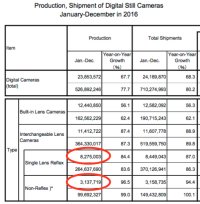
It's not blasphemy...it's just ridiculous and asinine given that mirrorless sales for 2016 only constitute 27% of total ILC sales. Unless you're suggesting that Canon should wait until nearly all ILCs are mirrorless before launching a FF MILC?
 

Attachments

  • CIPA 2016.jpg
    CIPA 2016.jpg
    205.5 KB · Views: 412
Upvote 0
Well, WHY it is 27% "only", Mr. Neuro?
Correct answer is: because SUPPLY sucks!

  • Nikon offers no mirrorless ILC system [Nikon 1 is dead and does not count]
  • Canon offers a limited APS-C system only
  • The 2 companies together hold around 80% combined share of camera market
[*]Despite this situation mirrorless systems have already grabbed 27% of market ...
[/list]

As soon as compelling APS-C and FF-sensored MILC systems are offered by Canon (and Nikon), market share will very rapidly eclipse "reflex systems" ... aka "mirrorslappers". Just to be sure: it will also happen - only a bit slower - should Canon and Nikon not come out with compelling mirrorless options in both APS-C and FF.
 
Upvote 0
AvTvM said:
Well, WHY it is 27% "only", Mr. Neuro?
Correct answer is: because SUPPLY sucks!

As soon as compelling APS-C and FF-sensored MILC systems are offered by Canon (and Nikon), market share will very rapidly eclipse "reflex systems" ... aka "mirrorslappers". Just to be sure: it will also happen - only a bit slower - should Canon and Nikon not come out with compelling mirrorless options in both APS-C and FF.

1) What makes you think that will change anytime soon? Consider that Canon and Nikon are the status quo.

2) Given the current rate of market evolution, your 'only a bit slower' is something like >15 years. Good luck with that. ::)
 
Upvote 0
neuroanatomist said:
1) What makes you think that will change anytime soon? Consider that Canon and Nikon are the status quo.
2) Given the current rate of market evolution, your 'only a bit slower' is something like >15 years. Good luck with that. ::)

1) Sony A7 Mk. III and A9.
2) Fuji's success - in only 3 years
...
3) Nikon might just falter ... and/or be bought by Sony
 
Upvote 0
AvTvM said:
neuroanatomist said:
1) What makes you think that will change anytime soon? Consider that Canon and Nikon are the status quo.
2) Given the current rate of market evolution, your 'only a bit slower' is something like >15 years. Good luck with that. ::)

1) Sony A7 Mk. III and A9.
2) Fuji's success - in only 3 years
...
3) Nikon might just falter ... and/or be bought by Sony

1) Just what Sony needs: another body. After the clearly nerfed and underwhelming A7R II landed like a dead turd with the photography market, I'm sure more fps and more pixels and more AF points will batter down the door this time. I can hear all the Canon faithful slamming down their well-built rigs that have excellent service and broad lens, lighting and third party accessory options in favor of the new toy with a sweet spec sheet. It's obvious. Stupid forum.

2) How do you define Fuji succeeding? They are not even in the top 3 mirrorless sales in their home country.

3) Down the dosage, son.

- A
 
Upvote 0
  • AvTvM said:
    Well, WHY it is 27% "only", Mr. Neuro?
    Correct answer is: because SUPPLY sucks!

    • Nikon offers no mirrorless ILC system [Nikon 1 is dead and does not count]
    • Canon offers a limited APS-C system only
    • The 2 companies together hold around 80% combined share of camera market
    [*]Despite this situation mirrorless systems have already grabbed 27% of market ...
AvTvM said:
As soon as compelling APS-C and FF-sensored MILC systems are offered by Canon (and Nikon), market share will very rapidly eclipse "reflex systems" ... aka "mirrorslappers". Just to be sure: it will also happen - only a bit slower - should Canon and Nikon not come out with compelling mirrorless options in both APS-C and FF.
actually.....
If the next Rebel came out as mirrorless, then the bulk of Canon DSLR sales would be mirrorless :)
 
Upvote 0
AvTvM said:
neuroanatomist said:
1) What makes you think that will change anytime soon? Consider that Canon and Nikon are the status quo.
2) Given the current rate of market evolution, your 'only a bit slower' is something like >15 years. Good luck with that. ::)

1) Sony A7 Mk. III and A9.
2) Fuji's success - in only 3 years
...
3) Nikon might just falter ... and/or be bought by Sony

Lol. Just lol. ::)
 
Upvote 0
ahsanford said:
2) How do you define Fuji succeeding? They are not even in the top 3 mirrorless sales in their home country.

due to price. Oly mFT stills sells in JP, because they have a lot of older models on clear-out sale.
In Europe Fuji seems to be doing rather well. Don't have numbers, just "personal, first hand observations". Judging from my photo buddies ... more than half of them have bought Fuji stuff over the last 2 years - mostly in addition to Ca/Nikon gear, but also some "switches for good" from Nikon, some from Canon.
 
Upvote 0