Deep Sky Astrophotography

Maximilian said:
jrista said:
Another image, again without the Astronomik CLS filter. This one was an easier target than the Pleiades: Andromeda Galaxy, actually the full complex of M31, M32, and M110.
Really Beautiful. Congrats.
I love those astro pictures that start to become three dimensional.


Thanks. Pretty happy with how this one turned out...definitely got some of that sense of three dimensions in there, which was actually more challenging than it sounds.
 
Upvote 0
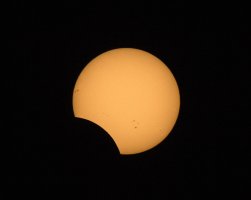
Partial solar eclipse from today. Started at 3:20pm, continued until sunset. I imaged through the central period, up to peak and a little after. The sun was too bright before and after that to really image it properly, as I was just using my 10-stop ND filter and f/22 or narrower. :P


Nice big cluster of sun spots just below center, though. (Note, this image is big, so you can see the sunspot detail. Also look at the periphery of the sun for some surface structure detail.)


kyiHK5Q.jpg


Next time, I have to have a proper solar filter handy, or maybe even a Lunt solar telescope.
 
Upvote 0
jrista said:
kkelis said:
I did a timelapse video which features Andomeda and Orion. Skip to 5:25 if you care to watch it.
Not bad i believe for 5 sec exposures. 6 seconds for Orion but there is a bit of star trailing.

https://www.youtube.com/watch?v=FDv7laP1G54


Good stuff! Damn good indeed for such short exposures. What camera did you use?

My 6D with 70-200 f/2.8 MKII at iso 6400. Very dark sky - you could spot Andromeda with the naked eye
 
Upvote 0
jrista said:
msm said:
That and the Pleiades photo are really impressive pictures, what sort of lens you need for that?


Thanks. :) I use my EF 600mm f/4 L II right now, which doubles as a very high end telescope. It's similar in IQ to the Officina Stellare Hiper APO 150mm, which is about $11,500.
Hi,
Hmm... I thought most super telephoto lens are not as good as telescope for imaging... how's the edge performance of the EF 600mm F4 L II??

Anyway, I saw my friend's 130mm f6 StarFire and it's super sharp right to the edge, but the waiting list is 7 to 10 years... :o

Have a nice day.
 
Upvote 0
jrista said:
Partial solar eclipse from today. Started at 3:20pm, continued until sunset. I imaged through the central period, up to peak and a little after. The sun was too bright before and after that to really image it properly, as I was just using my 10-stop ND filter and f/22 or narrower. :P


Nice big cluster of sun spots just below center, though. (Note, this image is big, so you can see the sunspot detail. Also look at the periphery of the sun for some surface structure detail.)


kyiHK5Q.jpg


Next time, I have to have a proper solar filter handy, or maybe even a Lunt solar telescope.

That sunspot is HUGE!!! it must be 10 times the size of the Earth. Is that with the 600mm?

Here is mine from last year solar eclipse.

3/11/2013 15:54

Partial Solar eclipse as seen from Limassol,Cypus

Canon 600D + 70-200/f2.8 is II + 2xTC + UV Filter + CPL Filter + 10 stop ND Filter — in Limassol, Cyprus.
 

Attachments

  • _MG_1898.jpg
    _MG_1898.jpg
    260.9 KB · Views: 518
Upvote 0
I botched my eclipse photos. It was right at sunset on the east coast, I had to drive around a bit before I finally found a place with a low enough view to see the sun during the eclipse, and even then I just had a couple minutes to try and dial things in. I should've planned ahead a little better, and I should've experimented with my equipment ahead of time. Anyway, I got so frustrated with my results, I went out the next day to see what kind of sun shots I could get when I wasn't rushed.

Sun - Single Mylar, Astronomik CLS filter by yorgasor, on Flickr

I tried various versions on this before I finally got a photo I was happy with. I first took some mylar from an emergency blanket. I cut a big rectangle, folded it in half, and wrapped it around this Nikon 300mm f/2.8 AIS lens, and had a 2x Canon Extender III. With the mylar doubled up, I had a difficult time getting a fast enough shutter speed, and the aperture was wide open. The double layer of mylar also inhibited some clarity.

Then I tried a single layer of mylar, but then the sun was too bright. I had to dial down the aperture to f/22 (with the 2x extender, f/44!) and 1/8000 on the shutter speed. This also inhibited clarity. Then I got an idea to use my Astronomik CLS XL clip filter. That let me bring my aperture down to f/11 and 1/8000th. This gave the moon a strong blue cast that needed a lot of post-processing to trim down. But the result was a very clear image of the sun that I was quite pleased with. I just didn't get it all worked out in time for the eclipse :(

Homemade Solar Eclipse Filter by yorgasor, on Flickr
 
Upvote 0
weixing said:
jrista said:
msm said:
That and the Pleiades photo are really impressive pictures, what sort of lens you need for that?


Thanks. :) I use my EF 600mm f/4 L II right now, which doubles as a very high end telescope. It's similar in IQ to the Officina Stellare Hiper APO 150mm, which is about $11,500.
Hi,
Hmm... I thought most super telephoto lens are not as good as telescope for imaging... how's the edge performance of the EF 600mm F4 L II??


As I stated, the 600/4 II has stellar corner performance. The field is extremely flat, a kind of flat that you have to spend tens of thousands of dollars for with a real telescope. The Canon superteles are used very often for astrophotography. There are even ultra sensitive, ultra high speed imaging arrays that use dozens of Canon EF 400mm f/2.8 L II lenses with FLI cameras to image some of the faintest stuff in the universe.


Canon L-series superteles make excellent telescopes. I don't know about other teles or superteles, but Canon's L-series superteles are extremely good.

weixing said:
Anyway, I saw my friend's 130mm f6 StarFire and it's super sharp right to the edge, but the waiting list is 7 to 10 years... :o

Have a nice day.


The StarFire is an Astro-Physics scope. Astro-Physics makes excellent quality products, however they are pretty costly. From what I understand, AP is no longer making that particular scope...they stopped making it years ago (maybe even over a decade ago), so there isn't a waiting list, they simply aren't available unless you buy them used (and owners don't generally sell them). There is a newer 130mm f/6.3 StarFire that is currently in production, however it doesn't take years to get them...if it did, no one would even bother, that would just be ludicrous.


AP mounts are some of the best in the world, and in such demand and built literally with hand-made quality, that their order-to-delivery lead time is around eight months right now. (I.e. if you order an AP mount today, it wouldn't even start being manufactured and assembled until about six months out or so, and wouldn't be shipped until at least eight months out.) I figure the StarFires have a similar lead time, but I don't know of anyone who has had to wait over a year for any AP product lately. They just don't mass-manufacture, they don't even start manufacturing until they get an order, and it is truly hand-made quality (assembly is all done by hand, each and every product made is manually tested for quality and optimized for best performance, especially for mounts with absolute encoding, etc.) It's the price you pay to get high end, high quality astronomy and astrophotography equipment. It is not easy or quick to ramp up new people with the skill level required to deliver that kind of quality (although from what I have heard, companies like Astro-Physics are training new people to improve their turnaround.)
 
Upvote 0
kkelis said:
That sunspot is HUGE!!! it must be 10 times the size of the Earth. Is that with the 600mm?


Yeah, gargantuan. It was an X-class flare level spot. They were expecting a LOT of energy from it, but I think it was pointed away from earth when flares occurred.


It was indeed shot with the 600mm. I should have tried imaging with the 2x TC...but for some reason I didn't think to try until the eclipse was over.


kkelis said:
Here is mine from last year solar eclipse.

3/11/2013 15:54

Partial Solar eclipse as seen from Limassol,Cypus

Canon 600D + 70-200/f2.8 is II + 2xTC + UV Filter + CPL Filter + 10 stop ND Filter — in Limassol, Cyprus.


Very nice. It's pretty amazing how much a 10-stop ND can do for imaging the sun. :D
 
Upvote 0
yorgasor said:
I botched my eclipse photos. It was right at sunset on the east coast, I had to drive around a bit before I finally found a place with a low enough view to see the sun during the eclipse, and even then I just had a couple minutes to try and dial things in. I should've planned ahead a little better, and I should've experimented with my equipment ahead of time. Anyway, I got so frustrated with my results, I went out the next day to see what kind of sun shots I could get when I wasn't rushed.


Sorry you missed the eclipse. Image looks nice, though...that one cluster of sunspots is just giant.
 
Upvote 0
I reprocessed my Pleiades image from a while back. I'd been waiting for clear skies to get more subs, I need about 260 to get the total integration time/SNR that I need to really take it to the limits without a lot of noise. Since I haven't had clear skies for a while, I decided to see what I could do with what I had.


I think this one definitely looks better than the last version, more detailed/colorful, and the faint outer IFN detail has better contrast.
 
Upvote 0
Well gentlemen, I am excited to be able to join you soon with posting some images.
I have been keeping my eye on things somewhat and have never been able to afford the tracking gear needed to do keep things in the veiwfinder without creating star trails for any longer than what ? 25 sec at 14mm at F2.8 with a huge iso setting ....
I found an entry level item which I am excited to start using the moment we get some clear skies
http://www.bintel.com.au/Mounts---Tripods/SkyWatcher-Star-Adventurer/SkyWatcher-Star-Adventurer-Bundle/1904/productview.aspx
I also just downloaded DSS .. so now all I have to do is work out how to use it all.
I am in the southern hemisphere and finding our polar axis is a little harder.
 
Upvote 0
[quote
I think this one definitely looks better than the last version, more detailed/colorful, and the faint outer IFN detail has better contrast.
[/quote]

As much as I liked the last one, you did get even more out of this one. The wider fields is exactly why I bought the 5DIII. I was hoping this new moon would be good weather, but doesn't look like it. Last time out I had a terrible time with tracking and could only get about two minutes without trailing, found the polar scope badly out of alignment so fixed that . Here is Andromeda from that night, it needed a lot more exposure .

http://src3rsteve.zenfolio.com/p289498573/e11012ef6
 
Upvote 0
Bad weather has basically shut me down lately. Decided to start spending my clear nights at a dark site, as it's vastly more efficient to gather photons without LP than with. Here is my latest:


93y1oFX.jpg


Orion's Sword - Wide Field with additional Dust and Reflections


Canon 5D Mark III
Canon EF 600mm f/4 L II
Orion Atlas EQ-G (Belt Modded)


Acquisition with BackyardEOS, processing with PixInsight and Photoshop. Total of 2h 20m integration for the background, grand total of ~4h total image data for bringing out the core (manual blending, this target has MASSIVE dynamic range.)


Upvote 0
Amazing job Jon, really beautiful, and so much detail in the dust, what are the light sources with cones of darkness on each side?

Another thing, when i see it full size, i see lots of noise in the dark areas, i expect a lot of noise since its a high ISO composite of many hours of long exposure, but this much color noise! is it a by-product of the Sensor, long exposure, composite, or all together? and shouldn't it be handled by dark frame subtraction?

Thanks for sharing and sorry for the noob questions :)
 
Upvote 0
Thanks. :)


So, there is noise. Lots of noise. It's only 2 hours of integration, and I probably need a minimum of 5 to really do it justice. It's just not easy to get that data, since there are only a handful of dark nights a month, and Orion is really racing towards the western horizon. I hope to gather another three hours at some point, which should help.


The 5D III, as I've tried saying so many times on these forums, is one craptastically noisy sensor! It is NOT, buy today's standards, a low noise sensor, at all. Which is a little sad, for a camera barely three years old. That's where the color noise comes from.


As for electronic noise overall, it's actually fairly low. I used ISO 1600 specifically to get read noise low. Its around 3.x e-. I was also imaging at around 3C (it's the heart of winter here, nights are 15-18F), so the dark current is very low. The reason the darker regions look noisy is they have been very significantly stretched. I had 21.3mg/sq" skies where I imaged this, which is getting pretty close to the darkest possible 22mg/sq" skies on earth. That was necessary to even get a reasonable amount of photons on those dark areas. Still, on a per-sub basis, the darker areas probably only had maybe 5-8 photons/pixel/minute tops! :P


So, yeah...there is noise. There is always noise, and when you do a ludicrous stretch like I did, that noise can present a bit of a problem. The only solution is to expose long enough to swamp read noise, and integrate more and more. I need three and a half more hours of integration for my minimum, and I would really prefer another 7 hours.


Regarding dark subtraction, you have to match the dark frame temps to the light frame temps. That can be a major PITA, so I stopped bothering and now use dithering instead. Along with Winsorized Sigma Clipping integration, that takes care of the hot and cold pixels, sat tracks, etc. I still use biases and flats, though...and flats actually tend to increase noise a bit as it removes LP and vignetting.

 
Upvote 0