Deep Sky Astrophotography

East Wind Photography said:
jrista said:
There isn't a whole lot of excitement in the astro community for Canon cameras these days. A couple guys promote them a lot, like Roger Clark, but most people are much more interested in the newer entry-level Nikon DSLRs, like the D5300 and D5500. They have lower dark current, higher resolution, lower noise at low ISO. Canon cameras are rarely used ISO 800 and heavily clipped stars are fairly common, but people are using Nikon's as low as ISO 200 (and in a few cases ISO 100) for the increased DR.

The D800, D810, and D810a, with black point clipping hacks and astro modding on the former two, have garnered FAR more interest among higher end DSLR imagers than the 5Ds. The guys I know who image with them produce some of the most amazing astro images I've ever seen.

If there was any field where read noise and dynamic range mattered more than landscape photography, astrophotography is it. By a long shot.

I grabbed a 5dsR the other day and once this full moon abates, I will give it a shot. Astro is not my primary use but will see how it holds up to something big, bright, and stacked.

The moon should do fine with the 5DsR. Because it is big and bright, you'll be able to get a very strong signal and noise won't be a problem.

It's the very faint deep sky astrophotography stuff that Canon cameras have more of a problem with. The Nikon cameras really reign supreme these days, with their exceptional noise handling. The Sony A7s has become a bit of a cult favorite with astrophotographers these days as well. It's small, light weight, and there is a project going on to see if it is possible to cool them with peltiers on the cheap, without having to be invasive into the camera body, and without needing a large enclosure. Sony's internal layout results in multiple metallic connections to the body, which improves heat conductance, making a simpler peltier cooler easier to do.

If Canon someday addresses their readout noise issues, I'm sure they will surge back to the forefront. They have the most software compatibility for astro imaging, which is a big bonus (although Nikon has caught up almost entirely). Sony currently lacks a lot of software support because of their limited SDK, although that is slowly improving.
 
Upvote 0
Haven't posted here in a while. Here is another of my more recent images. California Nebula in this case, in the constellation Perseus. This nebula is not all that far from the Pleiades cluster:

mPDhKWO.jpg


This is an integration of 155x150s subs, for a total of 6.5 hours of exposure time. Imaged at a very dark site, skies 21.36mag/sq", over three separate nights. Processed with PixInsight.
 
Upvote 0
Another more recent image. Elephant Trunk nebula in IC1396. This is in the constellation Cepheus, neighbor of Cassiopeia around the north celestial pole.

zN7K6PYh.jpg


This is an integration of 161x150s subs for a total of 6.7 hours of exposure time. Also imaged at a dark site, 21.36mag/sq", over four separate nights. Processed with PixInsight.
 
Upvote 0
scyrene said:
telemaq76 said:
thank yes i m proud of it 8) . but i wish i can do better if i have more time . but i live i a cloudy country :'(

This is the biggest problem! I'd invest a lot more time and money into astrophotography if it wasn't for the fact we get one good, clear night only once every two weeks or so.

And the moon kills it the rest of the time. I've found it necessary to avail myself at any window of opportunity...much to the dislike of my family.
 
Upvote 0
jrista said:
Haven't posted here in a while. Here is another of my more recent images. California Nebula in this case, in the constellation Perseus. This nebula is not all that far from the Pleiades cluster:

mPDhKWO.jpg


This is an integration of 155x150s subs, for a total of 6.5 hours of exposure time. Imaged at a very dark site, skies 21.36mag/sq", over three separate nights. Processed with PixInsight.

You always seem to have the perfect focus. What is your process for getting there? I know you often use your 600 and I'm curious to see where I can improve on that.
 
Upvote 0
East Wind Photography said:
You always seem to have the perfect focus. What is your process for getting there? I know you often use your 600 and I'm curious to see where I can improve on that.

I use software focus assist tools. For the 5D III and 600mm lens, I use BackyardEOS (BYE). There is a frame and focus module in that program that pipes in the live view feed. I just find a medium bright star, put it about a third of the way to the edge from the center, and use the 5x zoom mode to view the star at full size. I then center the star in a little readout, which displays the star's FWHM (full width at half maximum). BYE has built-in controls to adjust the lens' focus, electronically so you don't have to touch the lens and cause vibrations. These controls have coarse, medium and fine control in both directions, and I just use them to adjust focus until the FWHM drops to and settles at a minimum.

Because the lens is so large, I have to regularly focus throughout the night. It can contain a lot of heat, and it takes time for that heat to dissipate, and all the glass results in a fairly significant focus shift. I will focus every frame (usually 5-10 minutes) early, then every 2-3, then maybe once an hour, until the lens settles.

I have other software for my 8" RC telescope. SGP or Sequence Generator Pro, is more advanced than BYE. I purchased a Moonlite CSL 2.5" focuser for the 8" RC, a robotic focuser with support for computer control via ASCOM. With SGP, I can configure it to automatically focus, and do so every few frames. SGP has a whole bunch of other advanced features...automatic framing, the ability to reframe to the same object with pixel accuracy on subsequent nights, it can automatically handle meridian flips, it can synchronize with guiding, etc. You can basically automate the whole imaging process with it. Autofocus with SGP will usually get even better focus than I can when manually focusing with BYE.
 
Upvote 0
jrista said:
East Wind Photography said:
You always seem to have the perfect focus. What is your process for getting there? I know you often use your 600 and I'm curious to see where I can improve on that.

I use software focus assist tools. For the 5D III and 600mm lens, I use BackyardEOS (BYE). There is a frame and focus module in that program that pipes in the live view feed. I just find a medium bright star, put it about a third of the way to the edge from the center, and use the 5x zoom mode to view the star at full size. I then center the star in a little readout, which displays the star's FWHM (full width at half maximum). BYE has built-in controls to adjust the lens' focus, electronically so you don't have to touch the lens and cause vibrations. These controls have coarse, medium and fine control in both directions, and I just use them to adjust focus until the FWHM drops to and settles at a minimum.

Because the lens is so large, I have to regularly focus throughout the night. It can contain a lot of heat, and it takes time for that heat to dissipate, and all the glass results in a fairly significant focus shift. I will focus every frame (usually 5-10 minutes) early, then every 2-3, then maybe once an hour, until the lens settles.

I have other software for my 8" RC telescope. SGP or Sequence Generator Pro, is more advanced than BYE. I purchased a Moonlite CSL 2.5" focuser for the 8" RC, a robotic focuser with support for computer control via ASCOM. With SGP, I can configure it to automatically focus, and do so every few frames. SGP has a whole bunch of other advanced features...automatic framing, the ability to reframe to the same object with pixel accuracy on subsequent nights, it can automatically handle meridian flips, it can synchronize with guiding, etc. You can basically automate the whole imaging process with it. Autofocus with SGP will usually get even better focus than I can when manually focusing with BYE.

Ive messed around with bya but never actually used it in the field. The AF section is particularly interesting. I will give it a shot next window of opportunity. Ive noticed these lenses really take time to adjust to temperature. Not only AF is affected but lens shape as well. At first i just thought the mechanics would drift a bit being aimed up almost all night. But it seemed to calm down after a few hours. Ive started the acclimation process way ahead of time...however even so, its not as rapid as say a newtonian mirror. The autofocus in sgp sounds like the best way since it can be inserted in the workflow and yields less human error.

Its too bad Canon doesnt include the ability to AF on a star at 10x. Seems fairly trivial but i guess there are other factors to consider in the firmware.
 
Upvote 0
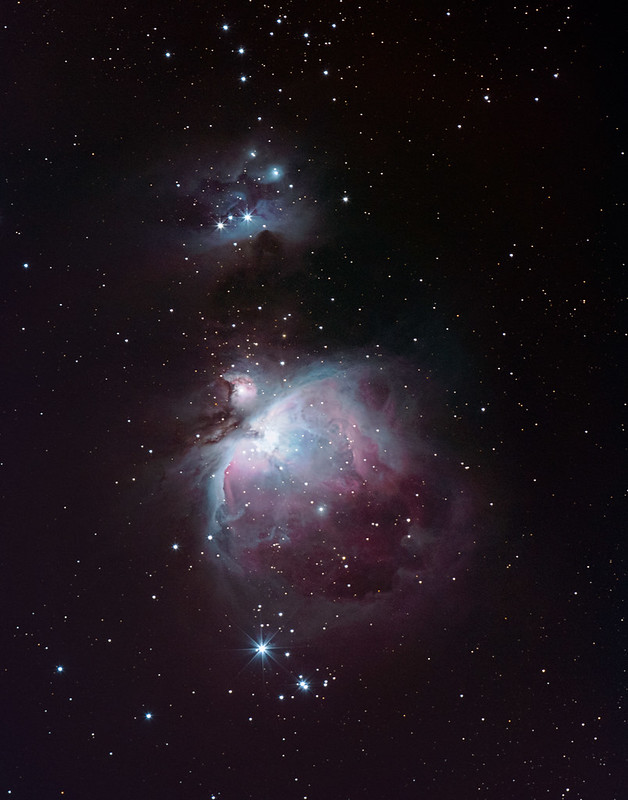
First try with my new canon 700d astrodon on IC 434
the best night for monthes..and my neq6pro died 3 days ago
good for me i still have my small ioptron skytracker
only 45 seconds exposure iso-1600 f5.6
with canon 400 f5.6L
but 372 pictures, 295 darks, 28 flats and 86 offsets
 
Upvote 0
telemaq76 said:
First try with my new canon 700d astrodon on IC 434
the best night for monthes..and my neq6pro died 3 days ago
good for me i still have my small ioptron skytracker
only 45 seconds exposure iso-1600 f5.6
with canon 400 f5.6L
but 372 pictures, 295 darks, 28 flats and 86 offsets

Wow! That is actually quite good. Those 372 subs really did the trick!! I think 295 darks is beyond excessive...you would have been fine with 50 of them, from a statistical standpoint. It is better if you get hundreds of biases (offsets) rather than hundreds of darks, since the biases are used to calibrate everything, while the darks are only used to calibrate the lights.

Anyway, great result for 45 second subs. Good, accurate color. You have a gradient...you can fix that with GradientXterminator in Photoshop, or with PixInsight. Starts are a bit bright, there are ways of dealing with that. Nice job!
 
Upvote 0