Deep Sky Astrophotography

alexthegreek said:
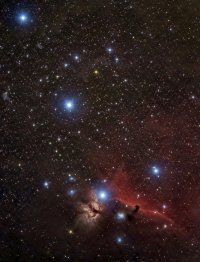
Thanks Click!By the way this is a 800% crop of another image.Does anyone know why I get these black dots?They're all over the place!It gives the image this almost honeycomb appearance.I oversharpened the image so it is easier for you to see.

This is what I call "webbing" (as it often looks like cobwebs), and is usually an artifact of processing. Most often deconvolution and noise reduction. Can you explain how you processed the image?
 
Upvote 0
jrista said:
alexthegreek said:
Thanks Click!By the way this is a 800% crop of another image.Does anyone know why I get these black dots?They're all over the place!It gives the image this almost honeycomb appearance.I oversharpened the image so it is easier for you to see.

This is what I call "webbing" (as it often looks like cobwebs), and is usually an artifact of processing. Most often deconvolution and noise reduction. Can you explain how you processed the image?
Thanks for the reply jrista!Im afraid I can't be very specific about proccesing as this image was done a couple of months ago plus I don't have a certain way of doing things except that I make tiffs with acr then stack with dss and continue with photoshop for stretching.I also use carboni's actions plus nik's local contrast and detail enhancer.I don't have a system I just do something and if I like it I keep the changes and carry on.A bad way to post proccess for sure!I don't think I used calibration frames either.Here is the full image
 

Attachments

  • hhead_2.jpg
    hhead_2.jpg
    644.8 KB · Views: 274
Upvote 0
StudentOfLight said:
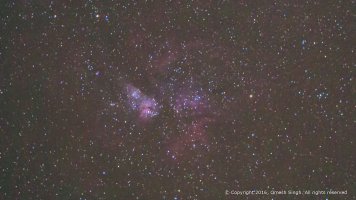
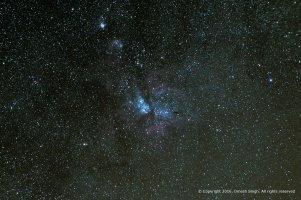
Carina Nebula - from the backyard (i.e. still in the city)

Canon 5D Mark-III, Tamron 70-200 f/2.8 (No-tracking)
15 x 2s @ f/3.2, ISO 1600

That's not a bad image, well done. To my eye's I thought you'd left some data on the table, I downloaded the jpeg and had a play at levels, curves etc then I realised you've hit a limit as you don't seem to have used "flats"

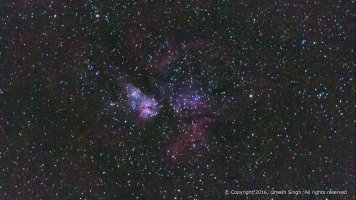
So I ran the image through IRIS and used the subsky command which can flatten an unevenly bright background, and then levelled the colour chanels to remove the remaining red glow and got the below image.

I think you could get this much better by using flats.. and it's probably your next step. (taking an image of a perfectly flat white object, 100% out of focus, and dividing your image frames by this flat image. it also leaves the bits of the image that should be brighter alone where subsky can't tell the difference between broad areas of nebula and skyglow)
 

Attachments

  • Carina Nebula_proc.jpg
    Carina Nebula_proc.jpg
    221.1 KB · Views: 252
Upvote 0
rfdesigner said:
StudentOfLight said:
Carina Nebula - from the backyard (i.e. still in the city)

Canon 5D Mark-III, Tamron 70-200 f/2.8 (No-tracking)
15 x 2s @ f/3.2, ISO 1600

That's not a bad image, well done. To my eye's I thought you'd left some data on the table, I downloaded the jpeg and had a play at levels, curves etc then I realised you've hit a limit as you don't seem to have used "flats"

So I ran the image through IRIS and used the subsky command which can flatten an unevenly bright background, and then levelled the colour chanels to remove the remaining red glow and got the below image.

I think you could get this much better by using flats.. and it's probably your next step. (taking an image of a perfectly flat white object, 100% out of focus, and dividing your image frames by this flat image. it also leaves the bits of the image that should be brighter alone where subsky can't tell the difference between broad areas of nebula and skyglow)
Thanks for the feedback, I reprocessed with a few more light exposures and some flat exposures. I'm looking to get out of the city in the next week or so, and I'll put more effort into those images.
 

Attachments

  • Carina Nebula.jpg
    Carina Nebula.jpg
    742.6 KB · Views: 214
Upvote 0
rfdesigner said:
getting there but I don't think your flats are doing what you need them to.. exactly what do you do with your processing?. what steps do you take and what order and what stacking program?
I used deep sky stacker, it crashed twice with using CR2 files so for speed sake I decided to try using converted JPG files instead. I know I should use CR2 but, if it keeps crashing then I'll never learn the interface. The program did warn that flats would not work properly as JPG uses lossy compression.

I went through the motions and stacked with DSS and adjusted exposure and saturation. I then saved as TIFF.

I then opened in GIMP, duplicated layer and used dodge blend mode. I then used selective curves per channel to try and maximize contrast in the region of of the image that interest me. Dial back red channel and bring blacks to a more neutral hue.

This is by no means the best way to process files as I used lossy compression at various points in the process for speed and personal convenience. This was just a DSS learning exercise for me. (Shooting in a light polluted city) I will try to get better quality exposures and darker skies in the coming few days when the weather clears up.
 
Upvote 0
StudentOfLight said:
rfdesigner said:
getting there but I don't think your flats are doing what you need them to.. exactly what do you do with your processing?. what steps do you take and what order and what stacking program?
I used deep sky stacker, it crashed twice with using CR2 files so for speed sake I decided to try using converted JPG files instead. I know I should use CR2 but, if it keeps crashing then I'll never learn the interface. The program did warn that flats would not work properly as JPG uses lossy compression.

I went through the motions and stacked with DSS and adjusted exposure and saturation. I then saved as TIFF.

I then opened in GIMP, duplicated layer and used dodge blend mode. I then used selective curves per channel to try and maximize contrast in the region of of the image that interest me. Dial back red channel and bring blacks to a more neutral hue.

This is by no means the best way to process files as I used lossy compression at various points in the process for speed and personal convenience. This was just a DSS learning exercise for me. (Shooting in a light polluted city) I will try to get better quality exposures and darker skies in the coming few days when the weather clears up.

ah.. right don't use JPEG as it's non-linear, image calibration must be done with linear data, you can try 16 bit TIFF. (i.e. use DPP with all settings at default but the "linear" box ticked), then save as TIFF. Never the less getting to know the tool is time well spent.

Flats are awkward and can easily have slight gradients if you can get one fully corrected light frame then that's a good step forward.. so I would take a single CR2 or TIFF light frame one CR2/TIFF flat. You should get a much better (flatter) background.

Also take at least one fast dark (i.e. no signal) as canon cameras do not usually put out zero but are usually offset a little to the positive side which mucks up the division process. you can use this for pseudo dark frame as well as a bias (dark_flat) frame.

Again if that all works for "fixing" a single frame then you can worry about getting DSS not to crash with multiple frames... I suspect it's simply running out of memory.
 
Upvote 0
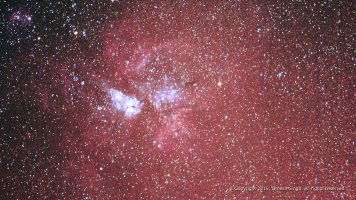
Eta Carina Nebula (Backyard practice, take 4)

Canon EOS 6D, with Tamron 70-200mm f/2.8 VC
491x Exposures: 3.2s at f/4, ISO 1600

Stacked in Deep Sky Stacker,
16bit TIFF edited in Lightroom,
8bit TIFF edited in GIMP (color, blends, etc)
 

Attachments

  • Carina 491x 3.2s.jpg
    Carina 491x 3.2s.jpg
    2 MB · Views: 268
Upvote 0
StudentOfLight said:
Eta Carina Nebula (Backyard practice, take 4)

Canon EOS 6D, with Tamron 70-200mm f/2.8 VC
491x Exposures: 3.2s at f/4, ISO 1600

Stacked in Deep Sky Stacker,
16bit TIFF edited in Lightroom,
8bit TIFF edited in GIMP (color, blends, etc)

getting better every time, nicely done.

starting to see a little lumpyness in the background, what calibration frames are you using?
 
Upvote 0
rfdesigner said:
StudentOfLight said:
Eta Carina Nebula (Backyard practice, take 4)

Canon EOS 6D, with Tamron 70-200mm f/2.8 VC
491x Exposures: 3.2s at f/4, ISO 1600

Stacked in Deep Sky Stacker,
16bit TIFF edited in Lightroom,
8bit TIFF edited in GIMP (color, blends, etc)

getting better every time, nicely done.

starting to see a little lumpyness in the background, what calibration frames are you using?
The combination of good advice, practice, a taller stack and the 6D sensor all make for better results ;)

I set up my mount an hour before I started imaging so all shots were taken at the same temperature. I took many calibration shots immediately after my imaging session:
76x Dark frames
28x Offset/bias frames
24x Flat frames

Are these number of shots enough or excessive?

Regarding the flats... does DSS only used flats for vignette correction or does a lens' color transmission properties come into play as well?
i.e. Do I need to use "full spectrum" light and a true neutral grey target or is okay to just get images of a flat surface which is evenly illuminated?

Do you have any advice on exposure settings?
For example Stellarium says Carina nebula is apparent magnitude 1.00 (extincted to 1.15)
Would it better for me to shoot brighter exposures? If I shot ISO 3200 instead of 1600, would the stacked image make better use of the DDS bit depth or would I just lose highlight detail?

Thursday night looks like the best conditions for me to head out of the city. Thanks again for all the help.
 
Upvote 0
StudentOfLight said:
rfdesigner said:
StudentOfLight said:
Eta Carina Nebula (Backyard practice, take 4)

Canon EOS 6D, with Tamron 70-200mm f/2.8 VC
491x Exposures: 3.2s at f/4, ISO 1600

Stacked in Deep Sky Stacker,
16bit TIFF edited in Lightroom,
8bit TIFF edited in GIMP (color, blends, etc)

getting better every time, nicely done.

starting to see a little lumpyness in the background, what calibration frames are you using?
The combination of good advice, practice, a taller stack and the 6D sensor all make for better results ;)

I set up my mount an hour before I started imaging so all shots were taken at the same temperature. I took many calibration shots immediately after my imaging session:
76x Dark frames
28x Offset/bias frames
24x Flat frames

Are these number of shots enough or excessive?

Regarding the flats... does DSS only used flats for vignette correction or does a lens' color transmission properties come into play as well?
i.e. Do I need to use "full spectrum" light and a true neutral grey target or is okay to just get images of a flat surface which is evenly illuminated?

Do you have any advice on exposure settings?
For example Stellarium says Carina nebula is apparent magnitude 1.00 (extincted to 1.15)
Would it better for me to shoot brighter exposures? If I shot ISO 3200 instead of 1600, would the stacked image make better use of the DDS bit depth or would I just lose highlight detail?

Thursday night looks like the best conditions for me to head out of the city. Thanks again for all the help.

First up, you've got plenty of calibration frames. The amount you need is debatable, but you don't need 100s. I use equivelent of about 16 (I use double length darks, but let's not go there right now)

vignette:

DSS does not know anything about vignetting or optics or anything like that, all it's doing is pixel by pixel calibration, the optical correction drops out by the process.

It's not just vignette, your pixels will not all be exactly the same size (sensor lithography variations), your bayer matrix will not be 100% even, and of course there'll be dust specs and uneven illumination. All of this is covered by a flat frame.

Of course if your flat isn't flat then you're into a whole different set of problems.. getting a flat flat is something that can take quite a bit of trial and effort. Flats must also be made with the focus in the exact same position as the image frames. Same temperature is handy but less critical.

You can build yourself a flat field box to get a really flat field:

http://www.skyatnightmagazine.com/feature/how-guide/how-build-flat-field-box

Dark frames are good for removing pixel to pixel variations in the offsets imposed by the sensor, primarily variations in dark current.

The equation for each processed light frame is:

calibrated frame = (light frame - dark frame) / (flat frame - bias frame)

THEN once all your images are calibrated they are aligned then stacked.. DSS does not stack your lights then remove the darks.. some people fall in this hole and get very confused.

Image length / ISO:

Ignore what stellarium says about brightness, it can be out (ps the BV values are totally unreliable for dimmer stars).. Brightness in stars you want as magnitudes (as they're point sources), but for nebula you want as magnitudes per area, typ mag/sq arc second, and that is often much harder to find.. anyway.. it's a nebula, so it's very very dim.

Ideally on long tracked telescope shots you'd ensure your skyglow would swamp your readnoise.. you mention "mount", does that mean you're tracking?.. if so then it'll probably be down to drive (& guiding) and alignment accuracy.

if you're on a tripod, then as I think you know, just go as long as you can without smearing the stars, after smearing starts your SNR begins to fall. If stars are clipping take a few short shots and HDR them together (it will stop your bright stars from going white instead of the colours they really are)

ISO, 1600 or 3200 are about right, that's where you get minimum read noise for maximum DR on a 6D.

If you're still confused... don't worry, we've all been there, just ask again.
 
Upvote 0
rfdesigner said:
First up, you've got plenty of calibration frames. The amount you need is debatable, but you don't need 100s. I use equivelent of about 16 (I use double length darks, but let's not go there right now)

I would say 16x is the minimum. With 16 subs you reduce random noise by a factor of 4x. That is ok, however you have to keep in mind that subtracting the master dark from each light is going to increase the random noise in the lights. I recommend no less than 25 darks for those who really don't want to stack a lot, and I usually recommend 49, which gives you a more reasonable 7x reduction in noise. That has a much smaller impact on the noise in each light, so small that it is swamped by all the other noise terms.
 
Upvote 0
I am using an equatorial mount from a Celestron 130EQ. It does not have a drive mechanism or GoTo functionality. The EQ mount makes it easier for me to make adjustments to keep my target in the frame, but my exposures are limited by focal length at the moment.
 
Upvote 0
jrista said:
rfdesigner said:
First up, you've got plenty of calibration frames. The amount you need is debatable, but you don't need 100s. I use equivelent of about 16 (I use double length darks, but let's not go there right now)

I would say 16x is the minimum. With 16 subs you reduce random noise by a factor of 4x. That is ok, however you have to keep in mind that subtracting the master dark from each light is going to increase the random noise in the lights. I recommend no less than 25 darks for those who really don't want to stack a lot, and I usually recommend 49, which gives you a more reasonable 7x reduction in noise. That has a much smaller impact on the noise in each light, so small that it is swamped by all the other noise terms.

Everyone I come across has a different view on this, but I do take issue with "7x reduction in noise". that's really quite an unhelpful way of putting it. (regardless of the undeniably correct underlying truth)

Here's the maths which I think makes it easier to see:

16 dark frames => 1/sqrt(16) noise = 1/4 in the master dark.

Light noise + master dark frame noise = sqrt(1^2 + (1/4)^2) = 1.03077...

That's 0.03 magnitudes... so long as there's dithering between lights (i.e. you have to use image alignment to stack images)

make it 100 dark frames and you get 0.0054 magnitude degradation; 84 shutter actuations for .0246 magnitudes!

For someone starting out 16 darks mean they're not generating hundreds of shutter actuations chasing 0.03 magnitudes when they could pick up far more from getting other aspects right, like flats.

Once someone's producing work as good as yours with a setpoint cooled camera, then more darks can make some sense.
 
Upvote 0
StudentOfLight said:
I am using an equatorial mount from a Celestron 130EQ. It does not have a drive mechanism or GoTo functionality. The EQ mount makes it easier for me to make adjustments to keep my target in the frame, but my exposures are limited by focal length at the moment.

Ah that explains it.. then yes you're still limited by stars moving across your field of view.
 
Upvote 0
rfdesigner said:
jrista said:
rfdesigner said:
First up, you've got plenty of calibration frames. The amount you need is debatable, but you don't need 100s. I use equivelent of about 16 (I use double length darks, but let's not go there right now)

I would say 16x is the minimum. With 16 subs you reduce random noise by a factor of 4x. That is ok, however you have to keep in mind that subtracting the master dark from each light is going to increase the random noise in the lights. I recommend no less than 25 darks for those who really don't want to stack a lot, and I usually recommend 49, which gives you a more reasonable 7x reduction in noise. That has a much smaller impact on the noise in each light, so small that it is swamped by all the other noise terms.

Everyone I come across has a different view on this, but I do take issue with "7x reduction in noise". that's really quite an unhelpful way of putting it. (regardless of the undeniably correct underlying truth)

Here's the maths which I think makes it easier to see:

16 dark frames => 1/sqrt(16) noise = 1/4 in the master dark.

Light noise + master dark frame noise = sqrt(1^2 + (1/4)^2) = 1.03077...

That's 0.03 magnitudes... so long as there's dithering between lights (i.e. you have to use image alignment to stack images)

make it 100 dark frames and you get 0.0054 magnitude degradation; 84 shutter actuations for .0246 magnitudes!

For someone starting out 16 darks mean they're not generating hundreds of shutter actuations chasing 0.03 magnitudes when they could pick up far more from getting other aspects right, like flats.

Once someone's producing work as good as yours with a setpoint cooled camera, then more darks can make some sense.

I don't use a setpoint cooled camera. ;P I use an uncooled, unmodified 5D III. That camera is a pretty noisy camera in the grand scheme of things. Especially when imaging with sensor temps over 20C. Especially when it approaches 30C, dark current becomes the most significant source of noise (it can top 5e-/s/px, and if I get into the mid 30's C, it can get up to 8-10e-/s/px, and I don't even bother imaging at that point.)

I also take great care to maximize the potential of my calibration. I used to be "sloppy" with my calibration, and that sloppiness showed in my results. Since I've started paying attention to every detail, it has improved my work considerably. I also chase every faint detail I can, so I guess extracting every last ounce out of my data and keeping the noise as low as possible does matter to me, where it might not for others.

Personally, I agree about the actuation count, however I take a slightly different approach to minimizing noise. I use PixInsight to do all my pre-processing. I DO dither, however again, there is an efficiency factor there. I don't dither every frame, because dithering overhead can be high. I also dither less aggressively than some, because the higher the aggression, the longer the settle time, and the less actual open-shutter exposure time on target you get each night. I dither every 2-3 subs, depending on exactly how long they are.

So, I tend to use 10-20 dark frames. However my dark frames are usually ~2x as long as the lights. PixInsight supports very accurate dark scaling, where by use of noise evaluation of each and every light frame, an optimized scale factor is used to match the master dark to the light. So with 20 frames that are 20 minutes long, scaled to 10 minute lights, it is more like having 40 frames, which is close enough to that 49 number I generally recommend. Also thanks to dark scaling, I do not need to have my darks 100% perfectly matched to the temperature of my lights. Some variation, I allow +/- 3C, is acceptable. Most of my lights fall into a couple of ranges of temperature, depending on the season, and I reuse darks for a while before recreating them. So, one need not expend a massive amount of shutter actuations needlessly creating 49 dark frames every time they image...not with the proper software.

I also agree that getting biases right is important. My previous bias frame was made from 100 biases, which are super easy to get, and the bias signal does not change much, I used my last master bias for about a year. This last time, while doing various testing on my calibration frames, I ended up creating a 512-frame master bias, which was actually quite a bit less noisy than my previous 100-frame master bias, and revealed the PRNU of the sensor much better. It was also much better than using a superbias, which tends to obliterate fine column to column variations in PRNU that I am finding can and do show up in the deeper parts of the signal once the LP is offset. If your a signal hunter like me, this can matter (although 256 frames would probably be good enough...I only have 512 as I was using that data for an entirely different purpose.)

Flats are probably the area where most of the issues come from. Creating proper flats can actually be quite a challenge. Flats correct a lot of things, but because they are divided out they can also interfere with a lot of things. Dust motes can move, which can result in improper correction. Vignetting can change, which can result in improper correction. Gradients can change, which at the very least can require different kinds of pre-processing and integration (i.e. in PI, you can use flux equalization and percentile clipping to deal with flat gradients to a degree). Getting the right ADU count in a flat matters for proper correction. Etc.

So for a beginner, I would agree, focusing their efforts on flats would be more valuable. That said, acquiring darks is easy. And if you use a dark scaling algorithm, you do not actually need the darks to be ideally matched, and can usually reuse master darks for a good while before having to recreate them.

 
Upvote 0
Looks like one of my images is going to be published in Sky & Telescope Magazine:

http://www.canonrumors.com/forum/index.php?topic=29527.0

Second time, although the first image, which should be in the May edition next month, was a collaboration between me and another astrophotographer. This time, it's 100% my work.
 
Upvote 0
jrista said:
Looks like one of my images is going to be published in Sky & Telescope Magazine:

http://www.canonrumors.com/forum/index.php?topic=29527.0

Second time, although the first image, which should be in the May edition next month, was a collaboration between me and another astrophotographer. This time, it's 100% my work.
Congratulations!
 
Upvote 0