Deep Sky Astrophotography

StudentOfLight said:
Thanks again for the feedback. I'll definitely implement the highlight retention processing going forward.

Side-note: On this occasion humidity was about 72% as well so not very good seeing conditions.

I'm still unfortunately without a tracking mount so there is still a tiny bit of trailing in my stars. So perhaps you guys can offer some advice. I think these are my requirements:
0) I'm looking to spend $800-1600 on a mount + drive system
1) I'm currently using the 6D, but will likely get an 80D (or 7D-III) in the future
2) I'm most interested in shooting objects with lenses in the 70-400mm focal length range
3) I value portability as I'd want to drive to a remote location and hike still further away from roads
4) I might get a telescope at a later stage so focal length could become a bit longer
5) I'd be happy with getting reasonably accurate tracking for 2-3 minute sub-exposures (Is that a realistic expectation given my price range?)

Ideally I'd want to walk into a brick-and-mortar shop, see the products first-hand, and speak in-person to an expert, but I don't think there are many shops like this anymore, not where I live at least.

First you should be aware of your image scale. 400mm on a 6D is about 3.3arc seconds per pixel, if your mount is thrashing by 60 arc seconds peak to peak due to drive imperfections then you'ld need to autoguide that out or reduce focal length. The most major of these imperfections is called Periodic Error (PE).

Assuming 60 arc seconds peak to peak periodic error (not at all uncommon in more affordable mounts), up to 20mm focal length will not need guiding regardless of shot length. If your PE period is say 4 minutes (time), then you could go to 40mm with roughly 1 minute shots as you won't suffer the whole magnitude of the PE just a portion so it shoudn't show. You could go to 80mm with 30 second shots and so on. A 30 arc second PE would double all the focal lengths without needing to guide.

If you end up adding guiding (second scope/lens or off-axis guider and a guide camera) + laptop to control the whole thing and to tether the camera, then the lower the periodic error the less there is to have to correct and the less overall error you'll get in your images. Remember a guide setup will only correct for errors THAT HAVE ALREADY OCCURRED and so are in your final exposure.

When it comes to mounts you want:

A: solid (so it doesn't flex at the first breath of wind) = expensive
B: accurate tracking. (so the stars stay in position) = expensive

Clearly something that's too heavy to lift is no good as a portable mount, but I don't think you're in that price range.

Here is a list of many available mounts all tested for periodic error. Some mounts allow you to correct for the average periodic error of the mount, but that still leaves a significant random element, and again the lower the uncorrected PE the better the final result.

http://lambermont.dyndns.org/astro/pe.html

Don't spend cash on a better camera for the sake of astrophotography at this stage, spend it on a mount and then in time, on a guiding setup. If you want a new camera for other reasons, by all means buy another camera.

AFTER that you might concider a dedicated cooled astro CCD or an IR modified DSLR.

Most shops are very thinly spread, but the vast majority will be only too willing to help and a few phone calls will help to put you on the right track, but do phone around. I will also point you at places like http://www.cloudynights.com and http://www.stargazerslounge.com Both generally good sites with many helpful posters, the second is mainly UK based.
 
Upvote 0
I will be going to a public talkby Dr Lucia Marchetti at the Astronomical Society on Saturday evening so will hopefully meet some local astrophotographers who could perhaps advise regarding local suppliers or perhaps second-hand equipment which would meet my requirements. But it definitely helps to have some background knowledge regarding what to look out for, so the advice is much appreciated.
 
Upvote 0
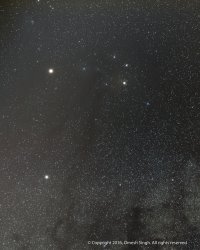
Sprained my foot so wasn't able to get out to a good dark sky area this past dark cycle. I shot this in my back yard... Mars and Saturn in Scorpius. Hopefully the weather will clear up and I'll have a good go at a better dark sky area and hopefully with low humidity as well.
 

Attachments

  • Mars and Saturn in Scorpius.jpg
    Mars and Saturn in Scorpius.jpg
    1.6 MB · Views: 229
Upvote 0
StudentOfLight said:
Sprained my foot so wasn't able to get out to a good dark sky area this past dark cycle. I shot this in my back yard... Mars and Saturn in Scorpius. Hopefully the weather will clear up and I'll have a good go at a better dark sky area and hopefully with low humidity as well.
Sorry to hear that. Hope it heals fast.
 
Upvote 0
Greetings creatures of the night!I was just wondering if anyone has used a pentax with that sensor shift resolution thing for astro stuff.Would it even be possible (given that tracking is good enough) ?I would have started a new thread but believe it or not I don't know how to!
 
Upvote 0
alexthegreek said:
Greetings creatures of the night!I was just wondering if anyone has used a pentax with that sensor shift resolution thing for astro stuff.Would it even be possible (given that tracking is good enough) ?I would have started a new thread but believe it or not I don't know how to!

check if the camera can work without a lens (i.e. with a telescope) if you get the bug big time you will want to upgrade to that way of doing things and changing systems is a right royal pain.

This is one of the reasons Canons do well for astro.


StudentOfLight said:
Sprained my foot so wasn't able to get out to a good dark sky area this past dark cycle. I shot this in my back yard... Mars and Saturn in Scorpius. Hopefully the weather will clear up and I'll have a good go at a better dark sky area and hopefully with low humidity as well.

nicely done, your astro skills are certainly getting better.
 
Upvote 0
alexthegreek said:
Greetings creatures of the night!I was just wondering if anyone has used a pentax with that sensor shift resolution thing for astro stuff.Would it even be possible (given that tracking is good enough) ?I would have started a new thread but believe it or not I don't know how to!

The sensor shift thing will occur over a short period of time, which probably would not work in an astro context. You need very long exposures for astrophotography, and a jittery sensor is actually going to cost you resolution, rather than improve it. I would avoid any camera that uses in-body image stabilization, or sensor shifting for increased resolution, etc. You need as much stability and rigidity as you can get with astrophotography.
 
Upvote 0
So far im pretty impressed with the 1dx2. I shot a few series of three different objects at iso 3200 since with the 5d3 1600 seemed to be the sweet spot. I still have a lot of processing to do so stay tuned.

Jrista, i need some help though on getting good flats. Ive tried a gazillion different things and its just not working the way i expect it should. Do they need to be at the same iso and shutter speed or is the same aperture good enough? I finally tried using the blue sky this morning but final results are still vignetted and pretty severly. Iso and shutter were different but aperture was the same.
 
Upvote 0
Oh one thing i noticed anout the 1dx2, in live view there is no shutter to start the exposure. It just starts. With my other bodies there is some mechanics still to get things going. I heard some talk about canon using a circular shutter in this model. Even in ttl mode, the shutter actuation has much less effect on the stars. In fact it had no effect in my testing.

Im wondering if the new shutter mechanism exerts a zero intertia. That is the same amount of force in all directions instead of left to right or right to left? Even with the mirror flop it seemed more stable.

More testing is required but so far i see some big plusses from the mechanical aspect.
 
Upvote 0
East Wind Photography said:
Oh one thing i noticed anout the 1dx2, in live view there is no shutter to start the exposure. It just starts.

same with the 1dx MK1, in liveview it just starts, which is good , no vibration . But image is so bad compared to my 300$ canon 700d modified astrodon with cls filter. I m not sure a 1dx2 is the best tool for astrophotography. I m sure you can do much better with a small body mofidied and much much much better if you have money with a ccd camera
 
Upvote 0
telemaq76 said:
East Wind Photography said:
Oh one thing i noticed anout the 1dx2, in live view there is no shutter to start the exposure. It just starts.

same with the 1dx MK1, in liveview it just starts, which is good , no vibration . But image is so bad compared to my 300$ canon 700d modified astrodon with cls filter. I m not sure a 1dx2 is the best tool for astrophotography. I m sure you can do much better with a small body mofidied and much much much better if you have money with a ccd camera

Oh, no, there are better options for Astro. however the 1dx2 brings in the money so it's what I have. I haven't seen anyone using one for astro yet so thought I'd give it a shot. The rain has kept me indoors for months so happy to get out and give it a shot.
 
Upvote 0
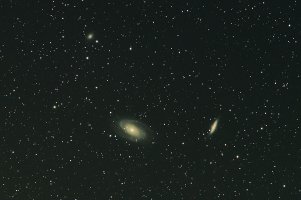
Here is a stack I did with the 1dx2, 59 subs, 45 seconds, ISO 3200, 300mm F2.8L IS II. I stacked them in DSS and unfortunately have my crappy laptop with me that only has Canons DPP for editing. :( I was surprised that it let me edit a TIFF image. Still it has it's limitations for this purpose. Sorry the colors are off. Need to profile this laptop it seems.
 

Attachments

  • M81 and M82 rough.JPG
    M81 and M82 rough.JPG
    1.5 MB · Views: 200
Upvote 0
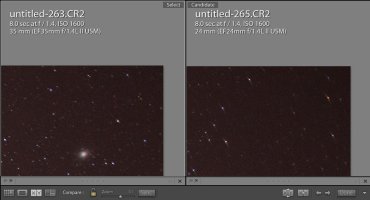
Got a couple of hours of good conditions tonight before humidity started building up. Just enough time to test out my new 35mm. Here is a corner comparison between the 35L II and the 24L II at f/1.4. I'm absolutely blown away by this new lens. :'( Tears of joy I tell you! The slight astigmatism is only in the extreme corners. I can't believe how usable the f/1.4 performance is for astro.

p.s. The Omega Centauri globular cluster is in corner of the 35L II image.
 

Attachments

  • Astigmatism Comparison 35L-II vs 24L-II.jpg
    Astigmatism Comparison 35L-II vs 24L-II.jpg
    89.1 KB · Views: 177
Upvote 0
yes the 24 1.4 II is pretty "not great" in the corner. new generations lens are far better. My new tamron 15-30 2.8 is almost perfect compare to 24 1.4 II too.

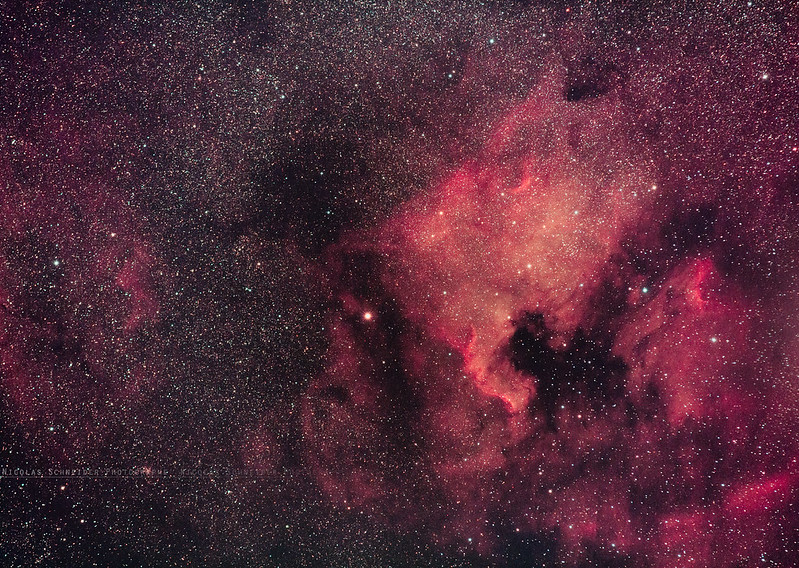
Here is another shot i took last night, was just a try, few minutes before the end of the night. Just time for 5 exposures of 4min30, blended in photoshop, no dof. But the night was really clear and the result is already interesting then i keep and publish it.

 
Upvote 0
telemaq76 said:
yes the 24 1.4 II is pretty "not great" in the corner. new generations lens are far better. My new tamron 15-30 2.8 is almost perfect compare to 24 1.4 II too.

Here is another shot i took last night, was just a try, few minutes before the end of the night. Just time for 5 exposures of 4min30, blended in photoshop, no dof. But the night was really clear and the result is already interesting then i keep and publish it.

There are some deep sky objects that are just too far North for me to shoot. This is one which only rises about 8 degrees above the horizon for me. Another great image!
 
Upvote 0