Do Sensors Make the Camera?

jrista said:
Sure, that's an option. You guys are STILL missing the point. Manually blending with layer masks and whatnot is STILL MORE WORK.

I get the point. But you overestimate what can be done with Exmor. The guys I know with Nikon and Sony have not abandoned their HDR software or GND filters. At least one person in that other thread who owns both Canon and Sony told you that the difference was simply not night and day like you seem to think it is.

Your darkest sunflower shot would not have worked on Exmor. You're focusing on the noise, but the tonality is mud that deep in the shadows. If the sun is in the frame and not masked by fog or a marine layer you are going to have to deal with the insane luminance range using filtration or multiple exposures. I would guess that's not really going to change until we have 20 stop sensors.

The river shot with the triangle patch of sky...I'm somewhat surprised you don't have a frame you can successfully process, and I can't help but wonder if you are being too critical of noise that will never be seen in print. I could certainly be wrong, I wasn't there, but I've shot scenes that seem similar and come home to discover I didn't need to blend.

Processing wide luminance range scenes will occasionally be easier with Exmor. You will occasionally be able to use a single frame where you would have decided to blend at least two on Canon. Not all the time. That said if you want occasionally easier...pick up an A7 or A7R and an EF lens adapter. Problem solved.

Going on and on about this on forums is not going to change anything on Canon's development schedule by even one second. It's false to assume Canon could release an Exmor type sensor tomorrow but they're being lazy. It's also false to assume that any of this is going to push them to produce something sooner.
 
Upvote 0
*Sigh* I guess I'll be renting a D800 at some point in the near future here, as I don't think anything else but real data is going to prove the point.

@PBD: Your photos of the 4WD are much more brightly exposed. I'd be willing to bet little if any data in the shadows is buried in the read noise, which means the image isn't DR limited. That's another point no one seems to get, but whatever, nothing but two RAW files, one from a 5D III and one from a D800, that I can upload so you guys can compare yourselves, is ever going to settle the issue. :P

Anyway, I did not want to completely hijack another thread. I hope the OP got is answer.
 
Upvote 0
jrista said:
@PBD: Your photos of the 4WD are much more brightly exposed. I'd be willing to bet little if any data in the shadows is buried in the read noise, which means the image isn't DR limited. That's another point no one seems to get, but whatever, nothing but two RAW files, one from a 5D III and one from a D800, that I can upload so you guys can compare yourselves, is ever going to settle the issue. :P

Of course it is DR limited, I exposed so I didn't lose the shadows (I do have some experience exposing for Canon sensors :) ), I completely blew the sky.
 
Upvote 0
privatebydesign said:
jrista said:
@PBD: Your photos of the 4WD are much more brightly exposed. I'd be willing to bet little if any data in the shadows is buried in the read noise, which means the image isn't DR limited. That's another point no one seems to get, but whatever, nothing but two RAW files, one from a 5D III and one from a D800, that I can upload so you guys can compare yourselves, is ever going to settle the issue. :P

Of course it is DR limited, I exposed so I didn't lose the shadows (I do have some experience exposing for Canon sensors :) ), I completely blew the sky.

Hmm, maybe I misunderstood. Did you recover the sky? Or replace the sky?
 
Upvote 0
jrista said:
rrcphoto said:
however I doubt 2EV DR would help unless you had two 2EV DR in highlight headroom.

This is a misnomer. There is no such thing as DR only in the highlights. Dynamic range defines the range from highlights to deepest usable shadows. You cannot have "highlight DR" or "two stops DR in highlight headroom"...that's just not how it works. The D800 gains dynamic range primarily by reducing read noise. That doesn't change the midtones or highlights, or for that matter even the brighter shadows. However, what it DOES allow you to do is underexpose to PRESERVE the highlights, and have relatively clean deep shadow detail that can be lifted and not be riddled with banding and color noise.

you're not thinking it through and looking to blame canon.

to use that extra headroom - you have to expose with a faster shutter speed, if you use a faster shutter speed, then you wouldn't get the water motion. Otherwise you have to use a higher ISO, in which the D800 serves no advantage over the 5D.

if your shot was at say ISO 100 f/32 1/50th of a second (as an example) on the 5D then shooting that at ISO 100 f/32 1/50th of a second will not give you more highlight headroom on the D800. your 2EV is in the shadows and no help to you. if you increased your shutter speed on the D800 to get the highlight headroom, thus ISO 100 f/32 1/200th of a second - and pulled the shadows, then your water would be stopped, and not show motion. Now if you had enough ND filters, etc - you could shoot at ISO 400 f/32 1/50th of a second on the D800 - but then again, you don't have that DR that you need as the 5D and the D800 at ISO 400 or so are close to the same anyways.

So saying .. OMFG more DR.. well not quite.

like i said - this is tricky with either camera.

I'm not sure if you used the original 5D .. but that baby really taught someone how to handle highlight clipping.

I'm a little more aware of highlight clipping because I also shoot infrared - and clipped raw highlights on IR .. completely ruin the image. there is no real recovery from that. you ETTR because basically you have a limited amount of data to work and you don't want to clip those precious highlights.

cloudly skies i always bracket for HDR regardless - why? because you can extract that much more dynamic and interesting cloud detail even from what would see to be overcast conditions than just a properly exposed .. bleh white sky.

I'm always of the belief that under most cases if you are 2EV short on DR - you should for most cases be able to handle that. by either RAW latitude or by multishot exposure.

I'm not sure what tools you are using for your work, but if you are having problems with your blending - have you tried different RAW converters? and used the TIFF outputs from them into something like photomatix?

some of your problems with bleeding etc could simply be what your raw converter is doing when it's in the clipping area - remembering of course that bayer is an inexact science to begin with.
 
Upvote 0
jrista said:
privatebydesign said:
jrista said:
@PBD: Your photos of the 4WD are much more brightly exposed. I'd be willing to bet little if any data in the shadows is buried in the read noise, which means the image isn't DR limited. That's another point no one seems to get, but whatever, nothing but two RAW files, one from a 5D III and one from a D800, that I can upload so you guys can compare yourselves, is ever going to settle the issue. :P

Of course it is DR limited, I exposed so I didn't lose the shadows (I do have some experience exposing for Canon sensors :) ), I completely blew the sky.

Hmm, maybe I misunderstood. Did you recover the sky? Or replace the sky?

I replaced it, it took 15 seconds and a further couple of minutes to make look OK (which I don't have on my laptop). I suppose my point was any picture that I want to display I am going to spend a few minutes on as a minimum, and I can deal with a blown sky in no time, anything I am going to print I will take much more time over anyway. It really doesn't make any difference to me what file the info is on, I can make it work fast.

I think there is something to Daniels comments, whilst you can lift the Exmor shadows without the noise of the Canon sensors, there still isn't any detail there, and I think you are thinking they will give you more than they actually will. I know when you do first try one out you will be amazed, but after time you will question the results you get in a different way.

Yes I agree more isn't a bad thing and the shadow noise in Canon's is a weak point, but as all solutions are invariably a compromise, I can deal with that as the biggest compromise in my system.
 
Upvote 0
rrcphoto said:
jrista said:
rrcphoto said:
however I doubt 2EV DR would help unless you had two 2EV DR in highlight headroom.

This is a misnomer. There is no such thing as DR only in the highlights. Dynamic range defines the range from highlights to deepest usable shadows. You cannot have "highlight DR" or "two stops DR in highlight headroom"...that's just not how it works. The D800 gains dynamic range primarily by reducing read noise. That doesn't change the midtones or highlights, or for that matter even the brighter shadows. However, what it DOES allow you to do is underexpose to PRESERVE the highlights, and have relatively clean deep shadow detail that can be lifted and not be riddled with banding and color noise.

you're not thinking it through and looking to blame canon.

to use that extra headroom - you have to expose with a faster shutter speed, if you use a faster shutter speed, then you wouldn't get the water motion. Otherwise you have to use a higher ISO, in which the D800 serves no advantage over the 5D.

if your shot was at say ISO 100 f/32 1/50th of a second (as an example) on the 5D then shooting that at ISO 100 f/32 1/50th of a second will not give you more highlight headroom on the D800. your 2EV is in the shadows and no help to you. if you increased your shutter speed on the D800 to get the highlight headroom, thus ISO 100 f/32 1/200th of a second - and pulled the shadows, then your water would be stopped, and not show motion. Now if you had enough ND filters, etc - you could shoot at ISO 400 f/32 1/50th of a second on the D800 - but then again, you don't have that DR that you need as the 5D and the D800 at ISO 400 or so are close to the same anyways.

So saying .. OMFG more DR.. well not quite.

like i said - this is tricky with either camera.

Have you ever heard of a neutral density filter? I use Lee ProGlass ND filters to solve the problem of needing a faster shutter speed, so it's not an issue. However, I broke the filter I had with me yesterday, though. I was using a 2-stop ND filter earlier, then this happened. :'( :'( :'():

gI1zTsk.jpg

BImpHrb.jpg


I don't know why, but this filter slipped right out of the Lee filter holder, hit the rocks in the shore of the river, and that was it.

Which brings me to another point. Getting good quality filters that have a minimal impact on IQ is expensive. This two-stop 100x100mm Lee ProGlass 0.6 ND filter costs about $160-$180. The resin versions, which have a larger impact on IQ (especially when paired with resin GND filters), still cost about $120. Now, I'd still use solid ND filters with a D800, for the exact same reasons. However, the GND filters are similar in cost...I've spend between $150 to $185 on Lee GND filters. I have a whole range of them, both soft and hard grad, one stop through four stop. That is a LOT of extra cost. It's also more to lug around. It's more that can get broken or scratched. I won't be able to completely eliminate GND filters with a D800. However improvements to sensor IQ won't stop at 14 stops of DR. Soon enough we'll have 16-bit ADC and we'll start seeing cameras with 15-16 stops. Then we'll probably see 20-bit ADC some time down the road, and we'll start seeing cameras with 18, 19, nearly 20 stops of DR.

Anyway, use of solid ND filtration, especially with glass ND filters (they don't affect IQ as much as resin filters) completely negates the whole shutter speed argument.
 
Upvote 0
jrista said:
rrcphoto said:
jrista said:
rrcphoto said:
however I doubt 2EV DR would help unless you had two 2EV DR in highlight headroom.

This is a misnomer. There is no such thing as DR only in the highlights. Dynamic range defines the range from highlights to deepest usable shadows. You cannot have "highlight DR" or "two stops DR in highlight headroom"...that's just not how it works. The D800 gains dynamic range primarily by reducing read noise. That doesn't change the midtones or highlights, or for that matter even the brighter shadows. However, what it DOES allow you to do is underexpose to PRESERVE the highlights, and have relatively clean deep shadow detail that can be lifted and not be riddled with banding and color noise.

you're not thinking it through and looking to blame canon.

to use that extra headroom - you have to expose with a faster shutter speed, if you use a faster shutter speed, then you wouldn't get the water motion. Otherwise you have to use a higher ISO, in which the D800 serves no advantage over the 5D.

if your shot was at say ISO 100 f/32 1/50th of a second (as an example) on the 5D then shooting that at ISO 100 f/32 1/50th of a second will not give you more highlight headroom on the D800. your 2EV is in the shadows and no help to you. if you increased your shutter speed on the D800 to get the highlight headroom, thus ISO 100 f/32 1/200th of a second - and pulled the shadows, then your water would be stopped, and not show motion. Now if you had enough ND filters, etc - you could shoot at ISO 400 f/32 1/50th of a second on the D800 - but then again, you don't have that DR that you need as the 5D and the D800 at ISO 400 or so are close to the same anyways.

So saying .. OMFG more DR.. well not quite.

like i said - this is tricky with either camera.

Have you ever heard of a neutral density filter? I use Lee ProGlass ND filters to solve the problem of needing a faster shutter speed, so it's not an issue. However, I broke the filter I had with me yesterday, though. I was using a 2-stop ND filter earlier, then this happened. :'( :'( :'():

Yes, true. stacking more ND filters in front of the D800 moreso than the 5D would assist, then ETTR for the highlights on the D800 while dealing with D800's woefully poor liveview implementation because your OVF is dark. :p

sorry to hear about the filter - those things are a bear to replace.

honestly? I bet most seriously landscapers still use GND's on the D800. with a bayer array I'm wondering how many actually even use ISO 100? I know for critical landscape - I dont' - as i like to keep my shutter speed up high enough to keep green foliage microcontrast as good as possible. I would say 60% of my landscape is at 400, and 20 at 200 and 10 at 100.

while pulling shadows is cool and fun - it doesn't replace good technique. you end up getting a picture that just seems "off" more time than naught.
 
Upvote 0
rrcphoto said:
jrista said:
rrcphoto said:
jrista said:
rrcphoto said:
however I doubt 2EV DR would help unless you had two 2EV DR in highlight headroom.

This is a misnomer. There is no such thing as DR only in the highlights. Dynamic range defines the range from highlights to deepest usable shadows. You cannot have "highlight DR" or "two stops DR in highlight headroom"...that's just not how it works. The D800 gains dynamic range primarily by reducing read noise. That doesn't change the midtones or highlights, or for that matter even the brighter shadows. However, what it DOES allow you to do is underexpose to PRESERVE the highlights, and have relatively clean deep shadow detail that can be lifted and not be riddled with banding and color noise.

you're not thinking it through and looking to blame canon.

to use that extra headroom - you have to expose with a faster shutter speed, if you use a faster shutter speed, then you wouldn't get the water motion. Otherwise you have to use a higher ISO, in which the D800 serves no advantage over the 5D.

if your shot was at say ISO 100 f/32 1/50th of a second (as an example) on the 5D then shooting that at ISO 100 f/32 1/50th of a second will not give you more highlight headroom on the D800. your 2EV is in the shadows and no help to you. if you increased your shutter speed on the D800 to get the highlight headroom, thus ISO 100 f/32 1/200th of a second - and pulled the shadows, then your water would be stopped, and not show motion. Now if you had enough ND filters, etc - you could shoot at ISO 400 f/32 1/50th of a second on the D800 - but then again, you don't have that DR that you need as the 5D and the D800 at ISO 400 or so are close to the same anyways.

So saying .. OMFG more DR.. well not quite.

like i said - this is tricky with either camera.

Have you ever heard of a neutral density filter? I use Lee ProGlass ND filters to solve the problem of needing a faster shutter speed, so it's not an issue. However, I broke the filter I had with me yesterday, though. I was using a 2-stop ND filter earlier, then this happened. :'( :'( :'():

Yes, true. stacking more ND filters in front of the D800 moreso than the 5D would assist, then ETTR for the highlights on the D800 while dealing with D800's woefully poor liveview implementation because your OVF is dark. :p

sorry to hear about the filter - those things are a bear to replace.

honestly? I bet most seriously landscapers still use GND's on the D800. with a bayer array I'm wondering how many actually even use ISO 100? I know for critical landscape - I dont' - as i like to keep my shutter speed up high enough to keep green foliage microcontrast as good as possible. I would say 60% of my landscape is at 400, and 20 at 200 and 10 at 100.

while pulling shadows is cool and fun - it doesn't replace good technique. you end up getting a picture that just seems "off" more time than naught.

Why would you need to stack more ND filters with the D800 than 5D III? Exposure is exposure, it doesn't change from camera to camera. The same exposure settings would be used for either camera...the only difference between the two is that two more stops of shadow detail are recoverable with the D800 than 5D III. I'd still use a single two stop, maybe a three stop filter.

From what I understand, the D810 does not have the D800's poor live view implementation, however even if it did...I'd still tether to my tablet and use that as a much larger, better live view screen.

And, again...pulling shadows isn't about being fun or cool. It fundamentally boils down to the preservation of highlights. That's the entire reason exposure had to be pushed down to begin with, and therefor the reason your lifting shadows. Neither is it my goal to have super bright shadows, either. I still prefer my images to have contrast...I just don't like to be forced to block up my shadows because to do otherwise would reveal banding or something like that. I'd prefer to have a softer, smoother falloff into shadows, rather than a harsh one...something having more DR would allow me to do more easily and with less effort.
 
Upvote 0
jrista said:
rrcphoto said:
jrista said:
rrcphoto said:
jrista said:
rrcphoto said:
however I doubt 2EV DR would help unless you had two 2EV DR in highlight headroom.

This is a misnomer. There is no such thing as DR only in the highlights. Dynamic range defines the range from highlights to deepest usable shadows. You cannot have "highlight DR" or "two stops DR in highlight headroom"...that's just not how it works. The D800 gains dynamic range primarily by reducing read noise. That doesn't change the midtones or highlights, or for that matter even the brighter shadows. However, what it DOES allow you to do is underexpose to PRESERVE the highlights, and have relatively clean deep shadow detail that can be lifted and not be riddled with banding and color noise.

you're not thinking it through and looking to blame canon.

to use that extra headroom - you have to expose with a faster shutter speed, if you use a faster shutter speed, then you wouldn't get the water motion. Otherwise you have to use a higher ISO, in which the D800 serves no advantage over the 5D.

if your shot was at say ISO 100 f/32 1/50th of a second (as an example) on the 5D then shooting that at ISO 100 f/32 1/50th of a second will not give you more highlight headroom on the D800. your 2EV is in the shadows and no help to you. if you increased your shutter speed on the D800 to get the highlight headroom, thus ISO 100 f/32 1/200th of a second - and pulled the shadows, then your water would be stopped, and not show motion. Now if you had enough ND filters, etc - you could shoot at ISO 400 f/32 1/50th of a second on the D800 - but then again, you don't have that DR that you need as the 5D and the D800 at ISO 400 or so are close to the same anyways.

So saying .. OMFG more DR.. well not quite.

like i said - this is tricky with either camera.

Have you ever heard of a neutral density filter? I use Lee ProGlass ND filters to solve the problem of needing a faster shutter speed, so it's not an issue. However, I broke the filter I had with me yesterday, though. I was using a 2-stop ND filter earlier, then this happened. :'( :'( :'():

Yes, true. stacking more ND filters in front of the D800 moreso than the 5D would assist, then ETTR for the highlights on the D800 while dealing with D800's woefully poor liveview implementation because your OVF is dark. :p

sorry to hear about the filter - those things are a bear to replace.

honestly? I bet most seriously landscapers still use GND's on the D800. with a bayer array I'm wondering how many actually even use ISO 100? I know for critical landscape - I dont' - as i like to keep my shutter speed up high enough to keep green foliage microcontrast as good as possible. I would say 60% of my landscape is at 400, and 20 at 200 and 10 at 100.

while pulling shadows is cool and fun - it doesn't replace good technique. you end up getting a picture that just seems "off" more time than naught.

Why would you need to stack more ND filters with the D800 than 5D III? Exposure is exposure, it doesn't change from camera to camera. The same exposure settings would be used for either camera...the only difference between the two is that two more stops of shadow detail are recoverable with the D800 than 5D III. I'd still use a single two stop, maybe a three stop filter.

From what I understand, the D810 does not have the D800's poor live view implementation, however even if it did...I'd still tether to my tablet and use that as a much larger, better live view screen.

And, again...pulling shadows isn't about being fun or cool. It fundamentally boils down to the preservation of highlights. That's the entire reason exposure had to be pushed down to begin with, and therefor the reason your lifting shadows. Neither is it my goal to have super bright shadows, either. I still prefer my images to have contrast...I just don't like to be forced to block up my shadows because to do otherwise would reveal banding or something like that. I'd prefer to have a softer, smoother falloff into shadows, rather than a harsh one...something having more DR would allow me to do more easily and with less effort.

you would have stack more to if you were ETTR'ing and exposing for highlights on the D800 versus a normal balanced exposure and bracket on the 5D, so if you wanted to move your exposure -3EV on the D800 to expose for the highlights, and then pull up the shadows by 3EV, then you'd have to have 3EV more ND in front to maintain the same ISO and shutter speed.

to be honest though - i'd take one shot that blew the snot out of the sky and just replace it.

but honestly if you are struggling so much and you feel it's the camera - why on earth aren't you using an A7R or even an A7 with an metabones adapter for your current lenses and your problem is resolved. (outside of sony's clunky RAW and bracketing mind you)

especially just an A7, shove it in your kit for the times you feel you need that extra bit of DR lattitude. Sony can barely give the things away now - I think I've seen them used for around 1K.

No offense but it really seems like alot of wasted time and effort discussing it when you have a fairly cheap solution that uses your current lenses.
 
Upvote 0
jrista said:
*Sigh* I guess I'll be renting a D800 at some point in the near future here, as I don't think anything else but real data is going to prove the point.

@PBD: Your photos of the 4WD are much more brightly exposed. I'd be willing to bet little if any data in the shadows is buried in the read noise, which means the image isn't DR limited. That's another point no one seems to get, but whatever, nothing but two RAW files, one from a 5D III and one from a D800, that I can upload so you guys can compare yourselves, is ever going to settle the issue. :P

I'd like to see the direct comparison too. I'd turfed my 5d2 so didn't get to compare it with my d800 on the same shot.
I did have my 60D and I used it as a comparison, taking similarly exposed shots with it and the d800 of the same scene. I've shot plenty of 60D landscapes with sun-in-frame and was able to retain adequate shadow detail when pushing them within reason. My 60D performed better than my 5d2 in this regard.

The 60D example, which I pushed fairly hard, I posted, way back, in the HDR thread.

www.canonrumors.com/forum/index.php?topic=8065.msg154889#msg154889

When I was comparing the 2, there was a considerable amount of shade information available from the d800, without showing read noise, in heavily pushed areas like the charred tree trunk, in shadow. The 60D's file was capable of being pushed even more than I would normally want for print or display without looking bad but comparing it to the same areas of the d800's shot showed a marked difference in quality.
Top-line FF Exmor vs a crop Canon is an unfair fight to start with when, even vice-versa, the crop exmor beat my 5d2. So, I would certainly be interested in seeing a direct FF comparison if you rent a D800 body.
 
Upvote 0
rrcphoto said:
you would have stack more to if you were ETTR'ing and exposing for highlights on the D800 versus a normal balanced exposure and bracket on the 5D, so if you wanted to move your exposure -3EV on the D800 to expose for the highlights, and then pull up the shadows by 3EV, then you'd have to have 3EV more ND in front to maintain the same ISO and shutter speed.

I think you have things backwards. You ETTL to preserve highlights. ETTR pushes the histogram to the right...TO the clipping point. If you are having problems with your signal clipping, you do the exact opposite...shift your histogram to the LEFT, reduce it, pull the highlights back out of the clipping point. If my highlights are clipping when I expose 1s f/16, then all I would have to really do is drop in a 2-stop ND, and that would correct the problem. I would do EXACTLY THAT, regardless of the camera...because 1s f/16 is the same regardless of whether I am using a Canon, Nikon, Sony or any other brand of camera. When you expose for the highlights, you expose for the highlights. The shadows SUFFER as a result.

Now, with the 5D III, by dropping in that 0.6 ND, I've pushed my shadows, which were likely already hovering just above the read noise floor, are now pushed two stops into the read noise floor. On the D800? They are pushed down two stops to...just above the read noise floor.

There is no handicap to the D800 here. I want a 1s f/16 exposure, because that's what will get the the amount of water blur I want. I don't mess with the exposure...I use a solid ND to get what I want. That may be a 1-stop, 2-stop, maybe even a 3-stop ND filter. If I REALLY want to go dreamy, and blur everything, leaves moving in the wind, clouds, and the water, I could go for the 10-stop "Big Stopper"...however I think that's more useful for coastal photography. ;)

rrcphoto said:
to be honest though - i'd take one shot that blew the snot out of the sky and just replace it.

but honestly if you are struggling so much and you feel it's the camera - why on earth aren't you using an A7R or even an A7 with an metabones adapter for your current lenses and your problem is resolved. (outside of sony's clunky RAW and bracketing mind you)

especially just an A7, shove it in your kit for the times you feel you need that extra bit of DR lattitude. Sony can barely give the things away now - I think I've seen them used for around 1K.

No offense but it really seems like alot of wasted time and effort discussing it when you have a fairly cheap solution that uses your current lenses.

I'm a technical guy. As you can see, I quibble and fret over technical details. One thing about Sony that REALLY irks me is their so-called RAW files. They are LOSSY-compressed, and there have been plenty of demonstrations, particularly of landscapes, of their compression introducing artifacts into the RAW. If their messing with the RAW data coming off the sensor, and reencoding it with a different storage structure (which is what they do), then I also suspect that those files will have similar editing latitude issues as the Canon sRAW and mRAW formats do. Both sRAW and mRAW use a compression format, which is also lossy for color. It's a YCbCr format, where full luminance and either 1/2 or 1/4 the color data (depends on whether your small or medium RAW) is encoded for each pixel.

I shot with mRAW for a couple months after I first got my 7D...those files have NOWHERE NEAR the amount of editing latitude as a real RAW. The primary ranges of exposure, the shadows, midtones, and highlights, effectively get "pinned" to a limited range. With a real RAW, I can pull bright highlights right down into the shadows, and I'll get a very dark or low-key image. With an mRAW, I simply cannot do that. I can try, but there is always a part of the bright highlights that just won't move down beyond a certain level. Same goes for shadows...I can lift them, but I cannot lift them beyond a certain point. With RAW, if I want to make certain midtones bright highlights, or even nearly-clipped whites, I can...not with mRAW. I can push and pull the midtones around within the general range of midtones, but I cannot push them very far. Not without moving the entire exposure up or down.

So, no, sorry. :P Not interested in any Sony cameras until they stop using a LOSSY "RAW" image format. That's just inane. They build a twenty billion dollar image sensor monstrosity that is cranking out some of the best sensors the world has ever seen...then they turn around and gimp the whole operation for themselves by lossy compressing their data? Just plain stupid. ::)

If Sony remedies that situation, then I'll gladly look into their mirrorless camera as a landscape camera. It would be nice to lighten the load a bit as well. Since I manually focus my landscapes anyway, the AF issues and such with the Sony wouldn't be an issue. Oh...I guess the only other requirement I would have is...do they support live-view tethering? Now that I've done that with my Windows 8 tablet...I really don't think I could do it any other way. It's like the digital version of a large format field camera...without the upside down image. :P

Finally, I hope the time is not wasted. Canon needs to get a move on and give their landscape photographers (and anyone else who shoots anything that can make use of more DR) a high resolution, high DR camera. So we don't have to deal with things like Sony hackRAW or adding an expensive new set of Nikon lenses and a D800 to our kits (especially when we may already have lenses...I already have the 16-35 f/2.8 L II...to add a D810 for landscapes, I'd need a lens as well...the 14-24 is the logical choice...but, lot more cost than adding just a Canon body that did what I needed.) I'd hope that people who need more DR for their work would get on the bandwagon and start being vocal about their need, just in general on the net, to Canon directly, etc.

The members of this site seem deeply steeped in the notion that there is nothing better than a Canon full frame camera...period. The benefits of less read noise on DR and editing latitude are not really benefits. Sensors with smaller pixels don't really resolve more detail. There are no better lenses than Canon's. The only thing you could ever possibly need is a Canon full frame camera...it'll literally do everything you need, and any improvement over a Canon FF is just a fantasy, a dream, a farce, a lie.

In that light...your right, it's futile and I'm wasting my time. I hear hummingbirds...I'm going to see if I can photograph them.

 
Upvote 0
Aglet said:
jrista said:
*Sigh* I guess I'll be renting a D800 at some point in the near future here, as I don't think anything else but real data is going to prove the point.

@PBD: Your photos of the 4WD are much more brightly exposed. I'd be willing to bet little if any data in the shadows is buried in the read noise, which means the image isn't DR limited. That's another point no one seems to get, but whatever, nothing but two RAW files, one from a 5D III and one from a D800, that I can upload so you guys can compare yourselves, is ever going to settle the issue. :P

I'd like to see the direct comparison too. I'd turfed my 5d2 so didn't get to compare it with my d800 on the same shot.
I did have my 60D and I used it as a comparison, taking similarly exposed shots with it and the d800 of the same scene. I've shot plenty of 60D landscapes with sun-in-frame and was able to retain adequate shadow detail when pushing them within reason. My 60D performed better than my 5d2 in this regard.

The 60D example, which I pushed fairly hard, I posted, way back, in the HDR thread.

www.canonrumors.com/forum/index.php?topic=8065.msg154889#msg154889

When I was comparing the 2, there was a considerable amount of shade information available from the d800, without showing read noise, in heavily pushed areas like the charred tree trunk, in shadow. The 60D's file was capable of being pushed even more than I would normally want for print or display without looking bad but comparing it to the same areas of the d800's shot showed a marked difference in quality.
Top-line FF Exmor vs a crop Canon is an unfair fight to start with when, even vice-versa, the crop exmor beat my 5d2. So, I would certainly be interested in seeing a direct FF comparison if you rent a D800 body.

Your experiences are like my experiences when I've pushed around a friends D800 files. He's a portrait guy (he's actually quite good...I have a link to his web site somewhere around here), but the shadow tonality is VASTLY superior to Canon shadow tonality. The point isn't even to lift all of the shadows so the deepest ones are bright...that's not the point, never had been, never will be. The point is that as the tonal grade falls off into the shadows, the D800 has such low read noise and low dark current that the color fidelity IS higher, the detail IS superior, and when you recover shadows, however much you do recover, the information is clean and looks excellent.

We'll see if I rent or just buy. :P I'm still looking at astro cameras. I think I've settled on this one:

QSI 683wsg-8 8.3mp Cooled CCD Camera w/8-pos filter wheel and Integrated Guider Port

This thing is four grand, and on top of that, I need to buy a $700 LRGB filter kit, and I'll need three $800 narrow band filters (that's $800 EACH)...so it will set me back pretty far. Winter is coming...so my opportunities to get out into the mountains where there are interesting landscapes is going to wane soon. I'll either get a D800 soon...or won't until next year. Not sure which camera I'll pick up first...but the astrophotography pull is very strong. ;)
 
Upvote 0
Re: Do Sensors sell the Camera?

scyrene said:
MichaelHodges said:
scyrene said:
Wildlife chooses the appropriate ISO setting. I find myself shooting from ISO 100 to 12,800 in RAW (yes, the 6D can handle this).

This shot was recently picked up for an international textbook run. It was *cold*, and I had to expose for the sky. I'm happy with what the 7D did here, but it could have been much cleaner. This was either ISO 100 or 200:

Bison-Sunset.jpg


I had to lift the bison/foreground by a couple stops. The pattern noise and lack of detail in the lower third of the frame has prevented me from printing this image as large as I would like, unfortunately.

For my preferred shots (animalscapes) low ISO dynamic range is incredibly important.
Oh yes, I remember that one. It's a valid case, although I'd say 'animals in landscapes' are a small subset of wildlife shots (or a crossover between the two genres). Surely many/most/a significant number/a majority of wildlife shots are taken with long lenses, so narrower apertures (f/4 and smaller), and therefore at higher ISO. I wonder if anyone else has input on this?


Nice image! I like its atmosphere. When I shoot wildlife (also with landscape) I make exactly the same experience: most often the high ISO performance of a camera is what really matters, and here the 5D3 still works nicely (I nearly stopped using my 7D). HDR normally is not possible because animals are moving and don't care about the photographer (or you would have a hell lot of work recomposing the picture in Photoshop by putting tiny pieces together).
 
Upvote 0
Re: Do Sensors sell the Camera?

dilbert said:
rrcphoto said:
dilbert said:
Let me rephrase the question a bit for you...

And answer that by saying that since the 5DII, I haven't seen a Canon camera with a sensor that was significantly better enough for me to want to buy it or recommend it to anyone.
if you recommend a camera system based upon a sensor, then i wouldn't want a hear a recommendation from you anyways.

i would look at whether or not the system fits the person, support, service, used market in the area, what they want to shoot; and recommend based upon that.

a sensor? wont' be as relevant as the above would be in 2-4 years time.

In 2-4 years time, I expect people with Sony/Nikon cameras to be taking and editing photographs that Canon people simply can't - at least not with the same level of detail and color. I fully expect Sony/Nikon cameras to have 15, if not 16, bit ADCs in 4 years time. As for the system? They'll fill that in. The vast majority of users don't need more than a handful of lenses - thus "a system" that has macro, T/S, etc, is meaningless to the average photographer that will buy a camera plus lens kit and use that for the next n years without buying anything else. How many people is that? There's a thread on here somewhere... the number of people that buy extra lenses is less than 10%. i.e the "system" is meaningless to 90%+ of the people that buy Canon cameras.

I usually take the time to read the whole topic before commenting but there are too many new topics and too many replies...so starting here!

Your assertion makes a a lot of unhealthy assumptions - the biggest one is about what the average/majority of DSLR want/need. The benefits of all that DR don't make a big impact unless you post process an image. IE, if you don't shoot in RAW and don't use any software to push those shadows then how does having the ability to push them help you? The benefit of all that DR is that it gives you more information to work with in post. The majority of the market, especially those you speak of (the one body one lens crowd, the ones who won't care about specialty lenses ---- the ones that will shoot in P mode with all AF points active....).

The people who do care about things like DR are the ones who are in the lower 10%, the serious users that want specialty items - but even in that category you only find that the NEED for DR only matters if you have a particular style of shooting - one that needs lots of shadow boosting.
 
Upvote 0
Something that has been bugging me for a while now reading all these DR posts ---I get why for some uses shadows are the enemy and must be lifted to unnatural levels - but - what about those of us who shoot other things where shadows are part of the image (not to be lifted --- dare I say, darkened?)

For portraiture and weddings, shadows help create drama. When I started on this path of photography I tried hard to eliminate shadows completely. the whole face must show. If I had stayed on that path then maybe I'd have switched to nikon. But, kind of once I got into learning about off camera lighting, I found that shadows are very useful. They help to sculpt an image.

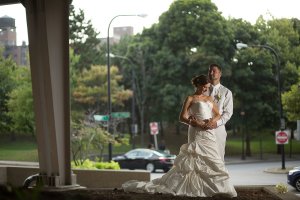
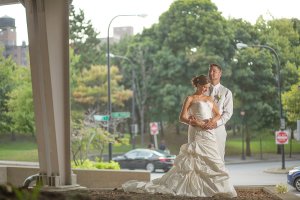
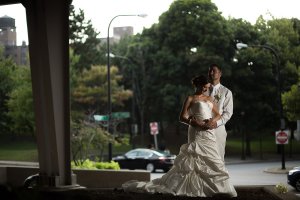
here's an example ---image out of cam, image with shadows pulled to 100%, and shadows reduced by 100% Of course I wouldn't just do that but, the one with shadows reduced is more the look I'd be going for. I'd WAnt the left half of the grooms face to be darker, and same for the bride, with a bit of highlight increase on the light side of the faces. It gives the images more depth.

also, should be noted that another thing went into that shot --- the st-e3 and 2 600RT's - settings for the shot - 85mm at 1.8...flashes set on HSS, SS of 1250, ISO 200 ----does the sensor make the camera?

Again, I get that for certain kinds of photography shadows are the enemy. But not all kinds...
 

Attachments

  • OOut of camera-0001.jpg
    OOut of camera-0001.jpg
    159.8 KB · Views: 192
  • shadows 100%-0001.jpg
    shadows 100%-0001.jpg
    176.2 KB · Views: 144
  • shadows -100%-0001.jpg
    shadows -100%-0001.jpg
    139.6 KB · Views: 195
Upvote 0
Chuck, if you can't see that the middle one should be the best, that's just sad. I say 'should be' only because it's hopelessly marred by the horrible noise and banding where you lifted the shadows. If only you had shot it with a modern Exmor sensor instead of a Canon sensor made with antiquated technology, you could have produced a noise-free image with the perfectly flat lighting that's the hallmark of good photography.

;)
 
Upvote 0
neuroanatomist said:
Chuck, if you can't see that the middle one should be the best, that's just sad. I say 'should be' only because it's hopelessly marred by the horrible noise and banding where you lifted the shadows. If only you had shot it with a modern Exmor sensor instead of a Canon sensor made with antiquated technology, you could have produced a noise-free image with the perfectly flat lighting that's the hallmark of good photography.

;)

LOL!!!!
 
Upvote 0
neuroanatomist said:
Chuck, if you can't see that the middle one should be the best, that's just sad. I say 'should be' only because it's hopelessly marred by the horrible noise and banding where you lifted the shadows. If only you had shot it with a modern Exmor sensor instead of a Canon sensor made with antiquated technology, you could have produced a noise-free image with the perfectly flat lighting that's the hallmark of good photography.
Neuro, I'm pretty well convinced that if your childhood had been slightly different, you could have been a very accomplished troll. 8)
 
Upvote 0