epsiloneri said:
The difference between wide and long is that longer lenses can have more extensive hoods without vignetting the field of view.
This just highlights that lens hoods cannot be constructed as effective for wide angle as for long lenses. Which is kind of evident, if you look at actual lens hoods provided with such lenses.
There is a physical difference in the hoods, yes. But I don't think your statements are correct once you take into account the angle of view. Optically, a hood for a 24mm lens will be designed to come just shy of physical vignetting for a 24mm AoV (the aperture is taken into account in the final design, i.e. the 24mm f/4 hood design for the 24-105mm lens has the petal edges squared off, whereas the 24mm f/1.4L II's hood does not, for some additional light protection at the expense of convenience - otherwise, the two 24mm hood designs are similar). The hood for a telephoto lens is 'more extensive' becuase the lens has a smaller AoV, but a hood for a 200mm lens will still be designed to come just shy of physical vignetting for a 200mm AoV - it's just longer because the AoV is narrower but the hood still has to attach to the front of the lens, just basic geometry.
epsiloneri said:
neuroanatomist said:
'Hoods protect mostly/only at the wide end of zooms' is a statement of fact...not advice against using a hood.
I think that statement is the reason for the confusion. As earlier pointed out, for most zoom lens designs, the hood is much closer to
optimal at the wide end. Normally, however, it is just as effective at the long end as at the wide end (the obvious interesting exception being the EF 24-70/2.8L). It's just that at the long end, the hood could have been
even more effective. But, it is just as effective at the long end as at the wide end.
Again, I must disagree. 'Just shy of optical vignetting' is where a hood provides optimal protection. Otherwise, the hood for a 400mm lens would not be deeper than the hood for a 200mm lens, the hood for a 200mm lens would not be deeper than the hood for a 70mm lens, etc. If a hood designed for a shorter focal length was 'just as effective' at a longer focal length, then hoods for longer lenses would be shorter, as there'd be no need to make them longer. But they are longer. As you noted, a hood designed for 200mm would vignette on a 70mm lens, so zooms require a compromise. But logically, if a hood of a given dimension provides optimal protection from flare (i.e. it's just shy of physical vignetting), then logically, a shorter hood will provide less than equivalent protection, i.e. it will be less effective at the long end. Honestly, I'm not sure how that can logically be disputed.
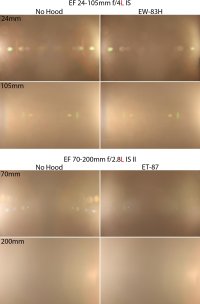
But as Jettatore suggests, it's easy enough to test empirically. The attached images used a pair of 150 W-equivalent lights, placed on either side of the frame, and those were the only lights in the room. I shot with the 5DII in M mode at f/8, ISO 100, and metered shutter speeds were the same for each focal length. I adjusted the position of the lights so they were 5° outside of the frame at each focal length, and took a shot with and without the hood for the two indicated lenses.
As you can see, the hood reduces flare at the wide end of the lens, and has essentially no effect at the long end - and that's true for a wide-to-tele zoom and a telephoto zoom. Obviously, the native flare is less at the long end of each lens - but if you compare -/+ hood at a given focal length, you see a difference at the short end and not at the long end. That is entirely consistent with the hood for the zoom lens providing
less effective protection at the long end, not being 'just as effective'.
epsiloneri said:
No, a hood should not reduce the light from the intended scene at all (only if the hood is mismatched to the lens this can happen).
Also not completely true. While I expect that it's
practically true for typical scenes, I can see situations in which that would not be the case. In the test shots below, the metered exposures were the same with and without the hood. But if you look at the images at the short end, where the hood is actually protecting from flare, you can see that the same metered exposure gives an image that looks a little brighter without the hood. That's because the reduction in flare yields an increase in contrast, in part because some of the light is blocked - light that is defocused in the iamge, but nonetheless adds to the brightness (not in a good way). I did try the empirical test, and if I moved the light sources closer to the lens, but still kept them outside of the frame, I could contrive a situation in which the metered exposure dropped by up to 2/3-stop with the hood in place. I could see a real-world situation, such as shooting at night with streetlights/spotlights, where this effect could occur in practice. Still, it would be better to use the hood, since the light that's affecting the exposure is not focused, but rather merely decreasing contrast in the image.