Does taking many very long exposures wear or damage a sensor?

Kit Lens Jockey

Canon Rumors Premium
Nov 12, 2016
916
615
14,371
I am experimenting with some very long exposure times with very dark ND filters, like ten hour long exposures, on a 5D3.

Would taking photos like this on a consistent basis harm or damage the sensor? I'm assuming that the wear on the mirror and shutter is no more than a normal photo since they are just sitting there not moving. (Hopefully whatever mechanism holds the mirror open will not burn out or anything, right?)

But, I'm not sure if this may be detrimental to the sensor. If it is, then I would probably just shelve my curiosity and not bother.

Oh, and I do not have long exposure NR turned on. :o
 
Kit Lens Jockey said:
I am experimenting with some very long exposure times with very dark ND filters, like ten hour long exposures, on a 5D3.

Would taking photos like this on a consistent basis harm or damage the sensor? I'm assuming that the wear on the mirror and shutter is no more than a normal photo since they are just sitting there not moving. (Hopefully whatever mechanism holds the mirror open will not burn out or anything, right?)

But, I'm not sure if this may be detrimental to the sensor. If it is, then I would probably just shelve my curiosity and not bother.

Oh, and I do not have long exposure NR turned on. :o

I don't know the answer, but I would be very interested to see a 10 hour exposure photograph, please.
 
Upvote 0
i've started experimenting with super long exposures as well. it never occurred to me that i could damage the sensor this way, but i suppose heat build up could become an issue? curious if anyone knows for sure.
 
Upvote 0
I have gone for about an hour worth of 20 second exposures, one after the other, and it seems to have not hurt the camera, but be warned about heat buildup......

You are going to be running the electronics and holding the mirror up the whole time. That sucks back the battery life and heats things up. There will be more thermal noise in your image than a short exposure, but that said, unless you are jrista doing astrophotography, you probably will not notice it.

Also note that this is about the same amount of strain on your camera as shooting video.... and Canon cameras tend to do this quite well without overheating. Unless you are in a hot environment or in direct sunlight, this should not be a problem. Also, since you are talking about a 10 hour exposure, you are probably not hand holding the camera :) and mounting it to a solid tripod head makes for a great heat sink....
Turn off the IS..... Turn off the AF...... I know this the hard way.....

On a final note, walk softly...... It is surprising how the slightest vibration can be picked up in a long exposure....
 
Upvote 0
Good point about it being similar to the strain of shooting video.

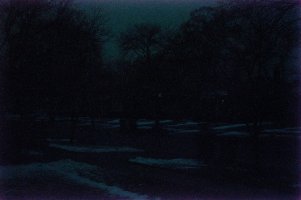
Well, unfortunately, my first attempt at doing this resulted in a very dark photo. Obviously my calculations for the proper time to expose the image were off. I think if I try this again, I would open the aperture up a few stops. I might take another shot at it. I dunno. From the image I did get, it's clear that the amount of pixel noise is so extreme that the image is unusable as anything but a curiosity. Maybe it would be less noticeable if the image was properly exposed, I dunno. It is interesting how the edges of the frame all took on that purple hue. Obviously something weird happening with the sensor due to the extremely long exposure. The camera seems to work fine after taking this photo.

But anyway, you asked, so here it is. This is a camera facing out of my front window.

I actually used my 6D for this instead of the 5D I said I was going to use.

50mm, f16, ISO 100, ten hours of exposure behind two 10 stop ND filters stacked on top of each other.
 

Attachments

  • _MG_6569.jpg
    _MG_6569.jpg
    905.1 KB · Views: 171
Upvote 0
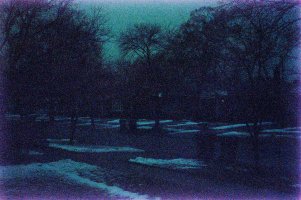
And here it is with the exposure brought up to the point where it's at least recognizable. I'm curious how bad the noise would be if I had gotten the exposure right to begin with and wouldn't have had to push it so far in post.
 

Attachments

  • _MG_65692.jpg
    _MG_65692.jpg
    2.5 MB · Views: 159
Upvote 0
There is no reason to be concerned about issues with long exposure, if you were to point the camera at the sun, probably a concern, but not in near dark.

The sensor heating can generate more noise, but the camera will shut down if it gets too hot. I doubt that is going to happen, but its possible.
 
Upvote 0
Kit Lens Jockey said:
And here it is with the exposure brought up to the point where it's at least recognizable. I'm curious how bad the noise would be if I had gotten the exposure right to begin with and wouldn't have had to push it so far in post.
Try again and post please :)
 
Upvote 0
Yeah, I'll probably try again. I really wanted the photo from today to turn out though, because we had warm temperatures today and a lot of snow melting. I thought it might be neat to see the melting of snow depicted in one very long exposure.

What would be really neat is to catch a day when it actually snows on ground that is not snow covered, so you would see a ghostly layer of snow on the ground. Hard to calculate the proper exposure when obviously the proper amount of exposure will get shorter as white snow accumulates on the ground.
 
Upvote 0
To help with trying to calculate a more proper exposure, does anyone know what the scale is for the "exposure" slider in Photoshop Camera Raw?

For instance, if I set it to +2.0, is that the equivalent of brightening the image by two stops? Or is it not set to any particular scale of reference?
 
Upvote 0
Kit Lens Jockey said:
And here it is with the exposure brought up to the point where it's at least recognizable. I'm curious how bad the noise would be if I had gotten the exposure right to begin with and wouldn't have had to push it so far in post.

you don't just have noise, you also have hot pixels. i have yet to settle on a good way to deal with them, so still experimenting.
 
Upvote 0
geekpower said:
Kit Lens Jockey said:
And here it is with the exposure brought up to the point where it's at least recognizable. I'm curious how bad the noise would be if I had gotten the exposure right to begin with and wouldn't have had to push it so far in post.

you don't just have noise, you also have hot pixels. i have yet to settle on a good way to deal with them, so still experimenting.

To deal with hot pixels, instead of one 10 hour image, one would do 100 six minute images, move the camera slightly between images, and use image stacking software to average things out.......
 
Upvote 0
Well, I tried again today, this time at f5.6, still ISO 100. Much better result, but sadly I didn't get any of the ghostly cars parked on the street that I was really hoping for. Do my neighbors never go to work!? :-\

Still obviously a lot of noise and hot pixels, even at ISO 100. I guess if anything the moral of this story is that if you want to do extreme long exposures, just get a film camera.

I might try it again because this is pretty damn underwhelming, and looks like a very noisy version of a shot that I could have easily taken by hand. I wish I could take more interesting subject matters with such long exposures, but I'm pretty limited since the only place I can really leave a camera unattended and plugged in for ten hours is in my house.

I did correct this a little in PS. It was actually a little over-exposed at f5.6.
 

Attachments

  • _MG_6576.jpg
    _MG_6576.jpg
    1,022.4 KB · Views: 164
Upvote 0
It's a much, much better image, though.

At least it's usable this time, and you can see stuff ok.

I imagine a lot of people walked and drove by, and you can't see any of them, of course, so in a sense, they ARE there, but totally ghostly, to the extent of being completely invisible.

I'm surprised that the topmost, outermost twigs of the trees are so well-defined. I'd've expected just blur there, because of repeated slight motion even in soft breezes. It must've been a very still day.

It's an interesting project.
 
Upvote 0
So, since I was kind of disappointed by the boring image I made, I decided to try something that will hopefully give more interesting results.

I plan to do about a 20 hour long exposure this time. At night, I just have one ten stop filter on the lens, then tomorrow before I go to work, I'll put the second ten stop filter on, mid-exposure. So, I should manage to get both night and day in one image, and hopefully there will be more cars coming and going in that time as well. It should be interesting to see how all of the porch lights on the other houses at night combine with the daylight part of the exposure.
 
Upvote 0
My advice would be, keep experimenting, but don't expect too much. Very long exposures are deceptive compared to what we expect - static elements are clear, but things that move too much disappear, and too little just seem mildly blurred. And changing light tends to average out, rather than producing something dramatic.

Time lapse is another way to go, and can be more intuitive in its results. But do keep at it, it's not done much and you might hit on something exciting.

Incidentally, mentioning time lapse, another technique is to do one (i.e. shoot lots of normal exposures at set intervals), then merge them creatively in post - I've seen some static hyperlapse shots, for want of a better word, and they can be exciting - try sunsets for instance (see https://iso.500px.com/time-stack-photo-tutorial/ for more details).
 
Upvote 0