
DPReview's turn to beat up the 5DS/5DSr results

ahsanford

Particular Member
Aug 16, 2012
8,656
1,664
57,701
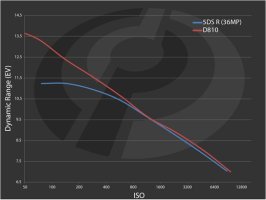
DXO shared their data with DPReview (aren't they partners?) and the DPReview folks gave their perspective on the results:

http://www.dpreview.com/articles/3673531883/dxomark-eos-5ds-r-sensor-is-highest-ranked-canon-sensor-yet

(It's not entirely a rehash, they preferred to compare DR at the D810's resolution rather than DXO's weird/arbitrary 8 MP)

Spoiler alert: not particularly flattering. The phrase 'dynamic range' is used as a cudgel numerous times.

- A
 

Attachments

  • DPR.jpg
    DPR.jpg
    31.4 KB · Views: 1,842
so they took a 50MP file and compressed it to 36 thus introducing compression and interpolation of the image. Then they compare it to an original RAW file from the Nikon. How much sense does that make? Why not increase the size of the Nikon image to 50 MP and see what happens then?

This will be sooooo dependent on the software used that it completely negates any chance of comparing the possible sensor advantages.

Also,and I might be off on this one, but they are talking about the amount of light being gathered by the exmor as compared to the Canon sensor. They are saying it lets more light in. Yeah no $hit Sherlock, if you have thinner color coded filters (RGB) in front of the photo cells, you will let more light in. The color in the Canon images is so much richer than the Nikon.

It just never seizes to amaze me how some ppl are the proclaimed experts without full understanding what they are talking about (not claiming to be one, but even as a laic I see issues with their reporting).

pierre
 
Upvote 0
The weirder bit is that some folks claim that with my A7 or D8X0 rig, 'I don't need ND grads or bracketing anymore' (see page 2):

"The sheer light-gathering and low-noise abilities of cameras like the Nikon D810 and Pentax 645Z mean I hardly find myself shooting with graduated ND filters or using HDR bracketing techniques in the field when dealing with high contrast scenes with these cameras."


I am an amateur, but it's been my experience that as much as you can push shadows or pull highlights in, you can never do it enough for some scenes -- i.e. the range of brightness in the frame is far greater than what the sensor can record. So I don't think 1, 2 stops difference between the Canon and Nikon means I can pitch my ND grads or cease bracketing, but I defer to the pro landscapers on that front.

- A
 
Upvote 0
ahsanford said:
The weirder bit is that some folks claim that with my A7 or D8X0 rig, 'I don't need ND grads or bracketing anymore' (see page 2):

"The sheer light-gathering and low-noise abilities of cameras like the Nikon D810 and Pentax 645Z mean I hardly find myself shooting with graduated ND filters or using HDR bracketing techniques in the field when dealing with high contrast scenes with these cameras."


I am an amateur, but it's been my experience that as much as you can push shadows or pull highlights in, you can never do it enough for some scenes -- i.e. the range of brightness in the frame is far greater than what the sensor can record. So I don't think 1, 2 stops difference between the Canon and Nikon means I can pitch my ND grads or cease bracketing, but I defer to the pro landscapers on that front.

- A

What you have quoted in blue would have been true had he been using reversal film. But the point is 12 stops EV range is generally more than enough to cover everything in landscape photography, and if it isn't then the chances are '14' won't be much better. The window of opportunity to make use of that available push is smaller than the window in a Nun's lavatory.

I tried to make use of it without resorting to cartoon-like HDR images, and in all honesty it was wasted on me. I only ever need to push a maximum of two stops, normally only one, and for that I found no real difference between Canon and Exmor, or 12 stops to 14 stops if you prefer.

The graph you have linked to is very misleading, especially to people who haven't tried a Nikon or Sony with that extra DR.
 
Upvote 0
This graph reminded me why I don't give a (insert your favorite phrase here) about dynamic range. The difference between sensors only shows up at ISOs that I seldom shoot at. Once you get into a normal range the differences are so tiny as to be totally irrelevant.

Couple that with the fact that whenever I look at sites that show comparison shots, Canon matches or outperforms competitors in noise at higher ISOs, which is far more important for my shooting than pushing shadows at ISO 100.

The truth is, there is no magic sensor, despite what some people seem to believe. It's all about what you want. What I want is an outstanding, all-around performer. I've got that in the 5DIII and Sony and Nikon have given me no reason to switch.
 
Upvote 0
dilbert said:
unfocused said:
This graph reminded me why I don't give a (insert your favorite phrase here) about dynamic range. The difference between sensors only shows up at ISOs that I seldom shoot at. Once you get into a normal range the differences are so tiny as to be totally irrelevant.
...
I think you'll find that almost everyone sees ISO 100-400 as being "normal" ISO.
"Almost everyone?" Would you cite your sources please?
 
Upvote 0
Orangutan said:
dilbert said:
unfocused said:
This graph reminded me why I don't give a (insert your favorite phrase here) about dynamic range. The difference between sensors only shows up at ISOs that I seldom shoot at. Once you get into a normal range the differences are so tiny as to be totally irrelevant.
...
I think you'll find that almost everyone sees ISO 100-400 as being "normal" ISO.
"Almost everyone?" Would you cite your sources please?

When I go into a dynamic environment, I usually set 800 (5D3 or A7R), and adjust up if required or down if possible for a desired aperture/shutter combo. If I know (or am setting) the lighting scenario, I'll tend to go lower.

Also, I am almost everyone. ;)
 
Upvote 0
ahsanford said:
Sporgon said:
The graph you have linked to is very misleading, especially to people who haven't tried a Nikon or Sony with that extra DR.

Agree -- just forwarding. Do not shoot the messenger. :D

- A

No, not meaning that. You do right to highlight this. On the face of it, at low ISO there is a huge difference.

When the D800 first came out I tried it casually, and didn't find much difference. In particular the 36 MP wasn't as practical as I thought it might have been - didn't see much difference in practice between that and 21 to be honest.

However after reading all the crap on the Internet (this never comes from working photographers outside of the Internet by the way) I thought I must be missing something, so tried one again.

Looking at the graph again, I just can't find a practical way of using that difference between the sensors because 11 EV is already covering so much. If you then go to an artificial situation, say taking a shot inside a room lit by window light where you want to get outside of the window exposed correctly too - in other words you are not only exposing for the incident light (the inside of the room lit by the window) but also the light source itself (the window + what's outside), the the 14 stops can't do it anyway.

The real answer to more EV range will be true 16 bit raws which will allow more highlight range. At present the Nikons / Sonys etc have no more highlight range than the Canon.

Didn't mean all that to be in italics : my iPad obviously is lacking in DR.
 
Upvote 0
dilbert said:
Orangutan said:
dilbert said:
unfocused said:
This graph reminded me why I don't give a (insert your favorite phrase here) about dynamic range. The difference between sensors only shows up at ISOs that I seldom shoot at. Once you get into a normal range the differences are so tiny as to be totally irrelevant.
...
I think you'll find that almost everyone sees ISO 100-400 as being "normal" ISO.
"Almost everyone?" Would you cite your sources please?

So I typed into Google, "what is normal ISO".

Are you going to argue with Google?

Many times, as is true in this case, the question itself is wrong. Or, as Tom Lehrer quoted his philosopher friend Hen3ry, "life is like a sewer: what you get out of it depends on what you put into it."

To ask what "normal ISO" is would be like asking what "normal volume" is on a sound system: you have to include context for it to make any sense at all. I was hoping you'd see that from my previous post so I wouldn't have to be explicit. It's true that 100 (or even lower) is common in studio environments, and 100-400 is common in landscape photography. On the other hand, there are many many photographers, pro and amateur, who routinely shoot at much higher ISOs. Sport and bird photographers shoot many thousands of frames at ISO 800, 1600 or higher.

In short, I was hoping you'd see that a better question is "what is normal ISO for each person's type of photography." As I (and others) have repeatedly said, you should choose the gear that's right for your type of photography, as I hope you'll choose to do so you're no longer frustrated by your Canon sensor. The question "what is normal ISO," when stripped of context, simply isn't very insightful.
 
Upvote 0
As a general comment, I'm not a pro and I capture available light handheld 95% of the time. ISO 100 is lovely for bright sunny days or when I've got the tripod, but my photography world lives in the ISO 400-3200 world on most days. Heck, when I shoot concerts, it's common to need 6400 and above.

So please don't mistake the cause of my bile for these DPR/DXO reports as being incorrect data -- that's not it. There's an abundance of data to state that there are better sensors than Canon's depending on your needs. It's just that data doesn't apply to me. In the ISO ranges I shoot, the sensors are so damn close in performance it stands to reason that I'd choose my cameras for much larger considerations -- support, lenses, size of the accessories ecosystem, ergonomics, etc.

I just can't stand the insights/judgments/conclusions that follow those charts and graphs, for example:

  • 'It's the 21st best sensor out there.' To whom?! The Low ISO, Low MP Loving Association of America? Some large print work heretofore relegated to MF is now possible with a rig that taps into the largest lens ecosystem on the planet. This is the 1st best sensor for those folks, one would think.

  • 'I seldom need ND grads any longer because I have 1-2 more stops than the other guys'. Congrats. Enjoy the parlour trick of irradiating your shadows and choking out your highlights for your one shot HDR magic -- just to say you didn't need to bracket or filter.

Ugh.

- A
 
Upvote 0
Orangutan said:
dilbert said:
Orangutan said:
dilbert said:
unfocused said:
This graph reminded me why I don't give a (insert your favorite phrase here) about dynamic range. The difference between sensors only shows up at ISOs that I seldom shoot at. Once you get into a normal range the differences are so tiny as to be totally irrelevant.
...
I think you'll find that almost everyone sees ISO 100-400 as being "normal" ISO.
"Almost everyone?" Would you cite your sources please?

So I typed into Google, "what is normal ISO".

Are you going to argue with Google?

Many times, as is true in this case, the question itself is wrong. Or, as Tom Lehrer quoted his philosopher friend Hen3ry, "life is like a sewer: what you get out of it depends on what you put into it."

To ask what "normal ISO" is would be like asking what "normal volume" is on a sound system: you have to include context for it to make any sense at all.

As an old Tri-X shooter, I consider ISO 400 normal. When I look at the chart, I see about one-third of a stop difference between the two sensors at ISO 400 -- that is insignificant. Especially if you shoot and know how to process in RAW.

I'm much more likely to need to go above 400, than to go below it. Any differences above 400 are imperceptible. And, this only registers "dynamic range" and doesn't consider noise. I have had a lot more pictures hurt by noise than by lack of dynamic range, so for me my 5DIII (which performs better than either of these cameras when it comes to noise) is the better choice.

Bottom line: just because you can measure a difference, doesn't mean you can see or benefit from the difference.
 
Upvote 0
Orangutan said:
dilbert said:
So I typed into Google, "what is normal ISO".

In short, I was hoping you'd see that a better question is "what is normal ISO for each person's type of photography." As I (and others) have repeatedly said, you should choose the gear that's right for your type of photography, as I hope you'll choose to do so you're no longer frustrated by your Canon sensor. The question "what is normal ISO," when stripped of context, simply isn't very insightful.

A vain hope. This issue also speaks to one of DxO's biases, propagated on DPR - two of the three Subscores are measured only at base ISO.
 
Upvote 0
ahsanford said:
As a general comment, I'm not a pro and I capture available light handheld 95% of the time. ISO 100 is lovely for bright sunny days or when I've got the tripod, but my photography world lives in the ISO 400-3200 world on most days. Heck, when I shoot concerts, it's common to need 6400 and above.

So please don't mistake the cause of my bile for these DPR/DXO reports as being incorrect data -- that's not it. There's an abundance of data to state that there are better sensors than Canon's depending on your needs. It's just that data doesn't apply to me. In the ISO ranges I shoot, the sensors are so damn close in performance it stands to reason that I'd choose my cameras for much larger considerations -- support, lenses, size of the accessories ecosystem, ergonomics, etc.

I just can't stand the insights/judgments/conclusions that follow those charts and graphs, for example:

  • 'It's the 21st best sensor out there.' To whom?! The Low ISO, Low MP Loving Association of America? Some large print work heretofore relegated to MF is now possible with a rig that taps into the largest lens ecosystem on the planet. This is the 1st best sensor for those folks, one would think.

  • 'I seldom need ND grads any longer because I have 1-2 more stops than the other guys'. Congrats. Enjoy the parlour trick of irradiating your shadows and choking out your highlights for your one shot HDR magic -- just to say you didn't need to bracket or filter.

Ugh.

- A

Excellent points. You've summed it up well.
 
Upvote 0
Pookie said:
if it's on the internet it must be real

You should sign up on Matchcom. It's unreal, everyone is a model!!!!

You can totally argue with Google, but Wikipedia? That sh-- is for reals, yo.

We never went to the moon. Vaccines don't save lives. Obama is secretly a Russian mole. Wolverine is a real person (he lives in Wisconsin). I read it on the interwebs. Fact.

- A
 
Upvote 0