
L
Loswr
Guest
ahsanford said:Effectively, the lens goes from a score of 38 to 49 solely based on the increased resolving power of the Nikon. See attached.
You fell victim to one of the classic blunders. The most famous is: Never get involved in a land war in Asia. But only slightly less well known is this: Believing that DxO's optical metrics are the primary determinants of the Lens Score.

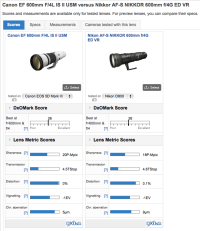
I know, as you show in the screenshot DxO sticks that Score right on top of the list of lens metrics, suggesting the Score is a synthesis of those measurements. It's not. The Lens Score is primarily based on 'performance in 150 lux illumination' (the light level found in a dim warehouse). What that means in practice is the the Lens Score is heavily influenced by the Sensor Overall Score of the body on which it is tested. So, while some of the Zeiss 85/1.4 Otus' higher lens Score on the D800E comes from the higher P-MPix value, the relative difference in the sensor Score also accounts for much of that difference. For example, comparing the two current 600mm lenses, we see that the Canon lens is sharper, has higher transmission, less distortion, equal vignetting, and less CA...the Canon lens is optically superior, but the two lenses get the same score because the D800 sensor scores higher (and I should point out that DxO has explained that their Sensor Score is independent of resolution, so it's not the 22 vs. 36 MP accounting for that difference). Also worth noting that their chosen conditions for the lens score – dim light – would generally require a high ISO setting, yet their Sensor Score is biased toward low ISO (2 of the three subscores are considered only at base ISO). Bias on top of bias. That's DxO's biased scores – aka BS – for you...
ahsanford said:Nice work, DXO, you have again failed to earn any respect as a neutral review source.
That part you got perfectly correct.
Attachments
Upvote
0


 I know full-time pros that need to budget for that super-lens. Because they are reaching that level in their business when they need the performance, functionality or durability that lens will give them.


