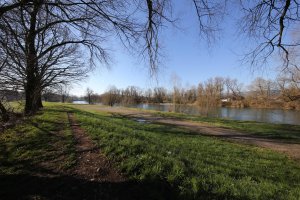
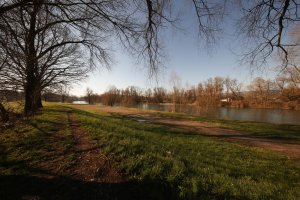
EF 11-24 neutral density filter - Kodak Wratten 2 works fine

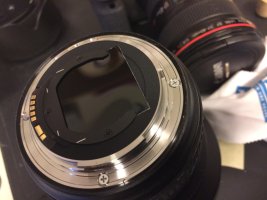
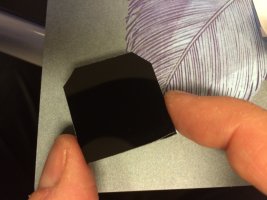
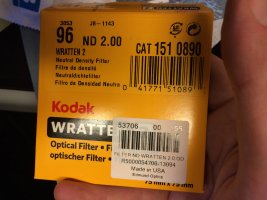
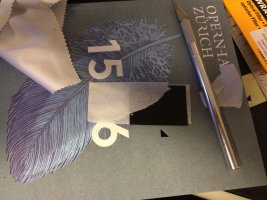
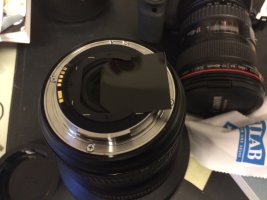
I received my EF 11-24 F4 today 8) and as its raining here in Zurich I couldn't make any real pictures. I also received the Kodak Wratten 96 ND 2.00 neutral density filter and so I cut it in shape to be used with the new lense (and the old 17-40, I never knew about this possibility in all those years ...). Even dough the manual said you shouldn't use it when on 11mm, I see no reason not to do that, it works fine.

I attached some pictures. I hope this helps others.

-Schlomo
 

Attachments

  • IMG_9104.JPG
    IMG_9104.JPG
    946.6 KB · Views: 338
  • IMG_9103.JPG
    IMG_9103.JPG
    506.5 KB · Views: 392
  • IMG_9106.jpg
    IMG_9106.jpg
    1.4 MB · Views: 354
  • IMG_9109.jpg
    IMG_9109.jpg
    1.7 MB · Views: 371
  • IMG_9110.jpg
    IMG_9110.jpg
    2 MB · Views: 326
Re: EF 11-24 neutral density filter - Kodak Wratten 2 works fine BUT ....

Yes, the filter works fine but its definitely not neutral. See for yourself ... (I just bought it, so it shouldn't be aged).
 

Attachments

  • 20150406-IMG_2426.jpg
    20150406-IMG_2426.jpg
    3.1 MB · Views: 332
  • 20150406-IMG_2428.jpg
    20150406-IMG_2428.jpg
    2.7 MB · Views: 302
Upvote 0
Schlomo said:
I have the B + W 3, 6 and 10 stop ND filter but never saw anything of that kind. You are right, its never neutral, but this looks quite unusable to me.

-Schlomo

My B+W 10 stop had the worse colour cast I've ever seen on a ND filter. I had a bizarre copper cast and couldn't be dialled out with wb. Lee: magenta, Hoya: pink (quite liked that), Lee Big stopped: green / cyan (tricky to wb). I find Heliopan and the most neutral / WB friendly / attractive.
There's nothing wrong with that colour cast. It's a nice warm up, which works well with landscapes. There are NO true ND filters...they don't exist, so I choose ND filters whose cast is gentle and attractive.
 
Upvote 0
Any Canon DSLR you can adjust the Kelvin number to take account of ND color shift. Unlike film many factors influance filtration on a DSRL, pixel size, pixel lenses, AA filter coatings, cast of the sensor itself and then also lenght of exposure thats behind the lens, in front of the lens the lens design can play a part along with the aperture as well.

All NDs are generally measured on a spectrometer and must fall in a certain range and I doubt Kodak filters are outside a permitted range.
 
Upvote 0
jeffa4444 said:
All NDs are generally measured on a spectrometer and must fall in a certain range and I doubt Kodak filters are outside a permitted range.

The B+W 10-stop ND passes more light at 650nm than at 600nm, and even more light approaching 700nm. It's not really 'neutral'.

FWIW, there are truly neutral ND filters (at least, neutral through the visible range), but they don't come mounted in conveniently-sized threaded rings.
 
Upvote 0
A few years back (back when no one bought filters for their dslr's)...I spoke to one of Lee's engineers. I spoke with him because I was seeing different colour casts from different batches of Lee resin filters. he told me that there are no dyes which are linear across the visual spectrum and there are no dyes currently available which cover the entire range. So each batch of filters uses a combination of dyes to "simulate" a straight line across the visible spectrum. But in reality, each dye produces a curve with peaks and troughs across it's spectral range. Between batches of dyes, there is manufacturing tolerances. None of the filter makers actually make the dyes...there's a sourced by 3rd party suppliers according to their spec sheets. But it's quite common for a batch of dyes to be slightly different to the next batch.
So the up shot is....every filter has a character and none of them is truly neutral. Within batches there's quite a variation and that the dyes on the filter may change with time too.
It's a bit like trying to find a truly neutral loud speaker in the audio world....yeah...good luck with that. Instead, just get a speaker you like the sound of...the same with ND filters, just get one you like and can work with.
 
Upvote 0
GMCPhotographics said:
A few years back (back when no one bought filters for their dslr's)...I spoke to one of Lee's engineers. I spoke with him because I was seeing different colour casts from different batches of Lee resin filters. he told me that there are no dyes which are linear across the visual spectrum and there are no dyes currently available which cover the entire range. So each batch of filters uses a combination of dyes to "simulate" a straight line across the visible spectrum. But in reality, each dye produces a curve with peaks and troughs across it's spectral range. Between batches of dyes, there is manufacturing tolerances.

That's true for resin and absorptive glass ND filters, where transmission is attenuated by absorption as light passes through the material. There are also reflective glass ND filters where light is attenuated by reflection from a surface coating of a superalloy containing chromium, cobalt, iron, and other elements. The latter type of filter is spectrally neutral, but I don't think they're used in photography applications.
 
Upvote 0
neuroanatomist said:
GMCPhotographics said:
A few years back (back when no one bought filters for their dslr's)...I spoke to one of Lee's engineers. I spoke with him because I was seeing different colour casts from different batches of Lee resin filters. he told me that there are no dyes which are linear across the visual spectrum and there are no dyes currently available which cover the entire range. So each batch of filters uses a combination of dyes to "simulate" a straight line across the visible spectrum. But in reality, each dye produces a curve with peaks and troughs across it's spectral range. Between batches of dyes, there is manufacturing tolerances.

That's true for resin and absorptive glass ND filters, where transmission is attenuated by absorption as light passes through the material. There are also reflective glass ND filters where light is attenuated by reflection from a surface coating of a superalloy containing chromium, cobalt, iron, and other elements. The latter type of filter is spectrally neutral, but I don't think they're used in photography applications.

True...but digital cameras are more sensitive to IR with longer exposures...so the cameras aren't linear either.
 
Upvote 0
neuroanatomist said:
GMCPhotographics said:
A few years back (back when no one bought filters for their dslr's)...I spoke to one of Lee's engineers. I spoke with him because I was seeing different colour casts from different batches of Lee resin filters. he told me that there are no dyes which are linear across the visual spectrum and there are no dyes currently available which cover the entire range. So each batch of filters uses a combination of dyes to "simulate" a straight line across the visible spectrum. But in reality, each dye produces a curve with peaks and troughs across it's spectral range. Between batches of dyes, there is manufacturing tolerances.

That's true for resin and absorptive glass ND filters, where transmission is attenuated by absorption as light passes through the material. There are also reflective glass ND filters where light is attenuated by reflection from a surface coating of a superalloy containing chromium, cobalt, iron, and other elements. The latter type of filter is spectrally neutral, but I don't think they're used in photography applications.
Each resin filter at Lee Filters in dipped in a bath at a set tempreture and hand-made, they are checked on a spectrometer and adjusted in different baths so that every ND.3 say leaves the factory with the same reading. Dye batch differences are therefor adjusted by the compensating dyes just to correct the above statement. They are not linear across the the visable spectrum as stated above the same is true of glass filters except attenuated.

Attenuated filters by reflection are expensive to produce, only available in glass and prone to surface scratching but they can be made completely neutral although not all filters are equal (in other words transmission and color can be still affected or wrong). This is an area Im fully involved with currently and have conducted numerous tests over the past 18 months. For stills the cost is faily prohibitive and for video the folmulations are combined to reduce IR pollution.
 
Upvote 0
neuroanatomist said:
There are also reflective glass ND filters where light is attenuated by reflection from a surface coating of a superalloy containing chromium, cobalt, iron, and other elements. The latter type of filter is spectrally neutral, but I don't think they're used in photography applications.

Wrong, I think. Hoya's new-ish ProND line seems just that - they mention clear glass with a 'metallic Accu-ND coating'. Bryan/TDP tested them and found they are quite neutral...but unfortunately they seem to have a big negative impact on sharpness away from the center of the frame.


GMCPhotographics said:
True...but digital cameras are more sensitive to IR with longer exposures...so the cameras aren't linear either.

I suspect the non-neutrality of the filter is more of an issue. That's why 10-stop ND filters like the B+W which have higher transmission at the red end give a warm color cast, while filters like the Haida which have higher transmission on the blue end give a cool color cast.
 
Upvote 0