

What is your favorite glass? I have increasing obbession with capturing foreground and the heavens. What's your go to? Thanks 


@!ex said:My best current lens is the 14mm 2.8 L II. it is wide enough that at 30sec exposure the star trail is very small, and the 2.8mm is pretty fast. I've heard the 24mm 1.4 is the best of both worlds, as far as wide-angle and speed is concerned, and I have been drooling over it for a while now. My other thought is to get a star tracker and then combine a foreground shot with a star shot in post for the ultimate in low noise and sharpness.
kubelik said:I do indeed. my go-to lens is the 16-35mm f/2.8 L II, because it lets me get some of the landscape in as well. I do wish I had a wide angle prime in the 16 to 35 range that let me go wider than f/2.8, which is still a little slow for me sometimes.

GoodVendettaPhotography said:A "Star Tracker"? I've never heard of that. Is it software or a device?
Fleetie said:GoodVendettaPhotography said:A "Star Tracker"? I've never heard of that. Is it software or a device?
A device. You put it on top of a tripod, and it is kinda like a wedge whose angle must be set to an angle corresponding to your latitude. A motor on the wedge then drives the camera/telescope mounted to it at 1 rev per 24 hours, thereby "despinning" the Earth. Or to put it another way, it compensates for the rotation of the Earth when you take long exposures, so you don't get star trails. So you can expose for very long times.
Martin

 which is unfortunate.. ) and merged all together: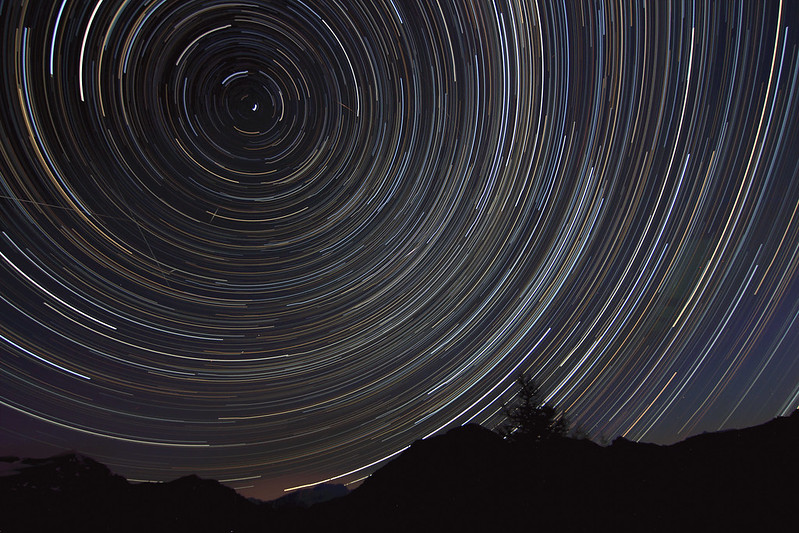

SwissBear said:i used the tokina 11-16 on a crop body - works quite fine, 30sec/f2.8/ISO400 gives decent images.
took some 400 shots (last half hour clouds came in
Sternenhimmel über dem Zwüschbi by SwissBear85, on Flickr
On a crop, i would suggest the tokina 11-16 II - should have better flare-controll and other benefits
Axilrod said:GoodVendettaPhotography said:Oh, wow, nice! I'd be very interested in this
I just ordered this one:http://www.optcorp.com/product.aspx?pid=1287-14905
Heard nothing but good things.
Nope, i exposed a few hundred times 30sec and did some miraculous postproduction with GIOTTOGoodVendettaPhotography said:SwissBear said:i used the tokina 11-16 on a crop body - works quite fine, 30sec/f2.8/ISO400 gives decent images.
took some 400 shots (last half hour clouds came in
[...]
On a crop, i would suggest the tokina 11-16 II - should have better flare-controll and other benefits
Great shot! Just out of curiosity, do you take one image with the lens cap on for canceling out noise?
I have a 5D m3 and I use a laptop, connected via cable to the camera, to focus. The EOS Utility software that comes with the camera allows you to drive the camera via the computer. One of the options is Live View, which can zoom an image on the laptop screen. Much easier than doing it on the back of the cameraHector1970 said:Any tips on focusing to infinity - I can't see anything on the screen at 10X at these wide angles (except maybe the moon - which I would focus on if it's out).
(hope that makes sense)


