Fellow stargazers & nighttime landscape loners!

Status
Not open for further replies.
Axilrod said:
GoodVendettaPhotography said:
Oh, wow, nice! I'd be very interested in this :)

I just ordered this one:http://www.optcorp.com/product.aspx?pid=1287-14905

Heard nothing but good things.

I use my telescope mount...Ask at any decent camera store or preferably, astronomy shop.... You are looking for a tracking or a "go to" mount... When I want to see something small I use a T-mount adaptor and shoot through the telescope.... great for things like Jupiter and Saturn... when I am after wider angles I mount the camera on the mount and can shoot time exposures with no motion trails.

BTW, as they come, a Canon shoots 30 sec max exposure... to get a longer exposure you can use a remote control and bulb mode..... you can use a rubber band and a stub of pencil over the shutter release, or you can go full hog and use ipods and apps to really get flexibility. You can also set the camera for "long exposure noise cancellation".
 
Upvote 0
Zeiss 21mm might be my fave now. The Canon 24L II proved pretty pointless for night sky more open than F2.8 anyway. Coma extends well into the photo, bad coma, so it tends to make it a little pointless for that added F1.4 to F2.8 range it would allow at night. Unless one likes big ol wings off their stars I guess. Samyang 24 F1.4 had less coma and might be interesting. Canon 14L had plenty of that too.
 
Upvote 0
extremeinstability said:
Zeiss 21mm might be my fave now. The Canon 24L II proved pretty pointless for night sky more open than F2.8 anyway. Coma extends well into the photo, bad coma, so it tends to make it a little pointless for that added F1.4 to F2.8 range it would allow at night. Unless one likes big ol wings off their stars I guess. Samyang 24 F1.4 had less coma and might be interesting. Canon 14L had plenty of that too.
I noticed bad coma in my Canon 35mm f2, which I initially used for testing the 5D m3 with star shots. The 40mm pancake is better (less coma), but not wide enough. IMO, the ultimate test for a lens is to try it with star images, as they really show any flaws (stars should be points of light, not flared out, like coma). And to a large extent, stopping down will minimise coma, but not eliminate it.
 
Upvote 0
please let us know how that tracking mount works out for you. I'd love to play with one, but if i bought one more photography related item, my wife..... it wouldn't be pretty.

i had a 17-40mm that i used for many things including star shots. it was okay. then i replaced it with a 16-35mmv2. it was better only because of now i was at f2.8, and it was noticeably(just) wider. i've since sold it and now have a pro-optic 14mm. I haven't gotten a chance to do much of anything with it yet, but i'm hoping to give it a go with the night sky over the christmas holiday.
 
Upvote 0
GoodVendettaPhotography said:
Fleetie said:
GoodVendettaPhotography said:
A "Star Tracker"? I've never heard of that. Is it software or a device?

A device. You put it on top of a tripod, and it is kinda like a wedge whose angle must be set to an angle corresponding to your latitude. A motor on the wedge then drives the camera/telescope mounted to it at 1 rev per 24 hours, thereby "despinning" the Earth. Or to put it another way, it compensates for the rotation of the Earth when you take long exposures, so you don't get star trails. So you can expose for very long times.

Martin

Oh, wow, nice! I'd be very interested in this :)

This is the star tracker I am drooling over right now. I imagine it very portable so it wouldn't be a bitch to carry around. I could take a long exposure with a low ISO of the foreground first, then turn this badboy on and take a long exposure of the stars (low ISO, relatively). then blend the two images in post. I know it would be awesome....

http://www.vixenoptics.com/mounts/polarie.html
 
Upvote 0
@!ex said:
GoodVendettaPhotography said:
Fleetie said:
GoodVendettaPhotography said:
A "Star Tracker"? I've never heard of that. Is it software or a device?

A device. You put it on top of a tripod, and it is kinda like a wedge whose angle must be set to an angle corresponding to your latitude. A motor on the wedge then drives the camera/telescope mounted to it at 1 rev per 24 hours, thereby "despinning" the Earth. Or to put it another way, it compensates for the rotation of the Earth when you take long exposures, so you don't get star trails. So you can expose for very long times.

Martin

Oh, wow, nice! I'd be very interested in this :)

This is the star tracker I am drooling over right now. I imagine it very portable so it wouldn't be a bitch to carry around. I could take a long exposure with a low ISO of the foreground first, then turn this badboy on and take a long exposure of the stars (low ISO, relatively). then blend the two images in post. I know it would be awesome....

http://www.vixenoptics.com/mounts/polarie.html

nice! do you know if that will work in the southern hemisphere? how do you align in the southern hemisphere anyway?
 
Upvote 0
wickidwombat said:
@!ex said:
nice! do you know if that will work in the southern hemisphere? how do you align in the southern hemisphere anyway?
Works in both hemispheres. To read more, the user manual is online: http://www.vixenoptics.com/PDF/POLARIE%20Manual.pdf

The Polarie is an attractive device, but personally I needed more load-carrying capacity for the Venus transit earlier this year, so I have the AstroTrac TT320X AG as mentioned earlier from Optcorp and other dealers. (Optcorp is good.)
 
Upvote 0
extremeinstability said:
Zeiss 21mm might be my fave now. The Canon 24L II proved pretty pointless for night sky more open than F2.8 anyway. Coma extends well into the photo, bad coma, so it tends to make it a little pointless for that added F1.4 to F2.8 range it would allow at night.
I agree. Same experience with the 24L II, even though I call it my "astronomy lens", which was its original justification. The coma on stars is very disappointing, especially below f/2.8. My checkbook cries to hear the Zeiss is better! :'(
 
Upvote 0
People may be interested in another example of what the AstroTrac TT320X AG (or any decent tracker) can do once you have aligned it reasonably well, using regular DSLR equipment (ok, quite good equipment).

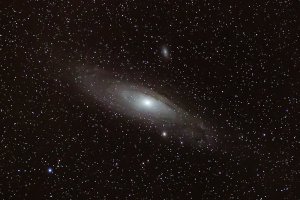
Here's an example on a 5D2 with 70-200mm f/2.8 L IS II at 200mm, 30% crop -- the Andromeda galaxy.
http://500px.com/photo/13988281

The processing story for this is here: http://500px.com/dswtan/stories/63249/andromeda-story
 

Attachments

  • IMG_0123-2-2.jpg
    IMG_0123-2-2.jpg
    320.7 KB · Views: 589
Upvote 0
risc32 said:
i had a 17-40mm that i used for many things including star shots. it was okay. then i replaced it with a 16-35mmv2. it was better only because of now i was at f2.8, and it was noticeably(just) wider. i've since sold it and now have a pro-optic 14mm. I haven't gotten a chance to do much of anything with it yet, but i'm hoping to give it a go with the night sky over the christmas holiday.
@risc32: Thanks for sharing your experience with the 17-40. I am pondering on the Sigma 12-24 F/4.5-5.6. I know it is very slow but it seems attractive by its lenght (24mm, good for 500/600 rule photography 600:24 yields 25 seconds of exposure, and at the wide end you are at F/4.5). Can it compensate a 16-35 2.8 wide open? My current 28 F/2.8 does pretty well, although it is quite narrow. As I have never stopped it down to 4.5 I am asking a kinda silly question...Sorry. I'll try to test it out during christmas holidays to get to a better conclusion, but your comment would be welcome anyway. Thanks and cheers, Pedro.

Here's a sample of my Canon 28 F/2.8 with the 5D3 @ISO 10.000 F/3.2 25s exposure

Z96A0762aALTxMasterKLEINDEF by Peter Hauri, on Flickr
 
Upvote 0
Quick question to the OP, or anyone really:

To capture those stars, constleations, and other space oddities do you need a special body like a 60Da or a modded sensor to capture all that stuff in space? I have a regular Canon 500d and I'm really interested in nighttime long exposure shots. I have all the required stuff to start (tripod, levels, remote trigger w/ timers, a UWA lens). Any tips for me?
 
Upvote 0
Synomis192 said:
Quick question to the OP, or anyone really:

To capture those stars, constleations, and other space oddities do you need a special body like a 60Da or a modded sensor to capture all that stuff in space? I have a regular Canon 500d and I'm really interested in nighttime long exposure shots. I have all the required stuff to start (tripod, levels, remote trigger w/ timers, a UWA lens). Any tips for me?

Well, your 17-35 lense is quite good to start with. You don't need an awful lot of camera, as long exposure star shots work well at iso 100, F/5.6 or even wide open. if you like a wider lens and will stay aps-c for a while try the 10-22 from canon. I did quite some stuff with my 30D before I went fullframe again.

"3286" color by Peter Hauri, on Flickr
for more stuff:
http://www.flickr.com/photos/guatitamasluz/sets/72157602075454706/
 
Upvote 0
Synomis192 said:
Quick question to the OP, or anyone really:

To capture those stars, constleations, and other space oddities do you need a special body like a 60Da or a modded sensor to capture all that stuff in space? I have a regular Canon 500d and I'm really interested in nighttime long exposure shots. I have all the required stuff to start (tripod, levels, remote trigger w/ timers, a UWA lens). Any tips for me?
The short answer is, if you want to take star trails or 30 second snaps of the stars, then the 500D will probably be sufficient, but a 5D is really nice :)

The 60Da is better suited to a certain part of the wave length (more of the red) that is prominent with certain celestial objects, such as nebulae. The usage of the 60Da is best done on a mount that tracks the stars (which is being referred to in this thread), either looking through a telescope or using a telephoto, mounted on a telescope (with a tracking mount).

P.S. I used to make telescopes back in the 80's and did some astrophotography when we used hyper sensitive film - the good 'ol days ;)
 
Upvote 0
extremeinstability said:
Zeiss 21mm might be my fave now. The Canon 24L II proved pretty pointless for night sky more open than F2.8 anyway. Coma extends well into the photo, bad coma, so it tends to make it a little pointless for that added F1.4 to F2.8 range it would allow at night. Unless one likes big ol wings off their stars I guess. Samyang 24 F1.4 had less coma and might be interesting. Canon 14L had plenty of that too.
+1 I use Zeiss 21mm 2.8 fully open. I had used a 16-35mm 2.8 fully open and the stars were ... seagulls at the edges! My 35mm 1.4L has coma too. Thanks for the coma information regarding 24L II and 14L.
 
Upvote 0
For wide field I use the Tokina 11-16/2.8. I have the Rokinon 8mm fisheye but have not been doing much night work with it. A wide prime is on my medium list, other items are currently on my short list. I primarily do time lapses with this setup. For non-timelapse astro I'll use anything from a 300/f4L to a 2250/f10 telescope.

The 60Da is a niche camera and not necessary for what the OP wants. In any case, it's cheaper to get a 60D and send it out for modification. Even cheaper to get a T2i/T3i and have it modified. I use a modified 40D and an unmodified 60D.

For a 'tracking mount' solution, I recommend this as a start, it's cost effective and it works:

http://www.telescope.com/Astrophotography/Astrophotography-Solutions/Orion-Adventures-in-Astrophotography-Bundle/pc/-1/c/4/sc/59/p/27154.uts

As for the Polarie, Astrotrac and other similar devices - they work, and work well, but the prices get up into the range of a used CG5 or SkyViewPro mount. The CG5 and SVP come with solid tripods and are designed for greater stability than all but very high end photo tripods. I use a CG5-ASGT for astrophotography with loads up to 20 lbs. I would prefer an even beefier mount but portability is a big issue for me.

Be advised, astrophotography is not a hobby, it's a sickness. It cannot be cured, only treated.......with ever more expensive 'medications'; i.e., cameras, lenses, telescopes, mounts, gizmos, etc. The Affordable Care Act does NOT cover these prescriptions.

I have timelapses at youtube.com/emagowan

Stills including photos of an old telescope mount modified for just what you want to do are at pbase.com/emagowan/astrophotography
The modified mount is an old C8 telescope drive base. Perfect for this application and not too hard to find.
 
Upvote 0
I wonder if there is anything wider than 50 and probably really wider than 35mm too that is faster than F2.8 and doesn't have much coma full frame edges/corners.

I'm tempted to try the Samyang 24 F1.4 for the night sky lens when stars are part of the subject.

http://www.lenstip.com/245.7-Lens_review-Canon_EF_24_mm_f_1.4L_II_USM_Coma_and_astigmatism.html

http://www.lenstip.com/330.7-Lens_review-Samyang_24_mm_f_1.4_ED_AS_UMC_Coma__astigmatism_and_bokeh.html

Sure otherwise the Canon is better but for stars I'd think the Samyang would be better even if wide open it has less resolution. If I ever have $600 laying around and a lens buying bug again I'd probably have to go with that. I really missed the wide faster than F2.8 deal the other night on the meteor shower. 50mm worked ok enough full frame and well 35 F1.4 would have probably been ideal for just that. But yeah big sky 24mm would be the end of the least wide.

The Samyang 14 really turned out to work well at night. I had my doubts because of the large vignetting wide open, but really it turned out to be ok. http://www.extremeinstability.com/2012-12-1.htm Some night stuff on there with both the Zeiss and the Samyang but not star fields. The fogbows would not have fit without the 14. Brief trip with the 24L II at night before I swapped it for a Zeiss 21. http://www.extremeinstability.com/2012-9-22.htm Really was pointless to get that one for night over the Zeiss since even F2 coma was nasty anyway. There was very little improvement. Least F2.8 is fast enough for most things anyway. But yeah the meteor deal, F2 felt like a huge improvement over F2.8. Sure some was 50mm compared to 21mm on them too but it just felt larger than simply F2 to F2.8.
 
Upvote 0
Mr Bean said:
Hector1970 said:
Any tips on focusing to infinity - I can't see anything on the screen at 10X at these wide angles (except maybe the moon - which I would focus on if it's out).
I have a 5D m3 and I use a laptop, connected via cable to the camera, to focus. The EOS Utility software that comes with the camera allows you to drive the camera via the computer. One of the options is Live View, which can zoom an image on the laptop screen. Much easier than doing it on the back of the camera :) (hope that makes sense)

I hired a Zeiss 21mm f2.8 a few weeks back. It uses manual focus, and it does have an infinity stop, like lenses used to have before auto focus. So, that was an easy one to use for night shots. A beautiful lens for such work. I'd like to compare it with the Canon 24mm f1.4, which is a great lens from all accounts. However, I hear there is an element of coma (at the extreme edges) of the 24. The Zeiss had very little coma.
Week before last when I used the 40mm to shoot the stars I used Jupiter to acquire infinity focus.
 
Upvote 0
SwissBear said:
i used the tokina 11-16 on a crop body - works quite fine, 30sec/f2.8/ISO400 gives decent images.
took some 400 shots (last half hour clouds came in :( ) and merged all together:

http://www.flickr.com/photos/swissbear85/8027477460/
Sternenhimmel über dem Zwüschbi by SwissBear85, on Flickr

On a crop, i would suggest the tokina 11-16 II - should have better flare-controll and other benefits ;)

After some searching, the only differences I can find in the II version are better coatings (better flare control and maybe slightly better transmission) and one more of the elements is SD (low dispersion) glass. There's also something about a GMR sensor for the front element to improve auto focus, but I can't tell if that's for Nikon, Canon, or both? Are there any good reviews of the II version? Is it worth the extra $150?


I've thought about getting a Samyang 35mm F/1.4 for star shots as it seems to do very well wide open, but it probably wouldn't be wide enough to be really useful on my crop body.

I plan to build a barn door tracker like this:
http://www.keteu.org/posts/a_smart_barn_door_drive.html
It's probably the most cost effective way to improve my star photos, and I can build one for well under $100. There are simpler plans out there (even manual ones), but I like the approach of this one because I'm an electrical engineer.

Now I just need to find somewhere dark enough to get good photos!
 
Upvote 0
m8547 said:
SwissBear said:
i used the tokina 11-16 on a crop body - works quite fine, 30sec/f2.8/ISO400 gives decent images.
took some 400 shots (last half hour clouds came in :( ) and merged all together:

http://www.flickr.com/photos/swissbear85/8027477460/
Sternenhimmel über dem Zwüschbi by SwissBear85, on Flickr

On a crop, i would suggest the tokina 11-16 II - should have better flare-controll and other benefits ;)

After some searching, the only differences I can find in the II version are better coatings (better flare control and maybe slightly better transmission) and one more of the elements is SD (low dispersion) glass. There's also something about a GMR sensor for the front element to improve auto focus, but I can't tell if that's for Nikon, Canon, or both? Are there any good reviews of the II version? Is it worth the extra $150?


I've thought about getting a Samyang 35mm F/1.4 for star shots as it seems to do very well wide open, but it probably wouldn't be wide enough to be really useful on my crop body.

I plan to build a barn door tracker like this:
http://www.keteu.org/posts/a_smart_barn_door_drive.html
It's probably the most cost effective way to improve my star photos, and I can build one for well under $100. There are simpler plans out there (even manual ones), but I like the approach of this one because I'm an electrical engineer.

Now I just need to find somewhere dark enough to get good photos!

The flares of version I are pretty bad - in this shot you can actually see moonflares on the right side between the startrails - if you know where to look. the version II is on my shoppinglist - as the lens i used belongs to a friend of mine ;)

For location... i shot from a location 2100m AMSL where the next seasonally inhabitet hut (!) is 1.5hr walking distance, as is the end of a dirt track that is passable with a 4WD car. One of the more remote places in switzerland ;)
 
Upvote 0
Status
Not open for further replies.