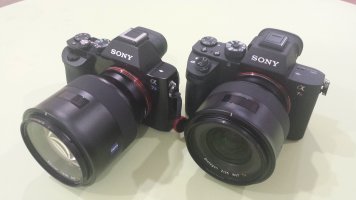
FF mirrorless mount -- go thin or go with EF?

What should Canon's lens mount strategy be for FF mirroless?


  • Total voters
    75
  • Poll closed .

ahsanford

Particular Member
Aug 16, 2012
8,656
1,664
57,701
Whaddya got? What do you think Canon should do with FF mirrorless?

As everyone has a jillion unique takes on the mount, I am not going to allow entries of 'other' with this poll. :P

Keep in mind, this has nothing to do with the size of the grip -- I'm just asking about the flange distance.

COMPANION POLL HERE:
http://www.canonrumors.com/forum/index.php?topic=28231.0


- A
 
I voted for the first alternative, even though I dont agree with all of it. Size matters, but so does ergonomics, and I dont think mirrorless is all about having small cameras. There are other benefits that for me is vastly more important. EVF is one of them, with all the info I can have directly in the viewfinder. Focus aids and a preview of selected exposure values. Great! The other benefit is all the lenses that can be adapted. Having an adapter to e able to use my EF lenses is a very small tradeoff.
Also, no more focus adjust would be awesome!
 
Upvote 0
Pitbullo said:
I voted for the first alternative, even though I dont agree with all of it. Size matters, but so does ergonomics, and I dont think mirrorless is all about having small cameras.

Yep. Good comment. I modified the choices to pull the opinions out of it.

- A
 
Upvote 0
mkabi said:
Why can't they do both without an adaptor?
I understand the whole flange distance problem, but can't they correct that with an in-body lens or lenses that correct for image size???
every bit of correction adds distortion.....

besides, some will prefer a larger body with more controls, while some will prefer a smaller body with simplified controls..... That's why I think the answer is both.....
 
Upvote 0
Don Haines said:
mkabi said:
Why can't they do both without an adaptor?
I understand the whole flange distance problem, but can't they correct that with an in-body lens or lenses that correct for image size???
every bit of correction adds distortion.....

besides, some will prefer a larger body with more controls, while some will prefer a smaller body with simplified controls..... That's why I think the answer is both.....

+1. EF-mount will not be suitable for making truly (Leica) small and light, and many want that as an option. EF+adapter will be the same frankenstein solution that Sony A7 offers, and I can't see why anybody would want that without native lenses. Sure, Canon must offer compability with EF lenses, but it can't be the only mirrorless solution.
 
Upvote 0
Don Haines said:
mkabi said:
Why can't they do both without an adaptor?
I understand the whole flange distance problem, but can't they correct that with an in-body lens or lenses that correct for image size???
every bit of correction adds distortion.....

besides, some will prefer a larger body with more controls, while some will prefer a smaller body with simplified controls..... That's why I think the answer is both.....

I'm not saying that the answer of adding a lens/lenses is an easy answer... what else is a R&D department for?
 
Upvote 0
A longer flange distance offers design options with more rigidity in the Z-axis which is important to provide support for longer and heavier, fast-aperture lenses which give the distinctive full frame look. IMHO if you don't need the sweet background blur then you can just as well use lighter APS-C mirrorless options.

Whether it is thick or thin it should have a nice deep grip to provide comfort even with extended use over the course of a day. I don't want cramping hands because it's too small or lacks contouring.
 
Upvote 0
StudentOfLight said:
A longer flange distance offers design options with more rigidity in the Z-axis which is important to provide support for longer and heavier, fast-aperture lenses which give the distinctive full frame look. IMHO if you don't need the sweet background blur then you can just as well use lighter APS-C mirrorless options.

Or others would say "The heck with that. To keep things small, this is where you settle for an f/2 prime instead of an f/1.4 prime, or an f/4 zoom instead of an f/2.8 zoom."

I happen to agree with you, but not everyone is shooting FF for small DOF reasons. Some folks really see FF mirrorless as the light at the end of the tunnel on the big/heavy camera front. But too many folks love fast FF glass to give it up with their mirror boxes, physics is physics and all that, and this new mount will need to be built for war.

If Canon only sold really high end small EOS-M lenses for APS-C, this would be easy. Go EOS-M for small and light, go EOS-Battleship for the FF goodness (and associated back pain).

- A
 
Upvote 0
Not sure why people tend to be against adapters to increase the flange distance. They are simple - no glass, no optics, no nothing. I used one with my Olympus OM-D. You put it on. You leave it on. You forget you even have it on fairly quickly. What could be easier? You get the advantage of a slightly smaller, lighter camera and you can use all your EF lenses. Works for me.
 
Upvote 0
dak723 said:
Not sure why people tend to be against adapters to increase the flange distance. They are simple - no glass, no optics, no nothing. I used one with my Olympus OM-D. You put it on. You leave it on. You forget you even have it on fairly quickly. What could be easier? You get the advantage of a slightly smaller, lighter camera and you can use all your EF lenses. Works for me.

This. The adapter should be reasonably small and unobtrusive (ideally, it will be identical to the current M adapter). While you're accumulating your new mirrorless lenses, you use the adapter as needed. It should be a smooth transition.
 
Upvote 0
The issue with short flange distances is that it becomes more difficult to build wide angle lenses that will cover full frame. The sharper angle of the light rays striking the sensor causes more light fall off which must be compensated for by boosting the ISO of the outer photosites.

I think its a bad solution, its workable, but a compromise in quality.
 
Upvote 0
Mt Spokane Photography said:
The issue with short flange distances is that it becomes more difficult to build wide angle lenses that will cover full frame. The sharper angle of the light rays striking the sensor causes more light fall off which must be compensated for by boosting the ISO of the outer photosites.

I think its a bad solution, its workable, but a compromise in quality.

Couldn't DO be used to mitigate that problem? It's my understanding that enhanced bending of light is what they do.
 
Upvote 0
brad-man said:
dak723 said:
Not sure why people tend to be against adapters to increase the flange distance. They are simple - no glass, no optics, no nothing. I used one with my Olympus OM-D. You put it on. You leave it on. You forget you even have it on fairly quickly. What could be easier? You get the advantage of a slightly smaller, lighter camera and you can use all your EF lenses. Works for me.

This. The adapter should be reasonably small and unobtrusive (ideally, it will be identical to the current M adapter). While you're accumulating your new mirrorless lenses, you use the adapter as needed. It should be a smooth transition.

Unless Canon insists you use the adaptor by limiting native the mirrorless FF mount lens offerings.

There's a strong argument to be had that since FF mirrorless and FF SLR glass are basically the same size/specs, Canon's not going to be a in a hurry to migrate the EF glass over -- it won't save mirrorless owners any size and Canon would have to spin up a new mfg line for those lenses. If they go skinny with the FF mirrorless mount, what's to stop them from only offering a smattering of smaller primes in the new mount and forcing us to use EF through an adaptor?

- A
 
Upvote 0
I definitely would like an ergonomically well integrated adaptor for EF lenses perhaps with a concentric ring to select f-stop or whatever you assign to it - like the S90 and other smaller cameras.

And I would like to have another adaptor to fit my FD lenses to that hypothetical Canon FF mirrorless.

Flexibility rules ... if well made.
 
Upvote 0
Canon will use the EF mount. However, they will modify it slightly to accept a new lens type - EF-T. The new EF-T lenses will only mount on full frame mirrorless cameras. (In the same way as EF-S lenses only mount on APS-C bodies).

The EF-T lenses will extend further into the camera body. This gives designers the option to reduce the size of the protruding, exterior part of the lens. It will also allow Canon to claim full compatibility with existing EF lenses and also display size reduction benefits with the new EF-T lenses.

Further, Canon have been working on reducing the thickness of their sensor modules and LCD dispaly. They've been able to shave 3mm off. This alone helps to create a noticeably more svelte camera body.
 
Upvote 0
StudentOfLight said:
Is a Full-frame lens to EOS-M speed booster possible?

Don't know, but one would think that if Metabones could, they would. They currently don't sell one for the EOS-M mount.

So, it's either:

1) Not possible due to there not being enough room (i.e. the flange distance of EOS-M is too close to that of EF to pull it off), or

2) EOS-M is too small a market for Metabones to make this for.

Gotta believe it's the former and not the latter, but I'm just speculating.

- A
 
Upvote 0