First Time: College Football Oh Boy!

Status
Not open for further replies.
I'm working for my college newspaper and they've procured me a credential to shoot on the sidelines of a D-I game in two weeks...never done this before. I've got a 5D3, 16-35 II, 70-200 II, and a nifty 50, as well as a 430EX. I also have a 500L II and a second 5D3 coming via the CPS Loan program that I plan to use at this game. I can buy a monopod by then for the 500. I also have the appropriate Arca plate.

My question is...any tips? Keep 500 on one, 70-200 on the other I assume? Any reason to switch to 16-35? Flash of any use? Obviously I want to keep my team facing me, but how is movement governed on sidelines. Can I get up and go where and when needed or am I locked down?

I'm sure there's tons I'm not even thinking to ask. Any help is greatly appreciated.
 
Well, I've never shot a sports game, but...

How about renting the Bigma 50-500? I've actually seen an event photographer use it in limited light on a 5d3 shooting to JPG with 3200/6400/12800 ISO. They at least looked decent on the back LCD.

Or the 100-400L/70-300L to give you more reach for the other end of the field. And then a standard zoom 24-70/24-105 for when the action gets closer to you.
 
Upvote 0
I could probably swap my loan to the 400 2.8. Hadn't really considered that option. The reason I was originally loaning the 500 II was because I have a short wildlife trip to Acadia NP planned for earlier during the rental period. This happened to coincide so it seemed like it would work out well.

Insurance is a good question. I hadn't given a ton of thought to the possibility of getting trucked while shooting with their glass. I'll check the loan agreement and contact them about possible insurance.

Any guidance on the monopod? Is their one particularly favored by sports pros for either the 500 or 400?
 
Upvote 0
newspaper... 5D3... 70-200...

One body, one lens, on a fairly basic monopod.

You have flexibility. You have the ability to crop loads and loads and still be fine for newspaper resolution.

You have the faster AF.

You have less clutter at your feet and less clutter in your head.

I've shot at a few SPL football games (for football read soccer) Once the teams are out you stay put. Frowned upon to move about as you'll be in the way of the folk who are paying to see the game. Thats my experience, absolutely none of US Football.

If you really must, and want the added stress and headaches and loss of mental focus, could you set up your 2nd camera with the wide lens to be wirelessly triggered, facing your team from the touchline?

Personally I wouldn't. It's your first time. Keep it simple. Pick a good spot for each half. Track track shoot. Lots and lots.

One body. One lens. Less is more.

And you'll be better prepared when you are asked back... Prepared mentally. Too much kit is a hindrance.
 
Upvote 0
As for your other questions regarding a stick and movement during the game:

1. I've always liked Manfrotto monopods; you only need one for the 400, though. 70-200 is handheld.

2. The good thing about football is you can move around plenty. There's something called a restraining line (dashed line around perimeter of field) that limits how close you can get. On the sidelines, as long as you're behind it, move freely. You can stand and shoot on the sidelines. Be aware of/courteous to other shooters, and line of sight.

In the end zones it's a little trickier, but still manageable. You'll always be sitting/kneeling and it's really important not to walk in front of the tv cameras. Generally only move out of there during change of possessions/timeouts, etc.
 
Upvote 0
rmfagan said:
I'm working for my college newspaper and they've procured me a credential to shoot on the sidelines of a D-I game in two weeks...never done this before.
I hope some more experienced folks will chip in. My only experience is one amateur game, so take this advice with that in mind.


I've got a 5D3, 16-35 II, 70-200 II, and a nifty 50, as well as a 430EX. I also have a 500L II and a second 5D3 coming via the CPS Loan program that I plan to use at this game.
Drop the 50. 500 is probably too long for most of what you're doing. 300 or 400 would be better for tight shots.

You'll use the 70-200 when the action is near you, and the long lens when it's near the opposite endzone. The 16-35 could be useful for reaction shots: up close after a TD, interception or the like (though obviously, don't get in the way)

Flash of any use?
Probably not. D-I should be well-lighted.

Obviously I want to keep my team facing me, but how is movement governed on sidelines. Can I get up and go where and when needed or am I locked down?
Call the press office of the hosting school and explain your situation. Ask them for guidelines on etiquette and movement. I've seen some D-I where the student photographers can move quite a bit. When you get on the field, ask advice from some of the other photographers.

Shoot bursts for all action. Try to anticipate the play. Remember that there are some shots you can't get because they're obscured, so it's better to follow players (wide receivers) who may not get the ball every play. On the other hand, if it's a likely running play, look to burst on the RB coming through the line. If the line stops him you're not getting the shot anyhow. Also think about covering an area: if you know it's third and 12, look for action from 10-15 yards from the line of scrimmage. Take some risks: better to get a few glorious shots than pedestrian coverage of every play. Bring ENOUGH BIG MEMORY CARDS. You will shoot several thousand frames during that game.

One more thing I tried to do toward the end of my one game: keep both eyes open during the play. Your "off" eye should be looking over the camera for the action, while your viewfinder eye is ready to focus in. Keep the camera at your eye for the entire play: don't expect to bring it up in time for action.

Enjoy!
 
Upvote 0
paul13walnut5 said:
newspaper... 5D3... 70-200...

One body, one lens, on a fairly basic monopod.

You have flexibility. You have the ability to crop loads and loads and still be fine for newspaper resolution.

You have the faster AF.

You have less clutter at your feet and less clutter in your head.

I've shot at a few SPL football games (for football read soccer) Once the teams are out you stay put. Frowned upon to move about as you'll be in the way of the folk who are paying to see the game. Thats my experience, absolutely none of US Football.

If you really must, and want the added stress and headaches and loss of mental focus, could you set up your 2nd camera with the wide lens to be wirelessly triggered, facing your team from the touchline?

Personally I wouldn't. It's your first time. Keep it simple. Pick a good spot for each half. Track track shoot. Lots and lots.

One body. One lens. Less is more.

And you'll be better prepared when you are asked back... Prepared mentally. Too much kit is a hindrance.
+1
The 70-200 is your best bet.
 
Upvote 0
I have shot a lot of HS football using the 100-400 and 70-200. I think the 500 may be a little too much. I would rather take the 400 2.8. As for tips, watch what the veteran photographers are doing. I follow newspaper and local news sports reporters around on the sidelines. They have shot hundreds of games and tend to know where to be most of the time. I try to stay behind the defense and watch the plays coming toward me. Also, when they are in the redzone, the back of the end zone is generally the best place to be. Good luck and have fun!
 
Upvote 0
You definitely need to think about the insurance. CPS holds you fully responsible for the full RETAIL (yes, the ridiculously high MSRP) amount of anything you "evaluate" from them. I have insurance for my gear and $3k of of insurance for rental equipment, but I was sweating bullets during my whole 800mm f/5.6 loan. When I shipped it back, the 2-day shipping was $30 and the insurance (aka Declared Value at FedEx) was $130!

You definitely want to keep that in mind.
 
Upvote 0
paul13walnut5 said:
newspaper... 5D3... 70-200...

One body, one lens, on a fairly basic monopod.

You have flexibility. You have the ability to crop loads and loads and still be fine for newspaper resolution.

You have the faster AF.

You have less clutter at your feet and less clutter in your head.

I've shot at a few SPL football games (for football read soccer) Once the teams are out you stay put. Frowned upon to move about as you'll be in the way of the folk who are paying to see the game. Thats my experience, absolutely none of US Football.

If you really must, and want the added stress and headaches and loss of mental focus, could you set up your 2nd camera with the wide lens to be wirelessly triggered, facing your team from the touchline?

Personally I wouldn't. It's your first time. Keep it simple. Pick a good spot for each half. Track track shoot. Lots and lots.

One body. One lens. Less is more.

And you'll be better prepared when you are asked back... Prepared mentally. Too much kit is a hindrance.

I would definitely +1 all that for Association Football.

American Football though I'd suggest the second body isn't such a bad idea because of all the breaks in the game which give more time for thought. You have much longer to set up for each phase of play and to review what you just took versus what you would like.

Actully, it sounds like a good sport to have a go at except that the helmets mean you lose most of the facial expression which is often an important part of a sports shot - in my view at least.
 
Upvote 0
JohnnyOntheSpot said:
400 2.8 on your main body, 70-200 for red zone. No flash during the game. Only time to bring out your 16-35 would be the scrum (players/coaches meeting near midfield after the game). Hope this helped.

Complete agree - good advice. As others have stated, stay 10-30 yards behind the defense (unless your trying to shoot defensive players - then slightly behind the offense). Move with the flow of the game (between plays, not during). Stay out of the way. Re: monopods, get a good one (Manfroto, Gitzo, etc.), it's worth the extra $$s. If you can catch a game before this assignment, watch the more experienced photogs.
 
Upvote 0
A lot of helpful information here, thanks all! Another question that just hit me... Where do you store your bag, case, etc while you're shooting the game? I figured on transporting the 400 in the big hard case Canon sent it with, but what do you do with it during the game? Surely with movement while shooting you wouldn't just leave it somewhere on the sideline? Thoughts?
 
Upvote 0
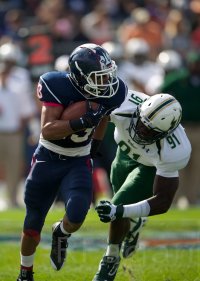
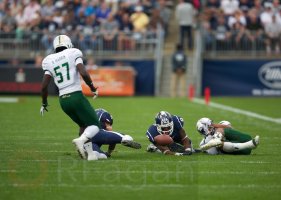
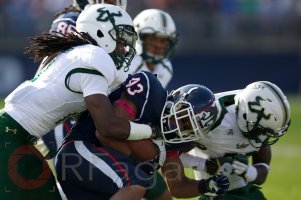
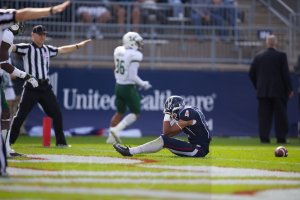
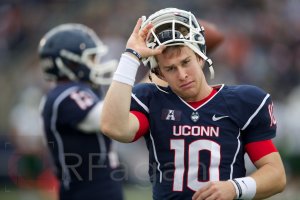
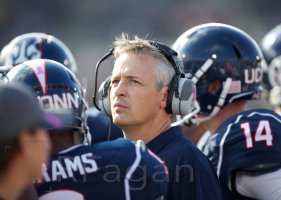
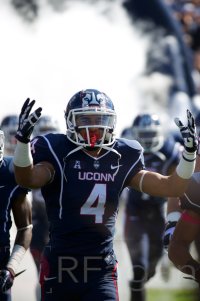
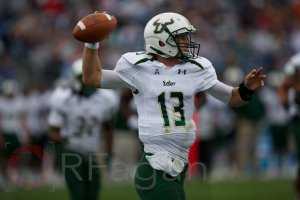
This topic didn't generate a ton of buzz, but I thought I'd post an update. I shot the game yesterday using my 5DIII/grip and a second loaned 5DIII from CPS, as well as a loaned 400L II and my 70-200L II. I also brought along my 16-35L though I didn't use it much at all due to the hassle of changing lenses. In my opinion, the best way to cover a game is with a second photographer, or having a 3rd camera. 400 stayed on a monopod, 70-200 on my shoulder.

I left cases and bags in the vehicle and carried everything in just as I planned to use it during the game. This seemed to work fine, thought I did find the media room and it seemed many photographers simply piled bags and cases up near the tunnels, so that is an option for next time.

Anyway, first impressions... WOW it was fast. I knew that going in, but seeing it just a few feet away brings it into focus for sure. These boys can fly. I was quite impressed with the AF of the 5DIII all things considered. I imagine as I shoot more games and learn the system better I'll get more keepers.

Anyway, here are a few of my favorite shots of the game...commentary is welcomed.
 

Attachments

  • UCONNUSF 334.jpg
    UCONNUSF 334.jpg
    205.9 KB · Views: 449
  • UCONNUSF 1011.jpg
    UCONNUSF 1011.jpg
    192.3 KB · Views: 467
  • UCONNUSF 1292.jpg
    UCONNUSF 1292.jpg
    206 KB · Views: 459
  • UCONNUSF 1250.jpg
    UCONNUSF 1250.jpg
    177 KB · Views: 468
Upvote 0
Status
Not open for further replies.