For our DR peepers: Sony A7000 - rumored 15,5 stops DR

neuroanatomist said:
msm said:
neuroanatomist said:
But some people – well, one person – apparently can't seem to come to grips with the fact that a screen DR of 13.9 stops means information in a scene that exceeds that range will be lost and unrecoverable. I suspect you can explain it more effectively if you choose, but I wouldn't bother.

Yes please looking forward to seeing that explanation. Particularly want to see the explanation of how I was able to recover information from a 16 stop underexposed image from my A7R, considering it has a "screen DR" of less than 13 stops and "information in a scene that exceeds that range will be lost and unrecoverable". ;D

Pointless as stated, but I have about one minute while my coffee brews so once more into the breach...

What do you need explained? The fact that a range has both lower and upper bounds? The fact that DR is a measure of the difference between those bounds? The fact that your 'proof':

index.php


...is so ridiculously far from simultaneously exceeding both of those bounds that it would be funny as a joke, but is just pathetic for your intent? The fact that the bounds of the range are defined by physics (FWC and read noise in e-), and not by any relationship to your camera's arbitrary algorithm for selecting a matrix-metered exposure on which your claim of a 16-stop underexposure is based?

I could go on, but as I stated...it's pointless, and my coffee is ready.

Considering that, as of that post, you've spent approximately 276 days, 7.75 hrs online in this forum, that's a pretty lame response.

Arbitrarily limiting your precious time to one minute to respond to a perfectly valid experiment, and using that minute to be little more than insulting, when you've obviously spent many hours of your online time in highly repetitive and pointless arguments with no educational opportunity for anyone is quite ironic.

For someone who claims to be so educationally-oriented your reply to msm is all attitude, no education.

Are you weaseling out of providing an explanation because you don't know how to describe why msm's experimental data supports msm's theory?

C'mon Dr. Brain, educate him. :D
 
Upvote 0
neuroanatomist said:
Aglet said:
...a perfectly valid experiment...

Hey, do you have one of those magical a7R cameras with >16-stops of DR, too? Is it powered by a perpetual motion machine? ;)

I'm still confused about your reactions here. I think we have clearly demonstrated that there is a disconnect between dynamic range, bit depth, and usable range of information. The Sony cameras store the most precise pixels in every 32-pixel block with only 11 bits. However that does not prevent them from supporting data recovery many stops beyond what any Canon camera is capable of. All of the Canon cameras I own can handle about two stops before non-gaussian noise begins to appear. The 5Ds may be capable of about three stops (although with heavy color noise.) The A7r, A7s, and A6000 all seem to be capable of lifting information as much as seven or eight stops, and the noise characteristics remain very close to gaussian (in other words, ridiculously easy to clean up, with some tools you can totally wipe out clean gaussian noise and leave behind useful information.)

You seem bound and determined to stand your ground. That's all well and good, certainly up to you...but I'm not really sure what it accomplishes.
 
Upvote 0
jrista said:
neuroanatomist said:
Aglet said:
...a perfectly valid experiment...

Hey, do you have one of those magical a7R cameras with >16-stops of DR, too? Is it powered by a perpetual motion machine? ;)

I'm still confused about your reactions here. I think we have clearly demonstrated that there is a disconnect between dynamic range, bit depth, and usable range of information. The Sony cameras store the most precise pixels in every 32-pixel block with only 11 bits. However that does not prevent them from supporting data recovery many stops beyond what any Canon camera is capable of. All of the Canon cameras I own can handle about two stops before non-gaussian noise begins to appear. The 5Ds may be capable of about three stops (although with heavy color noise.) The A7r, A7s, and A6000 all seem to be capable of lifting information as much as seven or eight stops, and the noise characteristics remain very close to gaussian (in other words, ridiculously easy to clean up, with some tools you can totally wipe out clean gaussian noise and leave behind useful information.)

You seem bound and determined to stand your ground. That's all well and good, certainly up to you...but I'm not really sure what it accomplishes.

Maybe it's burst Neuro's bubble-of-comprehension and he's trying to buy time with with snark while he inflates a new one to live in. :P
edit: i mean, it could be hard to accept that 1 bit could potentially represent something other than one stop of photographic information. As a canon-only user he may not have had any experience with any equipment that would display otherwise. All that expensive 24, 32, 48, 64-bit lab instrumentation doesn't have much bandwidth so raw file compression is unlikley to be encountered. Unlike Canon's generous supply of 14 bits to encode only 10 to 11 stops worth of data, generally dithered with a repetitive data pattern feature. ;)
 
Upvote 0
jrista said:
I'm still confused about your reactions here. I think we have clearly demonstrated that there is a disconnect between dynamic range, bit depth, and usable range of information. The Sony cameras store the most precise pixels in every 32-pixel block with only 11 bits. However that does not prevent them from supporting data recovery many stops beyond what any Canon camera is capable of.

A scene with 14.0 stops of dynamic range - can you capture that entire range with a single image using an a7R?

Most people posting in this thread know the correct answer to that question. One person does not. But you do have a point - that person will not be convinced.

Ps. To be clear, the 14-bit ADC 'limit' on DR is an artificial one, true - but AFAIK no current camera breaks that limit, the rumored A7000 would be the first. Until now, manufacturers have chosen ADCs that have greater bit depth than the sensor has DR, even if there are options to produce files with lower bit depth. If Sony releases a sensor with 15.5-stops of DR and a 14-bit ADC, that would be innovative, but not in a completely positive way. It's not unlikely they can make such a sensor, but they really should pair it with a 16-bit ADC.
 
Upvote 0
Yeah, Aglet - I've never had to map a higher number of bits of data down into a lower bit depth. Well, except for the few times I've converted an image to jpg. I think I did that once or twice in 2011. ;)
 
Upvote 0
neuroanatomist said:
jrista said:
I'm still confused about your reactions here. I think we have clearly demonstrated that there is a disconnect between dynamic range, bit depth, and usable range of information. The Sony cameras store the most precise pixels in every 32-pixel block with only 11 bits. However that does not prevent them from supporting data recovery many stops beyond what any Canon camera is capable of.

A scene with 14.0 stops of dynamic range - can you capture that entire range with a single image using an a7R?

Most people posting in this thread know the correct answer to that question. One person does not. But you do have a point - that person will not be convinced.

Since the sensor is actually capable of 13.5 stops, my answer is 'no'. However, it WILL capture 13.5 out of 14 stops of that scene with usable noise characteristics. The other 0.5 stops will have diminishing noise characteristics and thus reduced usability. Despite that...the full 14 stops of dynamic range is there, and in significantly better shape, than the other 3 stops of information the Canon camera is not capturing. ;)

Remember, a four stop lift with an ISO 100 image made with an Exmor sensor is ISO 1600. I doubt there is anyone on these forums that wouldn't call an ISO 1600 image from a modern Canon DSLR usable. I think you might be able to find some who find ISO 3200 images unusable, and a lot who find ISO 6400 images unusable...but I think you would be pretty hard pressed to find someone on these forums that finds ISO 1600 images unusable.

Now, a +4 stop push with an A7r is not only going to be like ISO 1600...but only the shadows are going to be like that. Everything else is still going to have ISO 100 quality! That bottom 0.5 stops of the shadows? You could very well lift that, but in that 14 stop scene are your true zone zero, so we don't need them to be lifted a ton. They could be left alone, or they could be lifted slightly if you want there to be just a hint of detail in there.

Either way, from a practical standpoint, the A7r is going to gather significantly more usable information from that 14 stop scene than any Canon DSLR on the market. It'll gather about 13.5 stops, to be exact. ;) That information is going to be limited by gaussian noise, which cleans up wonderfully, with minimal amounts of NR that are marginally destructive to detail at worst (especially if you use higher end NR tools, but LR's NR will do just fine.)
 
Upvote 0
jrista said:
neuroanatomist said:
Most people posting in this thread know the correct answer to that question. One person does not. But you do have a point - that person will not be convinced.

Since the sensor is actually capable of 13.5 stops, my answer is 'no'.

Mine, too.

As for the differential DR between camera brands, although that wasn't the point of the discussion your position on the importance of those differences is clear,and as you stated earlier, I'm not really sure what rehashing it accomplishes.
 
Upvote 0
I note a lack of symmetry in this thread. Both me and neuro make claims in this thread, but I always back these up with explanations and examples while neuro never does. Seeing that neuro is the first to ask for people to back up their claims when he doesn't like them that is quite clear example of double standards.

Here is a little challenge for you Neuro, start to back up your claims or they are just worthless.

neuroanatomist said:
[Information/image detail in the real-world subject at luminance levels which fall outside of the directly measured DR of a sensor (what DxO reports as "screen DR") is lost, and downsampling or other post-capture manipulation of the digital file will not recover those data.

Still waiting for the explanation of this one.....

neuroanatomist said:
A scene with 14.0 stops of dynamic range - can you capture that entire range with a single image using an a7R?

Most people posting in this thread know the correct answer to that question. One person does not. But you do have a point - that person will not be convinced.

You can't say that the correct answer is no because it depends entirely on what you mean by "a scene with 14.0 stops" and "capturing that entire range" as already explained. As you still haven't managed to produce any meaningful explanation of what either of those things mean it is still a completely meaningless question. Go back to page 3 or wherever this was first brought up.

jrista said:
Personally, outside of a pure comparison context, I don't believe the numbers spit out by 8mp normalized results tell us much about what we'll experience when actually editing a RAW file in a program like lightroom. I believe that Screen DR (non-normalized DR) tell us that, since that is the per-pixel DR of the RAW data that we are literally working with.

I agree if you do all your editing at 200% view. However I personally care more about what happens at image level, and I could be wrong but I think most photographers ultimately will agree with me on that one. The 20D, 7D, 7DII, 5DIII, 5DS/R all got screen DR which is practically identical in the range 10.95 to 11.12. I think we all know what happen at the image level when we try to edit raw files from those cameras of the same high contrast scene exposed similarly relative to saturation. But if someone needs proof then it would be nice if someone who has a 5DS/R and one of the other cameras could post some raw files taken under the above conditions and we could all see for ourselves.
 
Upvote 0
msm said:
neuroanatomist said:
[Information/image detail in the real-world subject at luminance levels which fall outside of the directly measured DR of a sensor (what DxO reports as "screen DR") is lost, and downsampling or other post-capture manipulation of the digital file will not recover those data.

Still waiting for the explanation of this one.....

There is no explanation, it's just wrong. Engineering DR is based on an SNR of 1 at the noise floor. For information within the noise floor, the SNR is less than one. Most people won't use such information. I won't use it for daytime photography, although with astrophotography, I will. However there IS information in that data, where the SNR is less than one. It's just that the noise is larger than the information, so identifying the information is extremely difficult. It is not impossible, just difficult. The higher the noise is, the more difficult it is to identify signals at increasingly lower SNRs below 1.

msm said:
jrista said:
Personally, outside of a pure comparison context, I don't believe the numbers spit out by 8mp normalized results tell us much about what we'll experience when actually editing a RAW file in a program like lightroom. I believe that Screen DR (non-normalized DR) tell us that, since that is the per-pixel DR of the RAW data that we are literally working with.

I agree if you do all your editing at 200% view. However I personally care more about what happens at image level, and I could be wrong but I think most photographers ultimately will agree with me on that one. The 20D, 7D, 7DII, 5DIII, 5DS/R all got screen DR which is practically identical in the range 10.95 to 11.12. I think we all know what happen at the image level when we try to edit raw files from those cameras of the same high contrast scene exposed similarly relative to saturation. But if someone needs proof then it would be nice if someone who has a 5DS/R and one of the other cameras could post some raw files taken under the above conditions and we could all see for ourselves.

I care about how it will look at my largest publication size. In my case, that is usually a 36x24" print, although I print at a range between 14x11" to as large as 40x30". This is part of why I have a problem with "print" DR...such a radically subjective term. :P

I edit at both the fill image size and 1:1 scale size in Lightroom. I don't usually edit at larger than 100%. I check detail and noise quality at 100%.
 
Upvote 0
msm said:
neuroanatomist said:
[Information/image detail in the real-world subject at luminance levels which fall outside of the directly measured DR of a sensor (what DxO reports as "screen DR") is lost, and downsampling or other post-capture manipulation of the digital file will not recover those data.

Still waiting for the explanation of this one.....

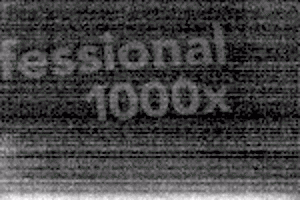
perhaps you need to make that second image more clear, as below, since lots of poorly setup displays and viewing environments will not show what's there.

It's quite apparent that the white text, against a gray background, is showing up very well. If the background had been much darker, then the 'noise' level of the gray background would be even (lower) darker and provide an even greater relative contrast (SNR) than this.
I'm not doing any analysis on it, but it looks to me like that white text is at a SNR >1 even if the gray background is considered the noise.

I think I saw, somewhere, that you'd set the white text to just below clipping (full well) with an exposure of 8 seconds.
You then made that other exposure at 1/8000 second. (presumably at the same F-stop) for a difference of 16 stops. (please correct me if I mis-remembered that)

so, with a 14 bit ADC, that "white" should have been buried 2 stops below the SNR=1 level and not even readable in a 14-bit linear system. It should be only somewhat visible in the LSB of a quiet 16-bit ADC's conversion of that signal.
Yet, there it is, nearly as discernable as snow against coal on a moonless night.

Now, if that were a 1:1 pixel crop and this was the result we'd be really amazed.
if it's the full frame reduced to this tiny output, well then, statistical smoothing goes a long way towards...
Hey, Wait a minute, didn't someone here say you're not going to be able to recover more information (scene DR &-or SNR) if it was outside of the range of the data conversion?...
And this is clearly a good example of the data being considerably smaller than the ADC's least significant bit.

Maybe they meant to say if it was only outside the UPPER ADC limit.
Did anyone say that, somewhere?..

Cuz this demo seems to prove that it is possible to pick fly-poop out of black pepper while wearing boxing gloves if given enough to work with. (I think I'd made that same point to the same party many months ago)
index.php
 

Attachments

  • edit.gif
    edit.gif
    29.5 KB · Views: 574
Upvote 0
I just created an image with more than 22 stops of dynamic range from a single RAW image capture with my 6D. It is high recommended that you calibrate your screen before viewing in order to fully appreciate the true epicness of this image. (See attached)
 

Attachments

  • Ultimate downsample.JPG
    Ultimate downsample.JPG
    5 KB · Views: 467
Upvote 0
StudentOfLight said:
I just created an image with more than 22 stops of dynamic range from a single RAW image capture with my 6D. It is high recommended that you calibrate your screen before viewing in order to fully appreciate the true epicness of this image. (See attached)
I don't know why, but I decided to take a picture of your masterpiece with my camera.. and the result turned out to be quite crappy, I suppose it's because of that amazing DR.
 

Attachments

  • 20150725-IMG_3501.jpg
    20150725-IMG_3501.jpg
    88.4 KB · Views: 373
Upvote 0
Proscribo said:
StudentOfLight said:
I just created an image with more than 22 stops of dynamic range from a single RAW image capture with my 6D. It is high recommended that you calibrate your screen before viewing in order to fully appreciate the true epicness of this image. (See attached)
I don't know why, but I decided to take a picture of your masterpiece with my camera.. and the result turned out to be quite crappy, I suppose it's because of that amazing DR.
Too bad, but don't worry, I'll eventually share a blog post on my processing workflow. One day you'll also be able create these masterpieces ;D
 
Upvote 0