From 5D Mark III to R5 Mark II - photographer review - first 1 month and a half - 12k shots

I recently went to Tokyo for a trip and decided to upgrade my 5D Mark III, benefitting from the very favourable local prices, and obviously take some pictures. I had two main reasons for the upgrade: silent shutter and eye controlled focus. Those two aspects felt crucial for the kind of pictures that I take and worth the switch from DSLRs.
I payed 2870 euro for a new body at MapCamera in Shinjuku, I highly recommend going to Japan to buy your gear if you can and you can get market rate conversion with your card, it saved me more than the trip price. A few other things I also bought: 2 extra batteries, fast CFexpress card reader, Canon EF converter and bottom loop for the neck strap. No new lenses since I only use 28mm and had my EF copy already, more on that later.
During the trip I shot around twelve thousands unique pictures, no burst or pre capture, and it was truly a joy despite a few things that I'd like to see improved. It is the only camera I'd consider for photography today since my budget can accomodate for it.

I've divided this review in sections to make it a bit more clean. I hope it will be useful to other people to make up their mind!


- Ergonomics
The R52 is and feels as tall as the 5D3 but significantly smaller. My small hand rests perfectly on 5D, taking the R5 in hand gives me a more "aggressive" feel which I actually don't dislike because when I lift it I know I am taking a shot. It is also easier to "play" with the body a little bit while keeping it close to the eye, which is something useful when taking pictures of people since it makes them feel less targeted, it is also generally less noticeable. The smaller body will be bothersome for those that cannot get the full height of their hand on, or those that want a "professional" look for clients, but there are many choices for vertical grips so it's a non issue. One thing I do not understand is why the current grip pattern doesn't cover the full extent of the plastic as it does on the 5D. I tried the R1 as well, I do like to have that in hand and the cross grip pattern is better, but it's just too big of an object to push in someone's face, let alone the price difference. The buttons of the R1 are also better, but R5 is still excellent, I just had some troubles to reach for the joystick but I think it is just a matter of habit. The new third wheel for ISO is great. The general balance while using the EF adapter is perfect.


- Reliability
I took a lot of shots so I can give my opinion about it. I had read a lot of different things about it which had scared me. I know the camera is way more complex than DSLR and there is a lot of code powering it. My 5D also had some hick-ups, they are not perfect either, regarding the R5 I think I benefited from being able to jump on the most recent firmware that corrected a bunch of issues and it has been generally very reliable for the amount of pictures I took, there were two sets of issues though. First thing is a random inability of the camera to take pictures, it happened randomly around 3-4 times in 45 days and lost me one picture, to be precise. The camera would respond properly but there was no flashing white border (I am shooting in blackout free mode) when pressing the shutter and the picture was not taken. It came back working after around 10 seconds. I did not power down and up the camera but I guess that would have fixed it faster. It would be nice if Canon could prevent something like this from happening ever but maybe it's not something realistic, I don't even know if the reason behind the multiple occurrences of the bug was the same. The second set of issues appeared during a rainy day and it was way more concerning in my opinion. I was walking and shooting under an umbrella, being careful to wipe excessive water that eventually builds up on the body and viewfinder, I wouldn't call it a very challenging scenario. Still the viewfinder completely froze two times. It freaked me out a bit because I was afraid something serious could have happened with the water but I doubt that's the case because since it came back working as normal, I was also being really careful, I don't see how water could have passed the tropicalization. Maybe an issue with coldness plus water? It wasn't that cold though.


- Stills quality
The reason behind my upgrade wasn't picture quality but still this is such a relevant topic that I ended up caring about it a bit. Let's start by the jpeg presets. I really love to shoot raw+jpeg because I do not care or have the time to edit most of the shots, I want them to look good out of the camera and Canon cares about that and it kept improving on what it already did. I used the faithful picture profile with minimum contrast on the 5D and kept doing the same on the R5. I was very pleased to see how the shifting reds are now fixed, it looks perfect now and I can trust it to deliver a realistic image. I am also extremely happy about how the camera deals with the data from high ISO. I have let it go up to 6400 and there is a night and day difference with the 5D, before I was scared as soon as I would hit 800 ISO, now I am thrilled about the night time results of 6400 and I've heard people pushing it even to 12800. This really allows you to take shots that were not possible before, keeping the aperture close, not using flash, fast shutter speed.
I have not much to say about resolution, I liked the 5D already, the extra pixels don't change much for me but I am not complaining. I do hope that we will get to a stable point though, bigger numbers each year must come at the cost of speed and other features.
My main complaint about picture quality comes from Dynamic Range. It scares me to read comments that say that dynamic range is so good today it doesn't need improvements, the reality is that dynamic range today still sucks, it is unbearably bad. Digital photography on the top class cameras is still unable to cover a sunny day with some shadows, how is that good enough? We need at least 3 more stops of DR to get there and it doesn't look like current sensor technology can improve. A breakthrough can come with DGO but it has to be implemented in electronic shutter mode for me to be relevant. I would gladly sacrifice burst speed to get it but I doubt that Canon will implement such a significant quality split and will instead wait to have it working perfectly for all modes. Just to be clear let's look at this example:
Normal sunny day, one person is shielding their face from the sun and is correctly exposed and one is not and is completely blown out, no details whatsoever to recover from the raw file. Terrible stuff which would never happen on film. The shot was taken at 800 ISO, a double gain output 100/800 would cover exactly the 3 stops needed to make the image decent. This is such an important aspect for me, I feel like a lot of people just don't take enough wide shots with patches of light and multiple subjects and are instead isolating a main character or shooting in interiors so they don't see the issue. It's baffling that we got 30 photos taken in one second before being able to shoot a sunny day.


- Viewfinder
This was my main concern coming from DSLR. I had tried some digital viewfinder on lower end models and it looked unusable to me. The R52 looks very very good, it's better than shooting with an OVF as well, especially at night where there is no match. With satisfaction my expectations rose as well and I noticed that I am not able to fully perceive faces expressions while looking through the viewfinder. I tried with an R1 as well and while I do notice the extra resolution and bigger magnification there is still something missing. I don't know why. Are my eyes not focusing well enough? The text looks crisp though and the 120 frame rate seems smooth enough but I just can't parse expressions as well as I do with my own eyes. Any improvement on the viewfinder front will be appreciated and is to be expected, but I am happy as is.
Now that the quality of the images is very similar across the lineup the viewfinder is one of the main segmentation feature that companies relies on so it kind of forces you towards the 5 series.

continues...
 
- Eye focus
This was one of the main features I was looking out for, how else could autofocus even work? A single focus point means reframing which adds a distinct layer of consciousness while composing and I personally don't like that. It's also slower. Anything else that relies on algorithms or preselection of a subject is completely useless if you want to take shots of complex human scenarios. So eye focus feels like a must. It is still not as fast as zone focusing, which you can achieve while raising the camera to eye level, but it's almost there if you have enough time to at least look at the subject (which is not guaranteed, more on that soon). Canon doesn't seem so confident about this feature yet, they hide it in a weird menu and the eyecup doesn't accomodate properly its usage. With eye focus the key is calibrating it properly with your eye and always looking into the viewfinder in a similar way. But the eye cup is surprisingly neutral, it doesn't make a good job of blocking external light or orienting your eye position and as far as I know Canon only alternative is that huge eye cup. I think that they choose this design because the current viewfinder is already scary enough, I remember looking at the R5 before buying it and it looks so protruding, in real life usage this is a non issue, I'd say it even helps to let room for the nose, but for new buyers some extra padding could make it look even longer. Also most people don't seem to care about eye focus at all.
On top of these issues with hardware that needs to improve I have a few software complaints. Sometimes the focus gets stuck on some random spot or head despite the eye pointer being on another face, this is an example of it,
the focus stayed behind. I should have engaged manual focus which works and bypass auto focus on half triggers but I was shooting with one hand only and I also generally prefer to avoid manual focusing once I get into the habit of auto focus. Another thing that happens is that when I shoot too fast and the eye doesn't have the time to get to the viewfinder the camera doesn't always automatically pick a face to focus on, I think it should. I feel like sometimes it does it but not reliably. Also sometimes it gets stuck on the text info at the bottom when I look there, or you need to generally reset the eye focus by looking away and looking back etc.
It sounds like a lot of complaints, and there are clearly many many things to improve, but the reality is that eye focus let me shot with way more reliability than zone focusing with limited focus throw of recent lenses ever could.


- Lenses
I didn't want to mention this on the eye focus section since this is a problem that originates from my lens. The auto focus is not fast enough on my 28mm EF, especially when having to focus in and out of close subjects. I tested a couple RF lenses and focus can be instantaneous. Canon currently has no good mid size RF 28mm. To me this is shocking but clearly not a big issue for most people or they would have produced it. The 28 from Sigma is just too big and the Canon pancake is atrocious. I am afraid that a usable 28mm will never get released since nowadays most people buy professional cameras for the tele/zoom experience. For me 28mm is still the king for taking pictures of humans and life in general. It's not by chance that 28mm is the default focal on iPhones. It's pretty depressing to see it neglected. The issue with the 28mm EF is not only limited to focusing. The aperture blades closing down is making a visible stutter when shooting in blackout free mode, I have no clue why but it does it and it took me a lot of time to understand where that stutter was coming from, another huge reason to have a RF alternative. Even if Canon opens up the mount I am not sure that third partied would produce such a lens, or not at the autofocus quality I need. I will probably have to accept the current offering.


- Usage
A few other things worth commenting about. Waking up time is amazing for such a complex camera. I like the asymmetrical storage with one CFe card and one SD card, I know that some feel like it's limiting but for me it is a feature and if Canon wants to separate the 5 series from 3 and 1 with this then it is a great compromise. Silent shutter is heaven, nothing else to say, I will never come back to mechanical shutter, the lost dynamic range is obviously worth it I haven't even tested it. Battery life feels extremely satisfying, this camera does a lot, getting 300+ unique shots on a single charge of such a small battery is an achievement, I carry 2 extras and I am covered for the day.
A couple negative things. It seems to me like the camera is going on standby when not using the viewfinder for a few seconds and having the monitor turned to the other side. I have all the power savings option switched off. When it does that the viewfinder takes a split second to come back on and if I try to press a button before that the first input it's not taken in! That drove me crazy until I got used to it. You cannot change your exposure unless you wake the camera up with another button press, how is that acceptable? I got into the habit of half pressing the shutter button before raising the camera, which also confuses the eye focus mechanism in my opinion. So this should really be addressed by Canon.
The inverse problem of this is that the viewfinder will always fire up if you use the neck strap on its default configuration. You just cannot let the camera rest against your body or the battery will drain in no time. I've seen people doing weird stuff to prevent it and had to do it myself, putting a mounting point on the bottom and having a setup in which the camera hits me on an angle, great solution... Even worst I've seen people carrying the camera in their hand only, that's just not an option for all day shooting despite the very light profile of recent cameras. Canon has to fix this: they either change the mounting strategy of the strap to something different but it seems hard, or they give us at least the option to only fire up the viewfinder with a half shutter press. I don't see any other solution to this unless they can figure out how to distinguish the body from the face.


- Video
I am interested in video but didn't have the time to test it out yet. I just looked at the menu and I am pretty amazed by the amount of codec options Canon included. Full frame recording feels needed though since the current only available aspect ratio is very narrow, the data transfer could be too high for the hardware though. I wonder how the dynamic range compares with something like the BMPCC 6K, I couldn't find a comparison online, the smaller form factor and stabilisation options are surely appealing.

Ending thoughts... Canon has managed to catch two birds with one stone: make me very happy with the purchase and at the same time having me wait for the next model. I will buy the Mark III near launch if it can deliver both substantial improvements in DR and any improvement in eye focus. If it's only one of the two things I'll wait a bit, if there is neither I'll skip.
 
Upvote 0
I don’t think digital will ever match large grained negative film for dynamic range (or rather latitude) in the highlights as when the silver nitrate crystals in film are exposed to light they effectively become less sensitive to light as the exposure continues. This characteristic allows for quite remarkable highlight range in films like Portra 400 / 800 for instance. It’s almost impossible to over expose it !
However, when it comes to dynamic range in the lowlights / deep shadows digital blows film out of the water as the latter has virtually no latitude at all.
 
Upvote 0
You are totally right, I don't think digital will be able to match the overexposure capabilities of film, and I get that I could just underexpose sunny days by 3 stops and the recover in post and be happy with it but I am not sure I want to do it. DGO seems like an achiavable compromise in the short term, 100/800 ISO would be a perfect split, it exactly covers shooting on a sunny day in which you would aim for f.8 / 1/400s / 100 ISO (sunny 16 rule) + 800 ISO (+3 for the shadows).
 
Upvote 0
Ending thoughts... Canon has managed to catch two birds with one stone: make me very happy with the purchase and at the same time having me wait for the next model. I will buy the Mark III near launch if it can deliver both substantial improvements in DR and any improvement in eye focus. If it's only one of the two things I'll wait a bit, if there is neither I'll skip.
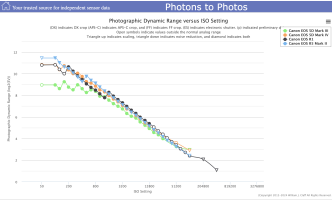
You won't get a substantial improvement in DR of the R5ii, it's at the upper range of mirrorless already, and the big leap for Canon in increasing DR was on going from the 5DIII to the 5DIV. You waited many years between buying the 5DIII and R5ii, and I fear you will now have another very long wait.

Screenshot 2026-01-04 at 10.18.55.png
 
Upvote 0
To be honest if you are having concerns over the dynamic range of these latest FF cameras I would suggest you reevaluate your technique !
The modern sensors can typically hold highlight detail about 3.2 stops over mid tone, which is a lot more than people think, and when you then consider the extensive latitude in the lowlights of the modern sensors you have a huge range to work with if you maximise highlights in the exposure.
 
Upvote 0
To be honest if you are having concerns over the dynamic range of these latest FF cameras I would suggest you reevaluate your technique !
The modern sensors can typically hold highlight detail about 3.2 stops over mid tone, which is a lot more than people think, and when you then consider the extensive latitude in the lowlights of the modern sensors you have a huge range to work with if you maximise highlights in the exposure.
Well sure, I could underexpose sunny pictures by 3 stops, or use that option for highlights that Canon has, I would prefer an improvement in technology that sacrifices other features like burst rate though, that's the point I was trying to make which is obviously personal :)
 
  • Like
Reactions: 1 user
Upvote 0
Well sure, I could underexpose sunny pictures by 3 stops, or use that option for highlights that Canon has, I would prefer an improvement in technology that sacrifices other features like burst rate though, that's the point I was trying to make which is obviously personal :)
I’ve only looked on my phone at the picture on which you didn’t like the highlights on the faces; assuming you shoot in raw have you had a look at the raw file with no tonal response applied ? If so you might be surprised at where the highlights actually sit, and it’s the applied tonal curve in the highlights that you don’t like. Just a thought !
 
Upvote 0
I am afraid of this as well. Do you think DGO will simply not be able to be implemented as I wish because the speed will not be enough?
I have how had a massive tutorial session with ChatGPT to answer this. The conclusion is: "Canon DGO is restricted to Cine EOS because it is architecturally incompatible with high-speed, high-resolution stills capture. It is not a feature being withheld; it is a feature whose physics conflict directly with the performance envelope stills cameras must satisfy."
And:

Why no manufacturer ships DGO in stills bodies​


It is not that it “does not work”.


It is that to make it work you would need to give up:


  • burst rate,
  • readout speed,
  • power envelope,
  • thermal envelope,
  • AF responsiveness,
  • electronic shutter usability.

That is a commercial non-starter for stills cameras.
 
  • Like
Reactions: 1 users
Upvote 0
to make it work you would need to give up:


  • burst rate,
  • readout speed,
  • power envelope,
  • thermal envelope,
  • AF responsiveness,
  • electronic shutter usability.

That is a commercial non-starter for stills cameras.
This is because the camera needs to read each pixel twice - at low and high gain - and then blend them into a single image?
 
Last edited:
Upvote 0
This is because the camera needs to read teach pixel twice - at low and high gain - and then blend them into a single image?
Yes, apparently it is a time and power consuming process. Anyway, I learned a bit about noise at very low photon flux. There is a changeover from photon shot noise when decreasing below about 10 photons per pixel exposure to electronic shot noise. The DGO lowers the photon floor to down to 1 photon when electron shot noise in the circuit takes over.
 
  • Like
Reactions: 1 user
Upvote 0
And presumably the processing power requirements would increase proportionally on higher MP sensors - meaning that DGO would be more appropriately used on lower MP sensors? I seem to recall that even on the Canon C cameras, DGO was only available at lower FPS - ie there was a limit even on a 35mm crop.
 
  • Like
Reactions: 1 user
Upvote 0
And presumably the processing power requirements would increase proportionally on higher MP sensors - meaning that DGO would be more appropriately used on lower MP sensors? I seem to recall that even on the Canon C cameras, DGO was only available at lower FPS - ie there was a limit even on a 35mm crop.
Yes. Low pixel count is needed with lower fps. Also rolling shutter artefacts aren’t as disturbing in video.
 
Upvote 0
I’ve only looked on my phone at the picture on which you didn’t like the highlights on the faces; assuming you shoot in raw have you had a look at the raw file with no tonal response applied ? If so you might be surprised at where the highlights actually sit, and it’s the applied tonal curve in the highlights that you don’t like. Just a thought !
I had indeed try to edit it and ended up not liking the results and left the jpeg as is. This is screen grab from ACR flat and other sliders just to give an hint of the data available. It's not only that there are unrecoverable patches of white, but even the data that is recoverable is structured in a way that doesn't make it very useful for me.
burn.jpg

At the end of it multiple people liked the photo as is, for the big burn of light as well. It's just me who would prefer to have full readability always. But I do think that Canon is feeling the competition from Sony and will probably do something about it in the future.
 
Upvote 0
I have how had a massive tutorial session with ChatGPT to answer this. The conclusion is: "Canon DGO is restricted to Cine EOS because it is architecturally incompatible with high-speed, high-resolution stills capture. It is not a feature being withheld; it is a feature whose physics conflict directly with the performance envelope stills cameras must satisfy."
Higher dynamic range is possible without DGO, it needs a fast sensor to read out the low and high gain modes simultaneously. The partially stacked sensors in the Sony A7 V and Panasonic Lumix S1II can do this.
According to DPReview:
“Unlike existing dual conversion gain sensors, which could use either a low gain (high capacity) setting for low ISO and a high gain (lower noise but lower capacity) mode for high ISOs, the new sensors can do both, simultaneously. So you can capture the full capacity of the low gain mode but combine the cleaner shadow data of the high gain mode.
This process, which we suspect involves sample-and-hold capability in the more complex readout circuitry, takes longer than reading out just a single mode. As a result, it can only be conducted in the mechanical shutter modes, where the physical shutter stops any more light accumulating, giving you as much time as you need to read the sensor.”

See: https://www.dpreview.com/news/57886...cmos-sensors-boost-dynamic-range-breakthrough
 
  • Like
Reactions: 1 user
Upvote 0
I have how had a massive tutorial session with ChatGPT to answer this. The conclusion is: "Canon DGO is restricted to Cine EOS because it is architecturally incompatible with high-speed, high-resolution stills capture. It is not a feature being withheld; it is a feature whose physics conflict directly with the performance envelope stills cameras must satisfy."
And:

Why no manufacturer ships DGO in stills bodies​


It is not that it “does not work”.


It is that to make it work you would need to give up:


  • burst rate,
  • readout speed,
  • power envelope,
  • thermal envelope,
  • AF responsiveness,
  • electronic shutter usability.

That is a commercial non-starter for stills cameras.
To sum it up: There is no free lunch...;)
 
  • Like
Reactions: 1 users
Upvote 0