Full Frame Mirrorless: Sideline or Replacement of dSLR?

On the other hand, if Canon can put out a camera with an EF mount than is "small enough" to compete with Sony and Nikon in the knife fight for small, they will have the only camera that uses EF lenses natively, which might make things interesting. Especially since a fair number of potential buyers of small FF mirrorless cameras already own EF lenses.

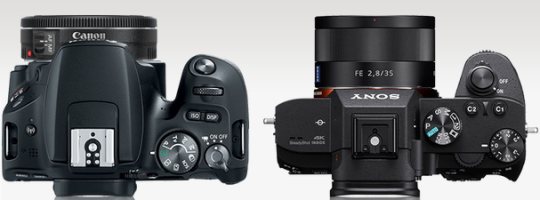
That's a size knife fight Canon loses, I think. Only with a 40mm pancake (or big / fast glass where it's more about the lens size) does an SL1/2 vs. A7 look like a similar size in the bag:
Screen Shot 2018-07-31 at 2.35.30 PM.png

On either side of that 40-ish f/2.8 space, Sony wins because that extra inch of mirror space is still there and it will lead to smaller overall constructs. The ads showing 'here's how much smaller our system is than theirs' almost write themselves. With a thin mount, Sony can demonstrably claim they are a smaller platform.

In short, the keep it small camp have hitched all their wagons to a thin mount and they will go bonkers if that doesn't arrive. I really think it's a binary response for them: Thin I'm in, EF I will melt down in broad daylight on as many social media platforms as possible. I also think the neutrals in social media -- influencers, tech media, Petapixel, DPR, etc. -- will pile on relentlessly if Canon struts out EF as new to the world.

Further: very few Canon pros will opt for the left above. They'll wait for a bigger body with a chunky grip.

- A
 
Upvote 0
That's a size knife fight Canon loses, I think. Only with a 40mm pancake (or big / fast glass where it's more about the lens size) does an SL1/2 vs. A7 look like a similar size in the bag:


On either side of that 40-ish f/2.8 space, Sony wins because that extra inch of mirror space is still there and it will lead to smaller overall constructs. The ads showing 'here's how much smaller our system is than theirs' almost write themselves. With a thin mount, Sony can demonstrably claim they are a smaller platform.

In short, the keep it small camp have hitched all their wagons to a thin mount and they will go bonkers if that doesn't arrive. I really think it's a binary response for them: Thin I'm in, EF I will melt down in broad daylight on as many social media platforms as possible.

Further: very few Canon pros will opt for the left above. They'll wait for a bigger body with a chunky grip.

- A

You've laid it out quite clearly. That is what I was asking. Wonder whether Canon will decide that this would be close enough to neutralize Sony's smaller size argument. To make this work, it might be helpful to come up with a new EF 24-70 f4 STM IS. We shall see. Canon has set themselves up to lose internet buzz battles before. Hasn't always worked out badly for them.
 
  • Like
Reactions: 1 users
Upvote 0
Canon has set themselves up to lose internet buzz battles before. Hasn't always worked out badly for them.
And that is the message that Canon will take on all this. For all the chatter and insults thrown at Canon for past decisions, when it comes to what matters, and what matters is whether your product sells, Canon always seem to get it right.
There are justifiable claims that this is brand loyalty because people are invested in the Canon lens system, but in turn what this means is that Sony (or whoever) has not done enough to overcome that hurdle.
And, as I have said many times, Sony has had a technological lead for 5+ years and that means an awful lot of newbies with no investment and Sony has still not expanded it market share to any great extent and still relies on stealing CaNikon customers for its client base. Which really says all you need to know about how important those technological superiorities are in the grand scheme of things.
 
  • Like
Reactions: 1 users
Upvote 0
You've laid it out quite clearly. That is what I was asking. Wonder whether Canon will decide that this would be close enough to neutralize Sony's smaller size argument. To make this work, it might be helpful to come up with a new EF 24-70 f4 STM IS. We shall see. Canon has set themselves up to lose internet buzz battles before. Hasn't always worked out badly for them.

If Canon does indeed go thin, I'd like to see Canon tinker with the ~ 3x zoom / constant max aperture paradigm a bit and see how small a 24-50 f/3.5-6.3 IS STM could be. Might not be that much bigger than a 35 f/2 IS USM.

- A
 
Upvote 0
I really don't see size as the driving factor. Once you have a FF sensor and fast lenses, especially with longer focal lengths, the size of the body has to be guided by ergonomics. Who would be buying a FF mirrorless and expect to keep it in their pocket like a smartphone?

No, I think the main reason to ditch the mirror box is to move on from a tech that has served well for generations but now slows down max frame rates, AF development, plus needs AFMA for fast lenses, introduces mirror vibration, and includes moving parts that add complexity to manufacturing. Size reduction is a bonus appealing to a subset of customers who are happy with a pancake lens.
 
  • Like
Reactions: 1 users
Upvote 0
You've laid it out quite clearly. That is what I was asking. Wonder whether Canon will decide that this would be close enough to neutralize Sony's smaller size argument. To make this work, it might be helpful to come up with a new EF 24-70 f4 STM IS. We shall see. Canon has set themselves up to lose internet buzz battles before. Hasn't always worked out badly for them.
And that is the message that Canon will take on all this. For all the chatter and insults thrown at Canon for past decisions, when it comes to what matters, and what matters is whether your product sells, Canon always seem to get it right.

I am often accused of being a Canon apologist here. But even the most bullish 'Full EF mirrorless or bust' Canon partisan here would admit that the combination of...
  • Photography reviewers
  • Photo media sites
  • Gear sites
  • Internet influencers, IG celebrities, YouTube personalities, etc.
  • People like us at CR who want a smaller FF rig, want Canon's innovation perception to change, etc.
...getting all spun up about the mount still being a clunky fossil from 1987 would represent some pretty withering fire for Canon to sustain as they try to launch their system.

Canon doesn't need to make an A7-like platform and go all in on that new mount. But I think it must be a symbolic form-factor step forward, and a thin mount is simply the expectation, IMHO. I could delightfully be wrong and we get to enjoy an EF mirrorless platform, but I don't think Canon has the stones to brazenly fight such a staggering headwind if they went full EF (and only full EF) at launch.

- A
 
Upvote 0
I really don't see size as the driving factor. Once you have a FF sensor and fast lenses, especially with longer focal lengths, the size of the body has to be guided by ergonomics. Who would be buying a FF mirrorless and expect to keep it in their pocket like a smartphone?

No, I think the main reason to ditch the mirror box is to move on from a tech that has served well for generations but now slows down max frame rates, AF development, plus needs AFMA for fast lenses, introduces mirror vibration, and includes moving parts that add complexity to manufacturing. Size reduction is a bonus appealing to a subset of customers who are happy with a pancake lens.

Agree 100% with you, but I don't subscribe to 'mirrorless is all about being small' like others do. I'm geeked about the possibilities of what a 5D-mirrorless could do that my 5D3 cannot.

But to the small camp, small is a really big deal. It makes the rig take up less space in your bag (with modest lens selection), makes it more likely to come with you in your travels, makes it a far less intimidating piece of kit for candids / travel / food / lifestyle photography and it mops the floor with what your cell phone can do.

These are two really different groups of photographers. They need two different products, IMHO. There's already 4-ish price points in FF SLRs for Canon today -- I don't see why two won't fly in FF mirrorless: one for the small camp, and one for the powerful camp. The idea that a new mount makes this a fundamentally different beast is only so if Canon rebuilds EF in the thin mount, which they probably definitely wouldn't do if a full EF mirrorless rig was coming.

- A
 
Upvote 0
I am often accused of being a Canon apologist here. But even the most bullish 'Full EF mirrorless or bust' Canon partisan here would admit that the combination of...
  • Photography reviewers
  • Photo media sites
  • Gear sites
  • Internet influencers, IG celebrities, YouTube personalities, etc.
  • People like us at CR who want a smaller FF rig, want Canon's innovation perception to change, etc.
...getting all spun up about the mount still being a clunky fossil from 1987 would represent some pretty withering fire for Canon to sustain as they try to launch their system.

Canon doesn't need to make an A7-like platform and go all in on that new mount. But I think it must be a symbolic form-factor step forward, and a thin mount is simply the expectation, IMHO. I could delightfully be wrong and we get to enjoy an EF mirrorless platform, but I don't think Canon has the stones to brazenly fight such a staggering headwind if they went full EF (and only full EF) at launch.

- A

I doubt very much that Canon will start with a A7 size camera and I doubt they will put a new mount on a 6D size camera or larger.
 
  • Like
Reactions: 1 user
Upvote 0
Agree 100% with you, but I don't subscribe to 'mirrorless is all about being small' like others do. I'm geeked about the possibilities of what a 5D-mirrorless could do that my 5D3 cannot.

But to the small camp, small is a really big deal. It makes the rig take up less space in your bag (with modest lens selection), makes it more likely to come with you in your travels, makes it a far less intimidating piece of kit for candids / travel / food / lifestyle photography and it mops the floor with what your cell phone can do.

These are two really different groups of photographers. They need two different products, IMHO. There's already 4-ish price points in FF SLRs for Canon today -- I don't see why two won't fly in FF mirrorless: one for the small camp, and one for the powerful camp. The idea that a new mount makes this a fundamentally different beast is only so if Canon rebuilds EF in the thin mount, which they probably definitely wouldn't do if a full EF mirrorless rig was coming.

- A

Just to clarify--you think there will be three mounts for mirrorless? EF and EF-X for full frame, and EF-M for cropped?
 
Upvote 0
Just to clarify--you think there will be three mounts for mirrorless? EF and EF-X for full frame, and EF-M for cropped?

Sure, but that framing is a bit odd: I see it as two SLR mounts and two mirrorless mounts. One SLR mount just happens to work on mirrorless and use SLR lenses. It's not like there will be (for instance) three exclusively mirrorless lens lines in production.

Some folks have argued EF-X might be EF-M -- that you could tuck an FF image circle in there -- but I believe many have poo-pooed that idea as it might be a shade too small. I'm not the ringer on that topic.

But the sheer number of mounts doesn't scare me off. If done right, that will be 3 mounts (EF-S, EF-M, EF-X) with just a handful of lenses each* and one comprehensive do-it-all EF mount where the big dollars and longer term investments go. It's only if EF-X truly gets big and comprehensive that the four mounts system will become too heavy to sustain, I think. What are 4-6 'keep it small' EF-X lenses versus 60 something EF lenses? Nothing Canon can't handle.

*On EF-S, to be clear: I'm talking about the more recent lenses lenses or ones they have refereshed, not the push-the-boat-out pricey EF-S USM lenses that we likely will never seen again.

- A
 
  • Like
Reactions: 1 user
Upvote 0
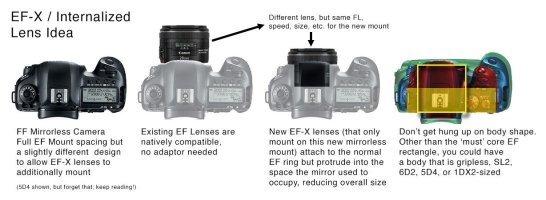
A small 24-50 might be an interesting candidate for using the recessed lens concept with the EF mount.

[The concept Bill is referring to is below, thread for discussion on it is here]

EF-X Idea.jpg

Agree on a 24-50mm f/3.5-6.3 IS STM, Bill, but I think that's a major technical lift Canon will opt out of doing. This wouldn't be a slightly rearward protrusion of the lens, it would be a significant one, possibly requiring some complicated 'mount by wire' rearward telescoping mojo to protect the lens elements. And the mount cap on those lenses could be hysterically big, like dixie cup sized.

- A
 
Upvote 0
...*On EF-S, to be clear: I'm talking about the more recent lenses lenses or ones they have refereshed, not the push-the-boat-out pricey EF-S USM lenses that we likely will never seen again...


I could see Canon selling the EF-S 15-85 walkaround lens (or something similar) for as long as there are 80D and 7D models. That and a decent ultrawide zoom are about all they need to keep. (And actually, they could just cede the ultrawide market to third parties.)
 
Upvote 0
A small 24-50 might be an interesting candidate for using the recessed lens concept with the EF mount.
[The concept Bill is referring to is below, thread for discussion on it is here]


Agree on a 24-50mm f/3.5-6.3 IS STM, Bill, but I think that's a major technical lift Canon will opt out of doing. This wouldn't be a slightly rearward protrusion of the lens, it would be a significant one, possibly requiring some complicated 'mount by wire' rearward telescoping mojo to protect the lens elements. And the mount cap on those lenses could be hysterically big, like dixie cup sized.

- A

Fair points. On the other hand, it's sort like trying to use the EF-M mount for FF mirrorless. It may not be practical, but if Canon can find a way to make it work, it could be very neat. Things that might not be practical for a wide range of lens, could still be workable in some cases.
 
Upvote 0
My guess is that Canon won't confuse its customers, marketing departments, or engineers with this many lens mounts. The proliferation envisioned here is a key reason for Canon to go with one new mount that will serve them for years to come.

But, come to think of it, once they go mirrorless, why stick with the 35mm format of full frame? But if they are sticking for now with the same sensor size currently in FF dSLR's, why change away from EF?

Looking forward to the announcement! Most excitement since the change to digital.
 
  • Like
Reactions: 1 users
Upvote 0
I could see Canon selling the EF-S 15-85 walkaround lens (or something similar) for as long as there are 80D and 7D models. That and a decent ultrawide zoom are about all they need to keep. (And actually, they could just cede the ultrawide market to third parties.)

Last ring USM lens for EF-S according to Keith's lovely chart was that 15-85 from 9 years ago. Canon has apparently left that price point and (by extension) left that technology out of EF-S, it would appear.

That said, just about everything EF-M gets, EF-S gets something like it: first it was the pancake, then the illuminated macro, and (who knows) perhaps an EF-S version of the EF-M 32 f/1.4 STM we've been hearing about. That would be cool.

- A
 
Upvote 0
On the other hand, if Canon can put out a camera with an EF mount than is "small enough" to compete with Sony and Nikon in the knife fight for small, they will have the only camera that uses EF lenses natively, which might make things interesting. Especially since a fair number of potential buyers of small FF mirrorless cameras already own EF lenses.
Obviously, it could be made the same size as a SL-2
 
  • Like
Reactions: 1 user
Upvote 0
Good ergonomics for large hands and or balance with large lenses can not only be achieved with large camera body, but also by offering well-designed (OEM) grips. Both front of camera and vertical/battery grips.

Every OEM battery grip I've used to date has flex between the grip and the body, which can be problematic for tripod mounting (flex = vibration).


PS: Long tele lenses / "Big Whites" will however not be slimmer, shorter, lighter, better or cheaper by moving to a "thin mount".

Not just long lenses. Is Sony's 24-70/2.8 GM slimmer/shorter/lighter/better/cheaper than Canon's 24-70/2.8L II? The answer to all of those is no. They're very equivalent lenses, despite the former being designed for a 'thin mount'.
 
  • Like
Reactions: 1 user
Upvote 0
I really don't see size as the driving factor. Once you have a FF sensor and fast lenses, especially with longer focal lengths, the size of the body has to be guided by ergonomics. Who would be buying a FF mirrorless and expect to keep it in their pocket like a smartphone?

No, I think the main reason to ditch the mirror box is to move on from a tech that has served well for generations but now slows down max frame rates, AF development, plus needs AFMA for fast lenses, introduces mirror vibration, and includes moving parts that add complexity to manufacturing. Size reduction is a bonus appealing to a subset of customers who are happy with a pancake lens.

This is it exactly. I feel like reflex DSLRs are more and more like mirrorless bodies stuck in an antiquated legacy design. It's kludgy and noisy to switch operational modes and the reflex mode is becoming less and less able to keep up with pure mirrorless designs with each iteration. If the new Sony 400 2.8 is any indication, LEM is faster than USM and other focus drive systems. Although users don't like FBW (Focus by Wire), modern FBW on higher end lenses have a long focus throw which is great for MF unliike mechanically linked FTM AF lenses that have an exceptionally short focus throw.

When e-shutter performance can exceed 1/300 with flash sync and deliver speeds 30+ fps already with no blackout in between, there will be little reason for DSLRs to exist, unless the user has a specific reason to trade off that performance for an OVF.
 
  • Like
Reactions: 1 users
Upvote 0
[The concept Bill is referring to is below, thread for discussion on it is here]


Agree on a 24-50mm f/3.5-6.3 IS STM, Bill, but I think that's a major technical lift Canon will opt out of doing. This wouldn't be a slightly rearward protrusion of the lens, it would be a significant one, possibly requiring some complicated 'mount by wire' rearward telescoping mojo to protect the lens elements. And the mount cap on those lenses could be hysterically big, like dixie cup sized.

- A

Nothing difficult or complex or with moving parts required. Simply a key (ridge) along the side of the protruding part of the lens, which has to be fitted into a slot in the bayonet. It certainly fits Canon's characterisation as "elegant".

As for the larger rear caps. the front caps on the extenders (teleconverters) are already a different size.
 
Upvote 0